
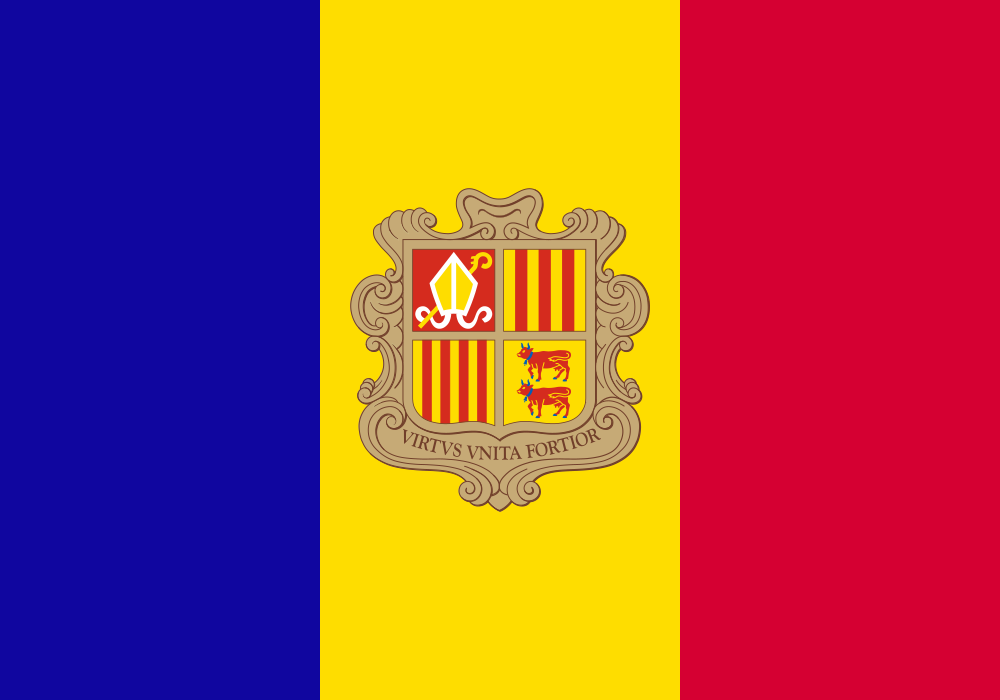

Andorra la Vella became the country’s political centre through a long accumulation of local and valley-wide institutions, not through one foundation date. Medieval assemblies met in the parishes; a representative body called the Consell de la Terra was documented before its privileges were formalised in 1419; and, by the fifteenth century, Andorra la Vella had become a tangible seat of that council. The old house now known as Casa de la Vall was built much later, in 1580, and acquired by the council in 1702. Those dates describe related stages, not a single uninterrupted building or institution.S001S002S003
This timeline follows the territory of today’s Andorra la Vella parish while setting local changes within the political history of the valleys. Santa Coloma and La Margineda are part of that geography, and Escaldes remained within the old parish until its separation in 1978. Some entries therefore concern Andorra as a whole: they matter here because decisions were negotiated, recorded or housed in the capital, not because every event took place inside the modern municipal boundary. The evidence is strongest for documents, buildings and institutional changes; it is thinner for the precise date when a settlement acquired a particular urban form.S001S004
Before the capital: settlement, church and parish
Before the ninth century: Santa Coloma’s early church
The church at Santa Coloma is evidence of an early Christian community in the area now within Andorra la Vella parish. The Government’s heritage inventory describes it as pre-Romanesque in origin and says it was erected at an indeterminate date before the ninth century. That wording is more reliable than a confident construction year: the surviving building contains several phases, and the date of its earliest fabric cannot be reduced to one precisely documented event.S005
The building’s later history is unusually legible. A major remodelling took place at an undetermined point in the twelfth century; maintenance followed between the thirteenth and seventeenth centuries; a Baroque interior campaign took place in the 1740s; and restorations in the twentieth century changed how medieval fabric was seen and presented. In 1933–34, architect Cèsar Martinell consolidated the tower and restored the interior and exterior, while fragments of Romanesque mural painting were found and restored. These are not minor footnotes to a fixed “old church”: they explain why the monument visible today combines periods and why present appearance is not a direct snapshot of its earliest phase.S005S006
Santa Coloma also demonstrates the difference between the age of a settlement and the date of its first surviving mention. The inventory says the village appears as a parish at some point in the Middle Ages, without assigning a year. A separate architectural survey notes documentary references to Santa Coloma as a territorial district in 1268. Neither statement proves that the place began in that year, nor does the early church by itself identify when a stable village formed. The safe chronology is a broad one: early ecclesiastical fabric, medieval documentary visibility, and repeated later alteration.S005S006
1133: Andorra appears in a recorded transaction
The Comú’s institutional history identifies Andorra as one of the six historic parishes and points to a representative named Sinfré Raimon, who signed the 1133 sale of Andorran possessions by Ermengol V of Urgell to Bishop Pere Berenguer. This reference places the parish and a local representative in a document from the early twelfth century. It does not establish that the modern town already existed in its present shape or that Andorra la Vella held a formally defined capital status in 1133.S001
The distinction is important because later political prominence can make earlier records appear more definitive than they are. A representative’s appearance in a transaction shows participation in a specific documentary act. It is evidence for a community’s political and property context, not a charter founding a city or naming a capital. The Comú’s history dates the tangible emergence of capital functions to the fifteenth century, when the first seat of the Consell de la Terra was established in Andorra la Vella.S001
Late thirteenth century: assemblies and shared government
The earliest surviving records of the Consell General’s predecessor show a representative tradition developing before the celebrated 1419 privileges. The Consell General’s historical-acts project began with nineteen documents dating from 1289 to 1419. In its introductory account, the institution states directly that these records show Andorran parliamentary practice was older than 1419 and that the council did not have a single founding act: it formed through a gradual process of practical decisions and consolidation.S002
The same institutional account explains how to read 1419. Before that year, representatives could be appointed when a particular matter arose; the privileges of 1419 regularised annual elections and structured the body. This avoids two opposite errors: treating 1419 as if representation began from nothing, or assuming that a fully formed modern parliament existed unchanged in the thirteenth century. The evidence supports continuity of a practice alongside important changes in membership, duration, authority and procedure.S002
The 1278 and 1288 Pariatges belong in this setting but are not local building dates. The first agreement, reached on 8 September 1278 according to the Consell General’s institutional chronology, addressed conflict between the Bishop of Urgell and the Count of Foix and established alternating collection of the annual quèstia. A second agreement followed in 1288. These valley-wide arrangements shaped the political framework within which local communities and later representative bodies operated. They should not be described as events that “founded Andorra la Vella” or as proof that the modern capital was already a defined city.S007S008
The Comú’s own institutional history describes early communal assemblies of household heads as documented from the end of the thirteenth century. They met in church porches or cemeteries, places that served both religious and community life. In the fifteenth century, larger assemblies gave way to smaller governing bodies of elected representatives, while the names still used for consuls and councillors settled during the sixteenth century. These shifts help explain local civic development without pretending that a single municipal foundation document survives.S001
1419: the Consell de la Terra is legitimised and organised
On 11 February 1419, Bishop Francesc de Tovià granted a privilege at La Seu d’Urgell in response to a petition from the leading men of the Andorran valleys. The surviving document’s catalogue summary says it legitimised the Consell de la Terra and allowed people to be selected each year to look after valley affairs. A second recognition followed on 17 December from Count of Foix Joan I. The institutional chronology later describes these acts as privileges that regularised an already functioning council.S002S003S009
The petition’s practical reasons are visible in the text. Representatives needed to negotiate with neighbouring communities, including Puigcerdà and the valley of Querol, over tolls, boundaries and other disputes. Gathering all household heads repeatedly meant leaving agricultural work and putting livestock at risk. The petition therefore proposed selecting two or three men from each parish annually, with authority to handle business and appoint messengers. The record captures a rural society seeking a workable form of representation, as well as a milestone later remembered as the Council’s institutional beginning.S003
The document also exposes a limit that a short anniversary account can hide: the assembly was not broadly democratic by modern standards. The Council’s historical overview says participation belonged to male household heads whose homes counted as a foc; the annual representatives were men. The 1419 structure was a form of delegated communal governance within a hierarchical society, not universal suffrage. The distinction becomes essential when later reforms are described as political expansions rather than the creation of participation from scratch.S003
The location of the Council’s first seat in Andorra la Vella matters locally. The Comú says that the town—called simply “the vila d’Andorra” until the eighteenth century—had tangible capital status from the fifteenth century, when the first Consell de la Terra seat was established in a house at the head of Carrer. The accessible municipal account does not give an exact year or identify the structure as today’s Casa de la Vall. It is best understood as an early institutional presence in the settlement, distinct from the later purchase of a surviving private house.S001
From council house to civic centre
1580: a private house above the valley
The date 1580 is carved into the heraldic stonework over the doorway of Casa de la Vall. The Government heritage inventory attributes the building to the Busquets family and places its construction in the final quarter of the sixteenth century. It describes a three-bay, square-plan house with a two-pitched roof and a principal façade facing east, towards the street connecting it to the rest of the settlement. This was a substantial private residence, not a parliament built for purpose.S004
The building’s position on a rocky rise above the Valira valley gave it prominence, while its domestic origins are still legible in the architecture. The Government inventory identifies a mixed civic and defensive vocabulary, including a façade lookout, a machicolation above the entrance and an attached tower with defensive openings. The date on the doorway is a physical clue, but later interventions altered the heraldry and the house. It should not be treated as a complete architectural record or proof that every visible element dates to 1580.S004
1702: the Consell General acquires Casa de la Vall
In 1702, the Consell General acquired the Busquets family house and converted it into its meeting place. The municipal history connects the purchase to the Council’s earlier seat in Andorra la Vella; the heritage inventory identifies the building as the former seat of the General Council. From this point, the place now called Casa de la Vall became a powerful physical expression of the capital’s institutional role.S001S004
The acquisition did not mean the house was designed from the start as a national parliament. It was adapted to public functions over time. The Government inventory describes the former meeting room, the archive cabinet and rooms that had other uses, including a room associated with the Comú and an earlier chapel. A visitor looking at the house now sees a layered civic building: a late-sixteenth-century residence repurposed for valley-wide representation and modified as institutional needs changed.S004
Casa de la Vall also links national and parish histories. Council representatives came from the parishes, while the building and the local Comú occupied the same urban centre. The source describes the house as a former General Council seat, but the Council’s wider functions cannot be reduced to the building alone. Rules, elections, records and negotiations happened across a network of local communities; the house was a recurring venue and repository, not the whole constitutional system.S001S004
Fifteenth to eighteenth centuries: “the vila d’Andorra”
The name Andorra la Vella should not be projected unchanged into every medieval source. The Comú notes that the settlement was called “la vila d’Andorra” until the eighteenth century. That naming history helps explain why older documents can refer to Andorra without distinguishing the parish, the principal settlement or the valley-state in the same manner used by contemporary maps.S001
In municipal memory, the town’s authority rested on more than its later national title. Its council house, administrative functions and position in the valley made it a practical centre. Still, the words “capital” and “city” can suggest a modern, sharply bounded urban government. The municipal history uses the fifteenth century as the point at which capital functions become tangible, not as a precise statutory declaration. The exact vocabulary of each historical record should be retained where possible.S001S002
The Comú itself changed alongside the national council. Its account says communes managed pasture and cultivation areas, natural resources, mines and forges, taxes, bridges, roads and local ordinances. These powers place the communal institution in everyday economic life as well as representation. They also remind readers that the historical story of Andorra la Vella is not only the story of the Council housed there: parish-level government influenced how residents used land, moved goods and organised common obligations.S001
Nineteenth-century reform and a wider electorate
1866: the Nova Reforma
The Nova Reforma of 1866 widened the right to vote to male heads of household, according to the Comú and Consell General histories. It also changed institutional relationships: the Comú says that from this point the office of consul became incompatible with that of general councillor. The reform altered who could participate and helped define a distinction between local and valley-level office. It did not introduce equal voting rights for all adults, and the phrase “all household heads” must not be mistaken for universal suffrage.S001S010
The political changes met a society negotiating how to respond to commerce, outside influence and new expectations. The Comú’s historical account describes the reform as followed by instability and conflict. That is a broad institutional summary, not a complete interpretation of nineteenth-century political disputes. For the local timeline, its significance is that parish institutions remained central while the selection and responsibilities of representatives were being revised.S001
Casa de la Vall later became the setting for public commemoration of the reform. A monument outside the building, commissioned for its centenary in 1966 and dated 1967 in the municipal visitor account, represents the contrapàs. The sculptural commemoration is not itself a nineteenth-century source; it records how a later generation chose to remember the Nova Reforma in front of the institution associated with parliamentary life.S011
1883 and 1900: schools in the parish
Education provides a different view of local change from the better-known political chronology. The scholarly historical synthesis Relat històric d’Andorra records a religious school in Andorra la Vella in 1883, after the first school of this particular network opened in Canillo in 1882. It also says France opened two schools in 1900, one in Sant Julià and one in Andorra la Vella, in a period when competing educational systems reflected wider political and cultural interests.S012
These dates do not describe a complete census of schooling or imply that no education existed before the named institutions. They mark the arrival of specific documented schools within a broader process of institutionalisation. The parish was a place where residents encountered overlapping authorities through education as well as through communal administration, church life and the General Council.S012
Roads, labour and political rights
1929–1935: FHASA reshapes the valley network
On 27 March 1929, the Consell General granted the promoters of FHASA a 75-year concession to exploit water resources. In return, the company was required to build infrastructure, including roads connecting Andorra la Vella with parishes to the north. The Government’s account of the FEDA exhibition identifies the road programme as a condition of the concession; FEDA’s own retrospective lists the Andorra la Vella–Escaldes road, the Encamp–Soldeu road and the Escaldes–La Massana–Ordino connection, alongside widening of existing routes.S013S014
FHASA’s power station was built in Encamp, not in Andorra la Vella. Yet the capital was a key node in the road system: the Government describes roads to the upper parishes as beginning from the capital’s square. This changed the relationship between the central settlement and outlying communities. Improvements in access were a material condition for wider circulation, but the chronology should not credit the capital with works undertaken elsewhere or suggest that every planned road opened simultaneously.S013
The concession also brought a large workforce into Andorra. The historical synthesis Relat històric d’Andorra estimates that close to 1,200 workers arrived for the works, almost a fifth of the country’s population at the time. That is a national estimate, not a count of workers who lived in Andorra la Vella. It nevertheless helps explain why the capital’s road junctions, institutions and service economy were affected by a transformation centred on the wider valley.S012
The road dates require care. Government history dates the road through the Envalira pass to France to 1933 and the connection towards Ordino through La Massana to 1934. Another historical account says the final transfer of the roads to the co-princes occurred on 16 September 1935, once the construction period had elapsed. These milestones can coexist: construction and inauguration, completion of a contractual obligation, and formal transfer are separate events.S013S015
1931: the first modern workers’ strike
On 21 March 1931, workers protested for higher wages and better conditions in what the national historical synthesis calls Andorra’s first modern labour strike. The workforce was connected with FHASA’s major construction programme, although the available source does not establish that the strike was confined to Andorra la Vella. The event matters to the capital’s chronology because it revealed the social consequences of the infrastructure programme and tested how the Council, the company and the co-princely authorities would exercise power.S012
The Government’s FEDA exhibition describes the 1930s as a period when infrastructure projects, immigration and political demands converged. It connects the labour tensions and 1933 events to the rapid social and economic change around FHASA. This is a useful official overview, while the detailed causes and the conduct of different political actors require specialist historical interpretation. A short local timeline should not reduce the strike to a simple prelude to universal suffrage.S013
5 April 1933: male suffrage and the “revolution”
The political crisis of 1933 expanded participation for adult men, but the legal sequence was contested. On 5 April, a crowd interrupted a Council session and forced approval of a law opening voting and eligibility to adult men; the co-princes halted that process and negotiated a replacement measure granting universal male suffrage to Andorran men over 25. The Comú summarises the outcome as the establishment of general male suffrage. It was a decisive extension beyond the 1866 category of male household heads, but women remained excluded from the franchise.S001S010
The word “revolution” appears in official institutional histories, but it should not imply a single event with one uncontested cause. The scholarly national history describes overlapping tensions: labour demands, FHASA’s concession and foreign capital, competing influence from France and Spain, and the General Council’s effort to secure greater decision-making power. The road and hydroelectric projects transformed everyday conditions at the same time that political actors contested representation and authority.S012S016
Male suffrage did not expand in a straight line. The Consell General’s chronology records a rollback in 1941 and restoration in 1947. Therefore, a timeline that moves directly from 1933 to women’s enfranchisement in 1970 would conceal an interruption in men’s voting rights as well as the continuing exclusion of women. The changes were institutional responses to conflict, not a smooth march toward a predetermined settlement.S010
1933–1934: Santa Coloma’s church is restored
While road works and political conflict changed the national setting, the restoration campaign at Santa Coloma altered how one of the parish’s oldest monuments was preserved. The Government inventory dates the campaign to 1933–34 and names architect Cèsar Martinell. It says he restored the church’s interior and exterior, reinforced the bell tower and uncovered/restored the mural fragments now visible inside. This intervention joined conservation to the creation of a modern heritage record.S005
The paintings themselves have a separate and complicated history. The Government account says the Romanesque apse paintings had been removed before 1926 and were recovered in 2007; they are now kept in another space. The fragments found during the 1930s work and the detached apse ensemble should not be merged into one set or described as if every original remained in situ. This is a local chronology of preservation as much as construction.S005
Parish change and constitutional statehood
1978: Escaldes separates, Andorra la Vella remains
On 14 June 1978, Escaldes-Engordany became Andorra’s seventh parish through division of the former parish of Andorra la Vella. The Comú’s account describes the change as the first modification to the historic parish structure and says the Escaldes quarter became a new parish, leaving the Andorra quarter as a parish in its own right. The present parish boundary is therefore not an ancient, unchanged outline.S001
The division also changed the meaning of “Andorra la Vella” in administrative use. In older accounts, the parish included Escaldes; after 1978, the parish and the neighbouring urban centre became separate jurisdictions even as their built-up areas remained closely connected. A historical population figure or description of local government must be matched to the relevant boundary date. Otherwise, a pre-1978 parish can be compared incorrectly with the smaller present-day unit.S001
The municipal history places the separation within political reforms beginning in the 1970s and leading to the Constitution of 1993. Its account says the Constitution recognised the role of the Comuns and that their competencies were subsequently developed in law. The separation was therefore both a territorial change and part of a broader reorganisation of Andorran political institutions.S001
1970 and 1973: women gain political rights
Women’s enfranchisement was a separate reform sequence from the 1933 extension to men. The Consell General’s institutional history dates women’s right to vote to 1970 and eligibility to stand for election to 1973. That gap matters: the right to vote and the right to hold office were not granted on the same date. The first women entered the General Council in the 1980s, and its official list names Mercè Bonell Bertran as a substitute councillor in 1984.S010S017
Those milestones are national, not parish-specific, but the institutional setting was in Andorra la Vella. They also complicate commemorative accounts that place a monument to “men and women” beside Casa de la Vall in 1993: the sculpture recalls the constitutional referendum, while political inclusion had required its own campaigns and legal changes over preceding decades.S011S017
2 February and 14 March 1993: the Constitution is adopted and approved
On 2 February 1993, the Consell General adopted the Constitution in a solemn session. On 14 March, voters approved it in a referendum. The text’s promulgation preamble records both dates, so they should not be collapsed into one “Constitution Day” event. The referendum date became a public anniversary, while parliamentary adoption was an earlier step in the constitutional process.S018
For Andorra la Vella, the Constitution marked a new phase in the relationship between national and parish government. The Comú’s history says the text recognised the role of the Comuns and that their competencies were to be elaborated by law. The legal change did not erase communal institutions; it set their role within a written constitutional state. The capital remained the site of national institutions, but the modern constitutional order also formalised local government as a part of that system.S001S018
The date is also visible in the civic landscape around Casa de la Vall. The official house history describes a sculpture in the rear garden commemorating the men and women who sought the Constitution, created by Emili Armengol after a competition. A public monument supplies evidence of commemoration and civic memory; it is not a substitute for the referendum record or the Constitution’s legal text.S011S018
The modern parish: a centre within a changed country
From valley town to connected urban capital
The twentieth-century transformation of Andorra la Vella is best understood through the joining of roads, services, political offices and building activity, rather than by a single declared moment when the settlement “became a city.” FHASA’s roads radiated from the central valley; political institutions continued to meet in the old town; and new movement and commerce developed along the routes that linked the parish to Escaldes, Santa Coloma and the northern parishes. The municipal historical timeline treats industrialisation and opening to the outside as central to the 1933 political crisis, connecting social change with physical connectivity.S001S013
Research on the built environment gives individual landmarks to that change. The historical synthesis on Andorran architecture describes Casa Xavier Maestre as built in two phases between 1935 and 1945 in the centre of Andorra la Vella and notes that it housed Clínica Vilanova, identified as the country’s first hospital. It also treats Plaça Guillemó, or Plaça de les Arcades, as an early example of urban planning influenced by granite architecture. These examples suggest that the new road network was followed by a new civic and commercial built form, but they do not alone describe the full pace or distribution of parish growth.S019
Modernisation also altered what counted as the “centre.” The medieval institutional seat, the parish church, commercial streets and newer civic spaces were not all created at once or for the same purpose. Buildings from the twentieth century can be historically significant precisely because they mark the transition from a small administrative settlement to a more connected service centre. The available sources support named architectural examples; a quantitative account of population, land conversion or building permits would require a separate statistical study.S019
2011: parliamentary work moves to a new building
Casa de la Vall ceased to be the parliamentary seat when the new Consell General building began operating in 2011, according to the national monuments catalogue. That change did not make the older house irrelevant: it became a monument and a place through which visitors can interpret the evolution of Andorra’s institutions. The move separates two meanings often collapsed in tourist language: the former parliament building and the institution that continues to function in a newer building nearby.S020
The distinction also improves historical precision. “The Consell General met at Casa de la Vall” is true for a long period beginning in 1702 and ending with the 2011 move. “Casa de la Vall is the current parliament” is not. Its present value lies in architectural fabric, historic associations, archival memory and interpretation, while current legislative business belongs to the operating parliamentary institution and premises.S004S020
The local timeline as overlapping histories
Andorra la Vella’s chronology has several tracks. Santa Coloma’s church preserves early religious and architectural phases; parish government appears in medieval documentary records; representative institutions grew from practical assemblies into a more regular council; the town acquired a durable role as the council’s seat; roads and hydroelectric works reshaped the modern valley; and political rights broadened through reforms that were interrupted, contested and incomplete. Each track has its own evidence and its own dates.S001S002S005S012
That is why a short list of “founding dates” would mislead. 1133 records a representative in a transaction; the late thirteenth century brings evidence of communal assemblies and agreements; 1419 formalises an annual representative mechanism; the fifteenth century establishes an institutional seat in the town; 1580 dates the Busquets house; 1702 converts it into the council’s seat; and 1978 draws the present parish boundary after Escaldes separates. These events are related, but none substitutes for another.S001S002S003S004
For the same reason, Andorra la Vella’s national importance should not be mistaken for a claim that every Andorran historical event happened there. The 1278 and 1288 Pariatges, suffrage changes, the constitution and Council privileges affected the entire country. Their connection to the capital is institutional and documentary: the General Council’s history, records and parliamentary buildings are centred here, while communal life remains parish-based. A sound account identifies the scale of each event before attaching it to a place.S001S007S010S018
The surviving landscape makes these differences readable. Casa de la Vall began as a private house and later held valley-wide political work. Sant Esteve is the parish’s historic church, while Santa Coloma preserves much earlier fabric and a distinct village setting. Modern landmarks and planned spaces belong to the urban expansion that followed improved connections. The buildings do not form one neatly preserved period; they show how administrative, religious and commercial functions accumulated and changed.S004S005S019
Reading the dates without overstating them
Historical dates carry different levels of certainty. An inscription such as 1580 on Casa de la Vall gives a firm material marker, though interpretation of the whole building still depends on architectural evidence. A dated privilege, such as the act of 11 February 1419, is secure for the issuance of that document; its role in institutional development requires the surrounding archive and historical interpretation. A heritage inventory’s “before the ninth century” is deliberately broader because the evidence does not establish a precise year for Santa Coloma’s earliest church.S003S004S005
Institutional summaries can also select different reference points without directly contradicting one another. The Consell General once commonly traced its history to 1419, the year of its formal privileges. The archive project’s newer documentary framing identifies acts from 1289 and says that the parliamentary tradition developed gradually. The difference is partly about what “origin” means: first surviving evidence, an organised annual body, later continuity, or a modern institution’s public anniversary. A reader should ask which of those is being dated.S002
The same care applies to geography. Before 1978, the parish of Andorra included Escaldes; today Andorra la Vella parish is smaller. “Capital” may refer to the settlement’s growing institutional role, the seat of national government or the present urban centre. “Andorra” can denote the country, a historic parish or the principal village depending on document and date. A timeline that does not label these units can make an old record appear more modern and precise than it is.S001
Finally, a date does not explain change by itself. The 1929 concession matters because it tied energy production to roads and labour; 1933 matters because suffrage demands intersected with institutional and economic conflict; 1978 matters because it changed the parish map during broader reforms; and 1993 matters because parliamentary adoption, popular approval and promulgation were distinct constitutional stages. The sequence becomes meaningful when each date is linked to the people, institutions and built places that it affected.S010S012S013S018
Sources
Història del Comú — Comú d’Andorra la Vella; accessed 26 September 2026. Relevant sections: medieval parish and assembly history; communal functions; capital role and old council seat; 1866, 1933, 1978 and 1993 paragraphs ↩
Presentació (Actes Històriques del Consell General) — Consell General; accessed 26 September 2026. Relevant paragraphs 19–34: transcription-project scope, nineteen documents dated 1289–1419, evolution before 1419 and distinction between ad hoc appointments and annual selection ↩
1419 febrer 11. La Seu d’Urgell — Consell General; accessed 26 September 2026. Document summary and transcription, pp. 1–3 of the four-page digital record; episcopal privilege, petition, annual representation and practical concerns; archival description identifies the parchment in the Andorra National Archives’ Casa Rossell fonds ↩
Casa de la Vall — Govern d’Andorra, national heritage inventory; accessed 26 September 2026. Inventory fields and description: house type, parish, late-sixteenth-century construction, 1580 inscription, architecture and 1702 acquisition ↩
Església de Santa Coloma — Govern d’Andorra, national heritage inventory; accessed 26 September 2026. Description: indeterminate pre-ninth-century origin, parish/town identification, building phases, 1933–34 restoration and 2007 recovery of detached apse paintings ↩
Santa Coloma (Andorra la Vella) — *Catalunya Romànica*, Enciclopèdia.cat; accessed 26 September 2026. Sections on documentary notices, construction phases and restoration (especially paragraphs describing 1933 and 1976–77); specialist secondary context, not used to override the national inventory’s cautious earliest-date wording ↩
Els precedents — Consell General; accessed 26 September 2026. Narrative on the 1278 and 1288 Pariatges and the alternating *quèstia* ↩
Constitution Day Reception, 14 March 2014 — Consell General; accessed 26 September 2026. Opening historical paragraph dates the first Pariatge to 8 September 1278; used with [S007] for the date ↩
En els orígens del Consell General — Consell General; accessed 26 September 2026. Two-page institutional history, pp. 1–2: privileges of 11 February and 17 December 1419, parish representation and household eligibility context ↩
Ampliacions del sufragi — Consell General; accessed 26 September 2026. Sections on Nova Reforma (1866), 5 April 1933 and negotiated replacement suffrage, 1941 rollback, 1947 restoration and women’s voting/eligibility in 1970/1973 ↩
Una casa amb història — La Casa de la Vall; accessed 26 September 2026. Sections on the 1580 house, 1702 acquisition and commemorative works; used for public-memory context, not as a replacement for the monument inventory ↩
Món contemporani — *Relat històric d’Andorra*; accessed 26 September 2026. Sections on education, “Fhasa i la vaga de 1931” and “La Revolució de 1933”; scholarly synthesis on schools, FHASA, labour history and contested political context ↩
FEDA: FHASA, la transformació econòmica i social d’un País — Govern d’Andorra; accessed 26 September 2026. FHASA introduction: 27 March 1929 concession, roads from Andorra la Vella and social context ↩
La construcció de les carreteres a Andorra, al Museu de l’Electricitat MW — Forces Elèctriques d’Andorra (FEDA); accessed 26 September 2026. Exhibition description identifies specific FHASA road connections and 1930–35 construction period ↩
Andorra al segle XX: una nova Andorra — *Relat històric d’Andorra*; accessed 26 September 2026. Section 9.3.3, pp. 12–13: road construction stages and 16 September 1935 transfer; political context ↩
De la “revolució” del 5 d’abril a la invasió d’agost del 1933 — Arnau González i Vilalta, Govern d’Andorra document repository; accessed 26 September 2026. PDF, 251 pages; specialist study of 1933 political events. Used for the plurality of actors and causes, not as a neutral municipal chronology ↩
Les dones al Consell General — Consell General; accessed 26 September 2026. “Els drets polítics” and councillor list; women’s petitions and first listed councillors/substitutions ↩
Constitució del Principat d’Andorra (English text) — Consell General; accessed 26 September 2026. Promulgation preamble, p. 54 (PDF p. 53): Council adoption on 2 February 1993 and approval at referendum on 14 March 1993 ↩
Josep Danés i els inicis de l’arquitectura del granit — *Relat històric d’Andorra*; accessed 26 September 2026. Section 12.8.9, pp. 27–28: Casa Xavier Maestre/Clínica Vilanova and Plaça Guillemó as examples of twentieth-century urban form ↩
Casa de la Vall — Govern d’Andorra, national monuments catalogue; accessed 26 September 2026. Opening description states parliamentary use from 1702 to 2011 and start of operations in the new building ↩