French Recipes

Waterzooi de poulet

A northern French and Flemish-border chicken waterzooi built around gentle poaching, tender leeks, carrots, celery and potatoes, then finished with a warm cream-and-yolk liaison that enriches the broth without turning it into a flour-thickened stew.

French Recipes
Share
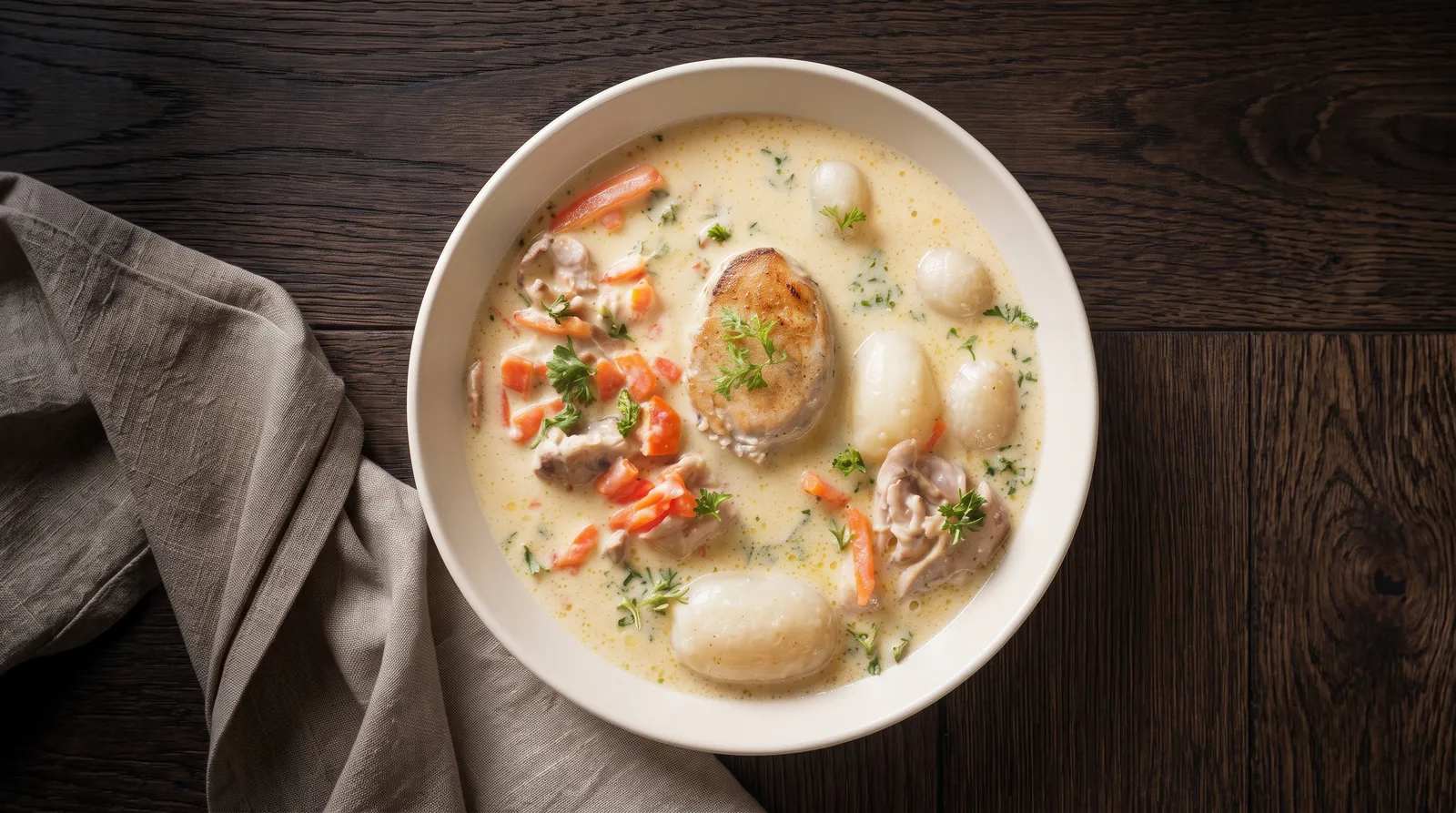
Waterzooi de poulet — served in a bowl
Prep 30 minutes
Cook 45 minutes
Total 75 minutes
Yield 4 deep bowls; about 2.5 kg finished food including about 1.05 L enriched broth
Introduction and overview

Waterzooi de poulet — chicken and vegetables in a delicate cream-yolk broth

Waterzooi is closely associated with Ghent and the wider Flemish culinary world, where early forms were made with fish and later chicken became an equally recognised version. It also belongs naturally to the food culture of northern France and the Flemish-border area. That cross-border setting matters: this recipe keeps the dish recognisable as waterzooi rather than recasting it as a generic French cream stew. Carrot, leek and celery form the vegetable backbone, potatoes make the bowl substantial, and chicken is gently cooked in stock rather than browned hard.

The broth is deliberately light. After the chicken and vegetables have cooked, the liquid is reduced before any dairy is added. That concentrates flavour without flour. A mixture of cream and egg yolk is then tempered with hot broth and returned to the casserole over low heat. The finished liquid should lightly coat a spoon while still pouring like broth. It should never become pasty, and it should never be allowed to boil once the yolk is in the pan.

Boneless, skinless chicken thighs make the household method straightforward because the purchased 800 g is also the edible raw weight: there is no bone or skin yield to estimate. Thigh meat also tolerates gentle poaching better than very lean breast meat. Even so, safety is measured rather than guessed. Every thick piece must reach 74 °C, and the egg-enriched broth is brought to 71 °C while being kept below a boil. Those two temperatures are separate controls: the first is for poultry, the second for the liaison.

The result is a complete bowl with distinct pieces of chicken, tender but intact potatoes, soft vegetables and a pale enriched broth. Parsley goes in only at the end. Serve it promptly, because prolonged holding or reheating can make an egg-and-cream liaison grainy even when the flavour remains good.
Success points

Success points

  • Keep the vegetables pale during the first cook; browning changes the character of the broth.
  • Maintain only a gentle simmer around the chicken and use a thermometer rather than colour to judge safety.
  • Reduce the plain broth before adding the liaison; this gives body without flour or starch.
  • Temper the cream and yolks gradually, then stop at 71 °C and do not boil.
Ingredients

Ingredients

  • 800 g boneless, skinless chicken thigh fillets, chilled and left in large pieces
  • 20 g unsalted butter, cold and diced
  • 120 g yellow onion, peeled and thinly sliced
  • 200 g leek, white and pale-green parts, washed and cut into 5 mm slices
  • 200 g carrots, peeled and cut into 5 mm batons
  • 120 g celery stalks, trimmed and cut into 5 mm slices
  • 500 g waxy potatoes, peeled and cut into 3 cm pieces
  • 1200 ml unsalted chicken stock, chilled or cool
  • 1 bay leaf
  • 2 sprigs fresh thyme
  • 3 g fine salt
  • 1 g ground black pepper
  • 150 ml pasteurized cream, about 30% milk fat, chilled
  • 36 g egg yolks, about 2 large yolks, preferably pasteurized and chilled
  • 15 g flat-leaf parsley leaves, finely chopped
Method

Method

Directions

  1. Prepare the ingredients. Measure the chicken, vegetables, potatoes, herbs, stock and liaison ingredients. Keep the chicken, cream and egg yolks refrigerated until they are required, and work on a clean board that will be washed thoroughly after raw chicken contact. Vegetables are evenly cut so they cook at the same rate.

  2. Sweat the vegetables. Melt the 20 g butter in the casserole over medium-low heat. Add the onion, leek, carrot and celery and cook for 8 minutes, stirring regularly and keeping the colour pale. The onion and leek are translucent and the vegetables have softened slightly without browning.

  3. Start the potatoes and broth. Add the 500 g potatoes, 1200 ml unsalted chicken stock, bay leaf, thyme, 3 g salt and 1 g black pepper. Bring the liquid towards a simmer over medium heat, then lower the heat and cook for 8 minutes. The stock is steaming with small bubbles at the edge and the potatoes have begun to soften.

  4. Poach the chicken safely. Add the 800 g chicken thigh fillets in a single layer and keep the liquid at a gentle simmer for 15 minutes. Check the thickest pieces with an instant-read thermometer rather than judging by colour. The thickest piece of chicken registers 74 °C and the potatoes are tender when pierced but still hold their shape.

  5. Reduce the broth. Lift the chicken, potatoes and vegetables into a warm bowl with a slotted spoon and discard the bay and thyme. Increase to medium heat and simmer the uncovered broth for 8 minutes, measuring if necessary. The broth is reduced to about 900 ml and tastes concentrated but remains fluid, not thick.

  6. Temper the liaison. In a heatproof bowl, whisk the 150 ml cream with the 36 g egg yolks until smooth. While whisking continuously, add about 200 ml of the hot reduced broth in a slow stream over about 3 minutes. The liaison is smooth, warm and pourable with no visible curds.

  7. Finish without boiling. Take the casserole away from vigorous heat, whisk in the tempered liaison and return the pan to low heat. Stir for about 3 minutes while checking the temperature. The enriched broth reaches 71 °C, lightly coats a spoon and shows no boiling bubbles or curdling. Return the chicken and vegetables just long enough to heat through, remove from the heat, stir in the 15 g parsley and serve promptly.

Serving

Practical

Serving

Divide the chicken, potatoes and vegetables evenly among four deep bowls, then ladle roughly 260 ml of enriched broth over each serving. The bowl should look abundant but still clearly broth-based: the liquid should flow around the solids rather than sit as a thick sauce.

Storage and reheating

Refrigerate leftovers within 2 hours in shallow covered containers at 4 °C or below and use them within 3–4 days. Reheat gently while stirring until the food reaches 74 °C throughout. Avoid a hard boil; the reheated liaison may become slightly grainy even when handled carefully. Freezing is not recommended because both the potatoes and the egg-cream broth lose texture after thawing.

Make-ahead

The complete dish is best made and served on the same day. For a one-day head start, cook the chicken, vegetables and reduced broth without the cream-yolk liaison, divide into shallow containers and chill quickly. Reheat that base to 74 °C, then prepare a fresh liaison and finish it at 71 °C just before serving.

Substitutions

Boneless, skinless chicken breast can replace the thigh meat without changing the basic identity of chicken waterzooi, but it is leaner and dries more easily. Start checking its internal temperature earlier and remove it as soon as it reaches 74 °C. A lower-fat cooking cream can be used, but the finished broth will be lighter and more prone to separation, so keep the final heat especially gentle.

Troubleshooting

Troubleshooting

  • The liaison curdles.The broth boiled after the yolks were added or the cold liaison met too much heat at once. Remove the pan from the heat immediately and whisk gently. A badly scrambled liaison cannot be fully restored, so prevention through tempering and temperature control is the reliable fix.
  • The broth is too thin.The stock was not reduced enough before the cream and yolks were added. Reduce the plain broth to about 900 ml first; adding flour afterwards would change the character of this version.
  • The chicken is dry.The liquid boiled hard or the meat stayed in the casserole long after reaching 74 °C. Keep the poach gentle and move cooked chicken to a warm bowl while the broth reduces.
Nutrition per serving

Nutrition per serving

  • Serving size1 of 4 bowls, about 650 g including about 260 ml enriched broth
  • Calories642 kcal
  • Carbohydrate40 g
  • Protein48 g
  • Fat32 g
  • Fibre6 g
  • Sodium644 mg
Allergens and food safety

Allergens and food safety

Contains egg, milk and celery. Keep raw chicken, cream and egg yolks refrigerated until needed, and prevent raw-poultry juices from contacting cooked food or clean utensils. Cook every piece of chicken to 74 °C in its thickest part. After tempering the liaison, heat the enriched broth to 71 °C while stirring, but do not allow it to boil. Refrigerate leftovers within 2 hours, keep them at 4 °C or below, use within 3–4 days and reheat to 74 °C. Boiling broth and steam can cause serious burns, so keep the casserole stable and ladle carefully.

Closing

Closing

  • Result: Tender chicken and vegetables in a pale, lightly coating broth that still eats like waterzooi rather than a thick cream sauce.
  • Decisive technique: Reduce the plain broth first, temper the cream-yolk liaison, then finish at 71 °C without boiling.