French Recipes

Tarte aux quetsches

An Alsatian quetsche tart on a yeast-raised base, packed with dark plums and finished in a second bake with a light cinnamon egg-cream migaine.

French Recipes
Share
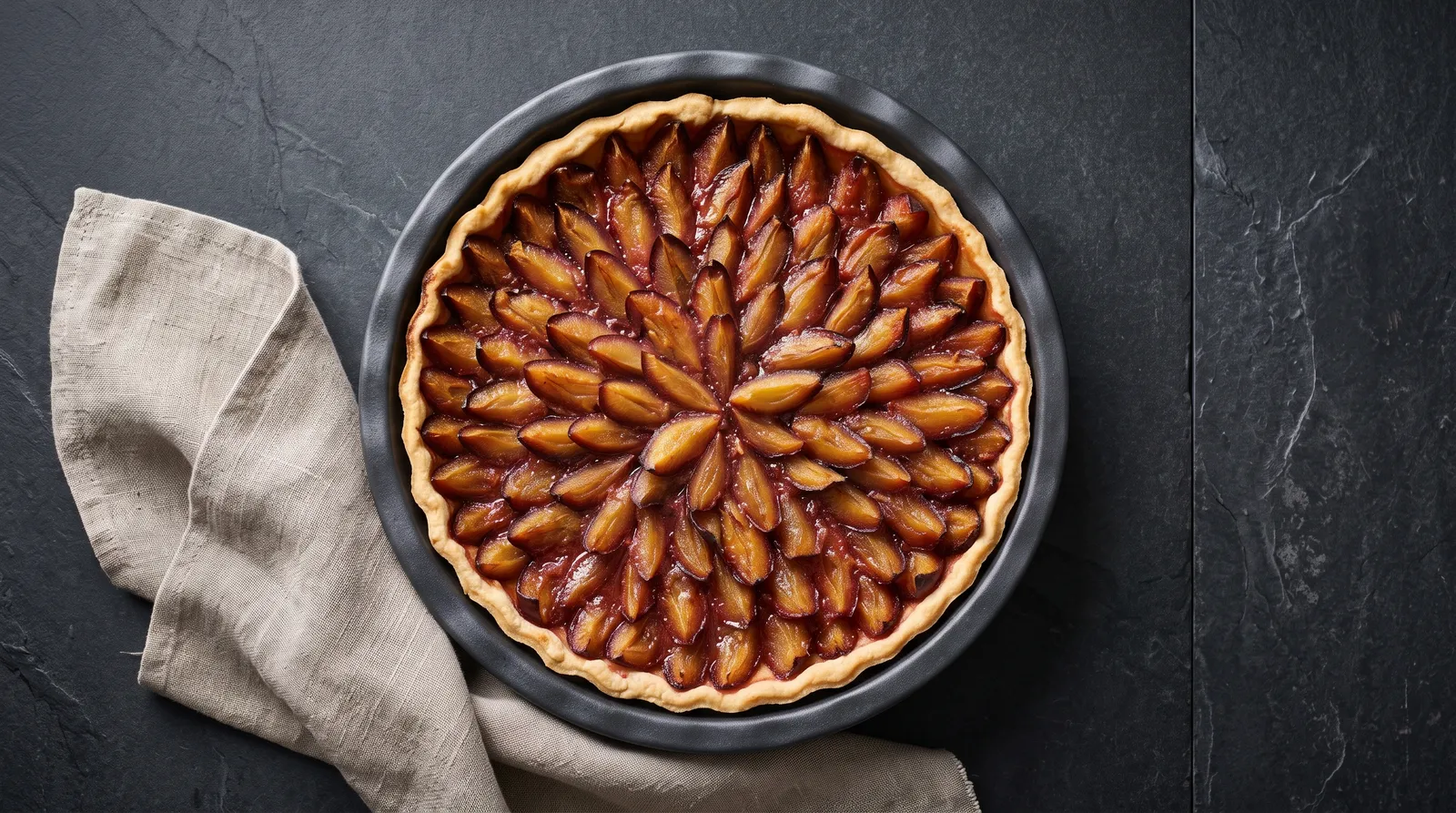
Tarte aux quetsches — shown whole after baking
Prep 52 minutes
Cook 40 minutes
Total 167 minutes
Yield 1 × 28 cm tart, 6 slices
Introduction and overview

Tarte aux quetsches — Alsatian plum tart with migaine

Alsatian tarte aux quetsches uses a plum with a different personality from the small golden mirabelle. Quetsches are elongated purple plums with a firmer, more tart-sweet character, and they are kept in recognisable halves rather than cooked into jam. This form also differs structurally from the Lorraine mirabelle tart: the base is yeast-raised and the fruit receives a light egg-cream migaine.

The fruit load is deliberately high. One kilogram of whole quetsches is expected to give about 940 g after roughly 60 g of pits are removed. Drying the fruit before pitting and arranging the halves tightly limits free water on the surface while ensuring the tart tastes primarily of plum. A first 20-minute bake begins setting the dough before any custard is poured in.

During that first bake, the migaine is whisked from egg, cream, sugar and cinnamon. It is poured around the softened fruit rather than over it so the quetsche pieces stay visible. The tart then returns to the oven until the centre reaches at least 71 °C and only just trembles. Cooling for 30 minutes is essential for both safe handling of hot plum juice and a filling that cuts cleanly.
Keys to success

Keys to success

  • Dry the quetsches thoroughly before they are pitted.
  • Give the yeast base its full visible rise before it goes into the tin.
  • Do not skip the first fruit-only bake before adding the custard.
Ingredients

Ingredients

Raised base

  • 200 g plain wheat flour
  • 110 g unsalted butter, softened
  • 15 g granulated sugar
  • 50 g whole egg, beaten — about 1 large egg without shell
  • 100 ml whole milk, lukewarm
  • 15 g fresh baker’s yeast
  • 2 g fine salt

Fruit and migaine

  • 1000 g ripe quetsche plums, whole purchased weight; washed and dried — about 940 g after removing roughly 60 g pits, about 6% loss
  • 120 g granulated sugar — 25 g on fruit and 95 g in custard
  • 100 g whole egg, beaten — about 2 large eggs without shell
  • 200 ml double cream or heavy cream — about 35% fat
  • 2 g ground cinnamon
Method

Method

Directions

  1. Activate the yeast. Stir the fresh yeast into lukewarm milk and leave it briefly until it is evenly dispersed and lightly foamy. The yeast is evenly dispersed and the surface shows light foaming. A short activation confirms the yeast is dispersed before the enriched dough is mixed. The milk should be lukewarm, not hot.

  2. Knead the raised dough. Combine the dough ingredients and knead until the soft mixture becomes smooth and elastic. The dough is smooth, elastic and soft, and pulls away from the bowl in stretchy strands. Kneading gives the raised tart enough structure to carry dense fruit. Scrape the mixer only when it is stopped.

  3. Proof the dough. Cover the dough and let it rise until clearly expanded and aerated. The dough is visibly expanded and airy, though not necessarily fully doubled. A moderate first proof keeps the base light without making it too bread-like. Keep away from excessive heat that would melt the butter.

  4. Prepare the quetsches. Dry the plums well, split them lengthwise and remove every stone while keeping the halves identifiable. About 940 g pitted fruit remains, with the halves intact and no pits left among them. Locking the pitted fruit weight controls the very high fruit load. Use a stable board and keep fingers clear of the knife.

  5. Assemble the first layer. Press the risen dough evenly into the tin, arrange the plums densely and scatter over the first portion of sugar. The dough is even and the quetsche halves form tight concentric rows with little empty space. Dense arrangement gives the Alsatian tart its fruit-forward character. Do not press fruit so deeply that it tears through the dough.

  6. Start the bake. Bake the fruit-topped dough until the base begins to set and the quetsches soften. The dough edge is beginning to colour and the quetsches have softened and released visible juice. A first bake sets the base before the custard is introduced. Hot fruit juice can burn; keep the tin level. Keep the oven at 180 °C.

  7. Mix the cinnamon custard. While the tart is in its first bake, whisk the eggs, cream, remaining sugar and cinnamon until smooth. The custard is smooth, evenly speckled with cinnamon and has no visible egg streaks. Preparing the custard during the first bake avoids unnecessary extra elapsed time. Keep the eggs and cream refrigerated until this step.

  8. Finish with the migaine. Pour the custard between the softened plums and return the tart to the oven until the filling is safely set. The custard reaches at least 71 °C, the centre is set with only a slight wobble, and the quetsche pieces remain visible above the filling. The second bake safely sets the migaine without losing the identity of the fruit pieces. Measure the custard in the centre with a clean thermometer.

  9. Cool before cutting. Leave the finished tart on a rack for 30 minutes so the custard and fruit juices settle. The custard has stopped bubbling, the fruit juices have settled and slices hold together. Cooling stabilises the migaine and keeps hot fruit syrup from running. Refrigerate leftovers within 2 hours and keep at 4 °C or below.

Serving

Practical

Serving

Serve cool or slightly warm after a 30-minute rest. The slice should show a raised base, identifiable quetsche pieces and just enough cinnamon custard to bind them.

Storage and reheating

Refrigerate within 2 hours at 4 °C or below for up to 3 days. The tart is pleasant cold; if served warm again, reheat to 74 °C and allow a few minutes for the custard to settle before eating.

Make-ahead and substitutions

The dough can be mixed and proofed earlier the same day, but the custard tart is best baked near the day of service. Another firm purple European plum can substitute mechanically, yet the flavour, shape and regional quetsche identity will be different.

Troubleshooting

Troubleshooting

  • Damp layer over the doughFruit was wet or the first bake was cut short. Dry the plums and give the base its full setting time before adding migaine.
  • Custard spills from the sliceThe centre did not reach the safe set or the tart was cut hot. Verify 71 °C and cool for the complete 30 minutes.
Nutrition per serving

Nutrition per serving

  • Serving size1 slice, 1 of 6
  • Calories574 kcal
  • Carbohydrate68.2 g
  • Protein9.3 g
  • Fat30.6 g
  • Fibre3.3 g
  • Sodium188 mg
Allergens and food safety

Allergens and food safety

Allergens: egg, milk, gluten.

Bake the egg-cream migaine until the centre reaches at least 71 °C.

Hot plum juice can cause burns.

Refrigerate the finished custard tart within 2 hours at 4 °C or below.

Reheat leftovers to 74 °C.

FAQ

FAQ

Is this the same as tarte aux mirabelles?

No. The fruit, pastry system and cinnamon migaine make this Alsatian tart materially different.

Why is the custard added later?

The staged bake lets the yeast base set under a kilogram of juicy fruit before additional liquid is introduced.

Closing

Closing

  • Result: A raised, buttery base supporting dense tart-sweet quetsches and a light cinnamon custard that holds the fruit together.
  • Decisive technique: Set the fruit-topped yeast base first, then add the migaine and bake to 71 °C before cooling.