French Recipes

Tarte aux pralines roses

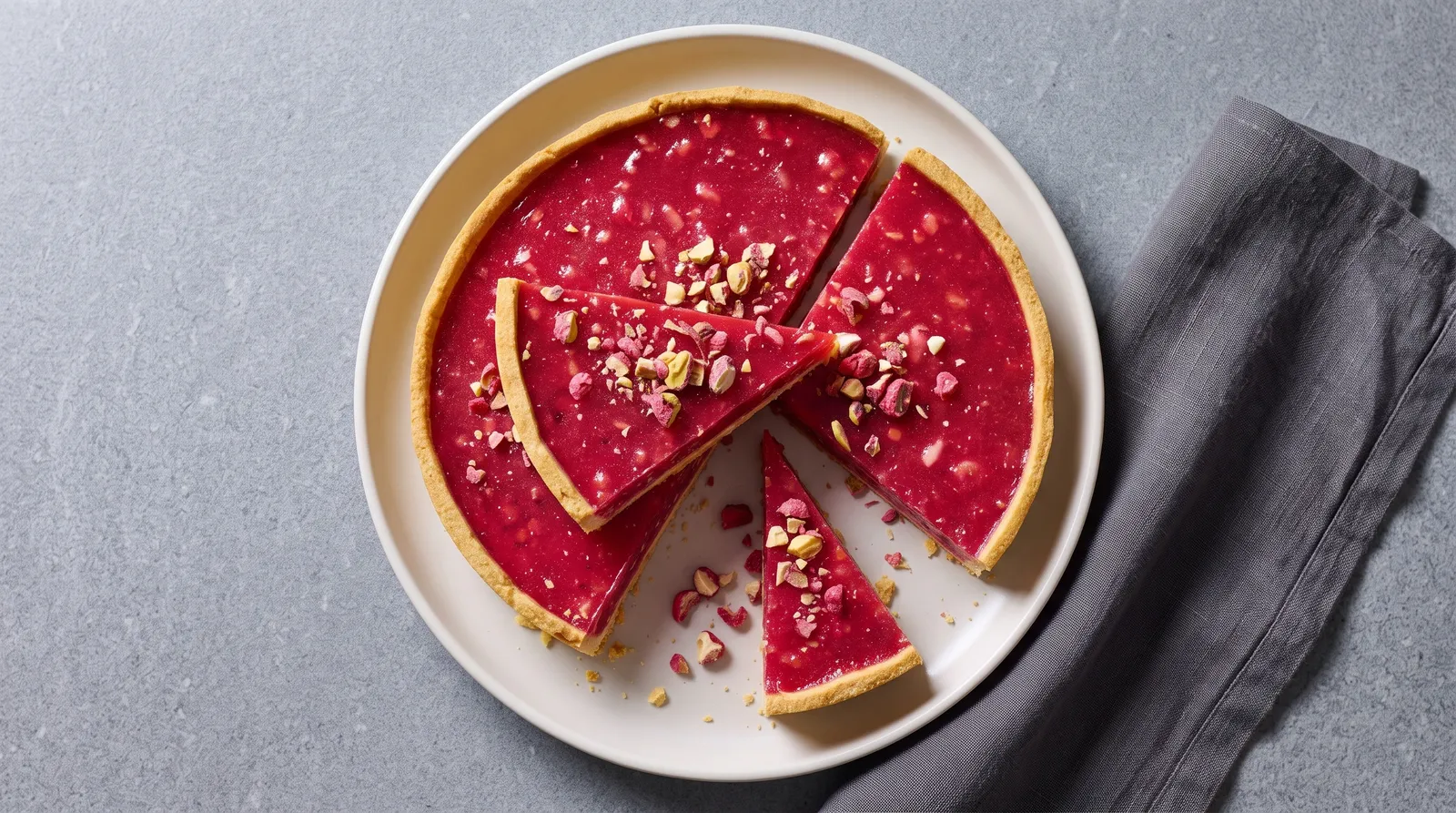
A crisp tart shell filled with crushed pink pralines and cream cooked to 110 °C, giving the Lyonnais dessert its vivid colour and clean, glossy set.

French Recipes
Share
Tarte aux pralines roses — shown with a cut section visible
Prep 20 minutes
Cook 28 minutes
Total 288 minutes
Yield 1 × 24 cm tart, 8 slices
Introduction and overview

Tarte aux pralines roses — Lyonnais pink praline tart

Tarte aux pralines roses is a Lyonnais sugar-and-nut tart whose filling is much simpler than its dramatic colour suggests. Pink pralines are almonds coated in coloured cooked sugar; when they are crushed and heated with cream, they dissolve into a concentrated bright-pink filling that sets as it cools. There is no frangipane or almond custard hiding underneath.

The tart shell therefore has an important structural job. It is rolled to 3 mm and blind-baked until fully golden and dry before any filling is introduced. A pale, under-baked shell would soften quickly under hot cream. The shell is then cooled completely so the concentrated filling begins setting from a stable crisp base rather than continuing to cook the pastry.

Temperature is the decisive control for the filling. Published pastry formulas cluster around the low 100s Celsius; 110 °C gives a practical household target between a runny under-concentration and a brittle overcooked sugar mass. Because boiling cream and sugar cling to skin, the deep saucepan and thermometer are safety equipment, not optional refinements. The tart then needs a long cold set before it is ready for clean slicing.
Keys to success

Keys to success

  • Blind-bake the shell until the base is dry and golden.
  • Crush the pralines coarsely so they dissolve predictably without becoming airborne powder.
  • Stop the filling at 110 °C and pour immediately.
Ingredients

Ingredients

Tart shell

  • 200 g plain wheat flour
  • 100 g unsalted butter, cold, diced
  • 50 g icing sugar
  • 50 g whole egg, beaten — about 1 large egg without shell
  • 2 g fine salt

Praline filling

  • 300 g pink pralines, coarsely crushed — sugar-coated almonds; use the ingredient label for additives
  • 300 ml double cream or heavy cream — about 35% fat
Method

Method

Directions

  1. Make the tart pastry. Rub the butter into the dry ingredients, add the egg and bring the dough together without prolonged kneading. The dough forms a smooth disc with no dry flour and no stretchy gluten development. A short pastry gives the concentrated praline filling a crisp base. Keep the egg chilled until use.

  2. Chill the dough. Flatten, wrap and refrigerate the pastry before rolling. The pastry is firm enough to roll to an even thin sheet without sticking badly. Chilling firms the butter and makes clean lining easier. Keep chilled until rolling.

  3. Blind-bake the shell. Line the ring with 3 mm pastry and bake it fully until the base is dry and golden. The shell is crisp, evenly golden and dry across the base. The filling is added after baking, so the shell must be fully cooked first. Use oven gloves when removing hot baking weights. Keep the oven at 180 °C.

  4. Cool the tart shell. Leave the shell on a rack until no warmth remains. The shell is completely cool and firm before the hot filling is added. A cool shell limits softening when the concentrated praline cream is poured in. Keep the empty shell clean and dry.

  5. Cook the praline cream to concentration. Heat the crushed pralines and cream together with steady stirring until the thermometer reaches exactly 110 °C and the mixture is thick and glossy. The filling reaches 110 °C, is vividly pink, and falls from the spatula in a thick glossy ribbon with no scorched specks. The concentration temperature determines whether the cooled filling slices cleanly rather than flowing or becoming brittle. Boiling sugar and cream cause severe burns; use a deep pan and keep hands clear of splashes.

  6. Fill and begin cooling. Pour the concentrated praline cream into the shell, level it and leave it undisturbed until the strong heat has dissipated. The surface stops steaming and begins to thicken without forming a hard skin. Initial cooling prevents excess condensation in the refrigerator. Do not touch or taste the hot sugar filling.

  7. Set the tart cold. Refrigerate the filled tart until the vivid pink layer is completely firm enough for clean slices. The filling is fully set, holds a clean cut edge and remains smooth rather than grainy. A long cold set stabilises the sugar-cream matrix. Keep at 4 °C or below after the tart is chilled.

Serving

Practical

Serving

Cut the tart while chilled for sharp edges, then let each slice stand for 10–15 minutes before eating. The praline layer softens slightly and gives a smoother bite without becoming runny.

Storage and reheating

Keep the cream-filled tart at 4 °C or below for up to 3 days. Do not reheat it: warmth reverses the set and makes the high-sugar filling sticky and difficult to portion.

Make-ahead and substitutions

The baked shell can wait one day in a dry airtight container; the assembled tart can be refrigerated overnight. Generic sugared almonds may function chemically, but without true pink pralines the colour, sweetness and Lyonnais identity change substantially.

Troubleshooting

Troubleshooting

  • Filling flows after a full chillIt was probably under-concentrated. Use an accurate thermometer and wait for 110 °C before pouring.
  • Filling sets glassy and too hardIt went too far above the target or scorched around the edges; remove the pan promptly at the endpoint.
Nutrition per serving

Nutrition per serving

  • Serving size1 slice, 1 of 8
  • Calories516 kcal
  • Carbohydrate56.4 g
  • Protein6.2 g
  • Fat29.2 g
  • Fibre1.8 g
  • Sodium124 mg
Allergens and food safety

Allergens and food safety

Allergens: milk, egg, gluten, nuts.

Boiling sugar-cream filling at 110 °C is a severe burn hazard.

Keep the cream-filled tart at 4 °C or below after setting and refrigerate within 2 hours of serving.

FAQ

FAQ

Is the filling frangipane?

No. Its body comes from cooked pink pralines and cream, not ground-almond custard.

Should extra food colouring be added?

No. The characteristic colour comes from the pink pralines themselves.

Closing

Closing

  • Result: Crisp pastry holding a smooth, intensely pink praline-cream layer with almond pieces and a clean slice.
  • Decisive technique: Control the boiling filling with a thermometer and stop at 110 °C before giving it a long cold set.