French Recipes

Tarte aux mirabelles

A fruit-forward Lorraine tart with ripe mirabelles packed tightly over thin shortcrust pastry and a small almond layer that absorbs juice without becoming a filling.

French Recipes
Share
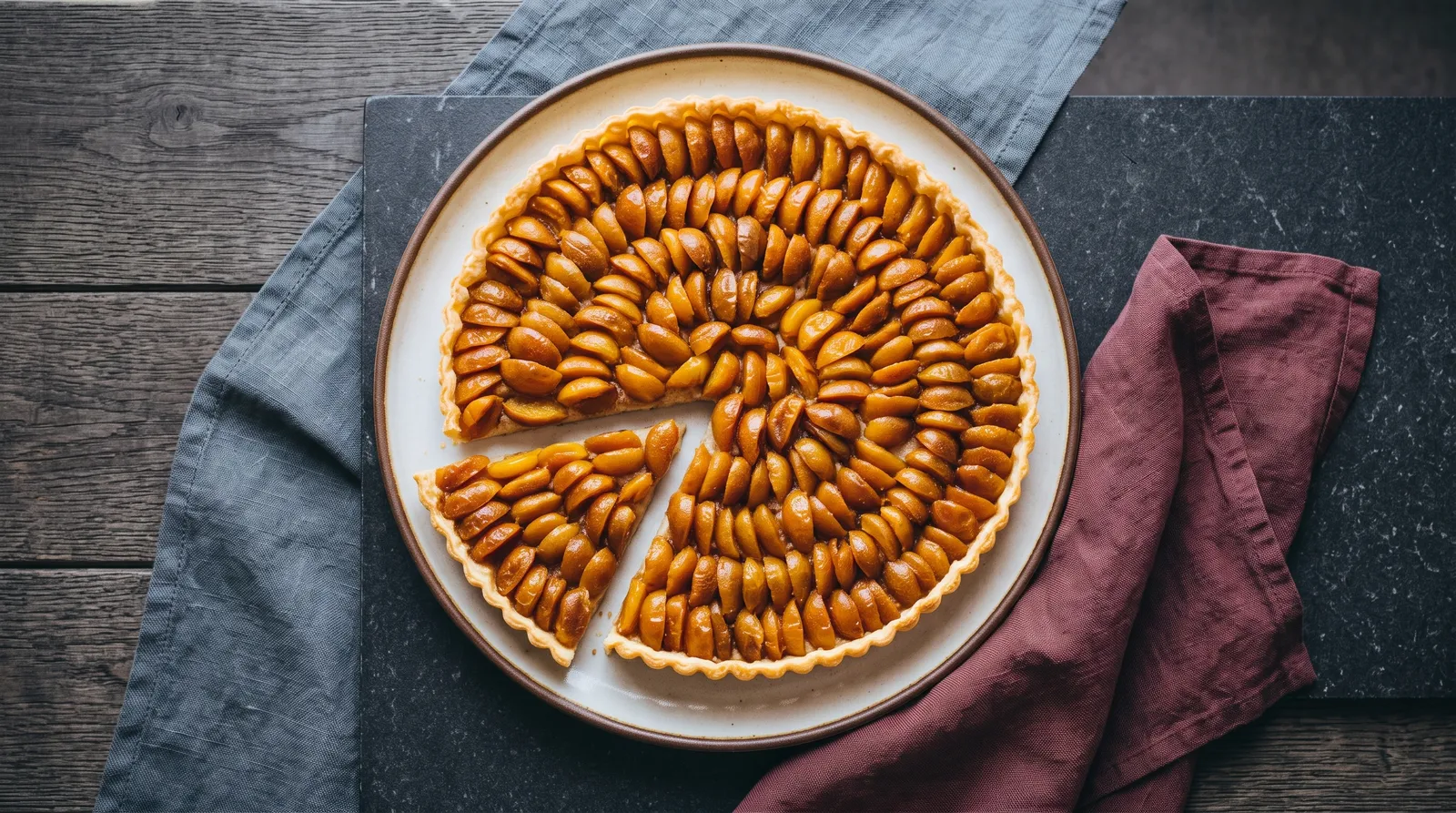
Tarte aux mirabelles — shown whole after baking
Prep 40 minutes
Cook 35 minutes
Total 140 minutes
Yield 1 × 26 cm tart, 8 slices
Introduction and overview

Tarte aux mirabelles — Lorraine mirabelle plum tart

Tarte aux mirabelles should read first as a mirabelle tart, not as a custard tart with a few plums. Lorraine's small golden plums release abundant juice as they bake, so the construction is intentionally simple: a thin short pastry, a light dusting of ground almonds and enough fruit to cover the surface densely.

The fruit weight is controlled before and after pitting. Nine hundred grams of whole mirabelles yields about 845 g edible fruit after roughly 55 g of pits are removed. That assumption matters because fruit load determines both baking time and moisture. The halves remain identifiable and are arranged tightly rather than chopped or cooked down into jam.

Ground almonds are used only as a moisture-control layer. At 25 g they absorb some juice but do not form frangipane or an almond cream. During baking, the mirabelles soften and release syrup while the crust browns underneath. Cooling for 45 minutes is part of the method: hot fruit syrup is dangerous and too fluid for a clean slice straight from the oven.
Keys to success

Keys to success

  • Dry the washed mirabelles before weighing and pitting.
  • Pack the fruit tightly so the tart remains fruit-led.
  • Give the tart the full cooling time so the retained juices settle.
Ingredients

Ingredients

Pastry

  • 200 g plain wheat flour
  • 100 g unsalted butter, cold, diced
  • 20 g granulated sugar
  • 2 g fine salt
  • 60 ml cold water

Fruit filling

  • 900 g ripe Mirabelles de Lorraine, whole purchased weight; washed and dried — about 845 g after removing roughly 55 g pits, about 6% loss
  • 25 g ground almonds — thin moisture-control layer
  • 20 g granulated sugar
  • 20 g unsalted butter, cold, diced
Method

Method

Directions

  1. Make the short pastry. Rub the butter into the dry ingredients, add the water and bring the dough together without kneading. The dough forms a cohesive ball with no dry flour and is not elastic. Minimal mixing keeps the crust short. Keep the butter cool enough to stay solid in small pieces.

  2. Rest the pastry. Wrap the dough and refrigerate it for 20 minutes. The dough is firm enough to roll without smearing butter. A brief rest firms the fat and hydrates the flour. Keep chilled until rolling.

  3. Pit the mirabelles. Wash and dry the fruit, split each mirabelle and remove every pit while keeping the halves intact. About 845 g pitted fruit remains, with halves intact and no pits left among them. The pitted weight locks the fruit load and keeps the filling reproducible. Use a sharp knife on a stable board and check every fruit for a pit.

  4. Assemble the fruit tart. Line the tin with thin pastry, spread the almond powder over the base, pack in the mirabelles and finish with the sugar and small butter pieces. The base is evenly covered with almond powder and the mirabelle halves stand tightly enough that little pastry shows between them. The almond layer absorbs released juice without becoming a separate cream filling. Keep fingers clear of the knife when trimming pastry.

  5. Bake until the fruit is tender. Bake the tart until the crust is golden and the tightly packed mirabelles have softened into bubbling, concentrated juices. The pastry edge is golden, the base is cooked through and the mirabelles are tender with bubbling juices that have thickened around the fruit. A hot enough bake cooks the base before the fruit juice can soak it completely. Hot fruit syrup can burn; keep the tart level when removing it. Keep the oven at 180 °C.

  6. Cool before cutting. Leave the tart on a rack until the hot fruit juices have settled and the base can support a slice. The fruit juices have stopped bubbling and settle into the tart rather than running immediately from a cut. Cooling allows natural pectin and sugar concentration to stabilise the fruit layer. Handle the hot tin carefully and do not taste bubbling fruit syrup.

Serving

Practical

Serving

Serve cool or slightly warm after 45 minutes on a rack. The best slice holds a dense layer of distinct mirabelle halves above a fully baked base.

Storage and reheating

Cover and refrigerate the cooled tart for up to 3 days. It is good cold or after a short return toward room temperature; prolonged reheating encourages the fruit to release more liquid and is unnecessary.

Make-ahead and substitutions

The dough can be prepared ahead, but pit the fruit close to assembly. Other ripe mirabelles will make a technically sound tart, though they cannot be labelled Mirabelles de Lorraine IGP unless they meet the protected origin. Fine dry breadcrumbs can replace almonds as a juice-control layer when a nut-free variation is needed, with a slightly drier, less fragrant base.

Troubleshooting

Troubleshooting

  • Wet pastry under the fruitThe fruit was too wet, the oven too cool or the tart was removed before the base finished baking. Dry the fruit well and bake until the underside is fully cooked.
  • Fruit collapses into a thin layerThe pan was under-filled. Keep the pitted fruit load near 845 g and arrange the halves tightly.
Nutrition per serving

Nutrition per serving

  • Serving size1 slice, 1 of 8
  • Calories303 kcal
  • Carbohydrate40.6 g
  • Protein4.2 g
  • Fat14.2 g
  • Fibre2.7 g
  • Sodium101 mg
Allergens and food safety

Allergens and food safety

Allergens: milk, gluten, nuts.

Use a stable board and sharp knife when pitting.

Hot fruit syrup can cause serious burns; cool before cutting.

Refrigerate the finished moist fruit tart within 2 hours once serving is finished.

FAQ

FAQ

Why not add custard?

Lorraine mirabelle tart is often at its clearest when the fruit remains the main filling; this form uses no egg custard.

Does the almond layer make it an almond tart?

No. At 25 g, it is a thin absorbent barrier, not a cream or frangipane component.

Closing

Closing

  • Result: A golden shortcrust tart densely packed with tender mirabelles and concentrated fruit juice, without a heavy secondary filling.
  • Decisive technique: Control the pitted fruit weight, dry it well and use only a thin absorbent layer under the plums.