French Recipes

Tarte au sucre

A low, brioche-like northern French tart made with two yeast proofs, shallow dimples, blonde vergeoise, butter and a final pour of cream.

French Recipes
Share
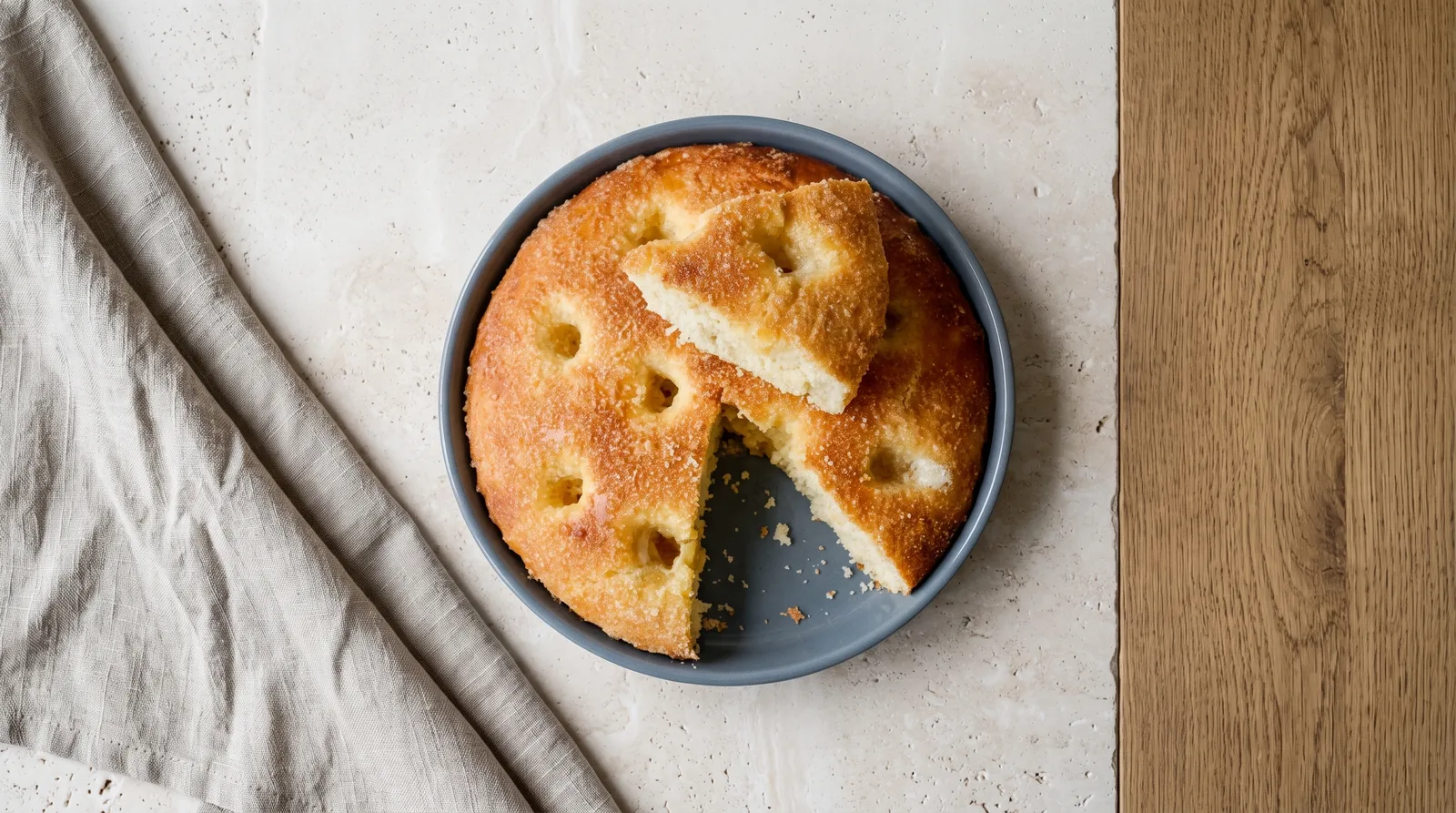
Tarte au sucre — shown with a cut section visible
Prep 40 minutes
Cook 40 minutes
Total 220 minutes
Yield 1 × 25 cm tart, 6 slices
Introduction and overview

Tarte au sucre — northern French raised sugar tart

Northern French tarte au sucre is easy to misread if the name is taken literally. It is not a Canadian-style sugar pie with a syrup custard. The French form is built on an enriched yeast dough, baked low and round like a shallow brioche, with sugar and butter concentrated on the surface.

Vergeoise gives the topping its regional character. The soft beet sugar melts into the fingertip dimples together with small pieces of butter, creating pockets of caramelised sweetness while the crumb stays airy. Cream goes on only after the main bake and returns to the oven briefly, so it soaks into those wells rather than becoming a separate custard layer.

The two rises are not optional waiting time. The first gives the dough body and gas; shaping knocks some of that out, so the second rise rebuilds a light structure in the tin. Dimpling must be gentle enough to preserve that lift. The finished tart is best after a short cool, when the topping has settled but the crumb is still warm and supple.
Keys to success

Keys to success

  • Use milk that feels lukewarm, not hot, when dissolving the yeast.
  • Let both rises reach their volume cues even if the room is cool and the clock runs longer.
  • Make shallow dimples instead of punching through or fully flattening the dough.
Ingredients

Ingredients

Enriched dough

  • 250 g plain wheat flour
  • 15 g fresh baker’s yeast
  • 100 ml whole milk, lukewarm
  • 100 g whole egg, beaten — about 2 large eggs without shell
  • 100 g unsalted butter, softened
  • 4 g fine salt

Topping

  • 150 g blonde vergeoise
  • 50 g unsalted butter, cold, diced
  • 200 ml double cream or heavy cream — about 35% fat
Method

Method

Directions

  1. Mix and knead the enriched dough. Dissolve the yeast in lukewarm milk, then knead it with the flour, eggs, salt and softened butter until the dough becomes smooth and elastic. The dough is smooth, soft and elastic, and begins to pull cleanly from the bowl. Kneading develops enough structure for a light enriched crumb. Use milk that is lukewarm rather than hot so the yeast is not damaged.

  2. Give the dough its first rise. Cover the bowl and let the dough rise until roughly doubled. The dough is visibly expanded to about double its original volume. The first proof builds gas and flavour before shaping. Keep away from direct heat that could melt the butter.

  3. Shape the round. Press the risen dough evenly into the tin, leaving a modest raised edge. The dough covers the base evenly and the rim is only slightly higher than the centre. An even layer bakes into the characteristic low brioche-like tart. Do not add excess flour while shaping.

  4. Give the tart its second rise. Cover the tin and let the dough become clearly puffy again. The dough is puffy across the surface and springs back slowly from a light fingertip touch. The second proof restores gas after shaping. Keep the dough covered so the surface does not dry.

  5. Dimple and add the sugar topping. Use fingertips to make shallow wells, then spread the vergeoise and butter evenly over the surface. The surface has shallow dimples, the sugar is evenly distributed and no large bare patches remain. Dimples hold melted butter and sugar while preserving an airy crumb. Press gently so the risen dough is not flattened completely.

  6. Bake the sugared tart. Bake until the brioche-like crumb is set and the sugar-butter topping bubbles across the surface. The edge is deep golden, the centre is set and the sugar-butter topping is bubbling without blackened patches. The long first bake sets the crumb and begins caramelising the topping. Use oven gloves and watch the sugar near the end because it can burn quickly. Keep the oven at 180 °C.

  7. Finish with cream. Pour the cream in a thin even layer over the hot tart and bake briefly until it is absorbed and glossy. The cream has soaked into the dimples, the surface is glossy and the edges remain caramelised rather than wet. A short final bake integrates the cream without turning the topping into a thick custard. Pour slowly to avoid splashing on the hot tin. Keep the oven at 180 °C.

  8. Cool to warm. Leave the tart uncovered on a rack for 20 minutes before cutting. The tart is warm rather than scorching and the topping no longer runs when the tin is tilted slightly. Partial cooling lets the caramelised topping settle while keeping the bread tender. Do not cover while hot; trapped steam softens the surface.

Serving

Practical

Serving

Cut into 6 pieces after 20 minutes on a rack. The tart is at its best warm, when the sugar-butter topping has set enough to stay on the slice but the crumb remains soft.

Storage and reheating

Because cream is added at the end, refrigerate leftovers within 2 hours if they will not be eaten that day and keep for up to 3 days. Rewarm briefly in a 150 °C oven to soften the crumb; avoid prolonged heating that hardens the caramelised top.

Make-ahead and substitutions

The first proof can be completed earlier in the day, but the second proof should happen in the baking tin close to oven time. Soft brown sugar will function if vergeoise is unavailable, although the flavour and regional specificity will change.

Troubleshooting

Troubleshooting

  • Heavy centreThe shaped dough needed more time in the second proof. Wait for visible puffiness and a slow spring-back to a light fingertip touch.
  • Top tastes burnt rather than caramelisedThe oven ran hot or the tart stayed under strong top heat too long. Aim for bubbling amber sugar, not black patches.
Nutrition per serving

Nutrition per serving

  • Serving size1 slice, 1 of 6
  • Calories578 kcal
  • Carbohydrate59.1 g
  • Protein8.0 g
  • Fat34.9 g
  • Fibre1.3 g
  • Sodium308 mg
Allergens and food safety

Allergens and food safety

Allergens: egg, milk, gluten.

Keep egg, milk, butter and cream refrigerated until use.

Refrigerate cream-topped leftovers within 2 hours if not eaten the same day.

FAQ

FAQ

Why is this not a Canadian sugar pie?

The northern French identity comes from a yeast-raised dough and surface topping rather than a syrup-thickened pie filling.

Can all the cream be added before baking?

Other recipes do that, but the staged cream addition here is part of the fixed cooking sequence and produces a different surface texture.

Closing

Closing

  • Result: A soft, low brioche crumb with glossy pockets of vergeoise, butter and cream across a caramelised top.
  • Decisive technique: Protect the second proof and dimple gently so the tart stays airy under the rich topping.