French Recipes

Soufflé au fromage

A savoury Comté soufflé built on thick béchamel, cooled before the yolks, then lightened with whipped whites and baked to 71 °C.

French Recipes
Share
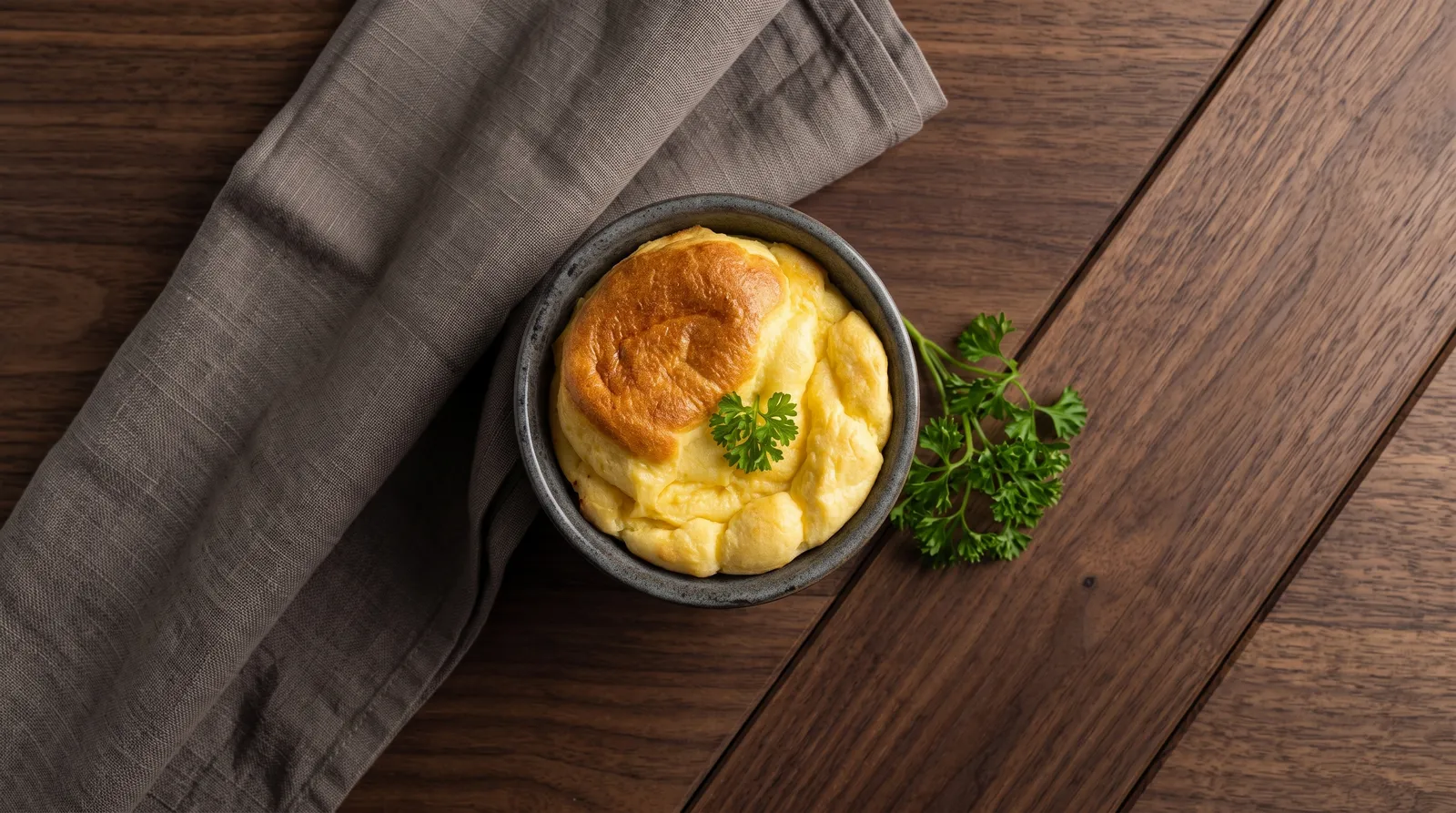
Soufflé au fromage — shown in a small ceramic baking dish
Prep 35 minutes
Cook 27 minutes
Total 77 minutes
Yield 6 individual 240 ml ramekins
Introduction and overview

Soufflé au fromage — French savoury cheese soufflé

Soufflé au fromage is a savoury French soufflé built on a proper béchamel-style base rather than on a custard alone. Butter and flour are cooked into a pale roux, hot milk is whisked in to make a thick sauce, and Comté is melted into that base before the egg yolks and whipped whites are incorporated. That structure is what lets the cheese taste full without turning the dish into a baked dip or crustless quiche.

Temperature management keeps the texture tender. The sauce is thickened thoroughly, then cooled before the yolks go in; the egg whites are whipped separately to a flexible medium-stiff foam. Folding should stop as soon as the mixture looks evenly aerated. Overworking at this point trades height for density.

The six straight-sided ramekins make the bake predictable and provide individual portions that can go straight to the table. A golden, well-risen top is a quality cue, while 71 °C in the centre is the safety control. Serve immediately, because a soufflé naturally settles as hot air and steam escape.
Keys to a light cheese soufflé

Keys to a light cheese soufflé

  • Cook the roux without browning it.
  • Cool the cheese base before the yolks go in.
  • Fold gently and bake without opening the oven door.
Ingredients

Ingredients

For the ramekins

  • 15 g unsalted butter — softened; for coating
  • 15 g plain wheat flour — for coating

For the base

  • 500 ml whole milk
  • 70 g unsalted butter
  • 70 g plain wheat flour
  • 180 g Comté cheese — finely grated
  • 100 g egg yolks — net weight
  • 200 g egg whites — net weight
  • 4 g fine salt
  • 1 g black pepper — freshly ground
  • 0.5 g ground nutmeg
Method

Method

Directions

  1. Prepare the ramekins. Brush the ramekins with the 15 g butter, dust with the 15 g flour and chill. The coating is thin and continuous from base to rim with no bare patches.

  2. Heat the dairy. Warm the milk to about 85 °C. Small bubbles appear around the edge and the milk is steaming.

  3. Cook the roux. Melt the 70 g butter, stir in the 70 g flour and cook for 2 minutes without browning. The roux looks foamy and pale and has no raw flour pockets.

  4. Make the béchamel. Whisk in the hot milk gradually, bring the sauce to about 95 °C and simmer for 5 minutes, whisking until thick. The béchamel is smooth and thick enough to coat the whisk heavily.

  5. Melt in the Comté. Take the pan off the heat, add salt, pepper, nutmeg and Comté, and stir only until melted. The cheese is fully melted and the base is smooth without oily separation.

  6. Cool the cheese base. Transfer the base to a shallow bowl and cool for 15 minutes to about 40 °C. The base is warm rather than hot and remains spoonably thick.

  7. Add the yolks. Whisk in the yolks until uniform. The base is uniform, glossy and free of visible yolk streaks.

  8. Aerate the whites. Whip the whites in a grease-free bowl to medium-stiff peaks. The whites form a defined peak with a slightly flexible tip and no dry clumps.

  9. Fold the batter. Fold one quarter of the whites into the cheese base, then fold in the remainder in two additions. The batter is light, uniform and free of large white streaks.

  10. Fill the ramekins. Fill the chilled ramekins about three quarters full and wipe the rims. The fill level is even and each rim is clean.

  11. Bake to a safe centre. Bake at 190 °C for 15 minutes without opening the oven, then check one centre with a probe. The soufflés rise above the rims, the tops are golden and the centre reaches 71 °C.

Serving

Practical

Serving

Serve immediately as a starter or light main with a simple salad if desired; the soufflés naturally settle after leaving the oven.

Make-ahead

Prepare and chill the coated ramekins several hours ahead. The cheese base can be prepared, covered and refrigerated for up to 24 hours; bring it back to the stated warm working range before adding yolks and whites.

Storage and reheating

Refrigerate baked leftovers within 2 hours and use within 2 days. Reheat to 74 °C, accepting that the soufflé will be denser.

Substitutions

A similarly aged firm Alpine-style cheese can melt successfully but will not reproduce the same Comté flavour. Do not remove the flour without rebuilding the thickened base.

Troubleshooting

Troubleshooting

  • Poor riseThe base may have been too hot, the whites overworked or the oven opened early. Keep the base warm rather than hot, fold lightly and leave the oven shut.
  • Greasy baseThe cheese was heated too aggressively. Melt it into the sauce off direct heat and stop once smooth.
Nutrition per serving

Nutrition per serving

  • Serving size1 individual soufflé (1 of 6)
  • Calories400 kcal
  • Carbohydrate15.9 g
  • Protein18.7 g
  • Fat29.1 g
  • Fibre0.4 g
  • Sodium543 mg
Allergens and food safety

Allergens and food safety

Allergens: Egg, Milk, Gluten (wheat).

Cook the centre to 71 °C. Keep eggs and dairy refrigerated before preparation. Refrigerate leftovers within 2 hours; reheat to 74 °C. Ramekins remain dangerously hot after baking.

FAQ

FAQ

Why cool the base before adding yolks?

A very hot cheese sauce can scramble the yolks and also weakens the later egg-white foam.

Why use straight-sided ramekins?

Straight sides give the expanding batter a consistent path upward.

Closing

Closing

  • Result: Golden, well-risen cheese soufflés with a tender Comté-rich centre.
  • Decisive technique: Build a thick cooled cheese base, fold flexible egg whites gently and verify 71 °C in the centre.