French Recipes

Rissoles savoyardes

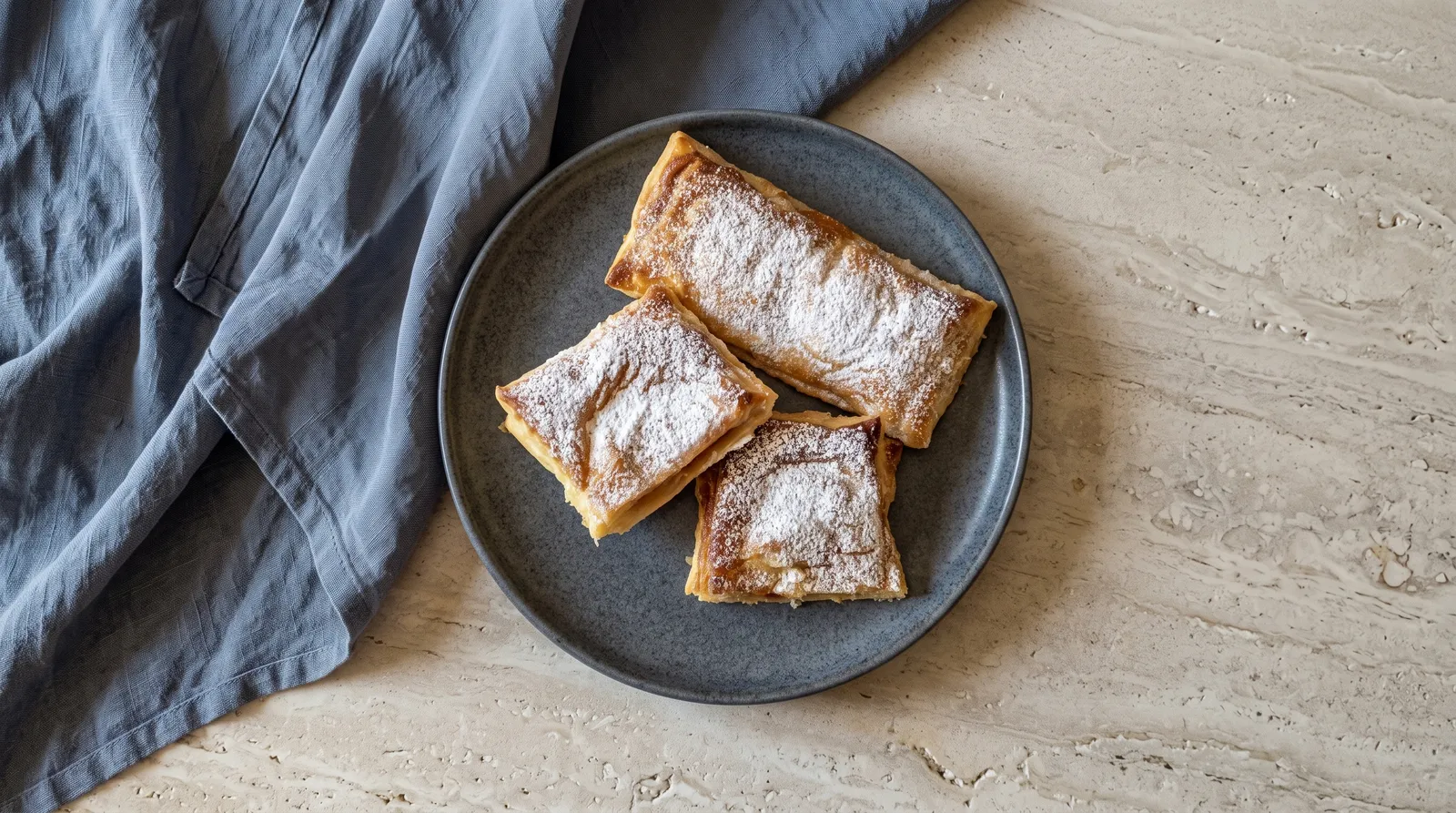
Twenty small Savoyard-style puff-pastry turnovers filled with a long-cooked pear compote, sealed cold, brushed with egg yolk and baked until the top, base and seams are deeply golden.

French Recipes
Share
Rissoles savoyardes — served on a plate
Prep 50 minutes
Cook 115 minutes
Total 240 minutes
Yield 20 small pear rissoles
Introduction and overview

Rissoles savoyardes — baked puff-pastry turnovers with pear compote

Rissoles savoyardes, also encountered under dialect names such as rzules or rézules, are small fruit-filled pastries rather than the fried meat rissoles known in other culinary traditions. Savoyard versions are strongly associated with pear or apple compote and can use puff pastry; pear is kept consistently here. The goal is a compact turnover with a real cooked-fruit centre, not a commercial jam pocket or a savoury fried parcel.

The filling starts with 1000 g firm cooking pears, ideally a local-style pear such as Blesson when available. Peeling and coring should leave about 800 g prepared fruit. That prepared weight goes into a wide saucepan with 150 g sugar, 15 g butter and 50 ml water and cooks slowly for 90 minutes. The endpoint matters more than a glossy appearance: the compote must hold a clear spoon track and show no free liquid. A wet filling will steam through the seams and soak the pastry.

The compote is spread out and cooled completely before assembly. The 500 g all-butter puff pastry stays cold, is rolled to 3 mm and cut into 20 rectangles about 8 × 12 cm. Each takes about 35 g filling. Once folded and sealed, the turnovers receive a thin egg-yolk wash and bake at 200 °C for 25 minutes. Deep colour on the top alone is not enough; the base and folded seam should also look fully baked. Fifteen minutes of cooling protects against the deceptively hot fruit centre.
Success points

Success points

  • Track both the 1000 g purchased pear weight and the target 800 g prepared fruit weight after peeling and coring.
  • Reduce the compote until it is genuinely thick and free of loose syrup, then cool it completely.
  • Keep all-butter puff pastry cold and maintain a 3 mm thickness for a crisp but not heavy shell.
  • Use about 35 g filling per piece and keep it away from the sealing border.
  • Bake until the underside and folded seam are fully coloured as well as the glazed top.
Ingredients

Ingredients

Pear compote

  • 1000 g firm cooking pears such as Blesson, purchased weight; peel and core to about 800 g prepared pear
  • 150 g caster sugar
  • 15 g unsalted butter
  • 50 ml water

Pastry

  • 500 g all-butter puff pastry, cold and rolled to 3 mm
  • 20 g egg yolk, beaten for egg wash
Method

Method

Directions

  1. Prepare the pears. Peel and core the 1000 g pears, trimming to about 800 g prepared fruit, then cut them into small even dice; allow 20 minutes. The prepared pear weighs about 800 g and is cut into small even dice.

  2. Cook the compote down. Put the 800 g prepared pear, 150 g sugar, 15 g butter and 50 ml water in a wide saucepan and cook over low heat for 90 minutes, stirring more often near the end. The pear compote is thick, darkened and holds a clear spoon track with no free liquid pooling around it.

  3. Cool the filling completely. Spread the compote in a shallow dish and leave it for 60 minutes before assembly. The compote is completely cool and weighs about 700 g, with no steam or loose syrup.

  4. Cut the cold pastry. Roll the 500 g all-butter puff pastry to 3 mm and cut 20 rectangles about 8 × 12 cm, allowing about 15 minutes. Twenty pastry rectangles are close to 8 × 12 cm and 3 mm thick.

  5. Fill and seal. Place about 35 g cold pear compote on each rectangle, fold into a small turnover and press the edges firmly closed, allowing about 15 minutes. All 20 turnovers are sealed with no compote on the edges and no free filling leaking out.

  6. Apply the egg wash. Brush the tops evenly with the 20 g beaten egg yolk and space the pastries on the tray, allowing about 5 minutes. The tops carry a thin even egg wash without puddles on the tray.

  7. Bake until fully golden. Bake at 200 °C for 25 minutes. The pastry is fully puffed and deep golden on the top and base, with no pale raw band at the folded seam.

  8. Cool the hot fruit centre. Transfer the turnovers to a wire rack for 15 minutes. The turnovers are warm rather than scalding and the pastry layers feel crisp at the edges.

Serving, storage and make-ahead

Practical

Serving, storage and make-ahead

Serve warm or fully cooled. The filling remains hotter than the pastry surface for several minutes after baking, so the cooling period is part of safe service as well as texture control. One piece is the nutrition serving, though a dessert plate may contain more than one depending on the wider meal.

Serving, storage and make-ahead

The compote is an excellent make-ahead component. Cook it a day in advance, cool it promptly and refrigerate it covered. Use it cold or only cool, never hot, when filling the puff pastry. Once assembled, keep the pastries cold if the oven is not ready so the butter layers do not soften before baking.

Serving, storage and make-ahead

Refrigerate leftovers within 2 hours and use within 2 days. Re-crisp in a moderate oven and, when serving reheated pastries hot, bring the filling to 74 °C. A microwave warms the centre but softens the puff pastry. Other local fruits are documented, but pear is the fixed filling here; switching to apple, plum or quince is a separate variation rather than a silent substitute.

Troubleshooting

Troubleshooting

  • Compote leaks during bakingit retained free liquid or contaminated the sealing edge. Reduce the fruit until thick, cool fully and keep the border clean.
  • Puff pastry stays flatit became warm during assembly or was rolled too thin. Keep it cold and hold the 3 mm thickness.
  • The base is pale while the top is darkthe tray or oven position is insulating the underside. Continue only until the base and folded seam are properly baked, protecting the top if necessary.
Nutrition per serving

Nutrition per serving

  • Serving size1 rissole (1 of 20)
  • Calories198 kcal
  • Carbohydrate25.1 g
  • Protein2.1 g
  • Fat10.5 g
  • Fibre1.6 g
  • Sodium65 mg
Allergens and food safety

Allergens and food safety

Allergens: Egg; Milk; Wheat/gluten.

Do not taste raw puff pastry or egg wash. Hot pear compote and the fruit centre inside a baked turnover can cause severe burns, so cool the filling completely before assembly and let the baked pastries stand before eating. Keep egg wash refrigerated until use. Refrigerate leftovers within 2 hours and reheat filled pastries to 74 °C when serving them hot again.

FAQ

FAQ

Are Savoyard rissoles fried meat pastries?

No. The Savoyard form here is a small dessert turnover filled with fruit compote and baked in puff pastry. The shared word rissole should not erase that regional identity.

Can commercial pear jam replace the compote?

Not for this preparation. The filling is built from pears cooked down with measured sugar, butter and water to a thick compote, giving a different fruit texture and water balance from commercial jam.

Closing

Closing

  • Result: Deep-golden, layered puff-pastry turnovers with a thick, softly textured pear centre and crisp sealed edges.
  • Decisive technique: Cook the pear filling until no free liquid remains, cool it completely and seal it inside cold 3 mm puff pastry.