French Recipes

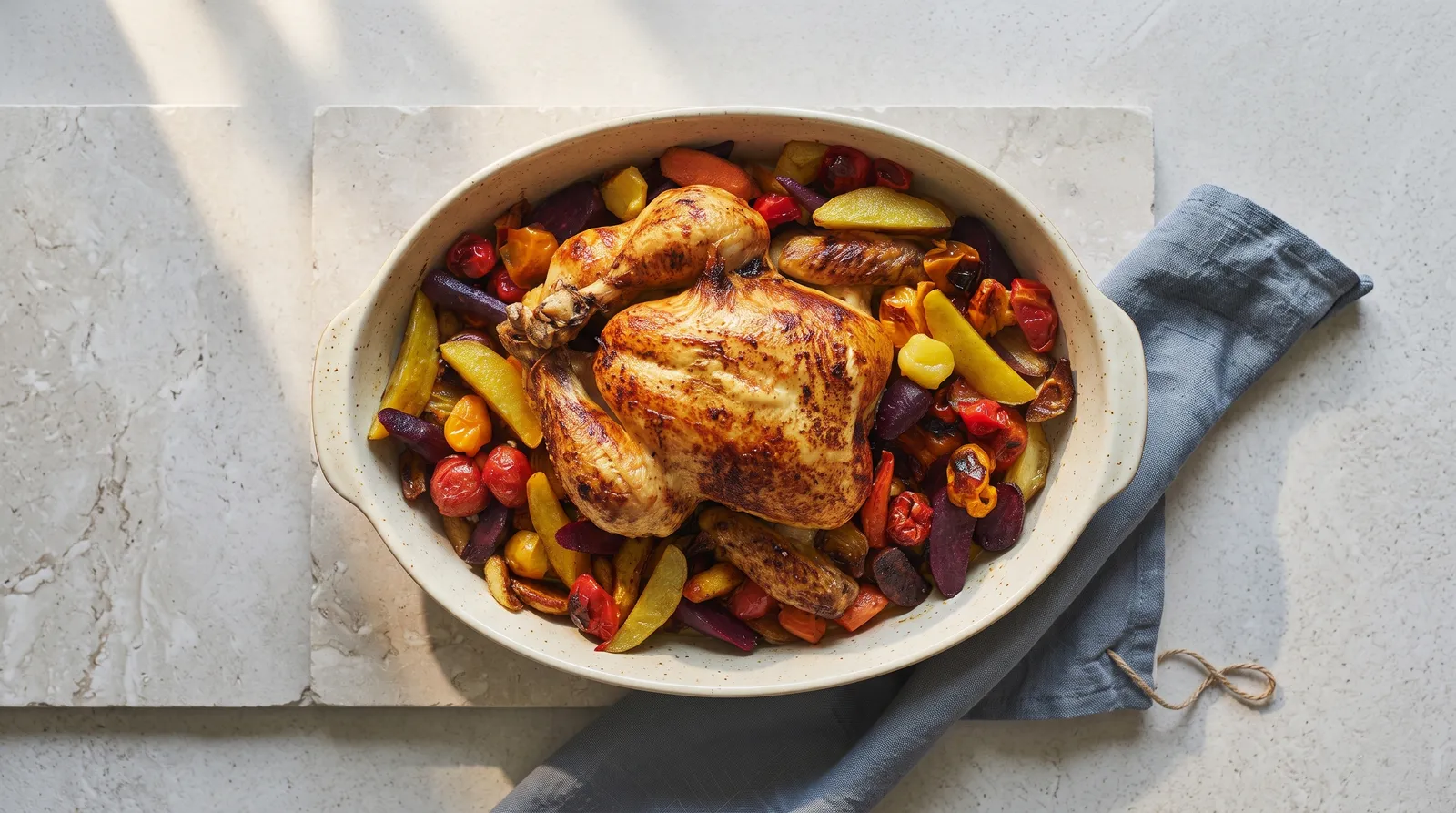
Poulet rôti

A restrained whole roast chicken uses butter, olive oil, garlic and herbs, then rests before carving; breast and thigh are each checked at 74 °C rather than judged by colour or clear juices.

French Recipes
Share
Poulet rôti — shown in close-up
Prep 20 minutes
Cook 85 minutes
Total 120 minutes
Yield 6 main-course portions
Overview

Classic French whole poulet rôti with garlic, thyme and rosemary

Poulet rôti is intentionally restrained, with garlic, herbs and a measured amount of fat rather than a regional sauce. There is no regional cream sauce, cider, mustard or tomato base. A whole free-range bird is coated with a modest amount of butter and olive oil, seasoned with garlic and herbs, and roasted unstuffed so the heat can reach the breast and thigh evenly.

The bird is left untrussed. That exposes the leg joints instead of pinning them tightly against the body and makes thermometer access straightforward. A little water is added to the tray only after the fond has developed, keeping the browned drippings from burning while preserving a small quantity of pan juice for service.

Whole poultry is not safely judged from skin colour, loose joints or clear juices alone. Check the coldest thick point of both the breast and thigh regions away from bone and require 74 °C in each area. Resting is then counted as part of the total elapsed time before carving, while the pan juices are finished separately and measured rather than treated as an unlimited extra.
Success points

Success points

  • Do not wash the chicken; dry it with paper towel instead.
  • Roast unstuffed and untrussed so the leg joints remain exposed.
  • Probe both breast and thigh at 74 °C before beginning the 15-minute rest.
Ingredients

Ingredients

Roast chicken

  • 1800 g whole free-range chicken — unstuffed and untrussed; purchased weight; expected cooked edible meat-and-skin yield about 1050 g
  • 35 g unsalted butter — softened
  • 15 g olive oil
  • 20 g garlic cloves — lightly crushed, skin on
  • 5 g fresh thyme
  • 3 g fresh rosemary
  • 8 g fine salt
  • 2 g black pepper — freshly ground
  • 120 ml water — for pan juices
Method

Method

Roast and rest

  1. Prepare the bird. Pat the chicken dry without washing it. Rub the butter and olive oil over the skin, season with salt and pepper, and place the garlic, thyme and rosemary around the bird in the roasting tray. The skin is dry, evenly buttered and seasoned, with herbs and garlic arranged around rather than packed as stuffing.

  2. Roast to 74 °C in breast and thigh. Roast at 190 °C for about 80 minutes. After roughly 45 minutes, pour the 120 ml water into the hot tray around the bird to keep the fond from burning, avoiding the skin. The breast and thigh regions each register 74 °C at their coldest thick points away from bone.

  3. Rest before carving. Transfer the chicken to a clean carving board and rest for 15 minutes under a loose foil tent. The surface stops actively sizzling and the juices settle before carving.

  4. Finish the pan juices. Skim obvious excess surface fat, scrape the roasting tray over medium heat for 5 minutes and strain the juices. The pan juices are hot, lightly emulsified and measure about 120 g after straining. Serve them with the carved chicken.

Serving and planning

Practical

Serving and planning

Carve after the full rest and divide the edible meat and skin between six plates. Spoon the measured pan juices over the portions. Optional potatoes or vegetables are separate.

Make-ahead

Seasoning can be measured in advance, but the chicken should be roasted close to service. Do not partially roast poultry for later completion.

Storage and reheating

Refrigerate carved leftovers within 2 hours for 3–4 days. Reheat portions with a spoonful of pan juice, covered, to 74 °C to limit drying.

Valid substitutions

Oil can replace the butter as an adaptation, removing the milk allergen and some of the butter character. A larger or smaller bird requires a different roasting time and cannot use the same 80-minute assumption.

Nutrition per serving

Nutrition per serving

  • Serving sizeabout 175 g cooked edible chicken meat and skin plus 20 g pan juices
  • Calories490 kcal
  • Carbohydrate2 g
  • Protein48 g
  • Fat32 g
  • Fibre0.2 g
  • Sodium760 mg
Allergens and food safety

Allergens and food safety

Milk from butter.

Do not wash raw chicken; prevent splashing and cross-contamination.

Cook the breast and thigh regions to 74 °C at the coldest thick point away from bone.

Rest on a clean board; never reuse the raw-poultry tray.

Refrigerate leftovers within 2 hours and reheat to 74 °C.

Bones, carving tools, hot fat and the hot roasting tray are physical hazards.

Closing

Closing

  • Result: crisp-edged roast chicken with herb-garlic pan juices and a clean roast flavour rather than a regional sauce.
  • Decisive technique: probe both breast and thigh regions at 74 °C, then rest the whole bird for 15 minutes before carving.