French Recipes

Petits farcis niçois

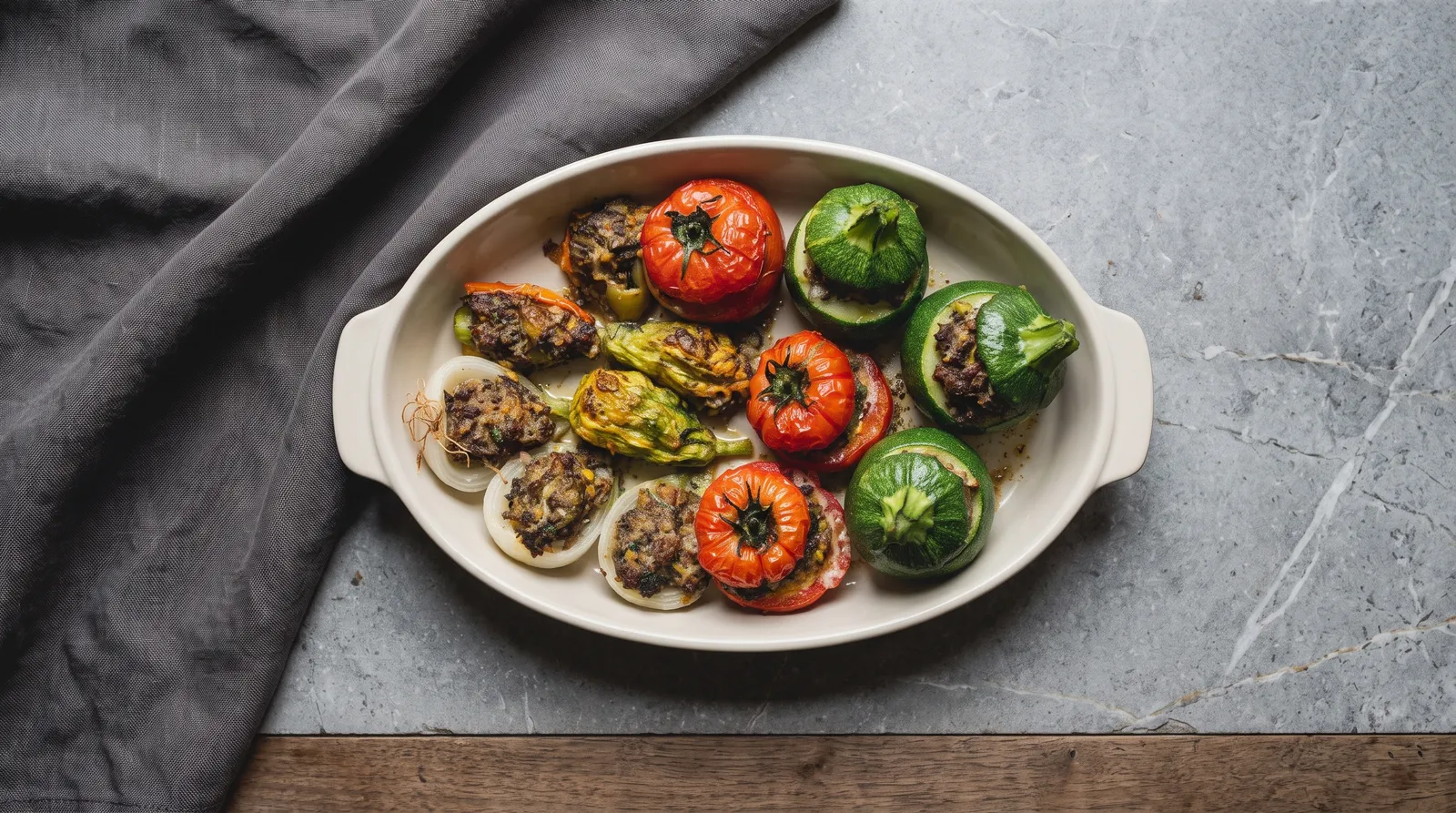
An assortment of courgette, tomato, onion and round pepper filled with one balanced Niçois-style meat-and-bread stuffing, baked until every centre is safely cooked without waterlogging the vegetables.

French Recipes
Share
Petits farcis niçois — arranged on a tray
Prep 45 minutes
Cook 54 minutes
Total 109 minutes
Yield 8 stuffed vegetables
Introduction

Petits farcis niçois — small Niçois vegetables with meat-and-bread stuffing

Petits farcis niçois are defined as much by scale and variety as by the filling. Instead of one oversized stuffed pepper, the baking dish holds several small Mediterranean vegetables, each with its own flavour and moisture level. Courgette, tomato, onion and round sweet pepper create the mix here, so a serving gives two different vegetables rather than repeating a single shell.

The stuffing follows the meat-and-bread branch of the Niçois family: beef and pork, milk-softened bread, egg, garlic, parsley and thyme. Retained courgette and onion pulp are cooked down before they return to the mixture. That step matters because raw pulp can release enough water to steam the filling, dilute its flavour and leave the baking dish flooded.

The vegetables need different preparation. Onion and courgette get a short blanch so their firmer walls can keep pace with tomato and pepper in the oven. Tomato seed gel is discarded rather than stirred into the filling, while the hollowed onion and courgette flesh are deliberately retained. The aim is not perfectly identical vegetables; it is similar shell thickness and equal filling depth.

Because the filling contains raw ground meat, the final check is objective: every centre reaches 71 °C. Browning on top is useful for texture but cannot stand in for that measurement. Once baked, the vegetables should be tender enough to cut with a fork while still holding their individual shape.
Success points

Success points

  • Choose small vegetables that can sit snugly in one baking dish; gaps encourage spreading and uneven browning.
  • Evaporate moisture from retained pulp before mixing the stuffing.
  • Divide filling evenly and verify 71 °C in every piece rather than checking only the largest one.
Ingredients

Ingredients

Vegetable cases

  • 360 g small courgettes — 2 pieces; purchased weight; halved to give about 260 g shells and 70 g retained pulp
  • 300 g small ripe tomatoes — 2 pieces; purchased weight; tops removed, about 220 g shells; watery seed gel discarded
  • 300 g small onions — 2 pieces; purchased weight; peeled, about 190 g shells and 80 g retained centre
  • 300 g small round sweet peppers — 2 pieces; purchased weight; tops removed and seeded, about 240 g edible shells
  • 2000 ml water for blanching — Discarded after blanching.
  • 15 ml olive oil — for the vegetable cases

Meat-and-bread stuffing

  • 250 g ground beef — raw, chilled
  • 150 g ground pork — raw, chilled
  • 80 g stale white bread — crust removed, torn
  • 120 ml whole milk
  • 50 g egg — 1 large egg, beaten
  • 10 g garlic — finely chopped
  • 20 g flat-leaf parsley — finely chopped
  • 2 g thyme leaves
  • 15 ml olive oil — for the aromatic base
  • 6 g fine salt
  • 1 g black pepper — freshly ground
Method

Method

Prepare the vegetable cases

  1. Blanch the firmer cases. Bring 2,000 ml water to a boil. Halve the courgettes lengthwise and hollow them to an even 8 mm shell, keeping 70 g pulp. Blanch the courgette shells and peeled whole onions for 6 minutes, then drain and handle with a spoon or tongs while still warm. The courgette shells bend slightly without collapsing and the onions have softened enough to hollow safely. A short blanch makes the firmer vegetables bake at the same pace as tomatoes and peppers. Use a stable board and keep fingers behind the spoon or small knife while hollowing.

  2. Hollow the vegetables evenly. Hollow the blanched onions, keeping 80 g centre, then prepare the tomato and pepper cases. Arrange all eight cases snugly in an oiled 30 × 24 cm baking dish. All eight vegetable cases have walls of broadly similar thickness and sit upright without splitting. Even shells give a more consistent cooking time and filling ratio. Discard damaged vegetable pieces rather than forcing filling into torn cases.

Build the stuffing

  1. Soften the bread. Soak the 80 g bread in 120 ml milk for 5 minutes while organising the measured filling ingredients, then squeeze it gently so it is moist but not dripping. The bread is fully softened and no free milk pools in the bowl. Moist bread binds the meat without making the filling watery. Keep the milk-and-bread mixture away from raw meat until ready to combine.

  2. Cook down the retained pulp. Heat 15 ml olive oil in a skillet and cook the reserved 70 g courgette pulp, 80 g onion centre, garlic and thyme for 8 minutes, stirring until the excess moisture has evaporated. The retained vegetable pulp is soft and moist but leaves no watery puddle in the pan. Cooking the retained pulp concentrates it so the stuffing does not steam inside the vegetables. Use a clean utensil; raw meat has not yet entered the pan.

  3. Bring the aromatic base down to temperature. Transfer the cooked pulp to a bowl and cool for 10 minutes before adding the chilled beef, pork, soaked bread, egg, parsley, salt and pepper. Mix only until evenly distributed. The aromatic pulp is no longer hot enough to warm the raw meat, and the stuffing is evenly combined without becoming pasty. Cooling protects the texture and keeps raw meat in a safe temperature range. Do not leave the raw-meat mixture at room temperature after mixing; fill and bake promptly.

Fill and bake

  1. Fill the cases evenly. Divide the stuffing evenly among the eight vegetable cases, packing it lightly and keeping the tops level rather than domed. Brush exposed vegetables with the remaining 15 ml olive oil. Each vegetable holds a similar depth of filling and none is split from overpacking. Equal filling depth makes the safety endpoint achievable at the same time. Wash hands, scale platform and utensils after contact with raw ground meat.

  2. Bake and check every centre. Bake in a preheated 190 °C oven for 40 minutes, rotating the dish once only if the oven browns unevenly. Verify 71 °C in the centre of every stuffed vegetable. The vegetables are tender, the tops are lightly browned and every filling centre reaches 71 °C. The thermometer, not colour alone, establishes doneness for the ground-meat filling. Measure each centre away from the baking dish and do not serve any piece below 71 °C.

Serving, storage and make-ahead

Practical

Serving

Offer two different farcis per person so the assortment remains visible on the plate. A little concentrated baking juice can be spooned around them.

Make-ahead

Hollow the vegetables earlier in the day and keep them covered in the refrigerator. Mix the raw meat filling shortly before filling and baking.

Storage and reheating

Chill within 2 hours and keep for up to 3 days. Reheat covered at 170 °C until every centre reaches 74 °C, then uncover briefly if the surface needs drying.

Substitution

Veal can replace beef at the same weight for a milder filling. If cooked leftover meat is used instead, treat it as a reheating preparation and take every centre to 74 °C.

Why are only some vegetables blanched?

Courgette and onion benefit from a head start; tomato and pepper would soften too much if treated the same way.

Can the vegetables all be filled with the same stuffing?

Yes. The purpose here is one coherent stuffing across the assortment, with the vegetable itself supplying the variation.

Nutrition per serving

Nutrition per serving

  • Serving size2 stuffed vegetables (about 420 g combined)
  • Calories465 kcal
  • Carbohydrate30 g
  • Protein31 g
  • Fat25 g
  • Fibre6 g
  • Sodium720 mg
Allergens and food safety

Allergens and food safety

Allergens: Egg, Milk, Gluten. - Keep raw beef and pork separate from ready-to-eat foods and wash hands, knives, boards and the scale after contact. - Ground-meat filling must reach 71 °C in every centre; colour is not a substitute for a thermometer. - If using previously cooked meat in an adaptation, reheat each centre to 74 °C. - Refrigerate leftovers within 2 hours.

Keep raw beef and pork separate from ready-to-eat foods and wash hands, knives, boards and the scale after contact.

Ground-meat filling must reach 71 °C in every centre; colour is not a substitute for a thermometer.

If using previously cooked meat in an adaptation, reheat each centre to 74 °C.

Refrigerate leftovers within 2 hours.

Closing

Closing

  • Result: tender small vegetables with a cohesive, herb-scented filling and no pool of excess liquid in the dish.
  • Decisive technique: equalise shell thickness and filling depth, then confirm 71 °C in every centre.