French Recipes

Pain d’chien

A dense Nord–Pas-de-Calais bread pudding made by fully soaking stale bread in sweetened milk, then mixing with eggs, raisins and rum before baking.

French Recipes
Share
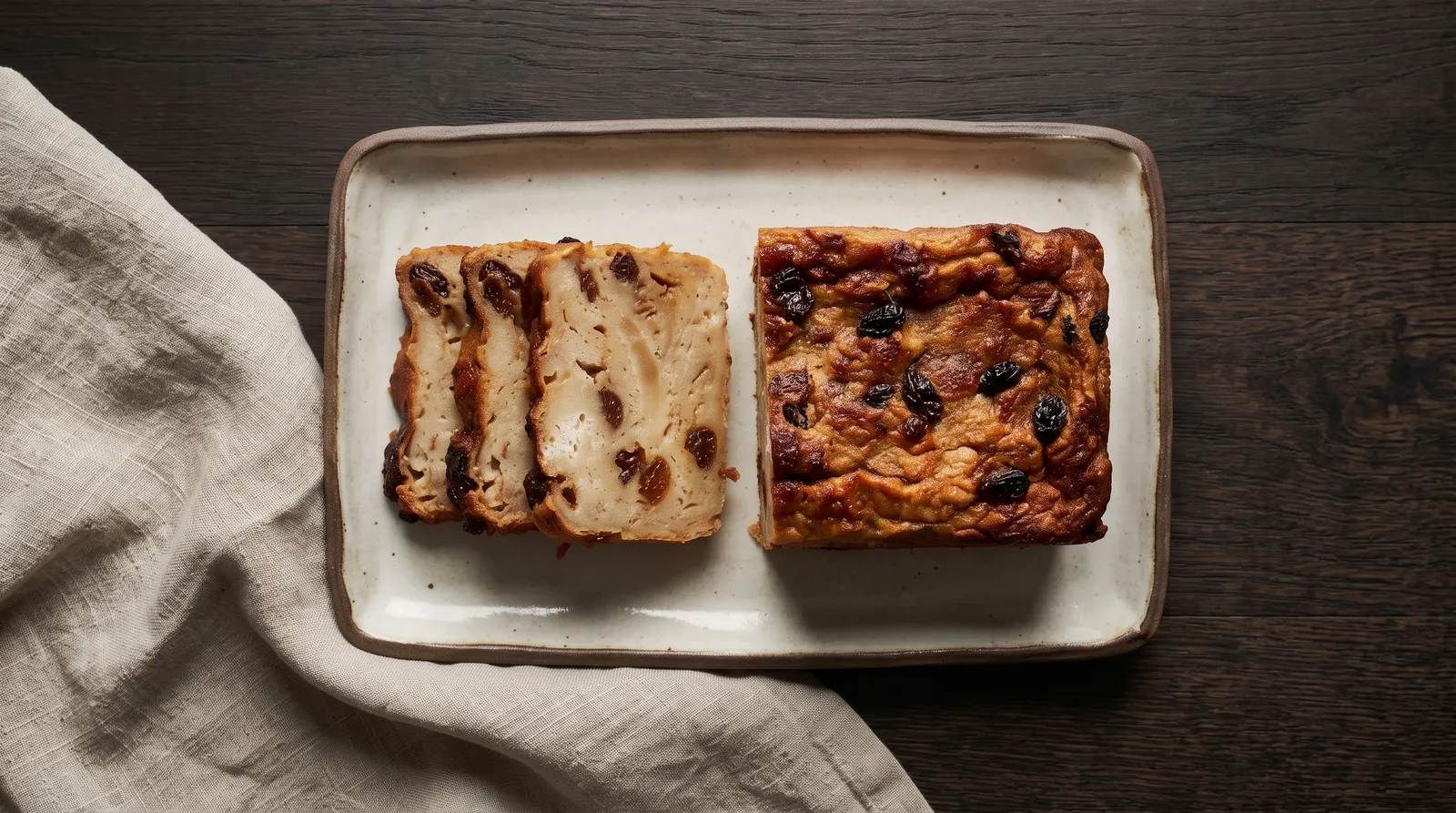
Pain d’chien — shown with a cut section visible
Prep 20 minutes
Cook 65 minutes
Total 235 minutes
Yield 1 loaf, 12 slices
Introduction and overview

Pain d’chien with vergeoise, raisins and rum

Pain d’chien is a northern French thrift pudding built to use stale bread, especially in Nord–Pas-de-Calais. Its texture is not that of British bread-and-butter pudding, where intact buttered slices remain visible. Here the bread is soaked until fully saturated and broken down into a dense, unified mixture before baking.

The sweetening comes from vergeoise, the soft brown beet sugar closely associated with northern French baking. Raisins and dark rum add the familiar fruit-and-spirit note in this household preparation. The raisins, bread and milk soak together for a full hour, so the fruit softens while the bread absorbs the sweetened liquid. The eggs are mixed through only after the soak, helping the pudding set without turning it into a light cake.

Bake the loaf at 180 °C until the centre reaches at least 71 °C and is set rather than wet. That temperature is a food-safety control for the egg-rich centre, not merely a texture cue. The loaf then needs a long cooling period because its dense crumb slices much more cleanly once fully cooled. Rum is not guaranteed to disappear during baking, so the finished pudding should not be presented as alcohol-free.
Success points

Success points

  • Use genuinely stale bread by dry weight so the milk is absorbed rather than leaving a loose custard.
  • Give the bread and raisins the full 60-minute soak before adding the eggs.
  • Check both set texture and a centre temperature of at least 71 °C.
  • Cool for 90 minutes before slicing.
Ingredients

Ingredients

  • 500 g stale white or country bread, dry weight, torn into pieces
  • 1000 ml whole milk
  • 150 g vergeoise brown sugar
  • 3 l arge shell eggs, about 150 g edible egg in total
  • 120 g raisins; check the package for sulphites
  • 60 ml dark rum
  • 20 g salted butter, softened, for the tin
Method

Method

Directions

  1. Sweeten the milk. Warm the milk and vergeoise over low heat for about 5 minutes, stirring until dissolved without boiling. The sugar is dissolved and the milk is hot but not boiling. Pour carefully to avoid steam burns.

  2. Soak bread and raisins. Tear the stale bread into a large bowl, add the warm sweetened milk, raisins and rum, press the bread into the liquid and leave for 60 minutes. The bread is fully saturated and can be broken into a dense coarse paste with a spoon. Keep the mixture covered during the soak.

  3. Add the eggs and prepare the tin. Beat the eggs, mix them evenly through the soaked bread in about 10 minutes, and butter a 23 × 13 cm loaf tin with the 20 g butter. The mixture is uniform, thick and spoonable with raisins distributed throughout.

  4. Bake until safely set. Transfer to the tin, level the surface and bake at 180 °C for 60 minutes. The centre reaches at least 71 °C and is set rather than wet. Check with a food thermometer and handle the hot tin with oven gloves.

  5. Cool before slicing. Leave the loaf to cool for 90 minutes, unmoulding onto a rack once stable. The loaf is completely cool and firm enough to cut into twelve clean dense slices.

Serving and make-ahead

Practical

Serving and make-ahead

Cut the fully cooled loaf into twelve substantial slices. It can be served at room temperature or lightly chilled. If planning ahead, the bread-and-milk mixture may soak under refrigeration; add the eggs shortly before baking rather than holding an egg-rich raw mixture unnecessarily.

Storage and reheating

Refrigerate leftovers within two hours, cover well and use within about three days. The pudding can be served cold or reheated gently until hot, but aggressive heating can dry the dense crumb. Do not leave the cooked loaf on the counter for prolonged storage.

Substitutions

A dark soft brown sugar can replace vergeoise if needed, though its molasses character may be stronger. Omitting the rum is the straightforward way to avoid alcohol, but it changes the rum-raisin profile. Do not claim that baking removes all alcohol.

Troubleshooting

Troubleshooting

  • The centre is wetThe loaf has not baked through. Continue baking and verify that the centre is set and reaches at least 71 °C.
  • Slices crumble or slumpThe pudding is still too warm. Complete the 90-minute cooling period so the dense crumb can stabilise.
Nutrition per serving

Nutrition per serving

  • Serving size1 of 12 dense pudding slices
  • Calories272 kcal
  • Carbohydrate44.9 g
  • Protein8.3 g
  • Fat6.7 g
  • Fibre1.5 g
  • Sodium270 mg
Allergens and food safety

Allergens and food safety

Allergens: egg, milk and wheat/gluten; raisins may contain sulphites depending on the product. Bake at 180 °C until the centre reaches at least 71 °C. Rum may retain alcohol after a 60-minute bake, so the pudding is not alcohol-free. Refrigerate leftovers within two hours. Check packaged raisins if sulphite avoidance is important.

FAQ

FAQ

How is pain d’chien different from bread-and-butter pudding?

The bread is completely soaked and mixed into a dense pudding mass rather than arranged as intact buttered slices in custard.

Does the rum all disappear in the oven?

No. Cooking reduces alcohol, but it does not justify promising complete evaporation. Anyone avoiding alcohol should use a rum-free preparation.

Closing

Closing

  • Result: Pain d’chien should cool into a dense, sliceable pudding with softened raisins and the caramel note of vergeoise.
  • Decisive technique: Soak the stale bread completely, then bake until the centre is both set and at least 71 °C before giving it time to cool.