French Recipes

Île flottante

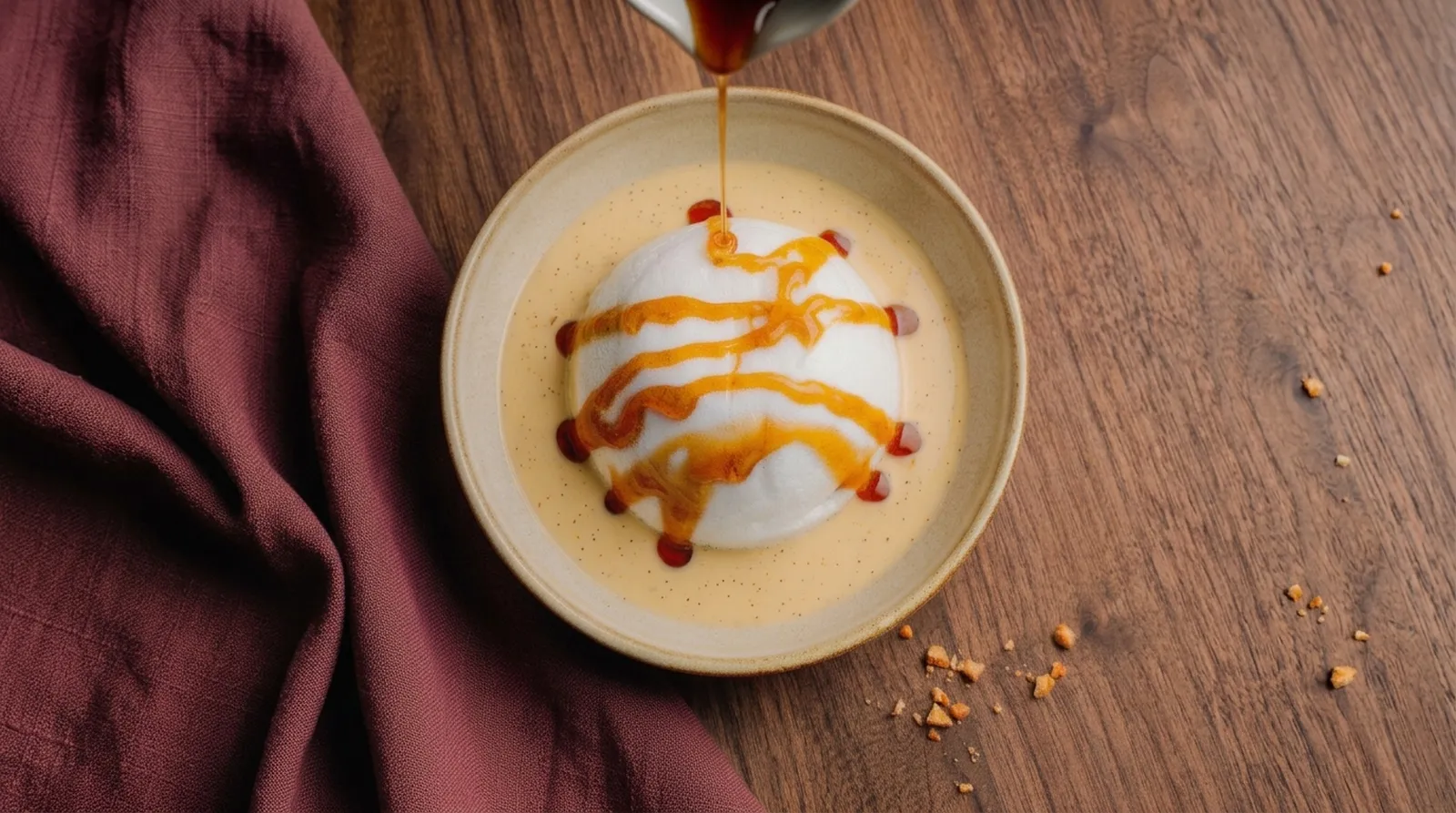
Soft poached meringue islands float on chilled vanilla crème anglaise and are finished with amber caramel, with pasteurized egg handling and measured temperature endpoints throughout.

French Recipes
Share
Île flottante — served in clear glassware
Prep 25 minutes
Cook 30 minutes
Total 210 minutes
Yield 12 meringue islands and about 700 ml custard
Introduction and overview

Île Flottante with Vanilla Crème Anglaise and Caramel

Île flottante combines three very different textures: fluid vanilla crème anglaise, soft meringue islands and a thin amber caramel. This household form poaches the meringue rather than baking one large island, yielding twelve small portions of foam so each serving receives two islands over the chilled custard.

Egg handling is central. Pasteurized eggs are separated by weight, and the yolks and whites are assigned to different components. The crème anglaise is cooked to 82 °C, hot enough to thicken and provide a clear temperature control while still staying below a boil that would curdle the custard. The meringue is poached gently and a test island reaches 71 °C at the centre.

Sugar is also divided deliberately. Eighty grams sweeten and thicken the custard, sixty grams stabilise the whites and forty grams become caramel. Keeping those allocations separate prevents the dessert from drifting sweeter or leaving the meringue unstable. Caramel is cooked last because hot sugar is easier to manage when the chilled custard and cooled islands are already ready for assembly.

Rapid cooling matters as much as careful heating. The crème anglaise first loses heat in a shallow bowl and then spends two hours under refrigeration at 4 °C or below. That counted chill is part of the real schedule, not hidden waiting time.
Success points

Success points

  • Use weighed pasteurized whites and yolks so the custard and meringue ratios stay repeatable.
  • Keep the crème anglaise below a boil and use 82 °C plus the spoon-coating cue as the endpoint.
  • Poach the islands gently and make caramel only after the chilled custard and cooled meringues are ready.
Ingredients

Ingredients

Crème anglaise

  • 110 g pasteurized egg yolks, about 6 large yolks, weighed
  • 600 ml whole milk, used first for poaching, then strained and reused for the custard — the full measured milk remains in the dessert apart from negligible pan residue
  • 80 g caster sugar, for the custard
  • 5 g vanilla paste, or seeds from the equivalent bean amount only if measured equivalently

Meringue islands

  • 180 g pasteurized egg whites, about 6 large whites, weighed
  • 60 g caster sugar, for the meringue

Caramel

  • 40 g caster sugar, for caramel
  • 30 ml water, for wet caramel
Method

Method

Directions

  1. Measure the components. Separate the pasteurized eggs by weight and measure 80 g sugar for the custard, 60 g for the meringue and 40 g for the caramel. The yolks, whites and three sugar portions are separate and accurately weighed.

  2. Whip the meringue. Whip the pasteurized whites until foamy, add the 60 g sugar gradually and continue until glossy peaks form. The meringue forms glossy peaks that stand upright but still look smooth rather than dry.

  3. Poach the islands gently. Heat the full 600 ml milk until it is steaming gently but not boiling. Shape 12 meringue islands and poach in 2 batches for about 5 minutes per batch, turning once. Each island is set on the surface, springy rather than wet, and a test island reaches 71 °C in the centre. Lift the islands out with a slotted spoon, then strain and reserve the warm milk for the custard.

  4. Cool the meringues. Set the poached islands on the lined tray for 15 minutes. The islands are cool enough to handle and no liquid is pooling around them. Refrigerate them once cool while the custard is prepared and chilled.

  5. Cook the crème anglaise. Whisk the yolks with 80 g sugar. Gradually whisk in the strained warm poaching milk, return everything to low heat and stir continuously for about 12 minutes. The custard reaches 82 °C and coats the back of a spoon in a thin, even film. Do not let it boil.

  6. Cool the custard promptly. Pour the custard into a shallow bowl and cool for 20 minutes, stirring occasionally. The custard is no longer steaming and has dropped well below its cooking temperature.

  7. Chill the custard. Cover and refrigerate the custard for 120 minutes at 4 °C or below. The custard is cold throughout and remains smooth after stirring.

  8. Make the caramel last. Cook 40 g sugar with 30 ml water over medium heat for about 8 minutes without stirring once dissolved. The caramel is clear amber rather than dark brown and flows in a thin thread from a spoon. Spoon the chilled custard into six dishes, add two meringue islands to each and drizzle with the caramel. Keep skin away from the hot syrup.

Serving

Practical

Serving

Serve each portion with roughly one sixth of the chilled custard, two meringue islands and one sixth of the caramel. The dessert should contrast cool, fluid custard with soft meringue and a thin caramel accent rather than a hard caramel shell.

Storage and reheating

Keep custard and poached meringues covered at 4 °C or below and use within 24 hours for best texture. Assemble shortly before serving. Caramel can soften on the moist meringue, so do not store fully assembled portions for long. Freezing is not recommended.

Make-ahead and substitutions

The crème anglaise can be made the day before and refrigerated after rapid cooling. The meringues can be poached several hours ahead and chilled separately. Make the caramel close to service. Pasteurized eggs are still treated conservatively because the dessert is chilled and handled after cooking.

Nutrition per serving

Nutrition per serving

  • Serving size1/6 custard, 2 meringue islands and caramel
  • Calories255 kcal
  • Carbohydrate39 g
  • Protein9 g
  • Fat7 g
  • Fibre0 g
  • Sodium120 mg
Allergens and food safety

Allergens and food safety

Egg and milk. Use pasteurized eggs, bring the custard to 82 °C without boiling and the poached meringue to 71 °C in a test island, cool the custard promptly, refrigerate at 4 °C or below, and keep total room-temperature holding under 2 hours. Steam and caramel syrup can cause serious burns.

Closing

Closing

  • Result: Soft poached meringue islands float on chilled vanilla crème anglaise and are finished with amber caramel, with pasteurized egg handling and measured temperature endpoints throughout.
  • Decisive technique: Use weighed pasteurized whites and yolks so the custard and meringue ratios stay repeatable.