French Recipes

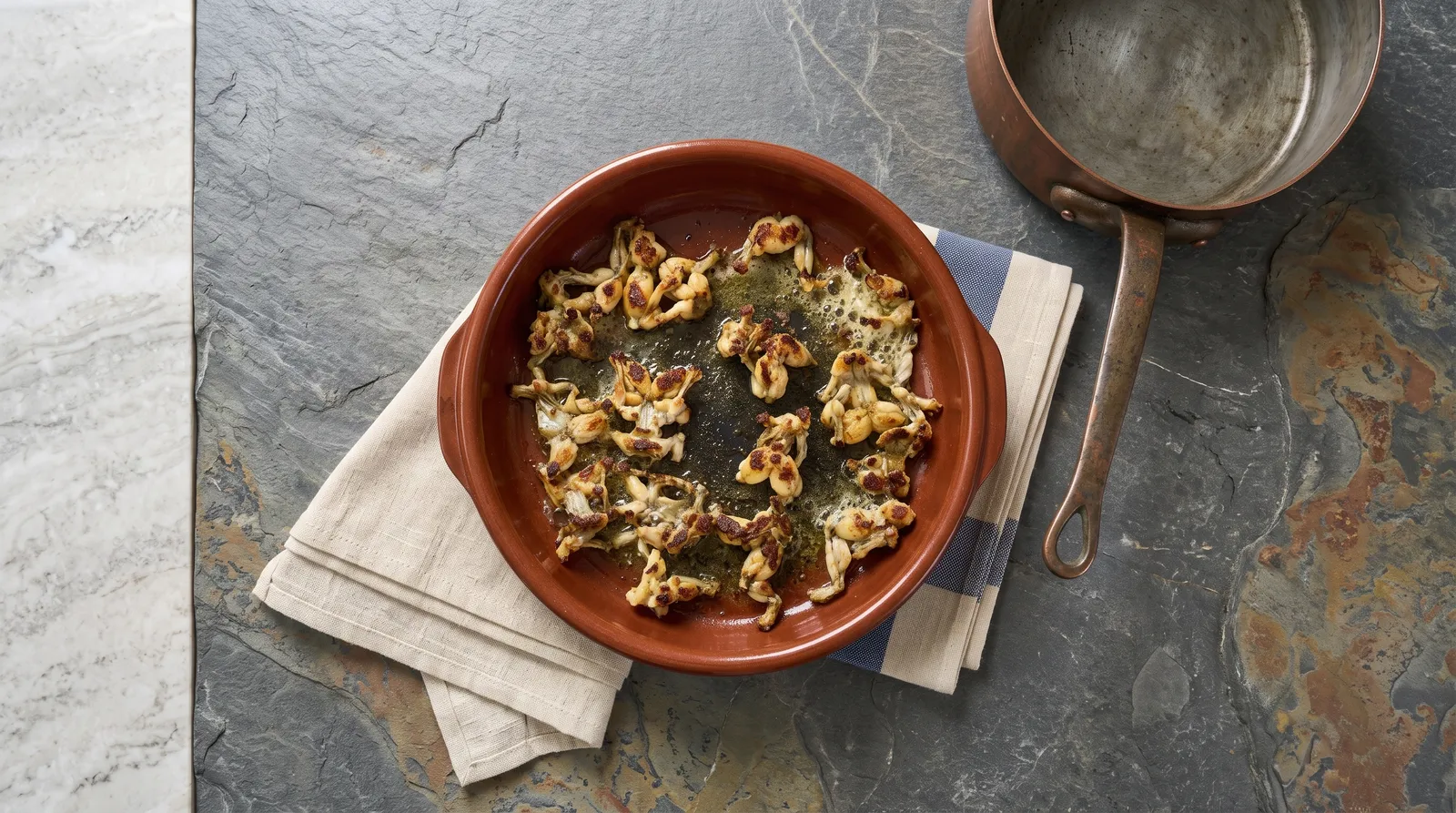
Grenouilles à la bressane

Commercially cleaned frog legs, thawed under refrigeration, lightly floured and browned in butter before a brief garlic-parsley cream finish.

French Recipes
Share
Grenouilles à la bressane — shown in a pan
Prep 20 minutes
Cook 21 minutes
Total 12 h 41 min (761 minutes)
Yield About 32 pairs of frog legs, 4 servings
Introduction and overview

Grenouilles à la bressane — butter-browned frog legs with garlic, parsley and cream

Frog legs are part of the food traditions around Bresse and the neighbouring Dombes, but the preparations are not all identical. Regional persillade versions rely on butter, flour, garlic and parsley; cream-finished household recipes also exist. This preparation keeps the Bresse-style butter-and-persillade framework and adds a restrained cream finish rather than presenting a Dombes persillade under a different name.

Start with a traceable, commercially cleaned frozen product. Eight hundred grams frozen should give about 720 g after slow refrigerator thawing and thorough drainage, roughly 32 pairs; that 720 g is the drained bone-in weight. For nutrition, the direct USDA frog-leg yield measure gives about 432 g cooked edible meat after cooking and bone removal from the 720 g drained bone-in weight. Drying matters: wet frog legs turn the flour pasty and make hot butter spit more violently. Use only a thin dusting of flour, then brown in two batches so the pan stays hot enough to colour rather than steam the meat.

After both batches are browned, return them to the pan with garlic, parsley and cream. The sauce should coat lightly, not become a heavy white gravy. More importantly, every thick portion must reach 74 °C on a food thermometer. Frog-leg colour is not an adequate safety test, and the many small bones should be mentioned clearly when the dish is served.
Success points

Success points

  • Thaw overnight in the refrigerator and dry the legs very thoroughly.
  • Use two uncrowded butter batches and only a light flour coating.
  • Finish the whole pan to 74 °C in the thickest portions.
Ingredients

Ingredients

  • 800 g commercially cleaned frozen frog legs — traceable retail product; After refrigerator thawing and thorough drainage, target about 720 g bone-in drained weight, approximately 32 pairs; estimated cooked bone-free edible meat for nutrition is about 432 g after cooking and bone removal.
  • 60 g plain wheat flour — for light coating; About 40 g estimated retained in the finished dish.
  • 100 g unsalted butter — for two pan batches; About 60 g estimated retained; visible leftover frying butter is discarded.
  • 15 g garlic — finely chopped
  • 30 g flat-leaf parsley — finely chopped
  • 150 ml full-fat cream — about 30% fat
  • 4 g fine salt
  • 1 g black pepper — freshly ground
Method

Method

Directions

  1. The frozen frog legs until fully thawed. Refrigerate the frozen frog legs until fully thawed. Use covered tray in refrigerator. Allow 720 minutes passive rest under refrigeration. The frog legs are fully thawed under refrigeration, still cold, and show no ice crystals in the thick joints. Slow cold thawing controls temperature and preserves texture. Use only legally sourced, traceable, commercially cleaned frog legs; keep them separate from ready-to-eat food.

  2. Thoroughly, pat dry and verify the thawed drained bone-in weight. Drain thoroughly, pat dry and verify the thawed drained bone-in weight. Use colander, paper towel and scale. Allow 10 minutes. The drained bone-in frog legs weigh about 720 g and their surfaces are dry enough that flour clings lightly rather than pasting. Dry surfaces reduce dangerous butter splatter and prevent a gummy coating. Wash hands and sanitise surfaces after raw frog-leg contact.

  3. Coat with 60 g flour and prepare the garlic-parsley mixture. Lightly coat with 60 g flour and prepare the garlic-parsley mixture. Use tray and bowl. Allow 10 minutes. The flour forms a very thin, even dusting and the garlic-parsley mixture is finely chopped. A light flour coat supports browning and modest sauce body without turning the dish into fried batter. Keep raw-coated frog legs away from the ready-to-eat parsley reserved for final sauce use.

  4. Cook the first batch. Brown the first half in 50 g butter, turning once. Use 28 cm sauté pan. Work at medium-high heat. Allow 8 minutes. The first batch is lightly browned on both sides without the butter smoking. Working in batches prevents steaming and crowding. Hot butter can spit; use long tongs and keep face and hands back.

  5. Cook the second batch. Brown the second half in the remaining 50 g butter. Use 28 cm sauté pan. Work at medium-high heat. Allow 8 minutes. The second batch is lightly browned on both sides without crowding the pan. A fresh butter charge supports even browning for the second batch. Discard visibly scorched or excessive leftover butter rather than pouring it into the sauce.

  6. All frog legs, add garlic, parsley and 150 ml cream, then cook through. Return all frog legs, add garlic, parsley and 150 ml cream, then cook through. Use 28 cm sauté pan. Work at medium-low heat. Allow 5 minutes. The cream lightly coats the frog legs, and every thick portion reaches 74 °C on a food thermometer. The short cream finish brings the batches together and completes cooking. Do not rely on colour; verify 74 °C in thick portions and beware steam from the cream.

Serving, storage and make-ahead

Practical

Serving, storage and make-ahead

Serve immediately while the cream is lightly coating and the frog legs are hot. Tell diners to expect numerous small bones. Bread, rice, potatoes or salad are separate accompaniments and are not included in the stated yield or nutrition.

Serving, storage and make-ahead

Refrigerate leftovers within two hours and use them within two days. Reheat gently until the thickest pieces reach 74 °C; avoid a hard boil, which can split the cream and toughen the delicate meat.

Serving, storage and make-ahead

If Beurre de Bresse AOP is unavailable, ordinary good unsalted cultured butter will function in the pan, but it does not preserve the protected Bresse butter identity. The substitution should be stated as practical rather than equivalent.

Nutrition per serving

Nutrition per serving

  • Serving size1 of 4 servings
  • Calories362 kcal
  • Carbohydrate10.6 g
  • Protein24.8 g
  • Fat24.0 g
  • Fibre0.7 g
  • Sodium490 mg
Allergens and food safety

Allergens and food safety

Allergens: Milk; Gluten (wheat).

Use only legally sourced, traceable, commercially cleaned frog legs; no wild processing.

Thaw under refrigeration and prevent cross-contamination.

Cook every thick portion to 74 °C and do not use colour as the safety test.

Refrigerate leftovers within two hours and reheat leftovers to 74 °C.

Warn diners about numerous small bones.

Closing

Closing

  • Result: lightly browned frog legs with a thin garlic-parsley cream coating, not a heavy batter or deep-fried crust.
  • Decisive technique: dry well, brown in uncrowded batches, discard excess frying fat and finish every thick portion to 74 °C.