French Recipes

Gratin dauphinois

A Dauphiné potato gratin made from raw, unwashed 2 mm slices baked slowly with garlic, whole milk and cream — with no cheese and no egg.

French Recipes
Share
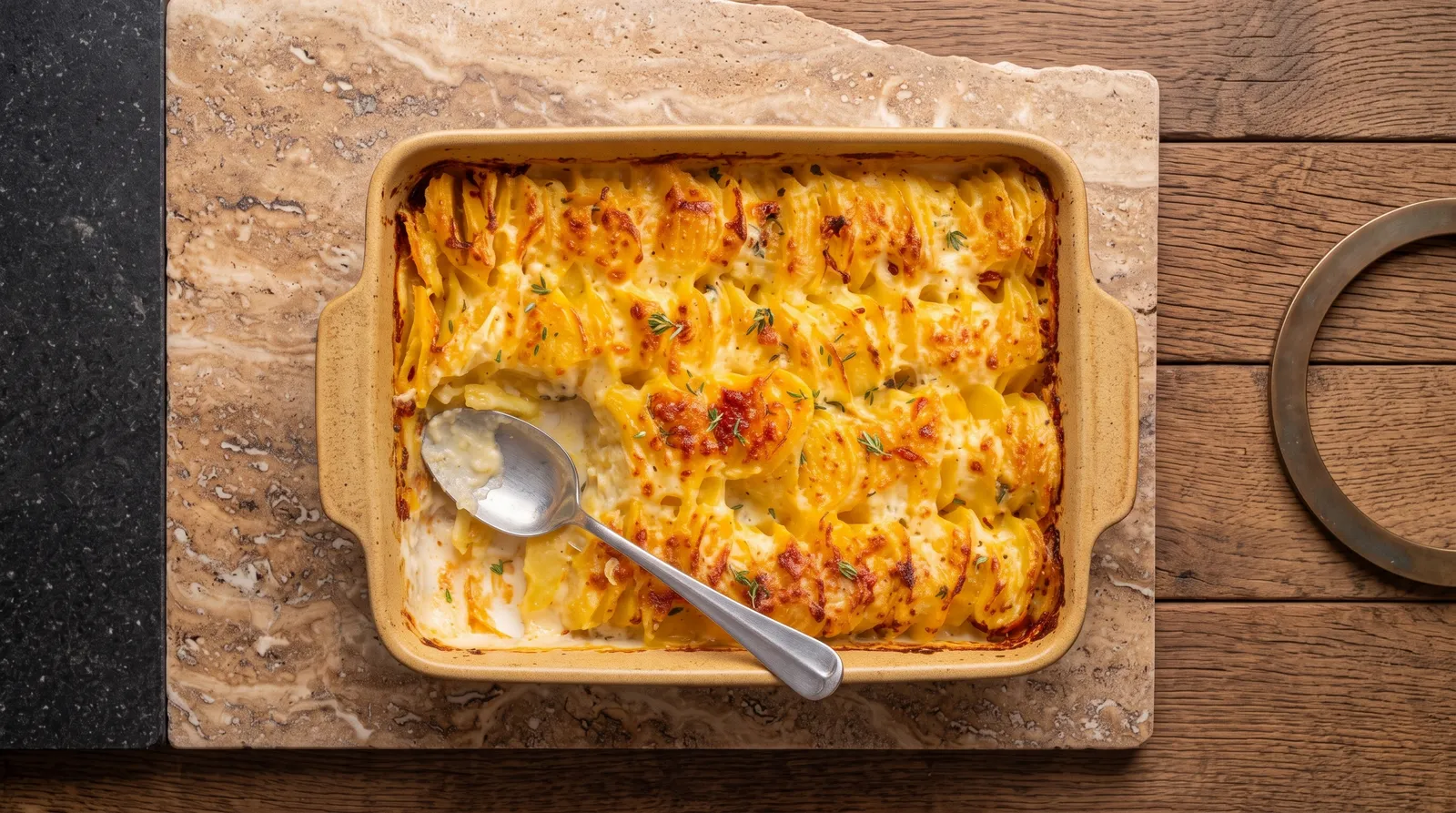
Gratin dauphinois — shown in an oven dish
Prep 35 minutes
Cook 90 minutes
Total 2 h 20 min (140 minutes)
Yield 1 gratin in a 30 × 20 × 6 cm dish, 6 servings
Introduction and overview

Gratin dauphinois — slow-baked potatoes with milk, cream and garlic

Gratin dauphinois is a potato-and-dairy dish from the Dauphiné whose identity is easily blurred by additions. In this preparation there is no cheese and no egg. Raw potatoes, garlic, whole milk, cream, butter, salt, pepper and a restrained amount of nutmeg are enough. The golden surface comes from slow reduction and browning of the dairy, not a layer of grated cheese.

The starch on the potato slices is useful, so once the potatoes are cut they are not rinsed. Use a guarded mandoline to make uniform 2 mm slices and lay them in compact overlapping layers. The 30 × 20 × 6 cm dish keeps the depth controlled; an unusually deep gratin may brown on top while the central layers remain firm.

A slow 90-minute bake at 160 °C gives the raw slices time to become tender while the milk, cream and starch thicken together. The gratin is ready when the dairy bubbles gently at the edges, the top is evenly golden and a knife slides through the middle without resistance. A 15-minute rest then lets the bubbling settle and the portions hold together.
Success points

Success points

  • Use a hand guard on the mandoline and keep every slice close to 2 mm.
  • Do not rinse the potato slices after cutting.
  • Judge the bake by centre tenderness as well as the golden top.
Ingredients

Ingredients

  • 1000 g potatoes — peeled edible weight from about 1,150 g purchased; Use a floury/all-purpose variety such as Monalisa; slice 2 mm thick and do not rinse after slicing.
  • 10 g garlic — about 2 cloves, halved
  • 20 g unsalted butter — for the dish
  • 500 ml whole milk — cold
  • 300 ml full-fat cream — about 30% fat, cold
  • 8 g fine salt
  • 1 g black pepper — finely ground
  • 0.5 g nutmeg — freshly grated
Method

Method

Directions

  1. And butter the baking dish and preheat the oven. Rub and butter the baking dish and preheat the oven. Use 30 × 20 × 6 cm baking dish. Allow 10 minutes. Keep the relevant temperature at 160 °C. The 30 × 20 × 6 cm baking dish is evenly buttered and rubbed with garlic, and the oven is fully heated to 160 °C. Garlic on the dish perfumes the dairy without adding a separate onion layer. Use oven gloves once the dish is hot.

  2. To exactly 1,000 g edible potato and slice uniformly with a guarded mandoline. Peel to exactly 1,000 g edible potato and slice uniformly with a guarded mandoline. Use mandoline with hand protector and scale. Allow 15 minutes. Exactly 1,000 g of peeled potato is cut into uniform 2 mm slices and the slices are not rinsed. Uniform thin slices cook together; retained surface starch helps bind the dairy. Always use the mandoline hand guard and stop before fingers approach the blade.

  3. The potatoes and add the milk, cream, salt, pepper and nutmeg. Layer the potatoes and add the milk, cream, salt, pepper and nutmeg. Use prepared baking dish. Allow 10 minutes. Keep the relevant temperature at cold dairy. The potatoes lie in compact overlapping layers and the milk-cream mixture reaches the upper layers without flooding the rim. Even layers and controlled depth support uniform tenderness. Keep milk and cream refrigerated until assembly and move the filled dish promptly to the oven.

  4. Slowly until tender and naturally gratinated. Bake slowly until tender and naturally gratinated. Use preheated oven. Work at 160 °C conventional oven. Allow 90 minutes. Keep the relevant temperature at 160 °C. The dairy bubbles gently at the edges, the top is evenly golden, and a knife slides through the centre without resistance. Slow baking cooks the raw slices while starch and dairy thicken together. Use oven gloves and watch for bubbling hot cream at the edges.

  5. The gratin before portioning. Rest the gratin before portioning. Use heatproof surface. Allow 15 minutes passive rest. The bubbling has settled and the gratin holds together when portioned without becoming dry. A short rest allows the starch-thickened dairy to settle. Keep the hot baking dish out of reach and refrigerate leftovers within two hours.

Serving, storage and make-ahead

Practical

Serving, storage and make-ahead

Serve the gratin hot after its 15-minute rest. It works as a side dish, but any roast, fish, salad or other accompaniment is outside the nutrition and yield given here.

Serving, storage and make-ahead

Keep the milk and cream refrigerated until assembly and put the filled dish into the oven promptly. Refrigerate leftovers within two hours and use them within three days.

Serving, storage and make-ahead

To reheat, cover the gratin and warm it at 160 °C until thoroughly hot, uncovering near the end only if the top needs to dry slightly. Cheese and egg are not shortcuts here; either addition changes the defining Dauphiné profile.

Nutrition per serving

Nutrition per serving

  • Serving size1 of 6 servings
  • Calories352 kcal
  • Carbohydrate35.4 g
  • Protein7.3 g
  • Fat20.6 g
  • Fibre3.8 g
  • Sodium586 mg
Allergens and food safety

Allergens and food safety

Allergens: Milk.

Use the mandoline only with its hand protector.

Keep milk and cream refrigerated until assembly.

Refrigerate leftovers within two hours and reheat thoroughly.

Closing

Closing

  • Result: tender layered potatoes in naturally thickened milk and cream, with a quiet garlic aroma and an evenly golden top.
  • Decisive technique: keep the 2 mm slices unwashed and bake slowly until a knife meets no resistance in the centre.