French Recipes

Gigot d’agneau à l’ail

A classic bone-in leg of lamb scented with garlic, browned in a hot oven and finished at moderate heat, with temperature rather than colour used to judge safety.

French Recipes
Share
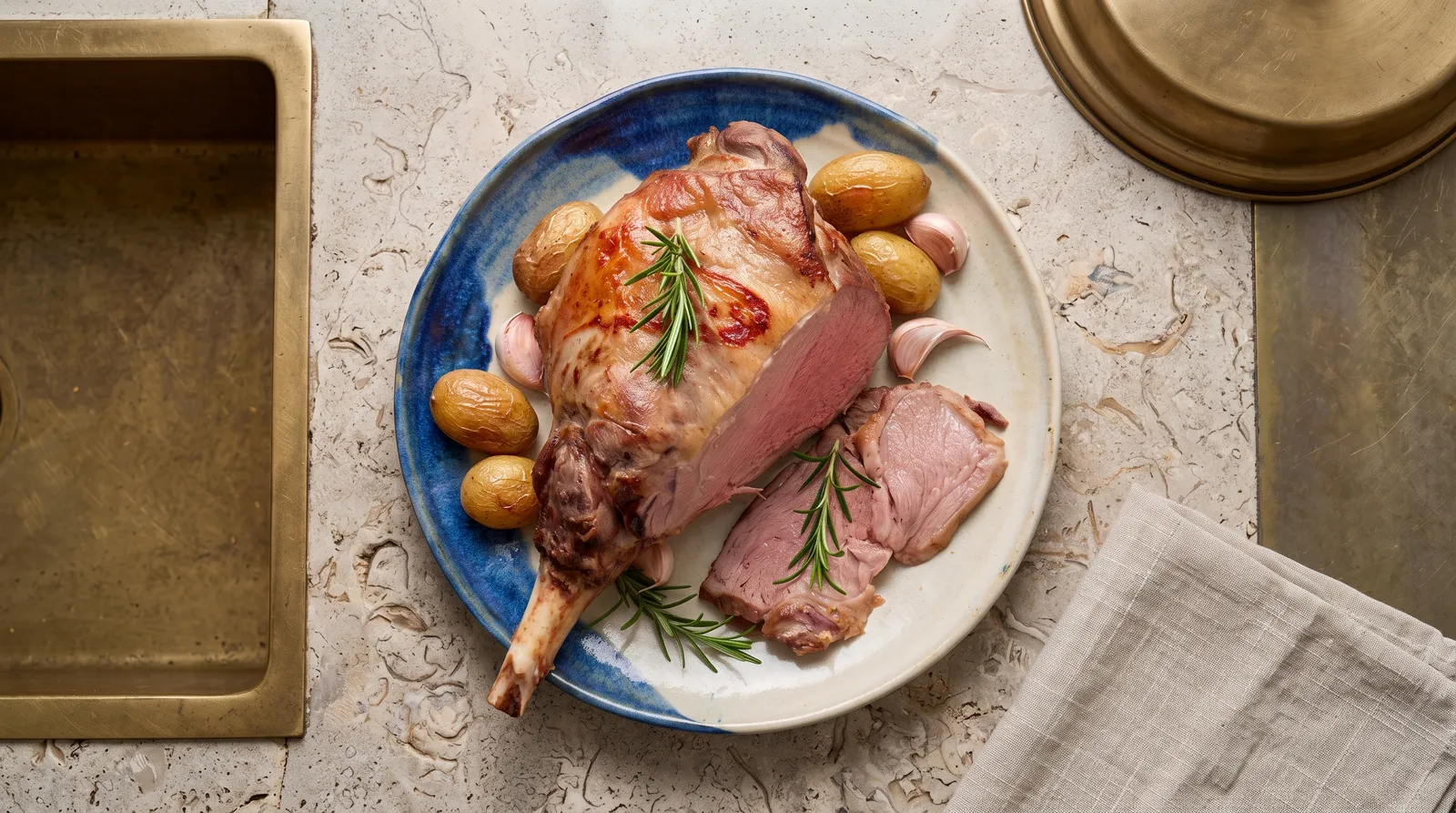
Gigot d’agneau à l’ail — arranged on a serving platter
Prep 30 minutes
Cook 80 minutes
Total 2 h 5 min (125 minutes)
Yield 8 main-course servings from 1 bone-in leg
Introduction and overview

Gigot d’agneau à l’ail — bone-in garlic roast lamb

Gigot d’agneau à l’ail is a direct French roast: a whole bone-in leg, garlic, a little olive oil, salt and pepper. The lamb is not boned, rolled or slow-cooked for seven hours, and it is not hidden under a heavy herb crust. The garlic goes into shallow surface slits so its aroma perfumes the roast without turning the meat into a deeply pierced, non-intact cut.

The oven starts at 220 °C for 15 minutes to establish browning, then drops to 180 °C for the main roast. Time gives a planning framework, but the endpoint is measured. Insert a calibrated probe into the thickest intact muscle and keep it away from the bone; the roast must reach at least 63 °C, followed by a rest of no less than three minutes. This recipe uses a 15-minute rest for both safety and better carving.

Colour is not a safety test. Lamb can remain pink at a safe temperature, and a browned exterior says very little about the centre. For vulnerable diners who need a more conservative endpoint, continue roasting to 71 °C before the rest. After resting, carve across the grain and keep side dishes separate from the measured roast and pan-juice nutrition.
Success points

Success points

  • Make only shallow garlic slits and keep the thickest centre intact for accurate probing.
  • Use the 220 °C stage for browning, then finish at 180 °C.
  • Rest 15 minutes before carving; do not cut immediately from the oven.
Ingredients

Ingredients

  • 2000 g bone-in leg of lamb — purchased weight; Trim to about 1,850 g raw ready-to-roast weight; expected cooked edible yield about 1,100 g.
  • 40 g garlic cloves — peeled and cut into short slivers
  • 15 g olive oil
  • 10 g fine salt
  • 2 g black pepper — freshly ground
Method

Method

Directions

  1. The lamb and make shallow clean slits for the garlic. Trim the lamb and make shallow clean slits for the garlic. Use board and small sharp knife. Allow 10 minutes. The garlic is tucked into shallow surface slits without piercing deeply into the centre of the leg. Shallow slits flavour the surface while keeping the main muscle intact for temperature measurement. Keep raw lamb juices away from cooked food and wash hands and tools after preparation.

  2. With 15 g olive oil, 10 g salt and 2 g pepper and preheat the oven with a rack set in the roasting pan. Rub with 15 g olive oil, 10 g salt and 2 g pepper and preheat the oven with a rack set in the roasting pan. Use roasting pan and rack. Allow 10 minutes. Keep the relevant temperature at 220 °C. The lamb is evenly coated with oil, salt and pepper, and the roasting rack is set over the pan. A rack exposes the surface to dry oven heat while drippings collect below. The roasting pan and rack become very hot.

  3. At high heat to begin browning. Roast at high heat to begin browning. Use preheated oven. Work at 220 °C conventional oven. Allow 15 minutes. Keep the relevant temperature at 220 °C. The exterior has begun to brown evenly without scorching the garlic. The short hot stage develops surface colour before the gentler main roast. Use oven gloves and avoid splashing hot drippings.

  4. The oven and roast to the safe endpoint. Lower the oven and roast to the safe endpoint. Use preheated oven. Work at 180 °C conventional oven. Allow 65 minutes. A calibrated probe in the thickest intact muscle away from bone reads at least 63 °C. Internal temperature determines safety more reliably than colour. For vulnerable diners who need a more conservative endpoint, continue roasting to 71 °C before resting.

  5. The lamb loosely tented before carving. Rest the lamb loosely tented before carving. Use warm board and foil. Allow 15 minutes passive rest. The lamb has rested at least 15 minutes, including the mandatory three-minute minimum, and the surface juices have settled before carving. Resting reduces juice loss and satisfies the minimum safety rest after 63 °C. Keep the hot bone and roasting pan away from bare hands.

  6. Across the grain and collect only the defatted natural pan juices intended for serving. Carve across the grain and collect only the defatted natural pan juices intended for serving. Use carving board and sharp slicing knife. Allow 10 minutes. The slices are cut across the grain, and the hot bone and roasting pan stay clear of hands and serving surfaces. Across-grain slicing improves tenderness. Do not reuse raw-meat boards or utensils for the cooked roast unless washed and sanitised.

Serving, storage and make-ahead

Practical

Serving, storage and make-ahead

Carve the rested gigot across the grain and spoon over only the defatted natural pan juices you actually want to serve. Potatoes, beans, vegetables and salads are accompaniments, not part of this recipe’s yield or nutrition.

Serving, storage and make-ahead

Refrigerate leftovers within two hours. For later service, slice only what you need and reheat leftovers to 74 °C so the rest of the roast is not repeatedly warmed and cooled.

Serving, storage and make-ahead

A boneless leg needs different timing and behaves differently during roasting, so it is not a direct substitution here. The bone-in form is part of the classic gigot presentation and of the yield calculation.

Nutrition per serving

Nutrition per serving

  • Serving size1 of 8 servings
  • Calories363 kcal
  • Carbohydrate1.8 g
  • Protein35.5 g
  • Fat23.3 g
  • Fibre0.2 g
  • Sodium592 mg
Allergens and food safety

Allergens and food safety

Allergens: No major allergen from the listed ingredients.

Prevent raw-lamb juices from contaminating cooked food.

Cook the thickest intact muscle away from bone to at least 63 °C and rest for at least 3 minutes.

For vulnerable diners, a higher 71 °C endpoint is a more conservative option.

Refrigerate leftovers within two hours and reheat leftovers to 74 °C.

Closing

Closing

  • Result: browned garlic-scented lamb with juicy slices after a full rest and clean across-grain carving.
  • Decisive technique: use a calibrated probe for at least 63 °C in the thickest intact muscle, then rest the roast before cutting.