French Recipes

Galettes de Pont-Aven

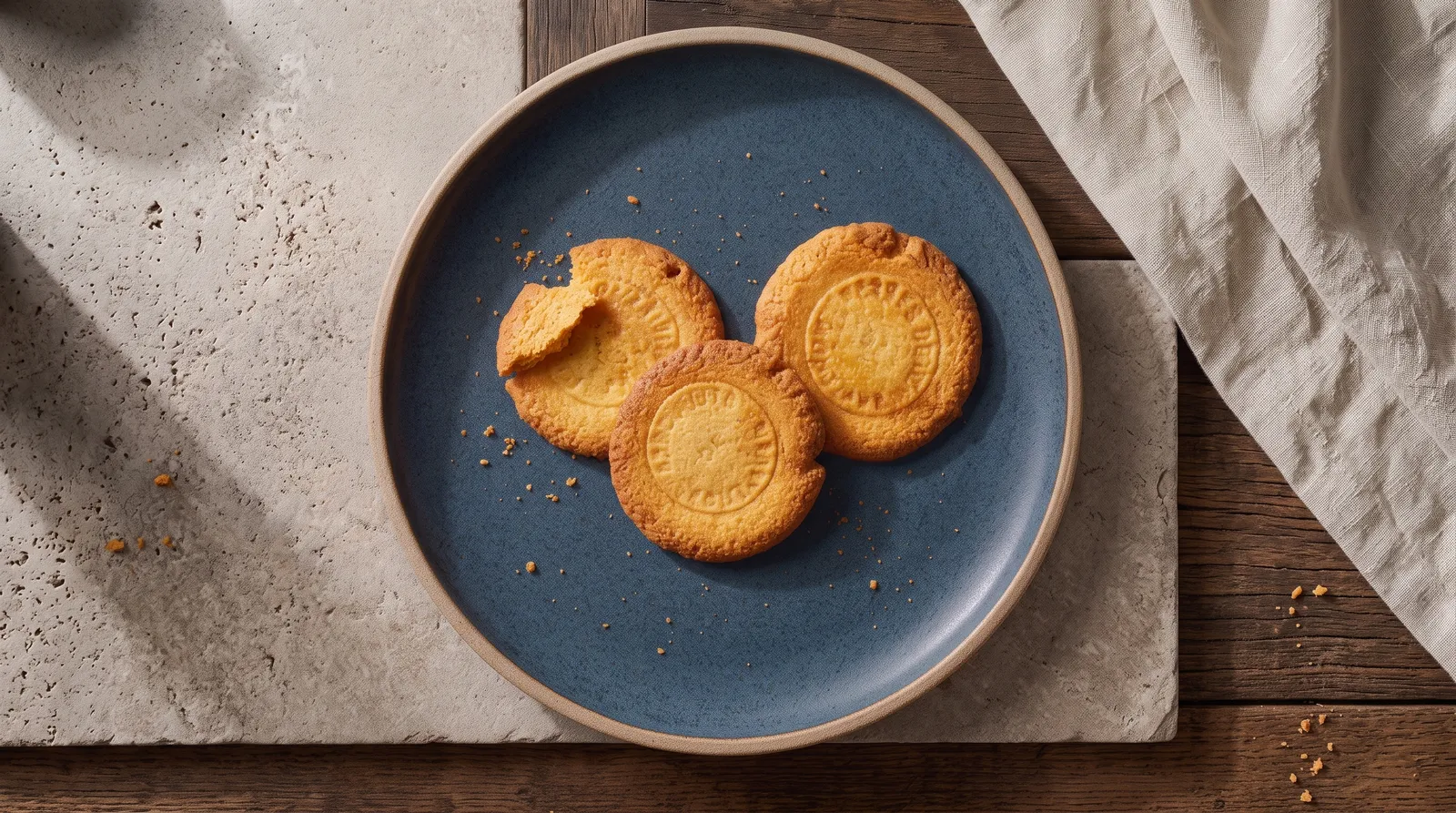
Thin, round and crisp butter biscuits associated with Pont-Aven, rolled to about 3 mm and baked until the edges are golden and the centres are dry.

French Recipes
Share
Galettes de Pont-Aven — several baked pastries on display
Prep 35 minutes
Cook 24 minutes
Total 149 minutes
Yield 30 biscuits, about 6 cm diameter
About the dish

Galettes de Pont-Aven — thin Breton butter biscuits

Galettes de Pont-Aven are butter-rich biscuits associated with the Breton town of Pont-Aven and its long-established biscuit tradition. Here, “galette” means a thin round biscuit, not a buckwheat crêpe. The form is also distinct from the thicker Breton palet: these biscuits are rolled fine, cut neatly and baked to a dry, crisp finish.

The dough is deliberately simple: wheat flour, salted butter, caster sugar and egg. Salted butter supplies both fat and seasoning, so no extra salt is added. The butter should be soft enough to mix but never melted; once the flour goes in, work only until a cohesive dough forms. A full hour of chilling firms the butter and makes the 3 mm rolling thickness easier to control.

Uniform thickness is more important than speed. Cut 6 cm rounds, reroll the scraps so the declared yield remains 30 biscuits, and leave enough space around each piece for even heat. Two sequential trays are baked at 180 °C. The biscuits are ready when the rims are clearly golden and the centres look dry; their final crispness develops as they cool completely on a rack.
Success points

Success points

  • Stop mixing as soon as the flour disappears.
  • Roll to an even 3 mm; thicker pieces behave more like palets and bake unevenly.
  • Reroll scraps without adding excess flour so the declared 30 biscuits are actually produced.
  • Judge crispness after full cooling, not while the biscuits are still hot and flexible.
Ingredients

Ingredients

  • 250 g plain wheat flour — sifted
  • 125 g salted butter — softened but not melted
  • 105 g caster sugar
  • 70 g egg — beaten
Method

Method

Dough

  1. Cream the butter and sugar, then mix in the egg and flour. Beat the 125 g softened salted butter with the 105 g sugar until evenly combined. Mix in the 70 g beaten egg, then add the 250 g sifted flour and stop mixing as soon as a cohesive dough forms. The dough is smooth and cohesive with no dry flour, but it is not elastic from prolonged mixing. Minimal mixing after the flour goes in limits gluten development and keeps the biscuit tender-crisp. The dough contains raw egg and flour.

  2. Chill the dough. Flatten the dough into a covered parcel and refrigerate for 60 minutes at 4 °C. The dough is firm enough to roll cleanly without sticking or smearing butter. Cold dough rolls evenly and holds the cut shape. Keep at 4 °C or below during the chill.

Shape and bake

  1. Roll, cut and reroll all scraps. Roll the chilled dough evenly to 3 mm. Cut 6 cm rounds, place them with space between on the lined trays and reroll the scraps until the full dough gives 30 complete biscuits. The dough is an even 3 mm thick and yields 30 complete 6 cm rounds after rerolling scraps. Even thickness is essential for a uniformly crisp bake. Do not eat raw dough.

  2. Bake the biscuits in two sequential trays. Bake one tray at a time at 180 °C for about 12 minutes. Repeat with the second tray for a 24-minute total oven schedule. The biscuit edges are golden, the centres look dry rather than glossy, and the underside is evenly baked. Thin rounds brown quickly; sequential trays make the timing reproducible in a domestic oven. Repeat with the remaining tray for a 24-minute total bake schedule.

  3. Cool until crisp. Move the biscuits to a wire rack and leave them for 30 minutes without covering. The biscuits are completely cool and the centre snaps cleanly rather than bending. Residual steam must escape before storage or the biscuits soften. Store only once fully cool.

Serving, storage and make-ahead

Practical

Serving, storage and make-ahead

If the biscuits spread, the butter was probably too warm; chill cut rounds briefly before baking.

Serving, storage and make-ahead

If centres remain chewy after cooling, roll more evenly or extend the bake by 1–2 minutes without darkening the edges excessively.

Nutrition per serving

Nutrition per serving

  • Serving size1 biscuit (1/30 of batch)
  • Calories78 kcal
  • Carbohydrate10 g
  • Protein1.2 g
  • Fat3.7 g
  • Fibre0.2 g
  • Sodium30 mg
Allergens and food safety

Allergens and food safety

Allergens: Gluten (wheat); Milk; Egg.

Raw flour and raw egg are not ready-to-eat; bake the biscuits fully.

Cool completely before airtight storage to prevent trapped steam and loss of crispness.

Closing

Closing

  • Result: Thin, round and crisp butter biscuits associated with Pont-Aven, rolled to about 3 mm and baked until the edges are golden and the centres are dry.
  • Decisive technique: Stop mixing as soon as the flour disappears.