French Recipes

Galette des rois à la frangipane

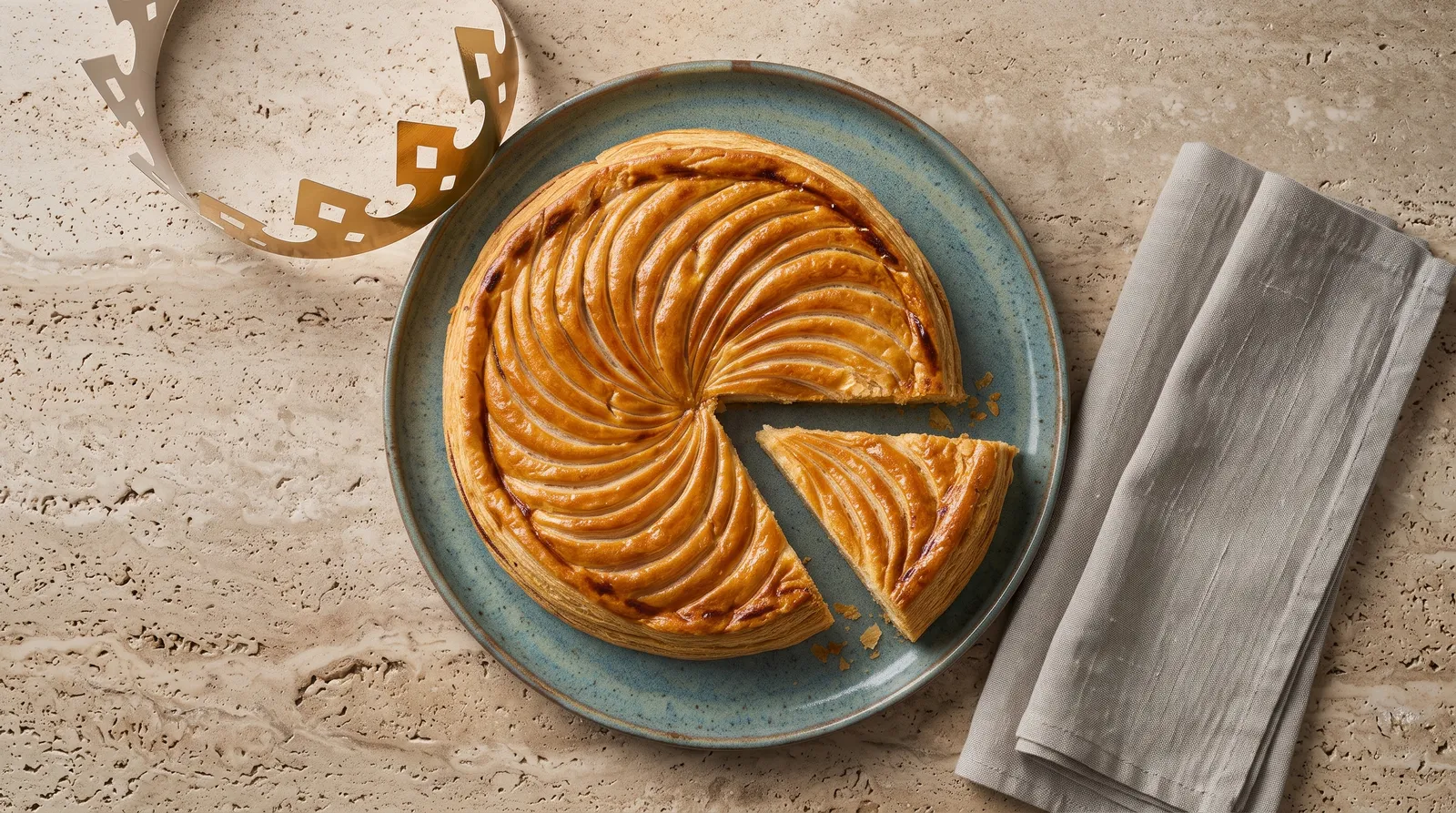
A 24 cm northern French Epiphany galette made with two crisp all-butter puff-pastry discs and a cooked frangipane filling that combines almond cream with pastry cream.

French Recipes
Share
Galette des rois à la frangipane — shown with a cut section visible
Prep 50 minutes
Cook 35 minutes
Total 205 minutes
Yield 1 galette, 24 cm diameter, 8 slices
About the dish

Galette des rois à la frangipane — all-butter puff pastry with true frangipane

Galette des rois à la frangipane is the puff-pastry form associated with Epiphany in much of northern France. Its character comes from the contrast between a deeply golden, flaky shell and a soft almond filling held inside two sealed pastry discs. This is not the southern brioche crown, and it is not an open almond tart: the enclosed puff-pastry construction is central to the dish.

The filling is true frangipane rather than plain crème d’amande. First make a small pastry cream and chill it thoroughly; separately make the almond cream; then combine about two parts finished almond cream with one part finished pastry cream. That distinction matters because pastry cream changes both the texture and the moisture balance of the filling. A restrained filling layer also helps the centre cook without compressing the puff pastry.

Cold handling is as important as the ingredient list. The pastry must stay firm while it is cut, filled and sealed, the edge must remain free of filling, and the assembled galette needs a final chill before baking. The oven starts hot to encourage lift and then drops to finish the centre without over-colouring the surface. A hidden fève is omitted here because it can cause choking or dental injury; the galette itself remains fully recognisable without it.
Success points

Success points

  • Keep both pastry discs cold and equally thick.
  • Use finished pastry cream at 4 °C or below before combining with almond cream.
  • Leave a 3 cm clean sealing margin and keep the filling at or below about 2 cm thick.
  • Vent the lid and score only the surface so steam can escape without cutting through the pastry.
Ingredients

Ingredients

Puff pastry and finish

  • 500 g all-butter puff pastry — refrigerated, two sheets with 500 g usable pastry after trimming
  • 25 g whole egg — beaten, for egg wash

Crème d’amande

  • 75 g unsalted butter — softened but cool
  • 75 g caster sugar
  • 75 g ground almonds
  • 75 g whole egg — beaten

Pastry cream

  • 100 ml whole milk — cold
  • 25 g egg yolk
  • 25 g caster sugar
  • 10 g plain wheat flour — sifted
  • 2 g vanilla extract
Method

Method

Pastry cream

  1. Cook the pastry cream. Whisk the 25 g egg yolk with 25 g sugar and 10 g flour. Heat the 100 ml milk, whisk it gradually into the yolk mixture, return everything to the saucepan and cook over medium heat, stirring continuously, until the custard reaches 82 °C. The pastry cream is thick enough to hold clear whisk trails and reaches 82 °C. Cooking the flour removes a raw taste and gives the custard enough body for a sealed galette. Stir continuously; use a clean thermometer and do not leave egg custard unattended.

  2. Cool and refrigerate the pastry cream. Scrape the hot custard into a shallow tray, cover the surface directly and cool it quickly. Refrigerate until it is 4 °C or below before it touches the almond cream. The pastry cream is cold throughout and has reached 4 °C or below. Cold custard will not melt the butter in the almond cream or soften the puff pastry. Spread in a shallow layer, cover the surface, and refrigerate promptly; keep at 4 °C or below.

Frangipane and assembly

  1. Mix the almond cream and fold in the cold pastry cream. Beat the 75 g softened butter with 75 g sugar, work in 75 g ground almonds, then add 75 g beaten egg in stages. Weigh 150 g of the cold pastry cream and fold it through the 300 g almond cream until uniform. The frangipane is smooth, thick and evenly blended with no streaks of pastry cream. The 300 g almond cream and 150 g finished pastry cream give a 2:1 frangipane ratio. Keep the filling cool and return it to the refrigerator if the kitchen is warm.

  2. Assemble and seal the galette. Cut two 24 cm discs from the 500 g cold puff pastry. Put one disc on the lined sheet, spread the frangipane into a 17 cm circle, brush the clean margin lightly with some of the 25 g beaten egg and cover with the second disc. Press out trapped air and seal the rim. The filling forms an even disc about 17 cm across and no more than about 2 cm thick, leaving a clean 3 cm sealing margin. A clean margin and even thickness reduce leakage and help the centre bake through. Keep the pastry cold; do not trap a hidden fève in the galette for children or anyone who may not expect it.

  3. Score, vent and chill the assembled galette. Brush the lid with the remaining egg, score a shallow decorative pattern without cutting through and make a small steam vent. Refrigerate the assembled galette for 30 minutes at 4 °C or below. The top is evenly egg-washed, lightly scored without cutting through, vented, and the pastry feels firm after chilling. Chilling sets the seal and firms the fat layers before baking. Keep the assembled galette refrigerated at 4 °C or below until it goes into the oven.

Bake and cool

  1. Bake with a hot start and a lower finish. Bake for 10 minutes at 200 °C, then lower the oven to 170 °C and bake for another 20 minutes. Keep the galette flat on the hot sheet so the base has enough heat to crisp. The galette is deeply golden, the puff pastry is crisp at the base and sides, and the centre is fully baked rather than doughy. The hot start lifts the pastry; the lower finish cooks the centre without scorching the surface. Bake 10 minutes at 200 °C, then 20 minutes at 170 °C.

  2. Cool before slicing. Transfer the galette to a wire rack and leave it undisturbed for 30 minutes before cutting. The galette has settled for 30 minutes and the filling no longer flows when a slice is cut. Cooling lets the frangipane set and protects the crisp layers from steam. Serve the same day for best pastry quality; refrigerate leftovers within 2 hours.

Serving, storage and make-ahead

Practical

Serving, storage and make-ahead

If the seam opens, the pastry was likely warm or the edge contaminated with filling; keep the next assembly colder and leave a cleaner margin.

Serving, storage and make-ahead

If the base is pale, bake on a fully preheated metal sheet and allow the lower-temperature stage to finish before removing the galette.

Nutrition per serving

Nutrition per serving

  • Serving size1 slice (1/8 of 24 cm galette)
  • Calories450 kcal
  • Carbohydrate42 g
  • Protein8 g
  • Fat29 g
  • Fibre2 g
  • Sodium279 mg
Allergens and food safety

Allergens and food safety

Allergens: Gluten (wheat); Milk; Egg; Tree nut (almond).

Keep pastry cream and the assembled galette at 4 °C or below.

Cook the pastry cream to 82 °C and cool it rapidly in a shallow container.

Refrigerate leftovers within 2 hours.

A hidden fève can cause choking or dental injury; it is omitted here. If a household uses one, it must be purpose-made and food-safe, kept away from the centre, disclosed to every diner and never hidden for a young child.

Closing

Closing

  • Result: A 24 cm northern French Epiphany galette made with two crisp all-butter puff-pastry discs and a cooked frangipane filling that combines almond cream with pastry cream.
  • Decisive technique: Keep both pastry discs cold and equally thick.