French Recipes

Fénétra

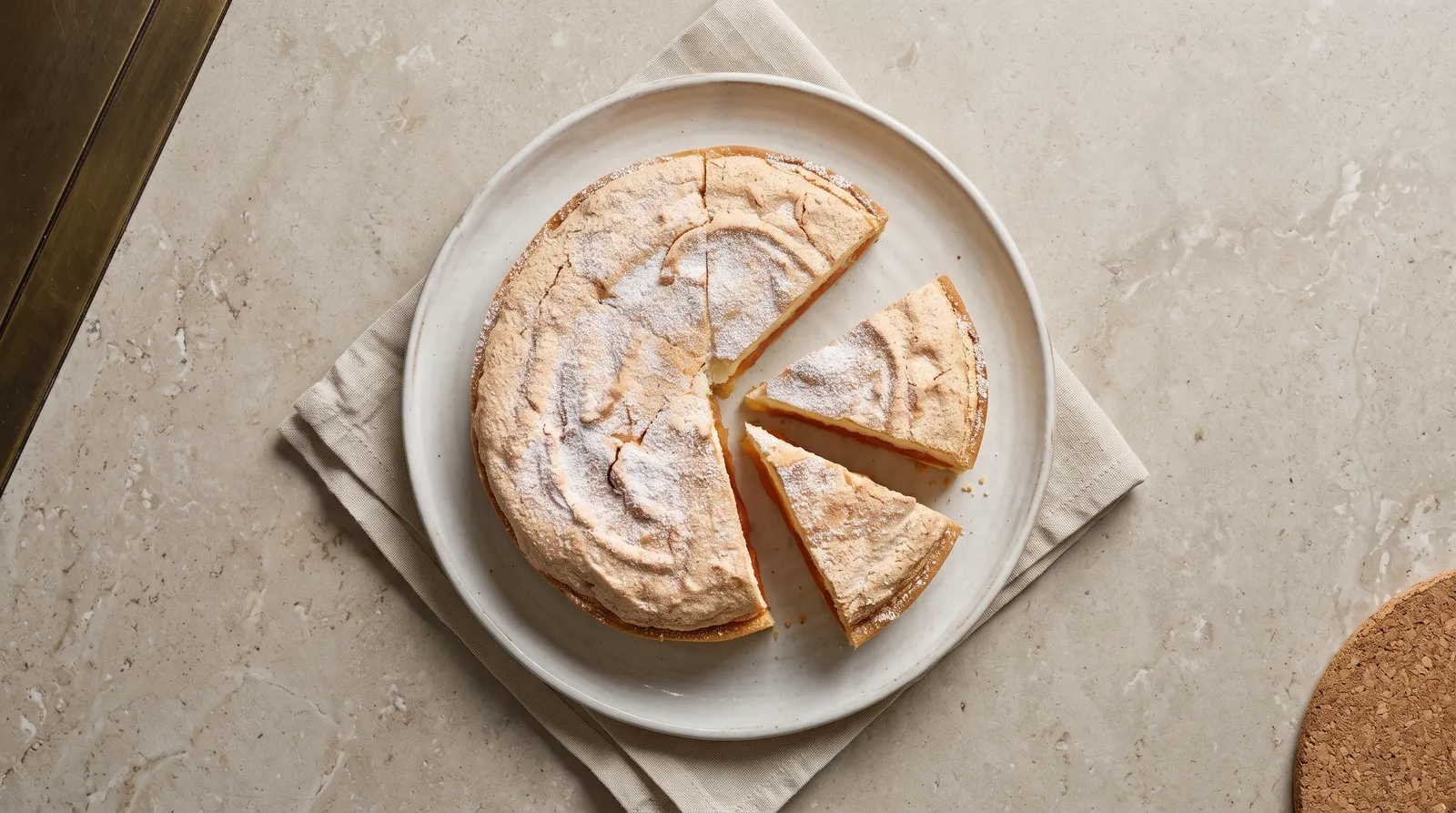
A Toulousain three-layer travel cake with a lemon-scented sablé base, a thin apricot-and-candied-lemon layer and a fully baked almond succès topping.

French Recipes
Share
Fénétra — shown with a cut section visible
Prep 40 minutes
Cook 30 minutes
Total 220 minutes
Yield 1 × 26 cm tart, cut into 10 slices
Overview

Fénétra — Toulouse apricot, candied lemon and almond travel cake

Fénétra is a Toulouse travel cake with a very specific architecture. A sablé pastry base carries a restrained apricot layer dotted with candied lemon, and an airy almond succès or dacquoise-style topping finishes the cake. Those three layers are the identity: replacing the almond top with lemon curd, pastry cream or an unrelated meringue would produce a different tart even if the flavours remained pleasant.

The sablé should be tender rather than bready. Cream soft butter with sugar and lemon zest, add the yolks, then mix in flour only until the dough holds together. A full hour in the refrigerator firms the butter so the dough can be rolled to an even 3 mm sheet without smearing or shrinking excessively. The 26 cm ring keeps the cake comparatively low, in line with a travel cake rather than a deep filled tart.

The fruit layer is deliberately thin. Apricot jam supplies acidity and fruit body, while measured 5 mm pieces of candied lemon give occasional concentrated citrus. Above it, egg whites are whipped to firm glossy peaks before almond powder and flour are folded in. That aeration is what creates a light, tender top instead of a dense almond paste.

Everything is baked together at 180 °C. The decisive cue is not simply browning: the exposed sablé edge must be golden and the almond surface must be dry and lightly crisp while remaining tender below. Ninety minutes of rack cooling then sets the layers for clean slices and protects the sablé from steam trapped by early wrapping.
Success points

Success points

  • Stop mixing the sablé as soon as the flour disappears; overworking makes the base tough.
  • Keep the apricot and candied-lemon layer thin so it supports rather than overwhelms the almond top.
  • Fold the almond powder and flour gently into glossy egg whites to preserve volume, then bake the topping fully.
Ingredients

Ingredients

Pâte sablée

  • 200 g plain wheat flour — All retained.
  • 100 g unsalted butter, soft — All retained.
  • 100 g caster sugar — All retained.
  • 40 g egg yolk, about 2 large yolks — All retained.
  • 1 g fine salt — All retained.
  • 4 g finely grated untreated lemon zest — All retained.

Fruit layer

  • 150 g apricot jam, smooth, with no large fruit chunks — All retained.
  • 40 g candied lemon peel, cut into 5 mm dice — All retained; check the label for sulphites.

Almond succès

  • 120 g egg white, about 4 large whites — All retained and fully baked.
  • 100 g caster sugar — All retained.
  • 100 g almond powder — All retained.
  • 30 g plain wheat flour — All retained.
  • 15 g icing sugar, for the surface before baking — All retained.
Method

Method

Directions

  1. Make the sablé dough. Cream the butter, 100 g caster sugar, salt and lemon zest until smooth. Mix in the yolks, then add 200 g flour and stop as soon as a cohesive dough forms. Time: 10 minutes. The dough is cohesive and soft with no visible dry flour, but it has not been overworked.

  2. Chill the pastry. Flatten the dough into a disc, wrap it and refrigerate for 60 minutes. Time: 60 minutes chilling. Temperature: 4 °C or below. The dough is firm enough to roll cleanly without smearing butter.

  3. Line the tart ring. Roll the dough to about 3 mm thick and line a 26 cm tart ring or shallow fluted tin, trimming the rim neatly. Time: 12 minutes. The pastry is an even 3 mm thick with tidy sides and no torn patches.

  4. Add the fruit layer. Spread the 150 g apricot jam in a thin even layer over the pastry and scatter the 40 g candied lemon peel evenly over it. Time: 3 minutes. The fruit layer is thin and level, with small candied-lemon pieces distributed across the whole base.

  5. Whip the whites. Whip the egg whites to soft peaks, then add the 100 g caster sugar gradually and continue to firm, glossy peaks. Time: 6 minutes. The meringue is glossy and holds a firm peak without looking dry or grainy.

  6. Fold the almond mixture. Combine almond powder with 30 g flour and fold it gently into the whipped whites in two additions. Time: 4 minutes. The almond mixture is evenly incorporated and remains visibly aerated rather than collapsing into a dense paste.

  7. Cover the tart. Spread the almond mixture over the fruit layer, level it without compressing, and dust with the 15 g icing sugar. Time: 3 minutes. The top forms one continuous airy layer and the fruit layer is no longer exposed.

  8. Bake the Fénétra. Heat the oven to 180 °C and bake for 28–30 minutes. Time: 30 minutes. Temperature: 180 °C. A full bake sets both the pastry base and the egg-white almond layer. The egg-white topping is fully baked; no raw-egg holding step remains. The exposed sablé edge is golden, and the almond top is dry, lightly crisp at the surface and tender underneath.

  9. Cool completely. Transfer the tart in its ring to a rack for 30 minutes, then remove the ring and cool for another 60 minutes before cutting. Time: 90 minutes cooling. The tart is fully cool, the sablé is firm, and the almond top cuts without sticking to the knife.

Practical guidance

Practical

Practical guidance

Cut the fully cooled cake into 10 slices with a clean serrated knife. A thin slice shows all three layers clearly and suits the rich almond-and-butter structure.

Practical guidance

For make-ahead, bake one day before serving and wrap only after it is completely cool. At a moderate room temperature it keeps well for several days as a travel-style cake.

Practical guidance

Do not reheat. Heat softens the sablé and the thin crisp surface of the almond layer.

Practical guidance

A thick apricot preserve may replace another thick apricot jam, but avoid runny fruit purée. Check candied lemon and jam labels for sulphites before deciding the allergen statement.

Troubleshooting

Pastry shrinks or toughens — it was overworked or insufficiently chilled; mix minimally and keep the full 60-minute chill.

Troubleshooting

Almond top turns dense — the whites were under-whipped or the dry ingredients were stirred too aggressively; fold gently into firm glossy peaks.

Troubleshooting

Fruit leaks through the top — the jam layer was too thick or too fluid; use a thin, smooth layer and dice the candied peel small.

Nutrition per serving

Nutrition per serving

  • Serving size1 slice, 1/10 tart
  • Calories369 kcal
  • Carbohydrate54 g
  • Protein7 g
  • Fat15 g
  • Fibre2 g
  • Sodium66 mg
Allergens and food safety

Allergens and food safety

Allergens: Egg; Milk; Gluten (wheat); Tree nuts (almond); Sulphites if declared on the apricot jam or candied lemon peel

Use clean equipment for the egg whites and bake the almond topping completely; no unbaked egg-white centre should remain.

If preserved apricot or candied lemon is labelled with sulphites, declare sulphites as an allergen.

FAQ

FAQ

Why is the almond top not called ordinary meringue?

It contains almond powder and flour folded into whipped egg whites, giving the baked succès/dacquoise character associated with Fénétra.

Can fresh apricots replace the jam?

Not here. Fresh fruit releases water and turns the defined thin preserve layer into a different tart structure.

Closing

Closing

  • Result: a low, clean-cut Toulouse travel cake with crisp-tender sablé, a bright apricot-lemon seam and an airy almond top.
  • Decisive technique: preserve air in the egg whites while folding the almond mixture, then bake until the top is dry and the pastry edge is golden.