French Recipes

Blanc-manger coco

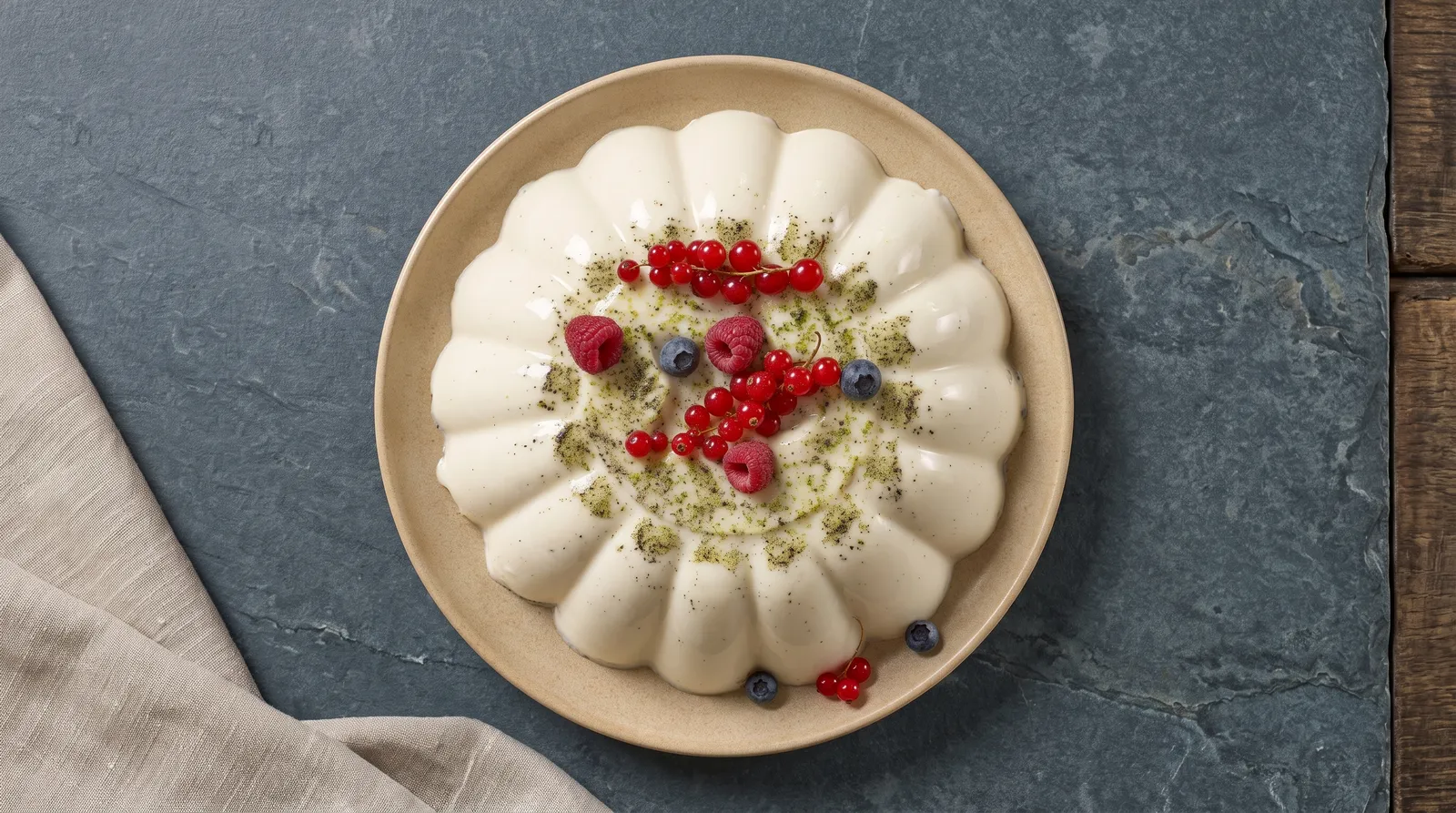
A chilled coconut blanc-manger made with coconut milk, condensed and evaporated milk, vanilla, lime and gelatin, set in a one-litre mould until it trembles as one piece and unmoulds with smooth sides.

French Recipes
Share
Blanc-manger coco — shown in close-up
Prep 20 minutes
Cook 10 minutes
Total 290 minutes
Yield 1 one-litre mould, 8 slices
About this dish

French Antillean blanc-manger coco in a mould

Blanc-manger coco is a French Antillean chilled dessert built around coconut and a clean set texture. Household formulas vary, but coconut milk, sweet dairy, vanilla, citrus and a gelling agent recur in modern preparations. Here, full-fat coconut milk is combined with sweetened condensed milk and evaporated milk, so no extra sugar is necessary. The goal is a mould that slices but still wobbles rather than a stiff rubbery block.

Gelatin is handled in three separate stages: hydrate it fully in cold water, warm the coconut-dairy mixture without boiling, then dissolve the swollen gelatin off the heat. Boiling is unnecessary and can encourage separation in a coconut-rich mixture. A fine sieve removes the vanilla pod and stray zest while leaving the liquid smooth. Ten minutes of brief cooling before moulding reduces steam and condensation in the refrigerator.

The four-hour chill is not decorative scheduling; it is the period in which the centre of a one-litre mould becomes reliably set. The practical doneness cue is movement: when the mould is nudged, the centre should tremble as a single mass with no liquid at the edge. For unmoulding, a few seconds of warm water are enough. A prolonged hot-water bath will melt the outer layer and make the dessert slump.
Success points

Success points

  • Bloom gelatin completely in cold water.
  • Warm the coconut and dairy only to steaming, not a boil.
  • Give the full four-hour chill before attempting to unmould.
Ingredients

Ingredients

Blanc-manger

  • 400 ml full-fat coconut milk, well shaken
  • 200 ml sweetened condensed milk
  • 200 ml evaporated milk
  • 8 g powdered gelatin, or equivalent sheet gelatin by verified bloom strength
  • 40 ml cold water, for blooming gelatin
  • 1 vanilla pod, split and scraped
  • 2 g finely grated lime zest
  • 1 g ground cinnamon
  • 1 g fine salt
Method

Method

Bloom, heat and set

  1. Bloom the gelatin. Sprinkle the gelatin over the 40 ml cold water and leave for 10 minutes. The gelatin is fully hydrated with no dry granules remaining.

  2. Warm, do not boil. Combine the coconut milk, condensed milk, evaporated milk, vanilla, lime zest, cinnamon and salt. Heat gently for about 10 minutes to around 85 °C. The mixture is steaming and fragrant but not boiling or separated.

  3. Dissolve the gelatin completely. Remove the saucepan from the heat and whisk in the bloomed gelatin for about 3 minutes. The gelatin disappears completely and the liquid is smooth with no visible strands or granules.

  4. Cool briefly. Pour through a fine sieve into a jug and cool for 10 minutes, stirring once or twice. The mixture is warm rather than hot and remains fluid and homogeneous.

  5. Chill until fully set. Pour into a lightly water-rinsed 1 litre mould, cover and refrigerate for at least 240 minutes at 4 °C or colder. The centre trembles as one piece when the mould is nudged and no liquid seeps at the edge.

  6. Unmould without melting. Dip the outside of the mould in warm water for only a few seconds, loosen the edge and invert onto a chilled plate. The dessert releases cleanly, keeps smooth sides and retains a gentle wobble instead of slumping.

Practical guidance

Practical

Practical guidance

Keep the dessert in its mould and covered until close to service; this makes it an excellent day-ahead preparation. Unmould onto a chilled plate and slice with a clean knife. Fresh acidic fruit such as passion fruit or pineapple can accompany it, but the base stands on its own. Refrigerate at 4 °C or colder and use within 3 days. Do not leave the mould on a buffet for an extended period, and do not freeze it for presentation because thawed gelatin desserts can weep. Agar-agar is not given as a direct swap: it needs a different dose and must be boiled to activate, producing a firmer, more brittle set.

Troubleshooting

Troubleshooting

  • Dessert stays loose after chillingGelatin was under-dosed, not fully dissolved or the chill was too short; verify all three before increasing gelatin.
  • Texture is rubberyToo much gelatin was used for the one-litre volume; keep the measured 8 g dose for this one-litre mould.
  • Layers form in the mouldThe coconut base was boiled or left unstirred while cooling; use gentle heat and brief, even cooling.
Nutrition per serving

Nutrition per serving

  • Serving size1 slice, about one-eighth of the mould
  • Calories210 kcal
  • Carbohydrate25 g
  • Protein5 g
  • Fat11 g
  • Fibre1 g
  • Sodium95 mg
Allergens and food safety

Allergens and food safety

Allergens: Milk.

Use pasteurized dairy products.

Keep the finished dessert covered at 4 °C or colder and use within 3 days.

Do not leave the moulded dessert at room temperature for extended service.

FAQ

FAQ

Can agar-agar replace gelatin gram for gram?

No. Its activation and texture are different, so it requires a separately tested formula.

How warm should the unmoulding water be?

Warm enough to loosen the outer film in a few seconds, not hot enough to melt a visible layer.

Closing

Closing

  • Result: A smooth white coconut dessert that slices cleanly yet keeps a gentle wobble and fresh vanilla-lime aroma.
  • Decisive technique: Dissolve properly bloomed gelatin into a hot-but-not-boiling base, then give the one-litre mould an uninterrupted four-hour chill.