French Recipes

Biscuits roses de Reims

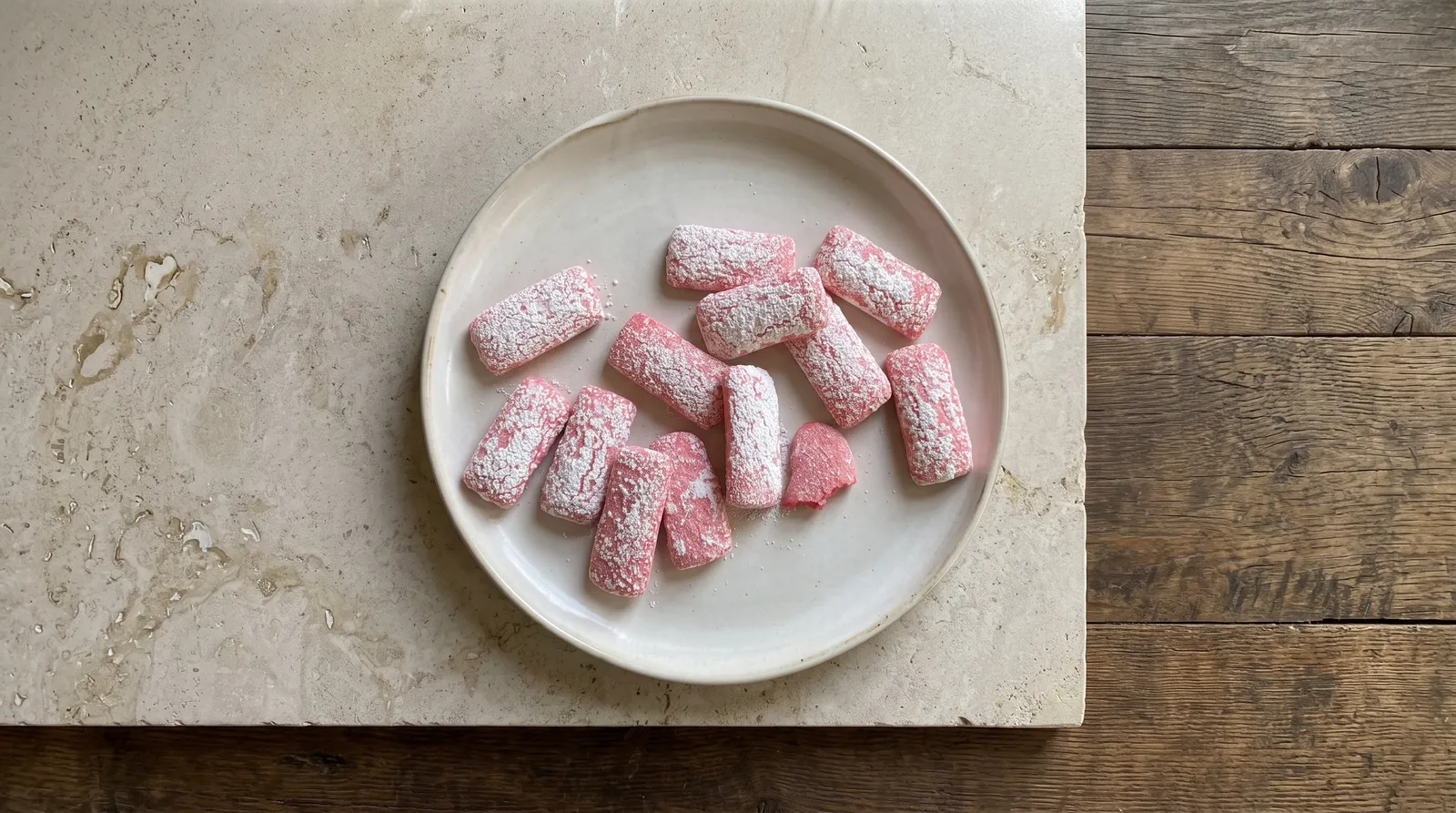
Pale pink Reims-style finger biscuits made from aerated eggs, sugar, wheat flour and corn starch, piped to even dimensions, lightly crusted, baked to set, then dried at low temperature until fully crisp after cooling.

French Recipes
Share
Biscuits roses de Reims — arranged on a board
Prep 30 minutes
Cook 27 minutes
Total 107 minutes
Yield 24 finger biscuits
About this dish

Home-style biscuits roses de Reims with a crisp low-moisture finish

The biscuit rose de Reims is closely tied to Reims and Champagne, and its characteristic dryness comes from a two-stage idea: first set the aerated biscuit, then remove more moisture without heavily browning it. A household kitchen cannot claim the proprietary commercial formulation, but it can reproduce the defining practical traits—pale pink colour, finger shape, dry crisp texture and enough structure to withstand a brief dip in a drink.

The batter begins with eggs and sugar whipped to a thick ribbon. Flour, corn starch and a small amount of baking powder are sifted and folded in gently so the foam does not collapse. Piping through a 10 mm plain nozzle into fingers about 7 cm long and 2 cm wide gives repeatable pieces. Two light dustings of icing sugar and a 20-minute crusting rest create the dry-looking surface before the tray reaches the oven.

The first bake at 180 °C sets the shape, but the biscuits are not judged finished there. A short 80 °C drying phase removes more moisture while protecting the pale pink colour. Full cooling on a rack is part of the process because a hot biscuit can still seem soft. Only once completely cool should the centre be crisp and low in moisture rather than cakey.

Success points

Success points

  • Whip the egg mixture to a real ribbon.
  • Fold dry ingredients without crushing the foam.
  • Pipe uniform fingers and include the low-temperature drying stage.
Ingredients

Ingredients

Biscuits

  • 2 l arge eggs, separated
  • 100 g caster sugar
  • 90 g wheat flour
  • 45 g corn starch
  • 4 g baking powder
  • 2 g vanilla extract
  • 1 g red gel food colouring, used sparingly for pale pink
  • 25 g icing sugar, for two light dustings
Method

Method

Batter and piping

  1. Build the aerated egg base. Beat the yolks with the caster sugar until pale and thick. Beat in one white, then the colouring and vanilla, then the second white. The egg mixture is pale, thick and ribboning, and the colour is an even light pink.

  2. Fold in the dry ingredients. Sift the flour, corn starch and baking powder together, then fold them through the egg mixture in two additions. No dry pockets remain and the batter still falls in a thick ribbon instead of running flat.

  3. Pipe even fingers. Pipe 24 fingers on lined trays, each about 7 cm long and 2 cm wide. The fingers are evenly spaced, about 7 cm long and 2 cm wide, with rounded ends.

  4. Let the surface crust. Dust lightly with half the icing sugar and leave the trays for 20 minutes. The surface looks matte rather than freshly wet and does not smear at a very light touch. Dust with the remaining icing sugar just before baking.

Bake, dry and cool

  1. Set the biscuit structure. Bake at 180 °C for about 12 minutes. The biscuits are set and risen with only the faintest colour at the edges; the pink remains pale rather than browned.

  2. Dry without browning. Reduce the oven to 80 °C and dry for 15 minutes, leaving the door slightly ajar only if the appliance permits it safely. The biscuits feel dry and crisp at the edges rather than soft or cakey.

  3. Cool to full crispness. Transfer to a rack and cool for 30 minutes. The biscuits are crisp through the centre and no longer warm underneath.

Practical guidance

Practical

Practical guidance

Serve only after complete cooling. The biscuits are naturally suited to tea and coffee, and the Reims tradition also pairs them with Champagne. For storage, let every biscuit become fully cool before transferring to an airtight dry tin; moisture trapped while warm will soften the batch. They keep their best texture for about a week in a dry container. If humid weather softens them, a brief low oven can remove moisture again, but cool completely before judging the result. Colouring strength varies sharply, so the measured red gel is a ceiling rather than an instruction to make the batter dark; use only enough for a clear pale pink.

Troubleshooting

Troubleshooting

  • Fingers spread into flat stripsThe egg foam was underdeveloped or folding was too aggressive; strengthen the ribbon before piping.
  • Pink turns beige or brownThe main bake was too hot or too long; stop as soon as structure is set and finish with low heat.
  • Stored biscuits turn softThey were packed warm or the container admitted humidity; dry again gently and cool fully before sealing.
Nutrition per serving

Nutrition per serving

  • Serving size1 biscuit
  • Calories48 kcal
  • Carbohydrate10 g
  • Protein1.1 g
  • Fat0.5 g
  • Fibre0.2 g
  • Sodium18 mg
Allergens and food safety

Allergens and food safety

Allergens: Wheat/gluten, Egg.

Use clean eggs and bake the biscuits fully before eating.

Cool completely before sealing in a container to avoid condensation.

FAQ

FAQ

Is this the proprietary Fossier formula?

No. It is a reproducible household version built around public characteristics and home baking technique.

Why dry at 80 °C after baking?

Lower heat removes moisture with much less additional browning, which protects both crispness and pale colour.

Closing

Closing

  • Result: Light, pale-pink finger biscuits that snap cleanly once cool and stay dry enough for dipping without immediate collapse.
  • Decisive technique: Treat baking and drying as separate jobs—set the aerated biscuit first, then remove moisture gently at 80 °C.