French Recipes

Bébélé

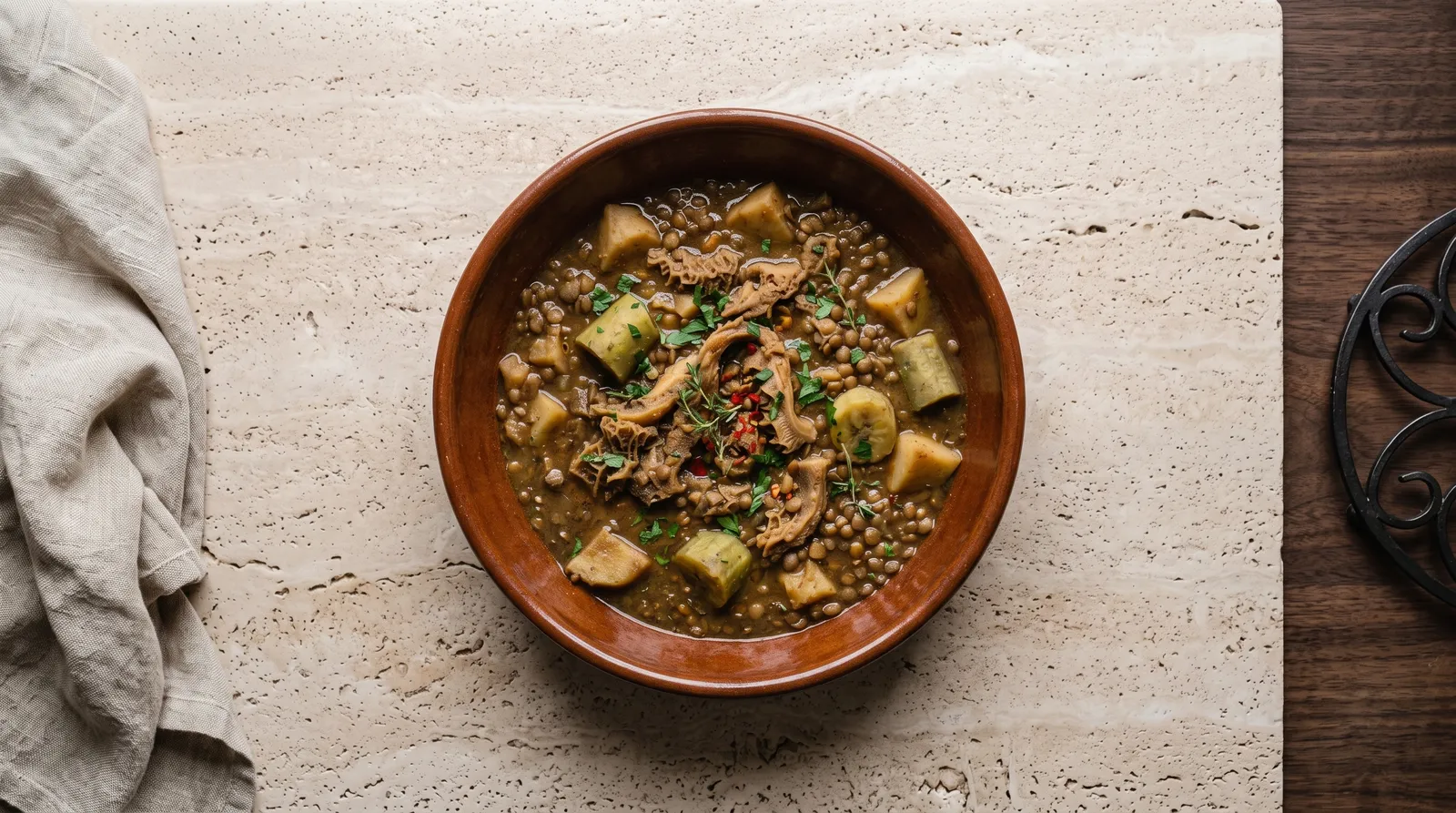
A substantial Marie-Galante soup-stew in which cleaned beef tripe is blanched and simmered until tender, then cooked with green banana, breadfruit and small flour-water dombrés before a bright lime-garlic-oil finish.

French Recipes
Share
Bébélé — shown in a cooking pot
Prep 45 minutes
Cook 165 minutes
Total 210 minutes
Yield 8 main-course bowls
About this dish

Marie-Galante bébélé with beef tripe, green banana, breadfruit and dombrés

Bébélé belongs specifically to Marie-Galante in Guadeloupe, and its identity comes from the combination of beef tripe, local starches and small dumplings rather than from a generic “Caribbean stew” profile. The Marie-Galante tourism recipe uses green breadfruit, green bananas and dombrés around a long-cooked tripe base. Household versions can become far more elaborate, but those extra cured meats and root vegetables are not required for the dish to remain recognisable.

Offal preparation demands both culinary patience and disciplined hygiene. Start with food-grade cleaned tripe, rinse it in a contained bowl instead of spraying raw offal around the sink, then blanch it and discard that first water. A full hour of simmering gives the tripe a head start before the breadfruit and green banana go in. Those starches then soften and begin to thicken the broth while still retaining visible pieces.

Dombrés are added only after the vegetables have had time to cook. Their dough is intentionally firm, rolled into small balls so the centres can cook fully during a long final simmer. Lime, garlic and oil are stirred in near the end to brighten a pot that has spent nearly three hours over heat. The finished bébélé should be thick and sustaining, with tender tripe and cooked-through dumplings, not a thin broth with separate garnish floating in it.
Success points

Success points

  • Use food-grade cleaned tripe and sanitize everything it touches.
  • Give the tripe its own long simmer before adding breadfruit and banana.
  • Roll small firm dombrés and keep the final simmer gentle.
Ingredients

Ingredients

Stew

  • 800 g cleaned beef tripe, food-grade, cut into manageable pieces after blanching
  • 600 g breadfruit, green, peeled and cut into 2 cm cubes
  • 800 g green cooking bananas, peeled and cut into 2 cm pieces
  • 2000 ml water
  • 120 ml fresh lime juice, divided
  • 30 ml neutral vegetable oil
  • 20 g garlic, finely grated, divided
  • 60 g scallions or cives, finely sliced
  • 10 g fresh parsley, chopped
  • 4 g fresh thyme
  • 2 whole cloves
  • 8 g fine salt
  • 2 g black pepper

Dombrés

  • 200 g wheat flour
  • 100 ml water
  • 2 g fine salt
Method

Method

Clean and tenderize the tripe

  1. Clean the tripe carefully. Place the cleaned tripe in a large bowl with cold water and 60 ml of the lime juice, agitate gently, then drain without splashing. The tripe smells clean and no visible debris remains. Wash hands and sanitize the bowl, sink area and tools before handling other ingredients.

  2. Blanch before the long simmer. Cover the tripe with fresh water, bring to 100 °C and blanch for 15 minutes. The liquid has returned to a boil and surface impurities can be skimmed away. Drain and discard the blanching water.

  3. Start the long tripe simmer. Return the tripe to the pot with 2 litres of water, half the garlic, the cloves, cives, parsley, thyme, salt and pepper. Keep at a gentle 95 °C simmer for 60 minutes. A fork enters the tripe with reduced resistance, but the pieces still hold their shape.

Vegetables and dombrés

  1. Cook the Marie-Galante starches. Add the breadfruit and green banana and keep the pot at a gentle 95 °C simmer for 35 minutes. The breadfruit and banana are tender at the edges but have not dissolved completely.

  2. Shape the dombrés. Mix the flour, 100 ml water and 2 g salt into a firm dough, then roll small balls roughly 1.5 cm across. The dough is firm and dry enough to roll into small balls without sticking heavily to the hands.

  3. Cook the dombrés through. Drop the dombrés into the simmering pot and cook for 50 minutes at about 95 °C. Stir gently enough to prevent sticking without breaking the banana. The dombrés are cooked through with no floury core and the broth has become visibly thicker.

  4. Finish the pot. Mix the remaining 60 ml lime juice with the remaining garlic and oil, stir it into the pot and simmer 5 minutes at about 90 °C. The broth tastes bright but remains savoury, and the tripe is fully tender rather than rubbery.

Practical guidance

Practical

Practical guidance

Serve in deep bowls while very hot, distributing tripe, breadfruit, banana, dombrés and broth evenly. The dish is well suited to cooking a day ahead because the flavours settle and the starches continue to thicken the liquid. For make-ahead service, cool in shallow containers within 2 hours, refrigerate at 4 °C or colder and use within 3 days. Reheat to 74 °C throughout, stirring gently so the dumplings heat through without disintegrating. If the chilled pot has become very thick, add only enough water to restore a spoonable stew consistency. Do not replace breadfruit or green banana automatically with potatoes and still describe the result as the same Marie-Galante composition.

Troubleshooting

Troubleshooting

  • Tripe remains rubberyIt did not receive enough time before the starch vegetables were added; extend the initial simmer until resistance clearly decreases.
  • Breadfruit and banana disappear into the brothThe pot boiled too hard; maintain a gentle simmer once the starches enter.
  • Dombrés have a floury centreThey were shaped too large or their 50-minute simmer was shortened; keep them small and cook through completely.
Nutrition per serving

Nutrition per serving

  • Serving size1 main-course bowl
  • Calories410 kcal
  • Carbohydrate72 g
  • Protein27 g
  • Fat8 g
  • Fibre9 g
  • Sodium660 mg
Allergens and food safety

Allergens and food safety

Allergens: Wheat/gluten.

Use cleaned food-grade beef tripe and prevent raw offal splash or cross-contamination.

Keep all cooked leftovers out of room temperature for no more than 2 hours; refrigerate at 4 °C or colder.

Reheat leftovers to 74 °C throughout.

FAQ

FAQ

Does bébélé have to contain cured pork?

Some households include it, but the Marie-Galante core used here is complete with tripe, local starches and dombrés.

Why use lime twice?

Part helps clean and freshen the tripe-handling stage, while the final measured addition brightens the cooked stew.

Closing

Closing

  • Result: A thick Marie-Galante bébélé with fully tender tripe, soft green starches and small cooked-through dombrés.
  • Decisive technique: Stagger the cooking: tripe first, then breadfruit and banana, then dombrés, so every component reaches tenderness at the same finish.