French Recipes

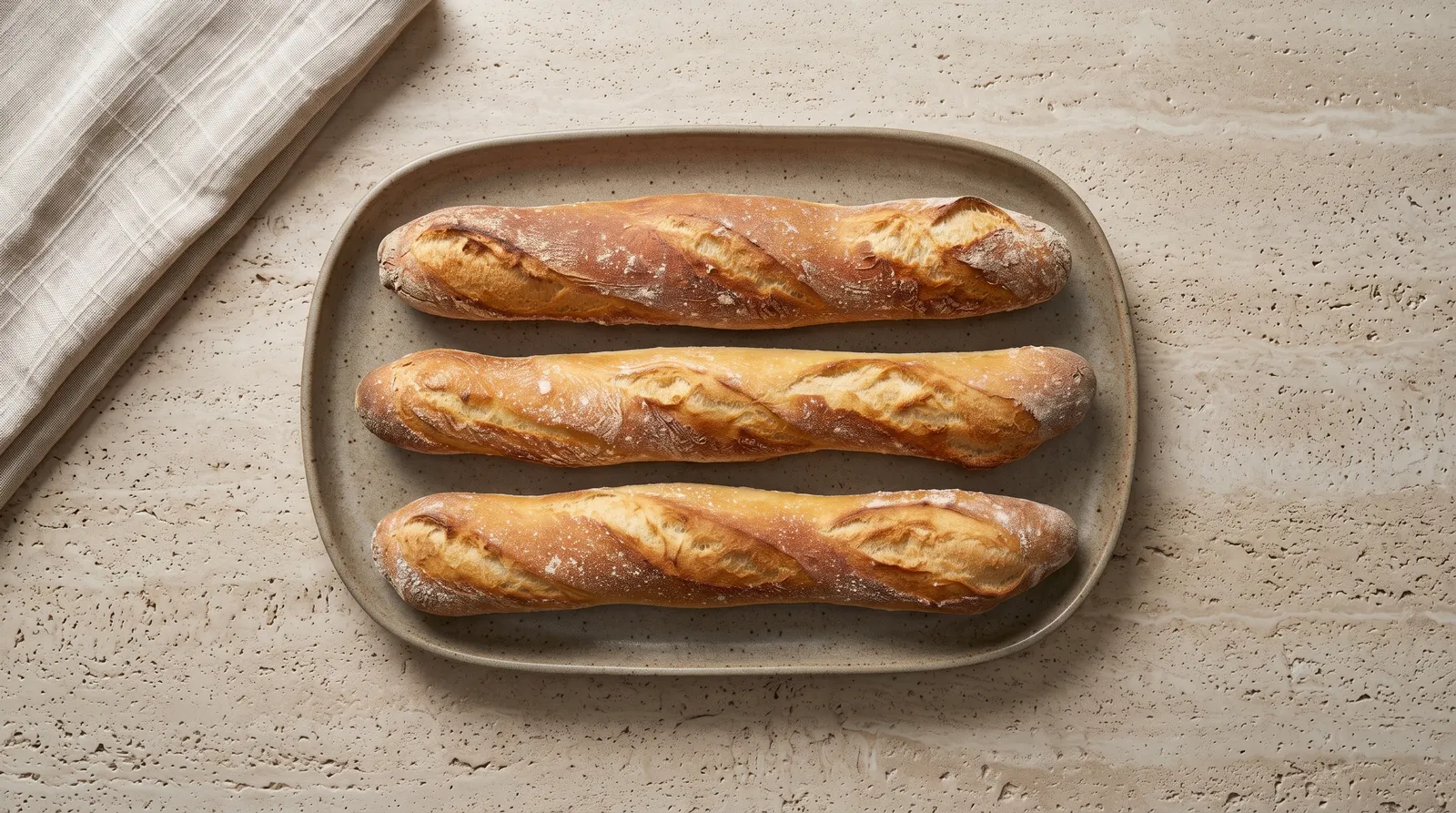
Baguette de tradition française

A four-ingredient lean baguette dough made with additive-free wheat flour, water, salt and baker’s yeast, strengthened by folds, fermented slowly overnight, shaped and scored by hand, then baked with an initial burst of steam for a crisp home-oven crust.

French Recipes
Share
Baguette de tradition française — shown in close-up
Prep 45 minutes
Cook 25 minutes
Total 1050 minutes
Yield 3 baguettes, about 250 g baked each
About this dish

Home-oven baguette de tradition française with long cold fermentation

The defining boundary of pain de tradition française is unusually clear in French law: wheat bread flour, potable water, salt and baker’s yeast and/or levain, with no ordinary bread additives and only narrowly specified optional flours. For a practical household adaptation, the dough here stays inside the simplest four-ingredient version. There is no sugar, oil, milk or improver to compensate for weak fermentation or shaping.

Because the ingredient list is short, time and dough handling carry most of the work. A brief flour-and-water rest hydrates the flour, moderate mixing develops gluten, and three folds during bulk fermentation add strength without making the dough tight. The dough then spends 12 hours in the refrigerator before it is divided, pre-shaped, rested, shaped again and proofed. Those waiting periods are real production time and are included in the total rather than hidden behind a short “prep” number.

A home oven cannot behave exactly like a professional steam-injected deck oven, so the goal is an honest adaptation. A preheated stone or heavy sheet supplies bottom heat, while a separate hot pan generates steam only at the start. Scoring and steam work together: the angled cuts create planned expansion points, and moisture delays crust setting long enough for those cuts to open. Once expansion is complete, drier heat is needed to build a crisp shell.
Success points

Success points

  • Keep the dough to the four defining ingredients.
  • Use folds and the cold retard rather than adding flour until the dough becomes stiff.
  • Score at a shallow angle and generate steam immediately after loading.
Ingredients

Ingredients

Dough

  • 500 g additive-free T65-style wheat flour, about 11–12% protein
  • 360 ml water, cool
  • 10 g fine salt
  • 5 g fresh baker’s yeast, crumbled
Method

Method

Mix and ferment

  1. Hydrate the flour. Mix the flour with 330 ml of the water until no dry patches remain, then cover and rest for 30 minutes. No dry flour remains and the dough has begun to relax and stretch.

  2. Finish the dough. Dissolve the fresh yeast in part of the remaining 30 ml water, add it with the salt, then mix while adding the rest of the water gradually. Work for about 10 minutes. The dough is smooth, elastic and tacky, and a stretched edge can become thin before tearing.

  3. Bulk-ferment with folds. Cover and rest for 120 minutes, giving the dough one gentle fold after 30, 60 and 90 minutes. By the end of bulk fermentation the dough is aerated, smoother and expanded by roughly half rather than fully doubled.

  4. Cold-retard overnight. Refrigerate the covered dough for 12 hours at about 4 °C. The cold dough shows bubbles along the sides and holds its shape better when turned out.

Shape and proof

  1. Divide evenly. Turn out the cold dough, divide into three pieces of about 290 g and pre-shape gently. Three pieces weigh about 290 g each and sit as loose, lightly tensioned logs.

  2. Relax before final shaping. Cover the pre-shaped logs and rest for 20 minutes. The pre-shaped logs relax enough to lengthen without snapping back hard.

  3. Shape with surface tension. Flatten each piece lightly, fold and seal it into a cylinder, then roll from the centre outward to about 38 cm. Each loaf has a sealed seam, even thickness and a taut but un-torn outer skin.

  4. Proof until resilient. Cover and rest for about 45 minutes. A light fingertip press returns slowly and leaves a shallow indentation.

Score, bake and cool

  1. Score decisively. Transfer the baguettes seam-side down and make four or five shallow overlapping cuts with the blade held at a low angle. The cuts are clean, about 5 mm deep and overlap along the loaf rather than crossing it sharply.

  2. Bake with controlled steam. Load the baguettes into a 240 °C oven. Carefully add boiling water to the preheated steam pan and close the door immediately. Bake for 10 minutes with steam, vent/remove the steam pan if practical, then bake about 15 minutes more. The crust is deep golden and crisp, the scores have opened, and the loaf sounds hollow when tapped underneath.

  3. Cool fully enough to set the crumb. Transfer to a wire rack and cool for 45 minutes before cutting. The crust stays crisp and the crumb no longer feels gummy when sliced.

Practical guidance

Practical

Practical guidance

Let the baguettes cool for 45 minutes before slicing; cutting much earlier can compress or gum the crumb. Serve the same day whenever possible. For a short hold, keep bread in paper or a bread bag at room temperature rather than sealing a warm loaf in plastic. Freeze fully cooled bread for longer storage, then thaw and re-crisp briefly in a hot oven. If the exact T65 flour is unavailable, a similar additive-free white wheat bread flour can work, but its water absorption may differ and a household loaf should not be presented as legally certified bakery output.

Troubleshooting

Troubleshooting

  • Loaves spread sidewaysFinal shaping lacked surface tension or the proof ran too long; shape more decisively and use the slow-return fingertip cue.
  • Crumb is tight and heavyFermentation was shortened or the dough was heavily degassed; keep the bulk and cold-retard schedule and handle gently.
  • Crust is thick and dullEarly steam was insufficient or was left in the oven too long; steam immediately, then vent for the dry finishing phase.
Nutrition per serving

Nutrition per serving

  • Serving size1 of 12 portions, about 60–65 g baked bread
  • Calories155 kcal
  • Carbohydrate31 g
  • Protein5 g
  • Fat0.6 g
  • Fibre1.4 g
  • Sodium330 mg
Allergens and food safety

Allergens and food safety

Allergens: Wheat/gluten.

Steam creation with boiling water can cause serious burns; keep face and hands away from the pan.

Cool on a rack before bagging to avoid trapped condensation and mould-promoting moisture.

FAQ

FAQ

Can oil or sugar be added for easier home baking?

Not in this preparation; that would leave the defining four-ingredient boundary.

Why is the cooling time counted?

The crumb is still setting as steam redistributes, so slicing immediately gives a misleadingly gummy result.

Closing

Closing

  • Result: Three lean baguettes with a thin crisp crust, opened scores and a resilient, irregular crumb.
  • Decisive technique: Combine long fermentation with careful shaping, angled scoring and brief initial steam rather than trying to force texture with extra ingredients.