French Recipes

Aïoli garni

A complete Provençal platter of desalted salt cod, individually cooked vegetables, hard-cooked eggs and a chilled garlic-olive-oil sauce made with pasteurized yolks.

French Recipes
Share
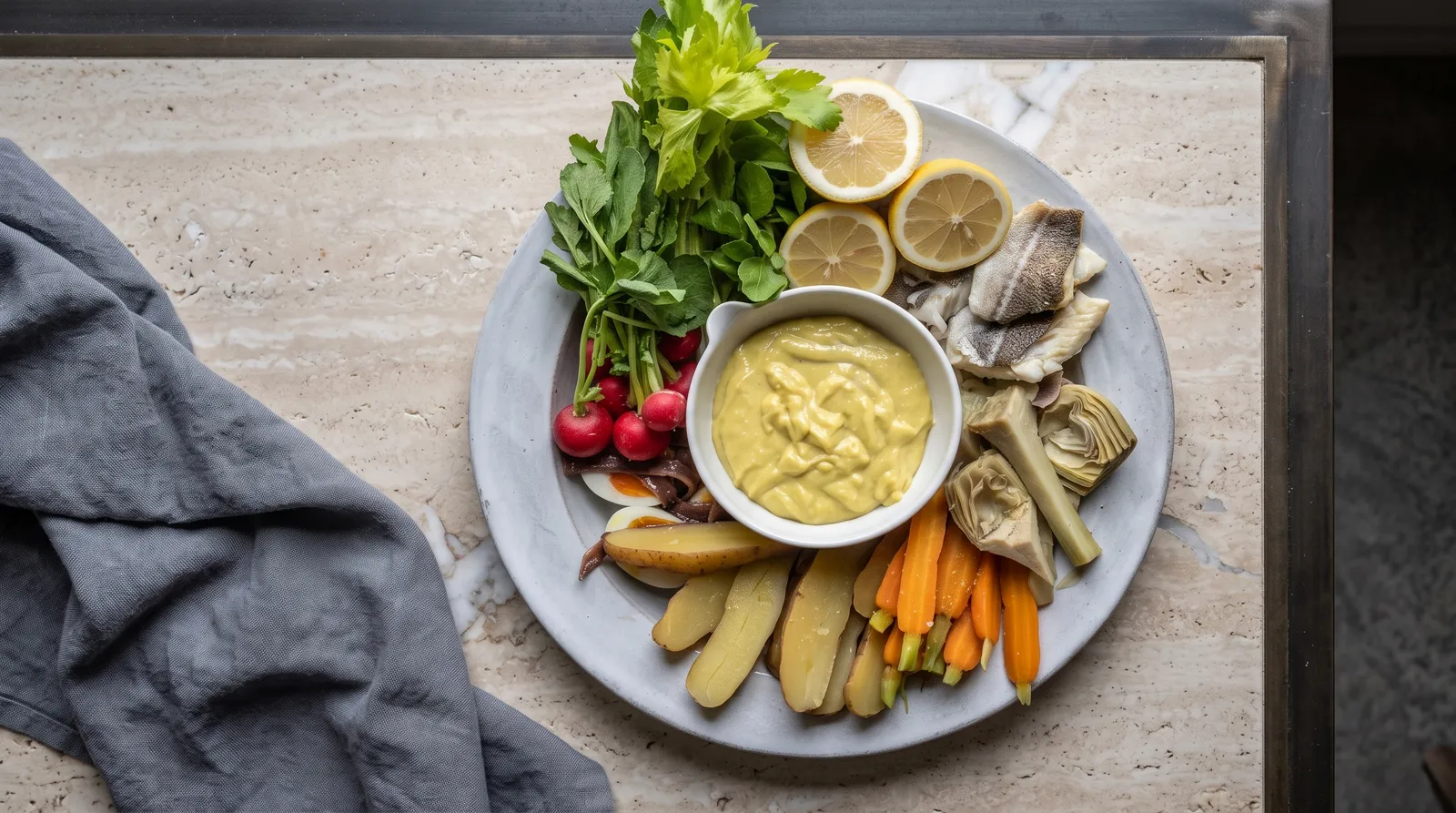
Aïoli garni — vegetables and lemon wedges around a bowl of yellow sauce on a white platter
Prep 45 minutes
Cook 50 minutes
Total 1535 minutes
Yield 6 complete platter portions
Introduction and overview

Aïoli garni — Provençal grand aïoli platter

Aïoli garni, often called grand aïoli, is the full Provençal meal rather than simply a bowl of garlic sauce. The Provençal platter commonly arranges cod, cooked vegetables and eggs around the emulsion, with other additions changing according to place, season and means. The combination below keeps the platter complete while making timing, food safety and portioning clear.

Salt cod starts the day before with a 24-hour refrigerated desalting schedule. On serving day, the vegetables are kept separate because each has a different ideal endpoint: potatoes and carrots should be tender but intact, while beans, cauliflower and courgettes need less time. The cod is poached gently so its flakes remain moist instead of tightening in a rolling boil.

The sauce is deliberately based on pasteurized egg yolks. Traditional aioli can be mounted from garlic and oil alone, but yolk is a common household stabiliser, and pasteurization addresses the risk of an uncooked egg emulsion. Keep the sauce cold while the fish and vegetables can be served warm or at a comfortable room temperature. The contrast is part of the practical pleasure of the platter.
Success points

Success points

  • Keep the cod cold during the entire desalting schedule.
  • Cook each vegetable separately or remove it at its own endpoint.
  • Start the aïoli oil drop by drop and keep the finished sauce at 4 °C or below.
Ingredients

Ingredients

Platter

  • 600 g salted cod, desalted for 24 hours
  • 700 g waxy potatoes, scrubbed, left whole
  • 500 g carrots, peeled and halved lengthwise if thick
  • 300 g green beans, trimmed
  • 500 g cauliflower, cut into medium florets
  • 400 g courgettes, cut into thick batons
  • 6 l arge eggs, hard-cooked
  • 5 g fine salt, for vegetable cooking water and final adjustment

Pasteurized-egg aïoli

  • 4 pasteurized egg yolks
  • 30 g garlic, germs removed, crushed to a paste
  • 240 ml extra-virgin olive oil, room temperature
  • 15 ml lemon juice
  • 2 g fine salt
Method

Method

Desalt and prepare

  1. Desalt the cod. Rinse the salt cod, cover with cold water and refrigerate for 24 hours, changing the water 3 to 4 times. The cod should taste pleasantly seasoned rather than aggressively salty after the final rinse. Long cold desalting makes the fish usable without warming it. Keep the cod at 4 °C or below throughout desalting.

  2. Prepare the vegetables. Trim the beans, cut the cauliflower and courgettes, peel the carrots and scrub the potatoes while keeping each vegetable separate for its own cooking time. The pieces should be large enough to stay intact on the platter, with similar sizes within each vegetable. Separate preparation prevents overcooking delicate vegetables. Keep prepared vegetables clean and separate from raw fish utensils.

Cook platter components

  1. Boil and steam the vegetables. Cook the potatoes, carrots, cauliflower, green beans and courgettes separately or in carefully timed batches in boiling water or steam at about 100 °C, using the 5 g salt; allow about 25 minutes total kitchen cooking time, removing each vegetable when tender. The potatoes and carrots should be tender to a knife but intact, while beans, cauliflower and courgettes should be cooked through without collapsing. Separate timing preserves the different textures. Drain promptly and keep the cooked vegetables protected from contamination.

  2. Hard-cook the eggs. Cook the 6 eggs in simmering water at about 100 °C for 10 minutes, refresh under running cold water, peel and halve. The yolks should be fully set with no liquid centre. A fully set egg suits the platter and avoids undercooked-egg risk in this component. Handle cooked peeled eggs with clean hands and refrigerate if not serving promptly.

  3. Poach the cod. Put the desalted cod in fresh water, bring the water gently to about 85–90 °C and poach for 10 minutes; drain, remove skin and bones and divide into large flakes. The cod should be opaque and separate into broad moist flakes without becoming rubbery. Gentle poaching keeps the fish tender. Verify fish reaches 63 °C or is opaque and separates easily.

Make the sauce and serve

  1. Emulsify the aïoli. Pound the garlic with the 2 g salt to a smooth paste, whisk in the pasteurized yolks, then add the 240 ml olive oil first drop by drop and then in a thin stream; finish with the lemon juice. The sauce should be thick, glossy and hold a soft peak on the whisk without an oily pool at the edge. Slow oil addition gives the emulsion time to form. Use pasteurized yolks and keep the finished sauce cold at 4 °C or below until service.

  2. Arrange the grand aïoli. Arrange warm or room-temperature cod and vegetables on a large platter with the halved eggs and serve the chilled aïoli in a separate bowl. The platter should keep each component distinct so diners can combine fish, vegetables, egg and sauce in each portion. Separate presentation prevents the sauce from warming unnecessarily. Discard perishable food left above refrigeration temperature for more than 2 hours.

Serving, storage and planning

Practical

Serving, storage and planning

Arrange the vegetables in distinct groups around large flakes of cod, add the halved hard-cooked eggs and keep the bowl of aïoli separate. The cod may be desalted ahead and the vegetables can be cooked earlier the same day if they are cooled promptly. Make the sauce the same day and use it within 24 hours. Refrigerate fish, vegetables, eggs and sauce separately within 2 hours at 4 °C or below. Reheat only the cod and vegetables, if desired, to 74 °C; never heat the emulsion. Fresh cod can replace salted cod technically, but it loses the cured flavour that helps define the platter. Replacing part of the olive oil with neutral oil makes the sauce milder rather than equivalent.

Troubleshooting

Troubleshooting

  • Aïoli splitsThe oil has been incorporated faster than the emulsion can hold it. Start with a fresh pasteurized yolk in a clean bowl and whisk the broken sauce into it a teaspoon at a time.
  • A vegetable starts collapsingThat vegetable has passed its tender-but-intact point. Remove it from heat immediately and spread it in a single layer rather than leaving it in hot water.
Nutrition per serving

Nutrition per serving

  • Serving sizeone-sixth of platter plus about 45 g aïoli
  • Calories650 kcal
  • Carbohydrate42 g
  • Protein39 g
  • Fat36 g
  • Fibre8 g
  • Sodium1200 mg
Allergens and food safety

Allergens and food safety

Allergens: Fish, Egg.

Use pasteurized egg yolks for the uncooked aïoli emulsion.

Keep aïoli at 4 °C or below and use within 24 hours.

Cook finfish to 63 °C or until opaque and separating easily; hard-cook eggs until yolks and whites are firm.

Refrigerate cooked components within 2 hours and reheat leftovers that are served hot to 74 °C.

FAQ

FAQ

Is aïoli garni only a sauce?

No. In this Provençal context the name refers to the complete meal built around the sauce, fish, vegetables and eggs.

Why use pasteurized yolks?

The yolks remain uncooked in the emulsion, so pasteurized egg is the safer basis for home preparation.

Closing

Closing

  • Result: a generous platter of distinct tender vegetables, moist salt cod and hard-cooked eggs served with a thick chilled garlic emulsion.
  • Decisive technique: organise components by their own cooking times and protect the cold emulsion from warm holding.