French Recipes

Accras de morue

Small French Antillean fritters built around properly desalted salt cod, fresh herbs and a thick spoonable batter, fried at a controlled 175 °C for a crisp shell and a fully set centre.

French Recipes
Share
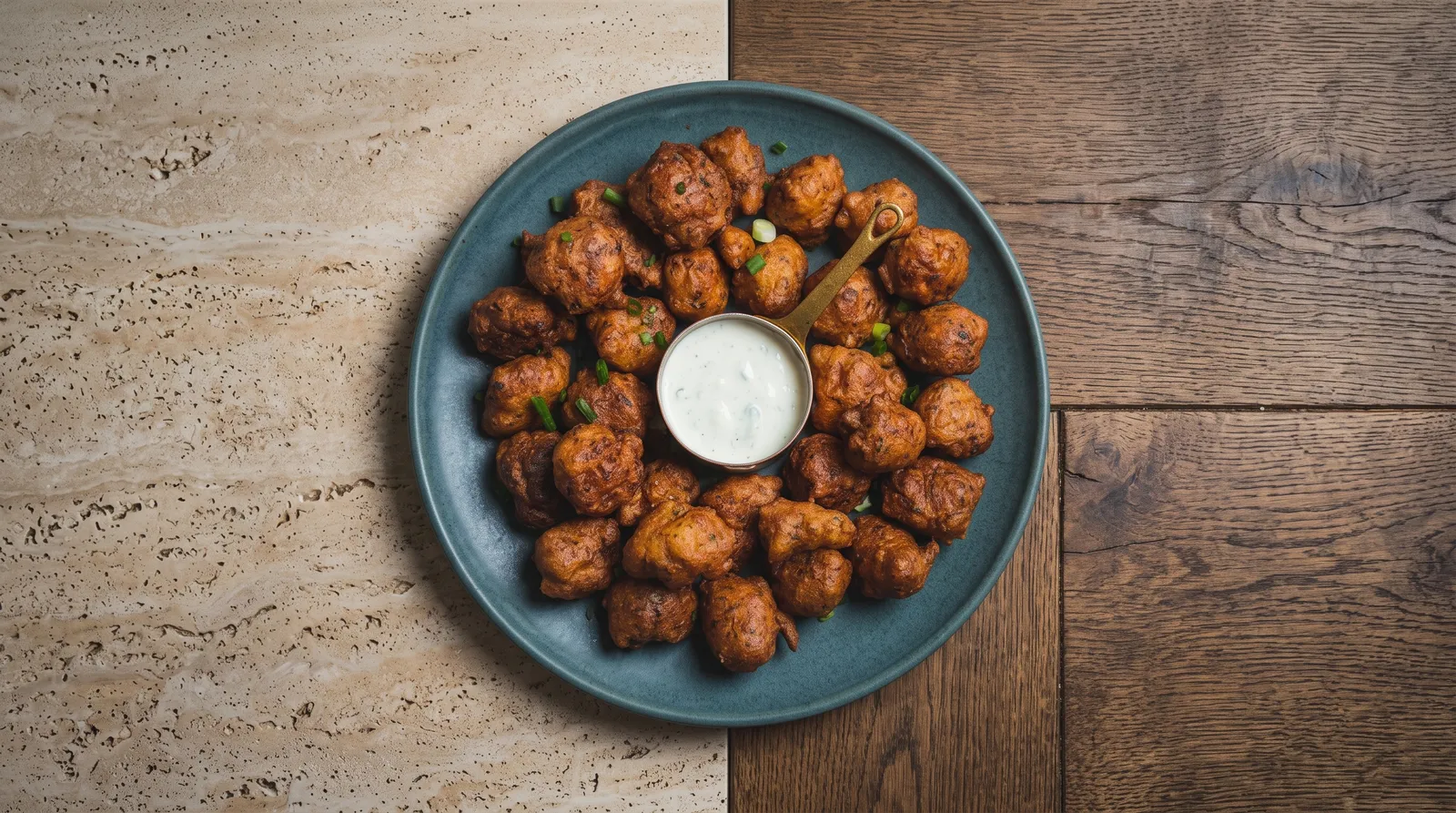
Accras de morue — golden-brown fritters around a sauce cup on a dark platter
Prep 35 minutes
Cook 28 minutes
Total 1563 minutes
Yield 30 small fritters
Introduction and overview

Accras de morue — French Antillean salt-cod fritters

Accras de morue belong to the French Antillean table rather than to a generic idea of French frying. In Guadeloupe, salt cod is combined with fresh alliums, herbs and chilli, then dropped in small portions into hot oil. Household formulas vary: some use egg or milk, while others rely on flour, water and leavening alone. The egg-free, dairy-free batter used here keeps the fish and aromatics at the centre of the fritter.

The most important work happens before the oil is heated. Salt cod must be desalted cold and patiently, then gently poached and flaked so no bones remain. The batter should be thick enough to mound on a teaspoon; a loose batter spreads, absorbs more oil and produces a thin crust around a damp centre. A one-hour refrigerated rest gives the flour time to hydrate and makes portioning more predictable.

Frying temperature is the final control. At roughly 175 °C, teaspoon-size portions colour while the middle has time to set. Work in small batches so the oil does not crash in temperature. The result should be deep golden, light enough to float, crisp outside and steaming rather than wet when broken open.
Success points

Success points

  • Desalt the cod in the refrigerator for 24 hours with at least three water changes.
  • Add the 250 ml water gradually and stop when the batter holds a rounded spoonful.
  • Use a thermometer and keep the frying oil close to 175 °C.
Ingredients

Ingredients

  • 400 g salted cod, desalted, poached, skin and bones removed, finely flaked; weighed after desalting
  • 300 g plain wheat flour
  • 250 ml cold water, add gradually
  • 8 g baking powder
  • 80 g cives or scallions, finely sliced
  • 80 g yellow onion, finely chopped
  • 12 g garlic, finely grated
  • 20 g flat-leaf parsley, finely chopped
  • 2 g fresh thyme leaves
  • 8 g fresh hot Antillean chilli, seeded and very finely chopped; reduce only if necessary for heat tolerance
  • 20 ml lime juice
  • 1 g ground black pepper
  • 1000 ml neutral frying oil, frying medium; nutrition counts an estimated 75 g retained by the batch
Method

Method

Desalt and cook the cod

  1. Desalt the cod. Rinse the salt cod, cover with plenty of cold water and refrigerate for 24 hours, changing the water at least 3 times. The final soaking water should taste markedly less salty than the first. Gradual diffusion removes excess salt without warming the fish. Keep the cod refrigerated at 4 °C or below throughout desalting.

  2. Poach and flake the cod. Put the desalted cod in a saucepan, cover with fresh cold water, bring the water to about 85–90 °C, then poach gently for 8 minutes; drain, let stand only until safe to handle, remove any skin and bones and flake very finely. The fish should be opaque and separate easily into moist flakes. Gentle poaching keeps the cod tender. Cook fish safely; a 63 °C centre is the reference safe endpoint for finfish.

Mix and rest the batter

  1. Mix the batter. Combine the flaked cod, flour, baking powder, cives, onion, garlic, parsley, thyme, chilli, lime juice and black pepper; add the 250 ml cold water gradually until the batter is thick enough to mound on a teaspoon. The batter should hold a rounded spoonful for several seconds instead of running like pancake batter. A thick batter limits spreading and excessive oil uptake. Wash hands and utensils after handling fish and keep the mixture out no longer than necessary.

  2. Rest the batter cold. Cover and refrigerate the batter for 60 minutes before frying. The rested batter should look cohesive and slightly thicker, with the aromatics evenly suspended. A cold rest hydrates the flour and firms the mixture. Keep at 4 °C or below during the rest.

Fry

  1. Fry in small batches. Heat the neutral oil in a deep heavy pan and fry rounded teaspoonfuls in about 6 small batches, turning as needed, for about 18 minutes total; keep the oil near 175 °C and drain each batch on a rack or absorbent paper. Each fritter should be deep golden outside, buoyant in the oil and firm enough to lift without collapsing. When one fritter is split open, the centre should be set and steaming rather than wet or floury. Small batches protect oil temperature and produce a cooked centre before the crust darkens. Do not overcrowd; keep raw batter utensils separate from finished fritters and serve hot or refrigerate within 2 hours.

Serving, storage and planning

Practical

Serving, storage and planning

Serve the accras immediately, about five per appetizer portion, while the crust is at its best. The cod can be desalted the day before, and the batter should complete its full 60-minute cold rest before frying. Refrigerate cooked fritters within 2 hours at 4 °C or below and use within 3 days. For reheating, arrange them on a rack in a 190 °C oven until the centres reach 74 °C; this restores more crispness than a microwave. Scallion is the most practical substitute for Antillean cive, although the flavour is not identical. A milder fresh chilli can reduce heat, but it changes the aromatic character of the batch.

Troubleshooting

Troubleshooting

  • Fritters spread flatThe batter is too loose. Mix in a small measured amount of flour, then test one fritter before adjusting further.
  • Dark crust, wet centreThe oil is too hot or the portions are too large. Return the oil to about 175 °C and use rounded teaspoonfuls.
Nutrition per serving

Nutrition per serving

  • Serving sizeabout 5 fritters
  • Calories382 kcal
  • Carbohydrate40 g
  • Protein21 g
  • Fat15 g
  • Fibre2 g
  • Sodium650 mg
Allergens and food safety

Allergens and food safety

Allergens: Fish, Gluten/wheat.

Keep desalting cod and rested batter at 4 °C or below.

Cook finfish to a 63 °C centre or until opaque and separating easily; the fritter centre must be fully set.

Refrigerate cooked fritters within 2 hours; reheat leftovers to 74 °C.

Frying oil can cause severe burns; keep the pot stable and never add wet utensils or water to hot oil.

FAQ

FAQ

Can the batter be made the day before?

It is best to use the mixed batter after its planned one-hour cold rest; the cod itself is the component designed for overnight preparation.

Why is all the frying oil not counted in nutrition?

Most of the litre of oil remains in the pan. The estimate uses about 75 g retained by the entire batch, which is more defensible than treating the whole frying medium as eaten.

Closing

Closing

  • Result: small fritters with a crisp deep-golden shell, moist salt-cod centre and clear herb-and-chilli aroma.
  • Decisive technique: control both batter thickness and a steady 175 °C frying temperature.