French National Dishes

Veau aux olives

Veal shoulder browned with smoked lardons, then braised with green olives, white wine, tomato concentrate, garlic, fennel and herbs.

French National Dishes
Share
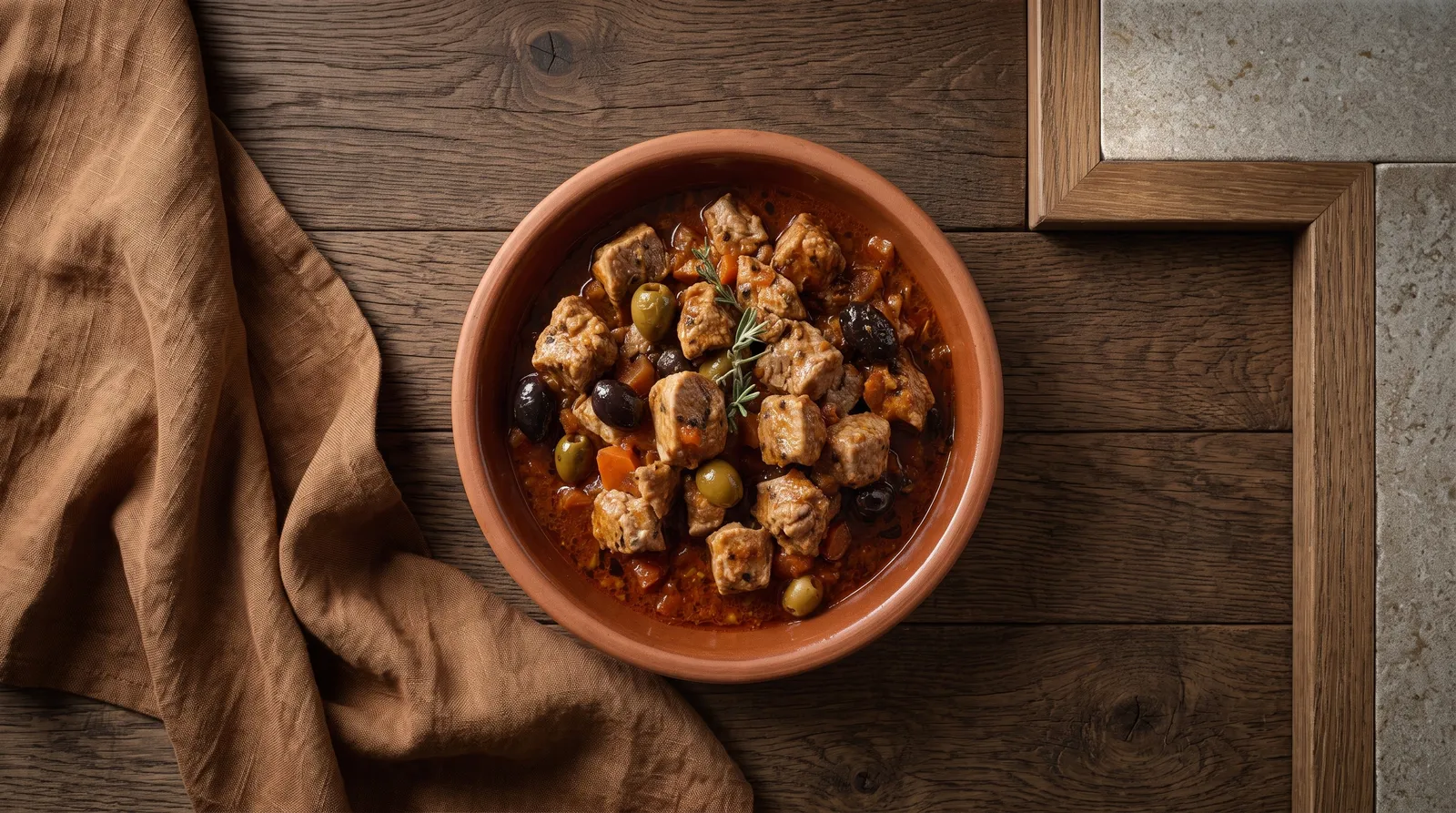
Veau aux olives — served in a bowl
Prep 25 minutes
Cook 140 minutes
Total 165 minutes
Yield about 2.2 kg braise
About this dish

Veau aux olives — Corsican-style veal and green olive braise

Corsican-style veau aux olives is built around veal rather than beef and around the salty, slightly bitter presence of olives in the finished sauce. This recipe uses boneless shoulder, a cut that benefits from a long gentle braise, with smoked lardons, white wine, tomato concentrate, fennel seed and herbs.

The olives are blanched briefly before they enter the stew. That does not remove their identity; it simply moderates surface brine so the sauce can be seasoned with more control. The meat is browned in batches, then onion and garlic are softened and a small amount of flour helps the braising liquid cling to the finished veal.

The veal reaches the safety minimum before the end of the braise, but tenderness remains the culinary endpoint. After 90 minutes the olives are added for a final 30 minutes, so they flavour the sauce without cooking into a soft paste. Final salt adjustment waits until the olive salinity is fully in the pot.
Success points

Success points

  • Brown veal in batches so the pan does not steam.
  • Deglaze with wine away from open flame.
  • Taste for salt only after the olives have finished in the sauce.
Ingredients

Ingredients

Veal braise

  • 1000 g veal shoulder — boneless, trimmed, 4 cm pieces; edible trimmed weight
  • 100 g smoked lardons
  • 150 g green olives — pitted, drained weight
  • 200 g onion — finely sliced
  • 15 g garlic — crushed
  • 20 g plain wheat flour
  • 200 ml dry white wine
  • 500 ml water — for braising; all listed water is added at once
  • 30 g tomato concentrate
  • 5 g fennel seeds — lightly crushed
  • 5 g fresh thyme
  • 2 g bay leaves — 2 leaves
  • 20 ml olive oil
  • 3 g fine salt
  • 2 g black pepper
Method

Method

Brown and build the sauce

  1. Prepare olives and aromatics. Blanch the drained olives very briefly, drain again, and prepare the onion and garlic. Use boiling water. Allow 1 minute. The olives are hot through at the surface but remain firm and intact.

  2. Sear the veal. Brown the veal in olive oil in batches, then add the lardons. Use medium-high heat. Allow 10 minutes. The veal has browned faces without crowding and the lardons have begun to render. Avoid splashing hot fat.

  3. Soften the aromatics. Add onion and garlic and cook until softened, then stir in the flour for a short minute. Use medium heat. Allow 5 minutes. The onion is translucent and the flour coats the meat without dry white patches.

  4. Build the braising liquid. Deglaze with white wine away from direct flame, then add 500 ml water, tomato concentrate, fennel, thyme, bay, salt and pepper. Use medium heat. Allow 4 minutes. The browned residue has dissolved into a smooth reddish-brown braising liquid. Alcohol vapour can ignite; keep away from open flame.

Braise and finish with olives

  1. Braise the veal. Cover and simmer gently until the veal is tender; the thickest pieces must reach at least 63 °C. Use low heat. Allow 90 minutes. Temperature: 63 °C. The veal is easily pierced with a fork but the pieces still hold together. Verify at least 63 °C in a thick piece; tenderness requires the full braise.

  2. Add the olives. Add the drained olives and simmer gently until the sauce is glossy and the olives are seasoned through. Use low heat. Allow 30 minutes. The sauce lightly coats the meat and the olives are hot, tender and still whole.

  3. Season and serve. Remove bay leaves, taste for salt only after the olives have cooked, and serve hot. The sauce is balanced rather than sharply salty and no bay leaves remain. Refrigerate leftovers within 2 hours.

Serving, storage and make-ahead

Practical

Serving, storage and make-ahead

Serve hot with a plain starch that can carry the wine-and-olive sauce. The braise can be made a day ahead; cool it rapidly, refrigerate, then reheat gently before service. Refrigerate leftovers within 2 hours and use within 3–4 days. Reheat to 74 °C. A half-green, half-black olive mix is a documented variation and gives a deeper olive flavour, but this version keeps green olives as the main identity. White wine is part of the finished sauce and complete alcohol removal is not assumed.

Troubleshooting

Troubleshooting

  • Sauce tastes too saltyOlives and lardons contributed more salt than expected. Keep added salt modest and wait until the final 30 minutes are complete before adjusting.
  • Veal is cooked but toughThe meat reached a safe temperature before connective tissue softened. Continue the gentle covered braise until fork-tender.
Nutrition per serving

Nutrition per serving

  • Serving size1 of 6 portions
  • Calories520 kcal
  • Carbohydrate17 g
  • Protein46 g
  • Fat27 g
  • Fibre3 g
  • Sodium1050 mg
Allergens and food safety

Allergens and food safety

Allergens: gluten, sulphites.

Keep raw veal chilled and avoid cross-contamination. Cook thick veal pieces to at least 63 °C and continue braising until tender. Refrigerate leftovers within 2 hours and reheat to 74 °C. White wine alcohol may remain.

FAQ

FAQ

Why use shoulder?

It has enough connective tissue to benefit from a long moist braise and remain succulent.

Can beef be substituted?

That would change the identity of the dish; this recipe is specifically veau aux olives.

Closing

Closing

  • Result — fork-tender veal in a savoury olive, wine and tomato braising sauce.
  • Decisive technique — brown without crowding, then braise gently and delay final seasoning until the olives have cooked through.