French National Dishes

Pissaladière

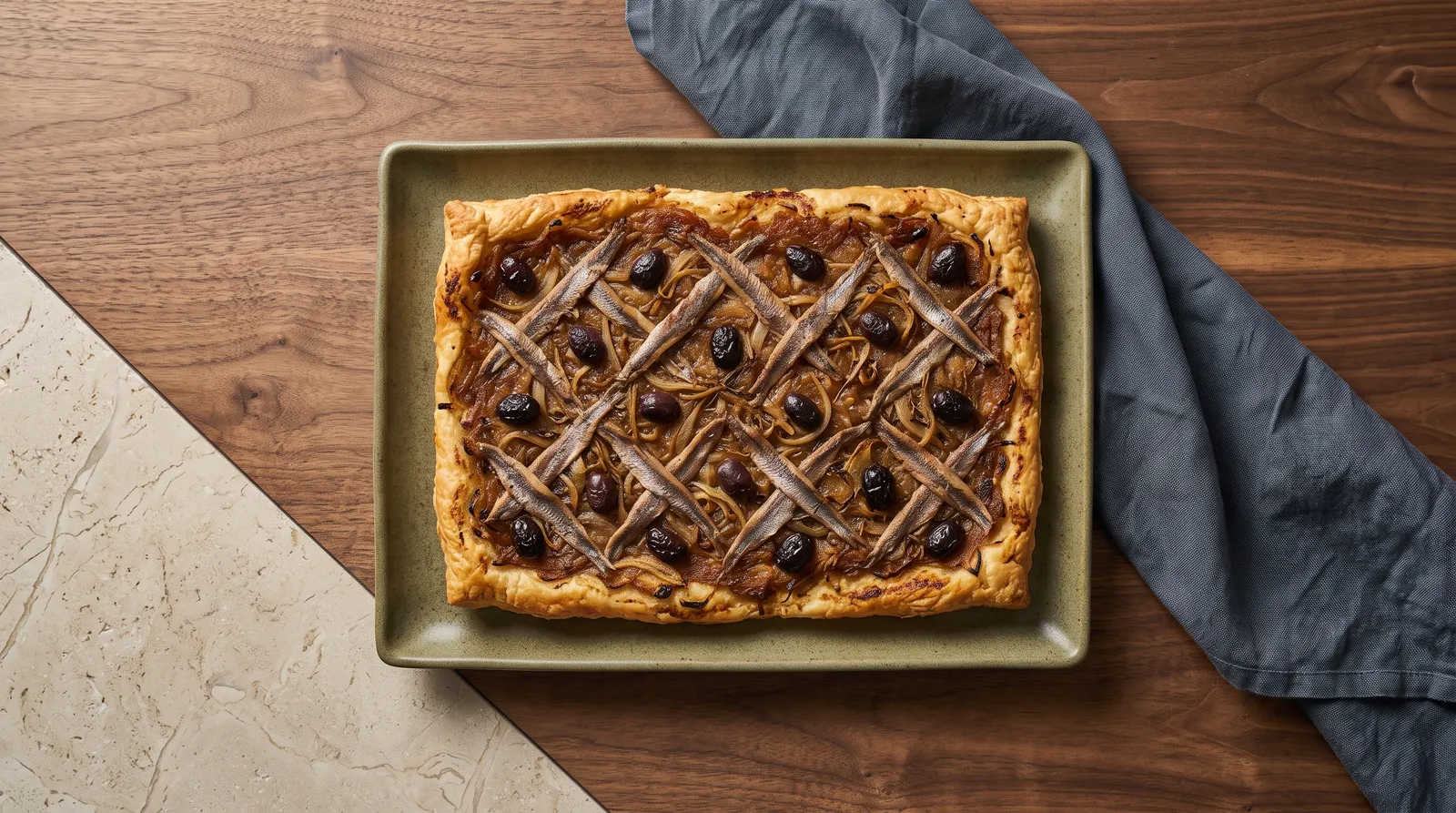
A true onion-forward Niçoise pissaladière on olive-oil yeast dough, with anchovies and black olives and no tomato or cheese, baked only after the onions have softened slowly and shed their free liquid.

French National Dishes
Share
Pissaladière — shown whole after baking
Prep 30 minutes
Cook 65 minutes
Total 200 minutes
Yield 12 rectangular pieces
Introduction

Pissaladière — Niçoise onion, anchovy and olive bread tart

Pissaladière is often placed next to pizza because it is flat, baked and shareable, but that shortcut hides what makes it Niçoise. The base is bread dough and the topping is a deep layer of slowly softened onions, sharpened by anchovy or pissalat and black olives. Tomato sauce, cheese and custard do not belong in this preparation.

The dough uses 400 g flour and 240 ml water, a practical 60% hydration that gives a soft but manageable bread base. Fresh baker’s yeast and a full ninety-minute rise provide enough expansion to support a heavy topping without becoming dense. The dough is pressed across a 30 × 40 cm tray rather than rolled paper-thin like crisp pastry.

The onions demand nearly as much attention as the dough. One and a half kilograms looks excessive before cooking, but that volume collapses dramatically. They spend the first part of the cook covered so they soften in their own moisture, then finish uncovered until the pan has no free watery liquid. Browning is not the goal: the sweetness comes from long softening, not frying the edges.

Anchovies and pitted black olives are added only after the topping is cool enough not to continue cooking aggressively. The oven stage is short and hot. The finished base should be baked through on the underside with golden edges, while the onion layer remains soft and savoury rather than crisp or dry.
Success points

Success points

  • Allow the dough to double before shaping; under-proofed dough becomes heavy under the onions.
  • Cook onions until pale and soft with no free liquid before topping.
  • Check the underside of the central pieces as well as the golden edge to confirm the bread base is fully baked.
Ingredients

Ingredients

Olive-oil yeast dough

  • 400 g plain wheat flour
  • 240 ml water — lukewarm; 60% hydration
  • 12 g fresh baker’s yeast
  • 8 g fine salt
  • 20 ml olive oil

Onion topping

  • 1500 g yellow onions — peeled and thinly sliced
  • 75 ml olive oil
  • 10 g garlic — 2 cloves, left whole and lightly crushed
  • 2 g thyme
  • 1 g bay leaf
  • 1 g rosemary
  • 60 g anchovy fillets — drained and kept chilled until needed
  • 80 g black olives — pitted
  • 1 g black pepper
Method

Method

Mix and rest the dough

  1. Knead the bread dough. Dissolve the fresh yeast in the 240 ml lukewarm water. Mix with flour, 8 g salt and 20 ml olive oil, then knead for 8 minutes until smooth and elastic. The dough is smooth, elastic and slightly tacky but pulls cleanly from the bowl. Moderate hydration gives a bread-like base that can carry a heavy onion layer. Keep flour away from wet floors and clean spills promptly to prevent slipping.

  2. Let the dough rise fully. Cover the dough and rest it at warm room temperature for 90 minutes passive rest, until visibly expanded to about double its starting volume. The dough has roughly doubled and a light fingertip indentation fills back slowly. A full rise develops the aerated bread base before topping. Do not place the dough directly on a heater or other uncontrolled hot surface.

Cook the onions slowly

  1. Collapse the onions gently. While the dough rises, place the 75 ml olive oil, sliced onions, garlic, thyme, bay and rosemary in a wide 32 cm pan. Cover and cook over low heat for 25 minutes, stirring several times. The onions have collapsed substantially and are translucent without crisp edges. Covered low heat starts the onions softening in their own moisture without browning. Use care with the large volume of hot onions and oil when stirring.

  2. Dry the onion topping. Uncover and continue cooking for 20 minutes until most free liquid has evaporated. Remove the garlic and herbs and spread the onions on a wide plate so heavy steam subsides while the dough finishes rising. The onions are soft, pale and sweet-smelling, with no watery liquid pooling in the pan. A dry-enough topping protects the dough from becoming soggy. Do not let the onion edges fry or darken.

Shape, top and bake

  1. Shape and arrange the topping. Press the risen dough over an oiled 30 × 40 cm tray to an even layer. Spread the onions to the edges, then arrange the chilled anchovy fillets and pitted olives evenly over the surface. The dough thickness is even and the onion layer covers it without puddles of liquid. Even thickness gives a fully baked base under a dense topping. Keep anchovies chilled until topping time and wash hands after handling them.

  2. Bake the bread base through. Bake in a preheated 200 °C oven for 20 minutes. The edges are golden, the underside is baked through rather than doughy and the onion topping remains soft rather than crisp. A hot oven sets the bread base before the topping dries out. Use dry oven gloves and support the full tray with both hands.

Set before cutting

  1. Let the surface settle before cutting. Cool on the tray for 15 minutes passive cooling, then season with black pepper and cut into 12 pieces. The base has firmed enough to cut cleanly and the topping stays attached to each piece. A short cooling period sets the crumb and prevents the onion layer sliding during cutting. If any olive still contains a stone, remove it before service and warn diners if complete pitting cannot be guaranteed.

Serving, storage and make-ahead

Practical

Serving

Let the tray settle for 15 minutes and cut into 12 pieces. Serve warm or at room temperature as an appetiser, snack or light meal.

Make-ahead

Cook the onions one day in advance and refrigerate them. Bring them back toward cool room temperature while the fresh dough rises.

Storage and reheating

Refrigerate within 2 hours and use within 3 days. Reheat at 180 °C for 6–8 minutes; a microwave softens the bread base.

Fish variation

Pissalat can replace part of the anchovy in a documented Niçois approach, but tomato and cheese are not stand-ins for the fish-and-onion topping.

Why do the onions cook before the tart goes into the oven?

The oven time is designed to finish the dough, not to evaporate the water from 1.5 kg raw onions.

Can the topping be made crisp?

The characteristic target is a soft onion layer on a baked bread base. Crisp, dark onions shift both texture and flavour.

Nutrition per serving

Nutrition per serving

  • Serving size1 of 12 pieces (about 160 g)
  • Calories255 kcal
  • Carbohydrate39 g
  • Protein8 g
  • Fat8 g
  • Fibre4 g
  • Sodium610 mg
Allergens and food safety

Allergens and food safety

Allergens: Fish, Gluten. - Anchovies are a fish allergen and should remain chilled until used. - The yeast dough must bake through completely; a browned edge does not excuse a doughy centre. - Use oven gloves for the large hot tray. - If using unpitted olives instead of the specified pitted olives, stones become a choking/tooth hazard and must be declared. - Refrigerate leftovers within 2 hours.

Anchovies are a fish allergen and should remain chilled until used.

The yeast dough must bake through completely; a browned edge does not excuse a doughy centre.

Use oven gloves for the large hot tray.

If using unpitted olives instead of the specified pitted olives, stones become a choking/tooth hazard and must be declared.

Refrigerate leftovers within 2 hours.

Closing

Closing

  • Result: a bread-based Niçoise tart with a thick, pale onion layer, salty anchovy, black olives and a fully baked underside.
  • Decisive technique: soften the onions slowly until dry enough to top the dough, then bake only until the base is cooked and the edges are golden.