French National Dishes

Nonnettes de Dijon

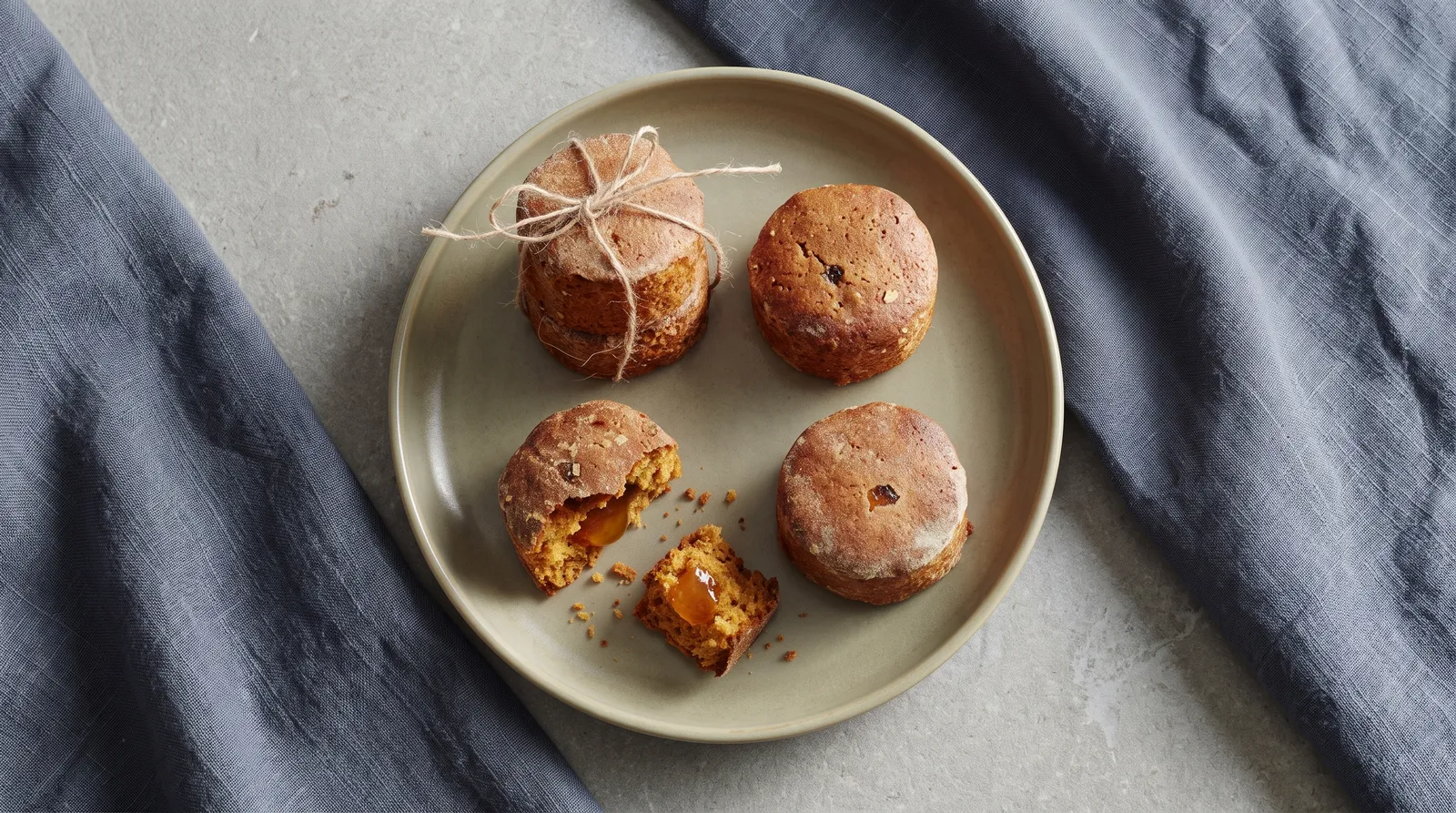
Small round honey-and-spice cakes hide an orange-marmalade centre under a thin lemon glaze, keeping the character of Dijon pain d’épices.

French National Dishes
Share
Nonnettes de Dijon — resting on baking parchment
Prep 25 minutes
Cook 20 minutes
Total 165 minutes
Yield 12 small cakes
Introduction and overview

Nonnettes de Dijon with honey, spices and orange marmalade

Nonnettes de Dijon are small round honey-and-spice cakes related to pain d’épices, with orange marmalade enclosed in the centre. They should not be treated as generic muffins: the crumb comes from a honeyed gingerbread-style batter, the spice profile is restrained, and the citrus filling is hidden inside rather than spooned over the top. A thin glaze finishes the cake only after it has cooled completely.

This household batter combines wheat and rye flour with honey, brown sugar, butter, spices and bicarbonate. Water, honey, sugar and butter are heated together only until smooth; honey syrup can cause serious burns, so the saucepan should stay stable and splashing must be avoided. The hot mixture is worked into the dry ingredients and then rested for one hour, giving the flours time to hydrate before the small moulds are filled.

Each of twelve 6 cm × 3 cm cavities receives batter, exactly 10 grams of orange marmalade in the centre, and enough remaining batter to cover the filling. Bake at 200 °C until the tops are dry-set and the centres spring back lightly, then cool for 30 minutes before glazing. The lemon icing needs another 30 minutes to set. Pack only when the glaze is dry to the touch; otherwise the cakes stick together and trap moisture.
Success points

Success points

  • Heat the honey syrup only until smooth; do not caramelise it.
  • Give the batter the full one-hour rest.
  • Keep 10 g marmalade centred and completely enclosed in each cake.
  • Bake until the centre springs back without drying the crumb.
  • Cool fully before glazing and let the glaze set before packing.
Ingredients

Ingredients

Cake batter

  • 160 g plain wheat flour
  • 120 g rye flour
  • 200 g honey
  • 150 ml water
  • 100 g brown sugar
  • 80 g unsalted butter
  • 10 g bicarbonate of soda
  • 5 g gingerbread spice
  • 2 g ground cinnamon

Filling and glaze

  • 120 g orange marmalade — 10 g per cake
  • 80 g icing sugar
  • 20 ml lemon juice
Method

Method

Batter

  1. Make the honey syrup. Heat the 150 ml water, 200 g honey, 100 g brown sugar and 80 g butter just until the butter melts and the mixture is homogeneous. Cook for about 4 minutes. The hot syrup is smooth, the butter is fully melted and no dry sugar remains on the pan base. A warm syrup disperses honey and sugar evenly through the flours. Hot honey syrup can cause severe burns; keep the pan stable and avoid splashes.

  2. Mix the batter. Whisk the wheat flour, rye flour, bicarbonate, gingerbread spice and cinnamon together, then pour in the hot syrup and mix to a smooth thick batter. Allow about 10 minutes. The batter is smooth, thick and evenly spiced with no pockets of dry flour.

  3. Rest the batter. Cover the batter and let it rest before filling the moulds. Allow 60 minutes resting. The rested batter is cohesive and slightly thicker but still spoonable. The rest hydrates the rye and wheat flours.

Fill, bake and glaze

  1. Fill the moulds. Divide half the batter among twelve greased 6 cm × 3 cm round mould cavities, place 10 g orange marmalade in the centre of each, then cover with the remaining batter so the filling is enclosed. Allow about 15 minutes. The marmalade is centred and completely covered by batter in every mould. Enclosing the filling prevents exposed jam from burning.

  2. Bake the cakes. Bake at 200 °C until the tops are set and the centres spring back lightly. Cook for about 16 minutes. The cakes are risen, the tops are dry-set and the centre springs back lightly without a wet batter line. The cakes should bake through without drying hard.

  3. Cool before glazing. Cool the cakes completely in the mould briefly, then on a rack. Allow 30 minutes cooling. The nonnettes are completely cool and firm enough to glaze without melting the icing.

  4. Glaze and set. Mix the 80 g icing sugar with the 20 ml lemon juice, brush a thin coat over the cooled cakes and leave the glazed cakes to rest uncovered until dry. Allow 30 minutes resting. The glaze is dry to a light fingertip touch and no longer tacky before storage. A fully set glaze prevents cakes sticking together in storage.

Serving and planning

Practical

Serving

Serve at room temperature once the glaze is dry. Each cake should reveal a distinct orange centre inside a moist honey-spice crumb.

Make-ahead

Nonnettes suit advance preparation. Bake, cool and glaze them several hours before serving so the glaze can set and the honey-spice aroma can settle.

Storage and reheating

Store in an airtight container at cool room temperature for up to four days after the glaze has set. Reheating is unnecessary and can melt the icing or loosen the marmalade.

Substitutions

A thick bitter-orange preserve can replace standard orange marmalade if it has a similar consistency. Avoid thin jam, which is more likely to leak through the batter during baking.

Troubleshooting

Marmalade leaking onto the tray means the filling was not fully enclosed; cover each 10 g centre completely before baking.

Troubleshooting

Dry cakes have been overbaked; remove them when the centre springs back rather than waiting for a dark crust.

Troubleshooting

Sticky stored cakes were glazed or packed while warm; cool fully and give the glaze the full setting period.

Nutrition per serving

Nutrition per serving

  • Serving size1 of 12 cakes, including 10 g marmalade and glaze
  • Calories265 kcal
  • Carbohydrate53 g
  • Protein2.6 g
  • Fat5.8 g
  • Fibre2.2 g
  • Sodium235 mg
Allergens and food safety

Allergens and food safety

Allergens: Gluten, Milk

Safety: Hot honey syrup is a burn hazard; keep children away from the pan and handle with care.

Safety: Honey-containing foods must not be fed to infants younger than 12 months because of infant botulism risk.

Safety: Cool fully before airtight storage.

FAQ

FAQ

Why use both wheat and rye flour?

The blend gives a gingerbread-style crumb and deeper grain flavour while remaining light enough for small filled cakes.

Can babies eat nonnettes made with baked honey?

No. Honey-containing foods should not be given to children younger than 12 months because of the risk of infant botulism.

Closing

Closing

  • Result: Small round honey-and-spice cakes hide an orange-marmalade centre under a thin lemon glaze, keeping the character of Dijon pain d’épices.
  • Decisive technique: Heat the honey syrup only until smooth; do not caramelise it.