
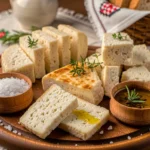
Soparnik (Poljički Chard Pie) – Traditional Recipe

Soparnik – Dalmatian Chard Filled Pie From Poljica

Soparnik is one of those dishes that quietly tells the story of a place. In this case, that place is Poljica, a historic rural region in central Dalmatia, tucked between Split and Omiš. For centuries, families there have stretched a simple dough of flour, water, salt, and a little olive oil into a thin round, filled it with chard and onion, then baked it on a hot stone under embers on the household hearth, or komin

At first glance, soparnik seems almost austere. The filling contains no cheese, meat, or eggs—only Swiss chard (or local blitva), onions, salt, and a measured amount of olive oil. The dough is unleavened and rolled very thin, closer to a covered flatbread than a deep pie. Yet this restraint gives the dish its character. The heat of the oven softens the chard and onion just enough, so that the vegetables steam inside the sealed crust. Once baked, the top is brushed with warm garlic and olive oil, which sinks into the surface and perfumes every slice. 

Historically, soparnik belonged to colder months, when older chard with a sweeter, deeper flavour grew in the fields around Poljica. It often appeared on fasting days and at important gatherings, making it both modest and ceremonial at the same time. Over time, the dish moved from farmhouse hearths to local festivals, markets, and restaurant menus. Today, the traditional method of making Poljički soparnik is listed as intangible cultural heritage in Croatia, and the pie itself carries protected status at the European level.

Despite that official recognition, its soul remains rural. The filling should taste of chard first, with onion and parsley in a supporting role, while olive oil and garlic finish the baked pie rather than dominate every bite. The crust ought to be thin but not brittle, with enough strength to hold the moist filling yet tender enough to tear cleanly when cut into the traditional rhombus-shaped pieces.

This version keeps close to that pattern. The dough follows a classic Poljica ratio of flour to water with a modest amount of olive oil, rolled as thin as a home oven reasonably allows, on a sheet pan instead of a stone hearth. The filling uses plenty of chard, a mix of onion and spring onion for freshness, and a restrained hand with salt so the minerals in the greens still come through. A final brushing of warm garlic oil gives the top its signature aroma and gloss.

From a practical cooking perspective, soparnik suits several situations. It works as a shared starter at the centre of the table, a light main with a simple salad, or a snack that can travel to a picnic. The recipe incidentally fits a vegetarian table and can be adapted for vegan visitors without any changes at all, since the traditional version contains no dairy or eggs. Slices keep reasonably well at room temperature for a few hours, which suits parties and gatherings.

For home cooks, the main task lies in handling a large, thin sheet of dough and spreading the filling evenly so that the crust cooks through while the chard softens. The method described here breaks that task into manageable steps: salting and resting the chard, mixing and resting the dough, rolling each round on baking paper, then assembling and baking on a standard oven tray at a high but controlled heat.

The result is a large, flat pie with a fragrant, lightly blistered top, a soft but not soggy interior, and a clean line of filling when cut. It tastes distinctly of Dalmatian fields, olive oil, and wood-fired traditions, even when baked in an everyday kitchen oven.

Soparnik (Poljički Chard Pie) – Traditional Recipe

Recept készítője Travel S HelperPálya: Appetizer, PieKonyha: horvátNehézség: Közbülső
Adagok

10

adagok
Előkészítési idő

45

jegyzőkönyv
Főzési idő

20

jegyzőkönyv
Kalória

260

kcal

This soparnik recipe produces a large, round Poljički-style chard pie with paper-thin unleavened dough and a generous layer of seasoned Swiss chard and onions. The dough comes together from flour, water, salt, and olive oil, then rests briefly for easier rolling. Raw chard strips mix with spring onions, parsley, olive oil, and salt, then steam inside the sealed crust during a quick, hot bake. Once out of the oven, the pie is brushed with warm garlic oil and cut into traditional rhombus-shaped pieces. The method suits an intermediate home cook, takes a little over an hour, and yields about ten servings—ideal for sharing as an appetizer, light main, or part of a Dalmatian-style spread with cheese, cured meats, and olives.

Hozzávalók

  • A tésztához
  • 500 g univerzális liszt — standard wheat flour; type 400–550 works well.

  • 1 tsp fine sea salt — seasons the dough; use slightly less if serving with very salty sides.

  • 250 ml lukewarm water — helps the dough come together smoothly.

  • 4 Tbsp extra-virgin olive oil — adds flavour and tenderness to the crust.

  • 1 tsp mild vinegar (wine or apple cider) — optional; helps the dough stretch and stay supple.

  • For the Chard Filling
  • 1 kg Swiss chard (blitva), stems removed, leaves cut into thin strips — central flavour; weight measured after trimming thick stems.

  • 1 közepes sárga hagyma, finomra aprítva — gives sweetness and depth.

  • 4–5 spring onions, finely sliced (white and green parts) — adds freshness and a light bite.

  • 1 small bunch flat-leaf parsley, finely chopped (about 20 g) — traditional aromatic herb in Poljica-style versions.

  • 2½–3 tsp fine sea salt — divided; start with 2½ tsp for the full batch, then adjust to taste.

  • 3 evőkanál extra szűz olívaolaj — mixed into the filling to help the greens soften and release flavour.

  • Frissen őrölt fekete bors (opcionális) — not strictly traditional but suits some tables.

  • For the Garlic Oil Topping
  • 4 large garlic cloves, very finely minced — classic finish over the hot pie.

  • 3 evőkanál extra szűz olívaolaj — warmed with garlic for brushing.

  • Small pinch fine sea salt — just enough to season the surface lightly.

  • Extra chopped parsley (optional, 1–2 Tbsp) — for a fresh herbal note on top.

Útvonalterv

  • Készítse elő a tésztát
  • Mix the dry ingredients. Combine flour and salt in a large bowl, making a well in the centre.

  • Add liquids and bring together. Pour in water, olive oil, and vinegar, then mix with one hand or a wooden spoon until a rough dough forms and no dry flour remains.

  • Gyúrd össze a tésztát. Transfer to a lightly floured surface and knead for 6–8 minutes, until smooth and elastic but still firm to the touch.

  • Pihentesd a tésztát. Shape into a ball, coat lightly with oil, cover the bowl, and let it rest at room temperature for 30 minutes; this relaxes the gluten and makes thin rolling easier.

  • Prepare the Chard Filling
  • Trim and wash the chard. Strip the leaves from thick stems, rinse well, and dry thoroughly in a salad spinner or layered in clean towels; excess water leads to a soggy filling.

  • Cut the leaves. Stack the leaves, roll into tight bundles, and slice into thin strips about 5–8 mm wide.

  • Combine vegetables. In a large bowl, mix chard strips, chopped onion, sliced spring onions, and chopped parsley.

  • Season the filling. Sprinkle with salt, add olive oil and a little black pepper if using, then toss thoroughly with clean hands until the greens glisten and start to soften slightly.

  • Rest the filling. Let the mixture stand for 10–15 minutes while the dough rests; during this time the salt draws out some moisture and helps the greens wilt.

  • Nyújtsa ki a tésztát
  • Divide the dough. Turn the rested dough onto a lightly floured surface and cut into two equal pieces; keep one piece covered.

  • Prepare the baking surface. Line a large baking tray (about 40 cm wide if possible) with baking paper and dust it lightly with flour.

  • Roll the base. Roll the first piece of dough into a thin round, about 2–3 mm thick and slightly larger than the tray, then transfer it onto the prepared baking paper.

  • Roll the top. On a floured surface, roll the second piece of dough to a similar thin round, again 2–3 mm thick; keep it lightly floured so it does not stick.

  • Assemble the Soparnik
  • Spread the filling. Distribute the chard mixture evenly over the base layer of dough, leaving a 2–3 cm border all around; gently press the filling so that the layer stays level.

  • Cover with the top crust. Lift the second round of dough with the help of the rolling pin or forearms, lay it over the filling, and align the edges as neatly as possible.

  • Seal the rim. Fold and twist the overlapping edges of top and bottom dough together all around the pie so that the filling is enclosed and no gaps remain.

  • Prick the surface. Use a fork or the tip of a knife to prick the top in several places; this allows steam to escape and helps the crust bake evenly.

  • Bake and Finish
  • Melegítse elő a sütőt. Heat the oven to 200°C (392°F), conventional setting, with a rack in the lower-middle position. 

  • Bake the soparnik. Slide the tray into the hot oven and bake for 18–22 minutes, until the top turns a light golden colour with a few darker spots and the crust feels firm when tapped.

  • Prepare the garlic oil. While the pie bakes, gently warm olive oil in a small pan over low heat, add minced garlic and a pinch of salt, and heat for 1–2 minutes, just until the garlic becomes fragrant without colouring.

  • Brush the baked pie. Remove the soparnik from the oven, let it stand for 3–5 minutes, then brush the surface generously with the warm garlic oil; scatter a little chopped parsley on top if using.

  • Vágjuk fel és tálaljuk. Transfer the pie to a large board if practical, then cut into rhombus-shaped pieces or simple squares and serve warm or at room temperature.

Tippek, hibaelhárítás és variációk

  • Tálalási javaslatok és párosítások
    Soparnik works well at the centre of a shared table. It pairs neatly with brined or marinated olives, Dalmatian-style cheeses, cured meats, and simple salads of tomato, cucumber, and onion. Dry white wines from Dalmatia, light coastal reds, or a chilled rosé suit the gentle bitterness of chard and the richness of the garlic oil. Non-alcoholic options such as sparkling water with lemon or unsweetened herbal tea keep the palate refreshed between bites.
  • Tárolás és újramelegítés
    Leftover slices keep in an airtight container in the refrigerator for up to 2 days. For best texture, reheat on a baking tray at 170°C for 8–10 minutes, just until the crust regains a slight crisp edge and the centre warms through. A short interval at room temperature before reheating helps. The pie can be eaten cold as well, though the crust softens and the garlic aroma becomes more pronounced on the second day.
  • Variációk és helyettesítések
    A kale-and-spinach mix can stand in for chard where needed, provided the greens are finely shredded and dried well. For a faster, weeknight version, the dough can be rolled slightly thicker and baked in a smaller tray, which shortens rolling time but gives a more bread-like crust. A seasonal twist might include a small handful of finely sliced young cabbage mixed into the filling, a variation that appears in some local recipes. A gluten-free version demands a strong, high-starch blend and gentler handling; rolling between two sheets of baking paper helps keep the dough intact.
  • Séf tippjei
    Thin, even rolling is more helpful than absolute size; a 2–3 mm crust bakes through cleanly without drying out. Very wet greens lead to soggy results, so careful drying and a short rest with salt before assembly make a real difference. A heavy, dark baking tray gives stronger bottom heat and a better base crust than a very thin or warped pan. Finally, the garlic should warm gently in the oil rather than fry; this keeps the aroma bright and avoids bitterness.
  • Szükséges felszerelés
    A large mixing bowl, sturdy wooden spoon, and a clean work surface handle the dough. A sharp knife and large cutting board make trimming and slicing the chard easier, while a salad spinner or clean kitchen towels help dry the leaves thoroughly. A rolling pin is highly recommended, since the dough needs to reach a wide, thin round. A large baking tray lined with baking paper stands in for the traditional hearth stone and keeps the base from sticking. A small saucepan or heatproof bowl for warming the garlic oil rounds out the list; its size matters less than the ability to heat the oil gently and evenly.

Tápanyagtartalom

Approximate values for one of 10 servings, based on standard reference data and the quantities listed above:

TáplálóHozzávetőleges mennyiség adagonként
Kalória~260 kcal
Szénhidrátok~40 g
Fehérje~6 g
Zsír~11 g
Rost~4 g
Nátrium~550 mg
Főbb allergénekGluten (wheat); no dairy, eggs, nuts, or soy in the base recipe

These figures serve as rough guidance only. Exact values vary with flour brand, chard size and age, salt level, and the precise amount of olive oil absorbed into the crust.

augusztus 11, 2024

Velence, az Adriai-tenger gyöngyszeme

Romantikus csatornáival, lenyűgöző építészetével és nagy történelmi jelentőségével Velence, ez a bájos Adriai-tenger partján fekvő város, lenyűgözi a látogatókat. Ennek a nagyszerű központnak a…

Velence-az-Adria-tenger-gyöngy
augusztus 12, 2024

Top 10 – Európa pártvárosai

Fedezze fel Európa leglenyűgözőbb városainak nyüzsgő éjszakai életét, és utazzon emlékezetes úti célokra! London vibráló szépségétől az izgalmas energiákig…

A 10 legjobb-EURÓPAI-SZÓRAKOZÁS-FŐVÁROS-Utazás-S-Helper