

How to use an onsen in Japan — and choose the right hot spring town
An onsen visit is not simply a spa appointment. It combines a regulated natural spring, a shared bathing ritual, local geology and, in many destinations, an overnight stay in a ryokan. The practical rules are straightforward once you know the sequence: change, wash thoroughly, enter the bath without swimwear, keep towels and hair out of the water, soak quietly and leave the wet area dry.
This guide explains the complete process for first-time visitors, including tattoo policies, private baths, family needs, ryokan meals, health precautions and transport planning. It then compares Japan’s major onsen towns and gives destination-specific routes for Hakone, Kusatsu, Kinosaki, Beppu, Kurokawa, Noboribetsu, Dōgo and Ibusuki.
What an onsen is — and how it differs from a sentō or spa
Japanese law defines a hot spring by water, mineral water, vapor or gas emerging from underground and meeting temperature or specified-substance criteria. The legal category concerns the source; the visitor experience depends on the bathhouse, mineral profile, water handling and setting.
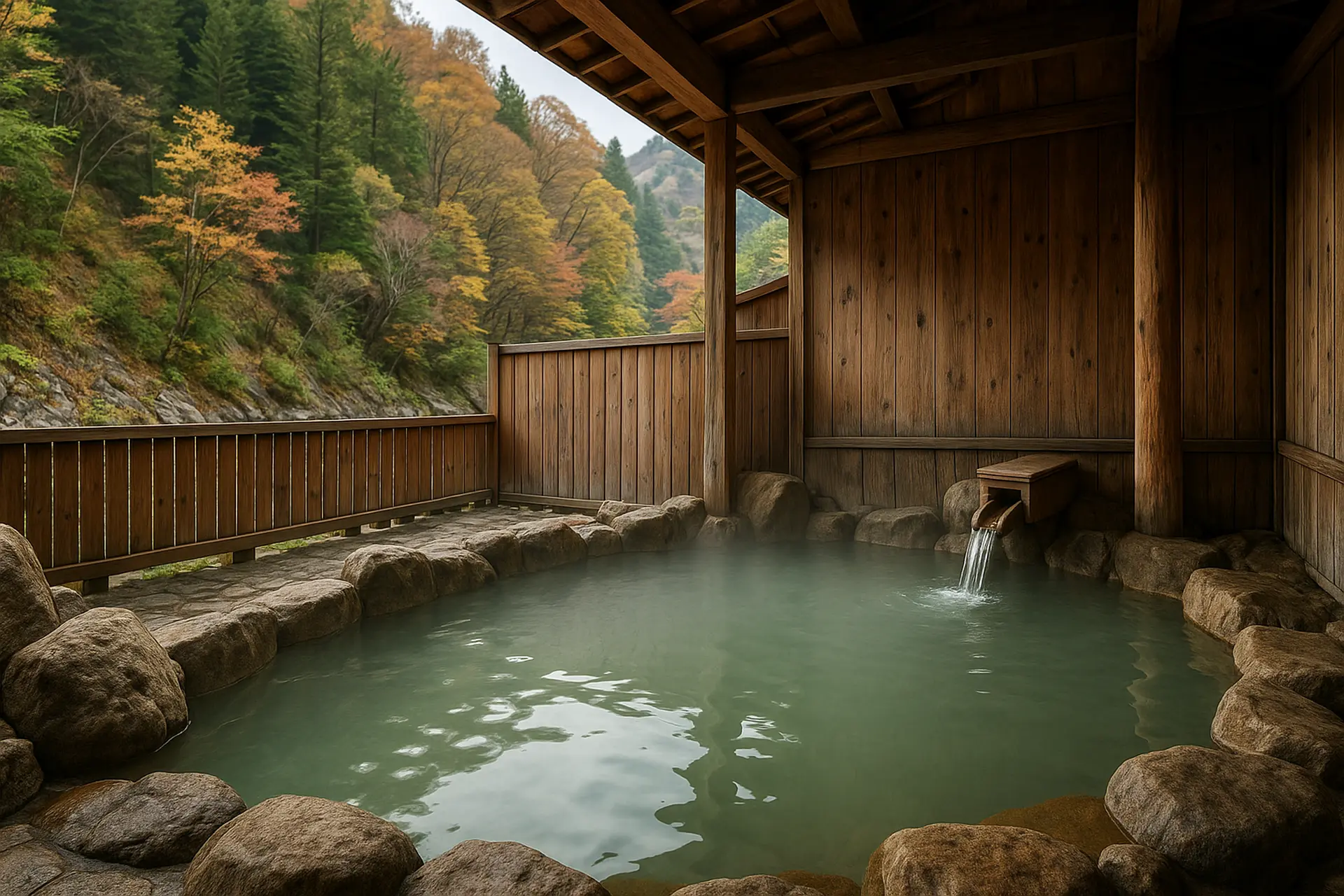
A bath supplied by natural hot-spring water may be indoors or outdoors. The landscape changes the atmosphere; the same hygiene and privacy rules still apply.
Minerals shape the water; the town shapes the trip
Onsen water can be clear, milky, greenish, rust-colored or almost black depending on dissolved minerals and oxidation. Sulfur springs announce themselves through scent; iron-rich water can leave reddish deposits; chloride springs often feel warming; bicarbonate and alkaline waters may feel smooth on the skin. These descriptions are useful for understanding texture and geology, not for treating the bath as a cure.
The same spring can produce different experiences. A large resort may circulate or adjust temperature for comfort, while a small inn may emphasize water flowing directly from the source. Some baths alternate hot and cooler pools; others provide only one deep tub. Outdoor baths add air temperature, weather and scenery to the experience, which is why winter rotenburo can feel entirely different from a summer soak.
Onsen towns developed around reliable sources, transport routes and lodging. Their local identity often extends beyond bathing: Hakone connects volcanic valleys with museums; Kinosaki organizes the entire evening around public bath-hopping; Beppu uses steam for cooking; Dōgo links a historic bathhouse district with Matsuyama’s castle town; Ibusuki turns geothermal heat into sand bathing on the coast.
Terms that make signs and bookings easier to understand
Romanization varies. Search both the town name and the Japanese bathing term when comparing accommodation.
Ryokan · 旅館
A Japanese-style inn, often with tatami rooms, futon bedding, communal baths and meal plans. Not every ryokan has natural onsen water.
Higaeri onsen · 日帰り温泉
A day-use hot spring. Some are standalone bathhouses; others are ryokan baths opened to non-guests during limited periods.
Gensen kakenagashi · 源泉かけ流し
Water flows from the source into the bath and out again rather than being continuously recirculated. Exact handling still varies by facility.
Yukata · 浴衣
A light cotton robe supplied by many inns. Guests commonly wear it around the ryokan and, in onsen towns, while walking between bathhouses.
Kaiseki · 懐石
A seasonal multi-course meal. At an onsen ryokan, it is often a central part of the stay rather than an optional restaurant dinner.
Yumeguri · 湯めぐり
Bath-hopping between several facilities or springs, sometimes with a pass, token or inn-issued ticket.
How to use an onsen in Japan, step by step
The sequence is designed to protect shared water and keep the changing room dry. Most first-time uncertainty disappears when you remember one principle: wash outside the bath; soak inside it.
Eight stages from entrance to cool-down
Confirm the correct bath, tattoo policy, towel arrangements and any temporary rules.
Use the shoe rack or locker before entering clean indoor areas.
Leave clothes, phone, large towel and valuables in the changing room.
Carry it for washing and modesty, but keep it out of every bath.
Sit at a shower station, use soap and shampoo, and rinse your body and stool completely.
Test the heat, lower yourself slowly and keep hair above the water.
Do not swim, splash, photograph, wash or submerge your head.
Use the small towel to remove surface water before returning to the dry room.
Prepare without overpacking
- Bring a hair tie: Long hair must stay out of the water.
- Carry some coins: Smaller facilities may use coin lockers or sell towels separately.
- Remove jewelry: Heat, minerals and sulfur can damage some metals.
Control heat and pace
- Start briefly: A first soak can be only a few minutes; leave before dizziness or nausea.
- Use a lower step: Shallow immersion reduces heat load while you acclimate.
- Правете си почивки: Several short soaks are often more comfortable than one long session.
Cool down before moving on
- Hydrate: Drink water before and after hot bathing.
- Rinse when needed: Sensitive skin may benefit from rinsing after acidic or sulfur-rich water.
- Sit if lightheaded: Do not rush into stairs, driving or strenuous activity.
Changing area, washing stations and bath zone
The changing room may have lockable cupboards, open baskets or a mixture of both. Put the large towel with your clothes; carry only the small towel into the wet area. Phones and cameras stay locked away because both the changing room and bath are private spaces.
Washing stations usually have a low stool, basin, handheld shower and toiletries. Sit while washing to keep spray controlled. Rinse away every trace of soap and clean the stool and basin before moving to the bath. A brief pour of warm water over your limbs and torso helps you adjust to the temperature.
When you leave the pool, move carefully on wet stone. You may follow the facility’s advice on whether to rinse. Before opening the changing-room door, use the small towel to remove enough water that you are not dripping across the dry floor. Dry fully with the large towel, dress, return borrowed items and drink water.
Onsen rules that matter — and why they exist
Most etiquette protects one of three things: water cleanliness, personal privacy or a calm shared atmosphere. The rules are easier to remember when you connect each action to its purpose.
Six behaviors that prevent nearly every mistake
Facility-specific exceptions exist, especially in swimsuit zones and mixed or outdoor settings. Posted rules override general practice.
Wash before soaking
The shared pool is for clean bodies, not for bathing with soap. Rinse shampoo, conditioner and body wash completely.
Do not wear swimwear
Standard gender-separated onsen require nudity. Swimsuits are used only where a facility explicitly creates a swimsuit zone.
Keep the towel out
Place the small towel on your head or on a dry edge. Do not wash it, wring it out or dip it in the bath.
Keep hair above water
Tie long hair securely. Do not submerge your head, which also reduces the chance of water entering your mouth.
Protect everyone’s privacy
No phones, cameras or recording devices belong in changing or bathing areas, even when the room seems empty.
Use a quiet voice
Conversation is usually acceptable, but splashing, shouting, swimming and prolonged group chatter change the room for everyone.
Actions that help the bath run smoothly
- Rinse the washing stool and basin when finished.
- Enter and leave slowly because heat can affect balance.
- Use the correct changing room by reading signs, not relying only on curtain color.
- Follow temporary instructions for water temperature, closures or cleaning.
Common first-time errors
- Do not reserve a place with personal items or spread belongings across benches.
- Do not shave, brush teeth, wash clothes or bring food into the wet area.
- Do not bathe after heavy drinking, during fever or while actively bleeding.
- Do not assume a tattoo policy based on another bath in the same town.
Rules that vary by facility
- Some baths request a final rinse; others suggest leaving mineral water on the skin.
- Mixed baths may supply approved bathing garments; ordinary towels are not automatically permitted.
- Children’s age and gender rules depend on local regulation and facility policy.
- Day-use hours, guest limits and amenity availability change seasonally.
Clean body, clean water, quiet room, protected privacy
Onsen etiquette does not require perfect Japanese or elaborate ritual knowledge. A thorough wash, a towel kept outside the bath, controlled movement and respect for privacy cover the essentials. When a facility uses different rules—such as a swimsuit area, private bath or mixed-gender rotenburo—it will normally state them at the entrance or during check-in.
How to plan around tattoos, families, gender and mobility needs
Access depends less on national custom than on the exact facility. A public bath, a ryokan’s communal bath and a private room bath in the same town may each have different rules.
Do not rely on assumptions or outdated lists
Some onsen still refuse any visible tattoo, while others accept small tattoos if fully covered with an approved patch. A growing number welcome tattooed guests without covering, and private baths usually remove the communal-entry issue. The dependable approach is to confirm the current written policy with the exact bath or accommodation before booking.
Kinosaki’s seven public bathhouses openly accept tattoos of all sizes, but individual ryokan baths in Kinosaki can set separate policies. Elsewhere, a town may be described as tattoo-friendly because several facilities accept tattoos, not because every bath does. Save a screenshot or message confirming permission when the policy matters to the trip.
For a small tattoo, ask whether a waterproof cover is accepted and whether the facility sells an approved size. For larger or multiple tattoos, search for kashikiri baths, an in-room onsen or a tattoo-welcoming public bath. Do not hide a tattoo when a facility explicitly requires disclosure.
Children and infants
Ask about diaper, toilet-training, age and gender rules before arrival. Water can be too hot for young children, and slippery edges require close supervision. A family bath gives parents control over pace and avoids uncertainty about which public bath a child should use.
Communal versus private bathing
Most standard facilities separate men and women. Mixed-gender baths are uncommon and use their own covering rules. Travelers who need a private, gender-inclusive or family arrangement should search for kashikiri, kazoku-buro or an in-room bath and confirm who may use it together.
Ask about the physical route
Useful questions include whether the bath has steps, handrails, a bathing chair, a transfer area, an accessible changing room or a private bath near the guest room. Historic bathhouses may have steep stairs and deep stone pools; modern hotels often provide easier routes.
Use hot water conservatively
Mineral water may feel therapeutic, but onsen should not be treated as a substitute for medical care.
Do not bathe when unwell
Avoid hot bathing with fever, active bleeding, severe exhaustion or acute worsening of an illness. Follow medical guidance for serious heart, lung or kidney conditions.
Avoid alcohol and dehydration
Do not enter after heavy drinking. Drink water before and after bathing, and avoid soaking immediately before or after a large meal.
Respect skin sensitivity
Acidic and sulfur springs can irritate sensitive skin. Use a shorter soak, rinse afterward when advised and leave if burning or rash develops.
Prevent falls
Stone floors, wooden steps and sudden changes in blood pressure can affect balance. Use handrails and avoid bathing alone when assistance may be needed.
Do not drink bath water
Mineral water should be consumed only where a clearly marked drinking source permits it and only according to posted limits.
Leave before symptoms build
Dizziness, headache, nausea, palpitations or unusual breathlessness are reasons to exit, cool down and seek help.
How to book an onsen ryokan without missing the important details
An onsen ryokan is often priced and scheduled differently from a city hotel. The bath, room, dinner and breakfast form one experience, so arrival time and meal choices matter.
Confirm these items before payment
Futon rooms are traditional; Western beds may suit mobility or sleep preferences.
Confirm whether a private bath uses onsen water and requires a timed reservation.
Rates may be per person. Check dining location and the latest meal start time.
Ask the property directly when a listing does not state the rule clearly.
Late arrival can disrupt a multi-course meal and staff preparation.
Reserve transfers when required and note the final connection.
Kaiseki menus are preplanned; some allergies and dietary restrictions cannot be handled last minute.
Meal-inclusive inns may have stricter cancellation schedules than city hotels.
One night can be enough
- Arrive mid-afternoon, bathe before dinner and take a second soak in the morning.
- Choose half board when the inn’s cuisine is part of the destination.
- Use luggage forwarding or station lockers to avoid carrying large bags through a small town.
Common booking misunderstandings
- A “private bathroom” may mean a normal shower, not a private onsen.
- An “open-air bath” may be communal rather than attached to the room.
- A room rate may display for one guest even when two-person occupancy is assumed.
What to expect at dinner
- Kaiseki moves through small seasonal dishes rather than one large main course.
- Regional specialties may include mountain vegetables, river fish, local beef, crab or citrus.
- Tipping is not expected; settle extras according to the inn’s checkout process.

A meal-inclusive stay often centers on small regional dishes served at a fixed dinner time.
Which Japanese onsen town is best for your itinerary
The right choice depends on your gateway city, preferred landscape and whether bathing is the whole trip or one part of a wider route. The table below emphasizes differences that affect planning.
Eight onsen destinations compared
| Дестинация | Най-добро за | Портал | Distinctive experience | Ideal stay | Planning note |
|---|---|---|---|---|---|
| Хаконе | First-time visitors and Tokyo side trips | Tokyo / Odawara | Ropeway, Owakudani, Lake Ashi and art museums | 1–2 нощи | Choose a base around the transport loop or Hakone-Yumoto. |
| Кусатсу | Classic mountain onsen atmosphere | Tokyo / Karuizawa or Naganohara | Yubatake, yumomi culture and acidic water | 1–2 нощи | High elevation brings colder weather and winter conditions. |
| Kinosaki | Public bath-hopping and tattoos | Kyoto / Osaka | Seven public bathhouses linked by a canal town | 1–2 нощи | Public baths welcome tattoos; accommodation baths set their own rules. |
| Беппу | Geothermal variety and active sightseeing | Fukuoka / Oita | Eight spring areas, steam cooking, hells and sand bathing | 2 нощувки | Baths and attractions are spread across several districts. |
| Kurokawa | Forest ryokan and quiet rotenburo | Kumamoto / Fukuoka | Bath-hopping among inns in a wooded valley | 1–2 нощи | Bus planning matters; a car simplifies wider Aso exploration. |
| Ноборибецу | Volcanic scenery and winter travel | Sapporo / New Chitose | Jigokudani, mineral variety and forest walks | 1–2 нощи | Snow and ice can affect walking routes and road travel. |
| Dōgo | Historic bathhouse architecture and city culture | Мацуяма | Public baths near shopping arcades, temples and castle sights | 1–2 нощи | Verify access and current operating arrangements at each bathhouse. |
| Ibusuki | Coastal relaxation and unusual bathing | Kagoshima | Geothermal sand bath followed by a conventional soak | 1 нощ | Sand-bath access can change with weather and facility operations. |
Choose access over remoteness
Hakone fits a Tokyo–Kyoto route without a major detour. Kinosaki works well from Kansai. Beppu adds a strong onsen chapter to a Kyushu itinerary. These destinations provide enough English guidance and transport structure for a first visit.
Choose altitude or northern latitude
Noboribetsu and Kusatsu pair cold air with hot outdoor baths. Ginzan and Nyūtō are atmospheric alternatives, but accommodation supply and winter transport can be less flexible, so book them as destination stays rather than casual stops.
Choose a village with little evening transit
Kurokawa favors slow walks, inn baths and early meals. It is a better fit for travelers who want to stay in the valley than for those trying to fill the day with separate attractions.
Hakone — the most practical onsen escape from Tokyo
Hakone combines hot-spring lodging with a mountain transport circuit, Lake Ashi, the Owakudani volcanic valley and major art museums. It suits travelers who want an onsen stay without giving up a full day of sightseeing.

A weather-protected bath and garden view illustrate the quiet overnight rhythm that makes Hakone practical in colder months.
Hakone works because the bath is part of a complete mountain route
Hakone is not one compact town. It is a network of valleys, lakefront areas and resort districts connected by distinctive transport. Hakone-Yumoto sits at the lower gateway with many inns and day-use baths. Gora offers the easiest access to the Open-Air Museum and the cable-car route toward Sounzan. The ropeway then crosses the active Owakudani landscape before descending toward Lake Ashi.
This geography makes accommodation choice important. A traveler arriving late or leaving early benefits from Hakone-Yumoto. A museum-focused visit works well in Gora. A lakeside inn creates a quieter stay but may require more bus planning. Mount Fuji views are weather-dependent and should be treated as a bonus rather than the reason to book a specific room.
The best rhythm is one overnight stay with an afternoon bath, an early kaiseki dinner and a morning circuit through Owakudani and Lake Ashi. A second night allows the Pola Museum, Venetian Glass Museum, old Tōkaidō road or a slower lake walk without turning the transport loop into a race.
What to do between baths
Build around transport geography rather than trying to visit every museum and viewpoint.
Owakudani
Ride the ropeway above sulfurous vents and stop at the volcanic valley for views, geology displays and the area’s black eggs.
Lake Ashi
Use the sightseeing boat as transport, then walk near Hakone Shrine, the lakeside torii and the former checkpoint district.
Hakone Open-Air Museum
Large sculpture gardens and indoor galleries make this a strong half-day stop close to Chōkoku-no-Mori Station.
Old Tōkaidō road
Walk a manageable section of cedar-lined historic road and stop at Amazake Chaya for a route tied to Edo-period travel.
Day-use onsen
Try a hotel or standalone bath when staying elsewhere, but verify admission windows and tattoo rules directly.
Ryokan evening
Leave enough time for check-in, bathing and dinner; Hakone’s value drops when the inn becomes only a place to sleep.
A balanced one-night Hakone itinerary
Travel to Hakone-Yumoto or Odawara and forward or store luggage.
Choose one major activity, then reach the ryokan before dinner.
Soak before dinner and again later if comfortable.
Cross Owakudani, continue to Lake Ashi and return via bus or the full loop.
Kusatsu — highland streets built around the Yubatake
Kusatsu’s identity is visible in the town center, where hot water moves through the Yubatake’s wooden channels before reaching baths and inns. The sulfur scent, rising steam and traditional water-cooling culture make the source part of the streetscape.

Steam, cold air and timber inns reflect the mountain-town atmosphere that draws visitors to Kusatsu after dark.
Why Kusatsu feels different from a resort attached to a city
The Yubatake turns the spring source into public infrastructure and theater. Water emerges at high temperature, moves through wooden channels and is distributed through town. Around it, inns, sweet shops, cafés and small lanes create a compact center that remains active after day visitors leave.
Yumomi demonstrations explain the traditional method of cooling water by stirring it with long paddles rather than diluting it. Sainokawara Park extends the geothermal landscape into a valley walk with visible streams and pools. The town’s elevation gives it a different climate from lowland Tokyo, with snow in winter and cooler evenings in summer.
Kusatsu suits travelers who want bathing to dominate the itinerary. One night covers the central streets and a ryokan experience; two nights allow several baths, a slower park walk and seasonal hiking or skiing. It is less convenient than Hakone but more coherent as a single onsen town.
Yubatake to Sainokawara
Begin at the Yubatake, follow Sai-no-Kawara Street past snack shops and continue into Sainokawara Park. Return after dark when the central steam and lighting create a different atmosphere.
Do not over-schedule multiple hot pools
Strong water and high temperatures can tire first-time bathers. Alternate bathing with meals, walks and rest instead of treating every facility as a checklist item.
Pack for altitude
Winter requires footwear suitable for snow and ice. Even in warmer months, evenings can be cooler than Tokyo, and mountain weather can change quickly.
A one-night Kusatsu rhythm
Store luggage, walk the center and check bath policies.
Follow the geothermal valley and return before ryokan check-in.
See the water-cooling tradition, then settle into the inn.
Bathe briefly, eat breakfast and explore side streets before departure.
Kinosaki — seven public baths, willow canals and yukata streets
Kinosaki organizes the whole town around sotoyu, public bathhouses used by visitors moving between ryokan in yukata and geta. Its seven public baths accept tattoos of all sizes, making it one of the clearest choices for tattooed travelers.

Lantern-lit timber streets and guests in yukata capture Kinosaki’s social rhythm between public bath visits.
The streets between baths are part of the bathing experience
Kinosaki’s strength is not one monumental bath. It is the relationship between seven distinct public bathhouses, the willow-lined canal, small bridges, arcades and ryokan. Guests change into yukata at the inn, carry a bath pass and walk through town in wooden sandals, stopping for a soak, dessert or game arcade.
Each bathhouse has a different architectural mood and bathing layout, so two or three carefully chosen baths give more value than trying to enter all seven in one evening. Staying overnight matters because the town’s atmosphere becomes most coherent after dinner, when day visitors leave and ryokan guests move between the baths.
Winter adds crab cuisine from the Sea of Japan coast, while warmer months make the surrounding beaches and cycling routes easier to combine. Kinosaki is also practical for first-timers because the station, canal district and bathhouses form a compact walkable plan.
How to make bath-hopping comfortable
Allow cooling time between baths and choose facilities by route and atmosphere rather than quantity.
Canal walk
Use the canal as your orientation line, crossing the stone bridges and exploring side streets before the evening bath circuit.
Two-bath evening
Visit one bath before dinner and one afterward, leaving enough time to cool down and enjoy the town.
Onsenji Temple
Take the ropeway or hiking route toward the temple for historical context and broader views over the valley.
Local craft and sweets
Browse mugiwara zaiku straw craft, cafés, rice crackers and small dessert shops between bathhouse visits.
Seasonal crab dinner
Winter ryokan menus may center on regional crab; confirm the meal plan and dietary options before booking.
Takeno or Izushi
Add a coastal beach town or the castle-town streets and soba culture of Izushi when staying a second day.
A one-night Kinosaki itinerary
Leave luggage, collect town and bath information, and walk the central streets.
Choose one near the ryokan and learn the bath routine before dinner.
Wear yukata, dine at the inn and take a quiet post-dinner walk.
Take one final soak, then visit Onsenji or continue to a regional day trip.
Beppu — Japan’s most varied geothermal city
Beppu is not a single preserved onsen street. It is a working coastal city with eight historic hot-spring areas, neighborhood baths, large resorts, steam vents, sand bathing and geothermal cooking. The scale rewards two nights and a clear district plan.
Replace with an approved Beppu image showing the city’s lived-in geothermal landscape rather than only a decorative pool.
Why Beppu needs a district-based plan
Beppu’s geothermal activity appears in everyday infrastructure. Steam rises around Kannawa, communal baths sit within residential streets, and restaurants cook ingredients using natural steam. The famous jigoku circuit presents vivid pools and vents as a geological attraction, while separate bathhouses offer mud, steam, sand and conventional hot-water experiences.
Beppu Station is the practical base for rail travelers and evening dining. Kannawa provides the clearest hot-spring atmosphere and easier access to several hells, steam-cooking facilities and local baths. Kankaiji and Myōban offer hillside views and a more resort-like or rustic setting. Because these areas are spread out, grouping sights by district avoids repeated cross-city travel.
A strong first day combines the hells, Kannawa streets and jigoku-mushi cooking. A second day can focus on a sand bath, a large bathing complex or a neighborhood-bath walk, followed by a side trip to Yufuin. Beppu is better than a small village for travelers who want options; it is less suitable for those seeking one quiet canal or a completely car-free ryokan enclave.
What makes Beppu distinct
Prioritize two or three bathing styles rather than trying every facility in one visit.
Джигоку Мегури
See colored pools, steam vents and geothermal formations in the Kannawa and Kamegawa areas; these are primarily viewing sites.
Jigoku-mushi cooking
Steam vegetables, eggs, seafood and meat using geothermal heat for a meal tied directly to Beppu’s landscape.
Sand bathing
Wear the provided garment while staff cover the body with heated sand, then shower and finish in a conventional bath.
Kannawa steam streets
Walk the old lanes, small baths and cooling towers where geothermal infrastructure remains part of daily life.
Neighborhood baths
Small local facilities can be simple and inexpensive, but amenities and English guidance may be limited; bring your own basic kit.
Yufuin day trip
Take the train or bus to a smaller valley town known for Mount Yufu views, art spaces, cafés and ryokan.
A practical two-day Beppu itinerary
Begin the viewing circuit before buses and paths become busiest.
Try jigoku-mushi, walk Kannawa and use one nearby onsen.
Reserve or arrive early when the chosen facility has limited capacity.
Choose a valley side trip or stay for local food, views and another bath.
Kurokawa — forest rotenburo and ryokan-led bath-hopping
Kurokawa is a small valley settlement where inns cooperate to create one shared onsen destination. The attraction is not a single public bathhouse but a network of landscaped outdoor baths connected by wooded lanes and the river.

A stone bath beneath changing leaves reflects Kurokawa’s quiet valley character and outdoor bathing focus.
Kurokawa is designed for staying, not passing through
Kurokawa’s ryokan share a coherent architectural language of dark timber, stone, trees and river edges. The nyūto tegata wooden pass allows access to selected outdoor baths at participating inns, turning private accommodations into a wider village circuit. Each rotenburo differs in shape, water, planting and relationship to the river or hillside.
The center is small enough to walk, but paths include slopes, stone steps and uneven surfaces. Travelers with mobility needs should select the inn carefully and ask which baths have handrails or simpler access. Because buses are limited compared with city rail, arrival and departure times should be built around the ryokan’s meal schedule.
One night is enough for two or three baths and a full inn experience. Two nights allow a slower pace and an Aso-region excursion, but the village itself remains deliberately quiet. This is not the place for late-night dining or a packed attraction list.
Limit the bath circuit
- Choose baths with different settings rather than the maximum number.
- Return to your own inn before dinner and use its bath after dark.
- Wear practical footwear when paths are wet, icy or covered with leaves.
Protect the final connection
- Reserve long-distance buses when possible.
- Do not plan a late arrival that conflicts with dinner.
- Check road and bus conditions in snow or heavy rain.
Add Aso only with enough time
- A rental car offers the most flexible access to caldera viewpoints.
- Volcanic access can change, so check local restrictions.
- Keep at least half a day unplanned for the ryokan and baths.
Noboribetsu — Hell Valley geology and mineral-rich resort baths
Noboribetsu places an active geothermal landscape immediately behind a compact resort town. Jigokudani supplies several types of hot-spring water, while forest paths connect steaming vents, natural hot-water streams and seasonal viewpoints.

A sheltered rotenburo shows the contrast of hot water and winter weather that shapes a Noboribetsu stay.
The source landscape explains the baths
Jigokudani is the clearest introduction to Noboribetsu. Boardwalks cross a basin of pale mineral ground, steam vents and sulfurous water, showing the activity that feeds the town below. From there, forest paths lead toward Oyunuma and natural hot-water channels when conditions allow.
Many hotels operate large bathing complexes with several water types, indoor pools, outdoor baths and saunas. This can be more accessible and weatherproof than a small historic bathhouse, though tattoo policies and day-use access still require confirmation. The town is compact, with restaurants, souvenir shops and demon-themed public art reflecting the “hell valley” identity.
Noboribetsu is a strong first Hokkaido onsen because it combines recognizable geology with established transport and a range of accommodation. A second night allows Lake Tōya or Shiraoi, but one night is sufficient when the wider itinerary continues toward Sapporo or Hakodate.
A one-night Noboribetsu itinerary
See the geothermal basin in daylight and note which forest paths are open.
Continue on foot only when weather and seasonal access are suitable.
Use the hotel baths before dinner and again later at a shorter pace.
Add Ainu culture or caldera scenery before continuing across Hokkaido.
Dōgo — historic public baths inside Matsuyama
Dōgo Onsen is a bathhouse district within Matsuyama rather than an isolated village. Historic architecture, covered shopping streets, temples, tram access and the city’s castle make it easy to combine onsen culture with a broader Shikoku city break.
Replace with an approved image of the historic bathhouse district in Matsuyama.
Dōgo adds onsen ritual to a complete castle city
The Dōgo Onsen Honkan is the district’s visual anchor, a layered wooden bathhouse surrounded by arcades, foot baths and ryokan. Other public bathhouses broaden the options and can reduce pressure on a single landmark building. Because Dōgo is connected by tram, visitors can bathe in the morning or evening while using the day for Matsuyama Castle and city museums.
Matsuyama’s local character extends to food. Tai-meshi appears in regional styles built around sea bream and rice; jakoten fish cakes, mikan citrus and confectionery make the arcade more than a souvenir corridor. Ishiteji, one of the temples on the Shikoku pilgrimage, is close enough to combine with the bath district.
Dōgo fits travelers who want history and public bathing without committing to a remote ryokan schedule. An overnight stay provides the best evening atmosphere, but a day visit is realistic when based elsewhere in Matsuyama.
Choose the experience before buying a ticket
Historic bathhouses may offer several admission types or room combinations. Decide whether you want a straightforward soak or additional rest space, then check what is operating.
Castle by day, Dōgo by evening
Visit Matsuyama Castle and the central city first, then ride the tram to Dōgo for dinner, arcade walks and a bath after dark.
Add Uchiko or the Shimanami route carefully
Uchiko offers preserved merchant streets; the Shimanami Kaidō requires more time and transport planning. Keep Dōgo as the slower end of the day.
Ibusuki — geothermal sand bathing on Kagoshima Bay
Ibusuki’s signature experience is sunamushi: lying in a cotton robe while attendants cover the body with naturally heated coastal sand. The session ends with a shower and conventional onsen bath, making it both unusual and easy to understand.
Replace with an approved Ibusuki image showing the provided robes, attendants and coastal sand-bath setting.
A hot-spring experience built from earth, steam and sea air
At a sand-bath facility, guests change into a supplied robe and lie in a prepared trench. Staff shovel hot, damp sand around the body, leaving the head exposed. The weight is noticeable and the heat builds quickly, so communication with attendants matters. Afterward, guests remove the sand, shower thoroughly and enter a regular bath.
The town sits on the Satsuma Peninsula, south of Kagoshima city. Coastal views and a slower resort rhythm make one night worthwhile, especially when the wider trip includes Chiran’s samurai district or inland landscapes around Lake Ikeda and Mount Kaimon.
Ibusuki works best as part of southern Kyushu rather than a standalone detour from central Japan. The distinctive bathing method justifies the journey when paired with Kagoshima cuisine, volcanic scenery and onward travel toward Yakushima or other islands.
A relaxed one-night Ibusuki itinerary
Travel south, leave luggage and confirm the sand-bath session.
Use the supplied robe, follow staff timing and cool down afterward.
Choose Kagoshima seafood, black pork or seasonal kaiseki.
Continue by bus, taxi or rental car before returning to Kagoshima.
How to fit an onsen stay into a Japan itinerary
An onsen stop works best as a pause between major cities or as the quiet end of a regional route. One night gives time for two baths and meals; two nights are useful when transport is slow or the area includes major sightseeing.
Four routes that avoid unnecessary backtracking
Check current rail, bus, road and pass conditions before booking; the route logic matters more than exact published journey times.
Tokyo → Hakone → Kyoto
Use Hakone as the overnight pause between the capital and the Tōkaidō corridor, returning to Odawara for onward rail travel.
Tokyo → Kusatsu → Karuizawa
Build a highland route with buses and rail, allowing enough margin for winter weather and final connections.
Kyoto or Osaka → Kinosaki → Himeji
Combine a compact bath town with castle sightseeing and Kansai rail access.
Fukuoka → Beppu → Kurokawa → Kumamoto
Use rail and bus, or rent a car for greater flexibility across northern Kyushu and the Aso region.
Sapporo → Noboribetsu → Lake Tōya
Link two volcanic landscapes while keeping snow and road conditions in the schedule.
Kagoshima → Ibusuki → Yakushima gateway
Pair coastal sand bathing with southern Kyushu food and island travel, allowing weather margin for ferries or flights.
Best for snow and outdoor contrast
Kusatsu and Noboribetsu gain atmosphere, but transport disruption, icy streets and cold changing areas require practical clothing and schedule margin. Book sought-after inns early.
Best for walking and regional routes
These seasons balance cooler bathing weather with gardens, trails and town walks. Autumn foliage timing varies by altitude and latitude rather than following one national date.
Choose altitude, coast or cooler hours
Highland towns can offer relief from city heat. In warm regions, bathe early or late, shorten hot soaks and prioritize hydration.
What to bring for an onsen stay
Useful at simple day baths that provide limited amenities.
For lockers, towels, local buses, small baths and incidental taxes or charges.
Choose clothes that are simple to remove, plus warm outerwear for post-bath walks.
Small towns may have slopes, stone lanes, snow or wet paths.
Keep messages about tattoos, private baths, food needs or accessibility.
Carry regular medication and avoid placing heat-sensitive items near baths.
A small overnight bag is easier on buses, ryokan stairs and bath-town streets.
Save final bus times, pickup instructions and the inn’s meal deadline.
The best onsen is the one whose rules, route and pace fit the traveler
Hakone offers the easiest first experience from Tokyo; Kusatsu provides a concentrated mountain town; Kinosaki makes communal bath-hopping simple and tattoo-friendly; Beppu delivers the broadest geothermal variety; Kurokawa prioritizes forest ryokan; Noboribetsu pairs baths with visible volcanic terrain; Dōgo adds historic bathhouses to a city itinerary; and Ibusuki offers a rare sand-bathing ritual. Choose one that fits the route, then protect enough time to arrive early, bathe slowly and stay for the evening.
Japan onsen FAQ
Do you have to be naked in a Japanese onsen?
In standard gender-separated communal baths, yes. Swimwear and underwear are not worn. Private baths also usually follow nude-bathing practice, though only your party is present. Swimsuits are used only in facilities or zones that explicitly require or permit them.
Can tourists with tattoos use an onsen?
It depends on the exact facility. Some refuse visible tattoos, some allow approved covers for small tattoos, and others accept tattoos without restriction. Kinosaki’s seven public bathhouses accept tattoos of all sizes, while individual ryokan in the town may use different rules. Confirm before visiting.
Can I cover a tattoo with a bandage?
Only when the facility permits it. Ask whether a waterproof tattoo cover is accepted and whether size limits apply. A private bath or an explicitly tattoo-friendly bath is more reliable for large tattoos.
What is the difference between an onsen and a sentō?
An onsen uses water, mineral water, vapor or gas from underground that meets Japan’s legal hot-spring criteria. A sentō is a public bathhouse, usually using heated municipal water. The washing and soaking etiquette is broadly similar.
Do I shower before entering the onsen?
Yes. Sit at a washing station, wash your body and hair, rinse off all soap and clean the stool and basin. The communal bath is for soaking after you are clean.
Where does the small towel go?
Carry it for washing and modesty, then place it on your head or on a dry edge while soaking. Never put it in the bath water. Leave the large drying towel in the changing room.
How long should a first onsen soak last?
Start with only a few minutes and leave before you feel dizzy, nauseated or unusually tired. Water temperature, depth, air temperature and personal health all affect tolerance. Several short soaks with cooling breaks are safer than forcing one long soak.
Can children use an onsen?
Often yes, but diaper, toilet-training, age and gender rules vary. Children need close supervision because of heat and slippery surfaces. A private family bath is the simplest option when the public-bath arrangement is unclear.
Can couples bathe together?
Not in ordinary gender-separated public baths. Couples can book a private kashikiri bath, an in-room onsen or a facility with an explicitly mixed or swimsuit zone.
Can I take photos in an onsen?
No photos or video should be taken in changing rooms or bathing areas. Leave the phone in a locker. Photograph exterior architecture only where permitted and without intruding on guests.
Should I rinse after an onsen?
Many bathers do not rinse so the mineral water remains on the skin. Rinsing can be sensible when the facility advises it, when the water is strongly acidic or sulfurous, or when you have sensitive skin. Follow posted guidance.
Is an onsen safe during pregnancy or with a medical condition?
Heat tolerance and medical risk vary. Avoid very hot water and long soaks, do not bathe when unwell, and follow individualized medical guidance for pregnancy or cardiovascular, respiratory, kidney and other conditions that can be affected by heat or water pressure.
What is the best onsen town for a first visit?
Hakone is the easiest fit from Tokyo and combines baths with major sightseeing. Kinosaki is the clearest public bath-hopping experience from Kyoto or Osaka. Beppu is best for travelers who want several distinct geothermal activities in one city.
Do onsen towns require an overnight stay?
No. Many offer day-use baths, but an overnight stay gives time for evening streets, meals, multiple short soaks and early-morning bathing. Remote villages and meal-inclusive ryokan are usually more rewarding as overnight stops.


