Vienna · luxury shopping district and historic mixed-use quarter
Goldenes Quartier in Vienna
Flagship boutiques, protected architecture and pedestrianised lanes meet between Tuchlauben, Bognergasse and Am Hof.
Goldenes Quartier, luxury district in Vienna’s 1st district·Tuchlauben, Bognergasse, Seitzergasse and Am Hof·Includes Dior, Prada, Valentino, Bottega Veneta, Armani, Miu Miu, Alexander McQueen, Etro and others
Introduction
Goldenes Quartier — Luxury shopping and historic architecture in the Innere Stadt
Flagship boutiques, protected architecture and pedestrianised lanes meet between Tuchlauben, Bognergasse and Am Hof.
Goldenes Quartier is Vienna’s luxury-shopping district in the historic centre, concentrated around Tuchlauben, Bognergasse, Seitzergasse and Am Hof in the 1st district. The queue names it “Golden Quarter Vienna,” while the current official website and Vienna Tourist Board use the German identity Goldenes Quartier. It is not a conventional enclosed shopping mall with a single entrance, central ticket desk or one universal schedule. Instead, it is a cluster of historic buildings, pedestrianised streets, passages, courtyards, flagship boutiques, offices and hospitality uses woven into the Innere Stadt between Graben, Kohlmarkt and Am Hof. For travellers, that distinction matters. The public streets can be walked independently of shop opening times, while each boutique decides its own retail hours, appointments and holiday closures. The current official shopping list includes Dior, Prada, Valentino, Bottega Veneta, Giorgio Armani, Emporio Armani, Miu Miu, Alexander McQueen, Etro, Zegna, Rimowa, Pomellato, Brunello Cucinelli, Balenciaga and other premium brands.
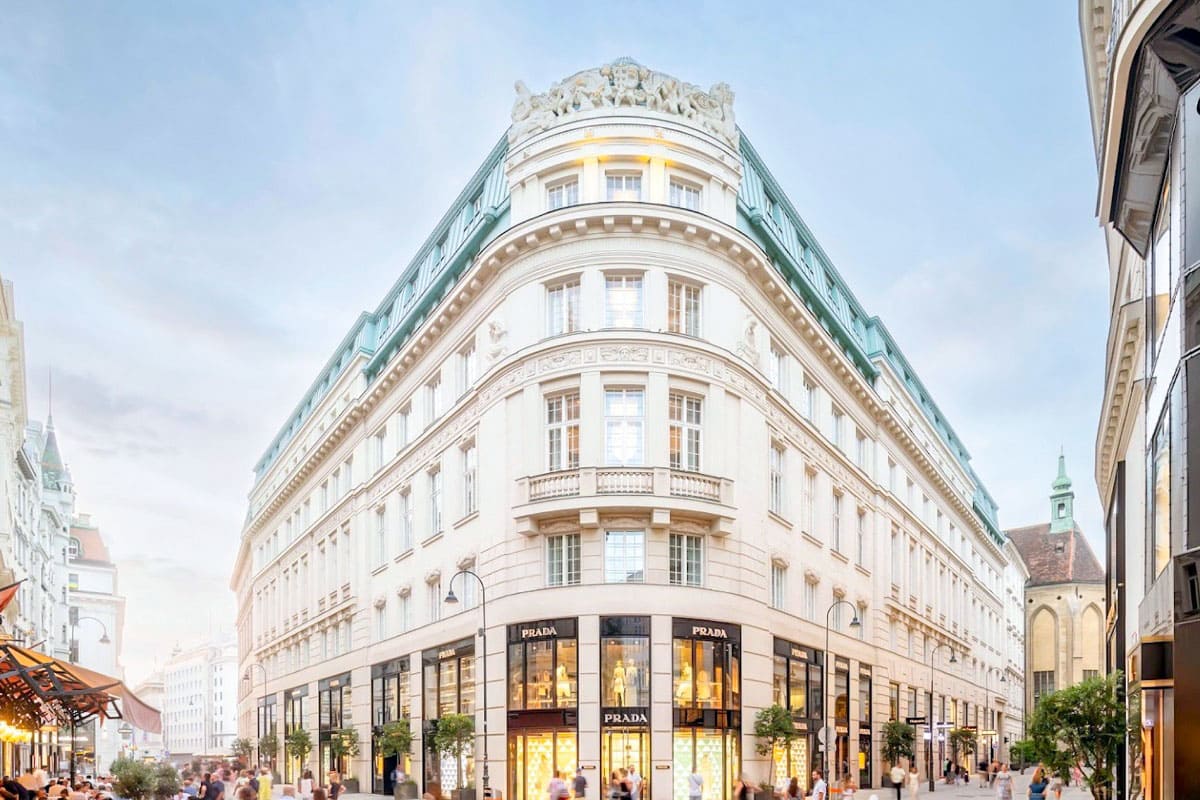
The district is especially useful for visitors who want to understand how Vienna has adapted protected historic architecture to twenty-first-century luxury retail. The modern Goldenes Quartier emerged from the redevelopment of major building groups around Tuchlauben and Am Hof. HNP architects describes the Tuchlauben ensemble as a protected commercial, office and residential project whose historically valuable parts range from the seventeenth-century Hochholzerhof façade to early reinforced-concrete structures from the years around 1910–1922. The complex was comprehensively renovated between 2010 and 2015 under heritage constraints. At Am Hof, the former banking complex was restored and incorporated into the wider development, with Park Hyatt Vienna opening in 2014. The result is a district where old façades, arcades and street alignments frame boutiques that are global rather than local in brand identity.
The current tenant mix confirms that the district remains commercially active in 2026. Vienna Tourism still presents Goldenes Quartier as one of the city’s leading luxury-shopping zones, and the official Goldenes Quartier site lists active boutiques across Tuchlauben, Bognergasse and Seitzergasse. This matters because the property entered a sale process after the collapse of the Signa group. CBRE announced on 27 May 2026 that the Goldenes Quartier property was being marketed for sale and described roughly 18,200 square metres of lettable space with major international luxury tenants. The sale process concerns ownership of the real-estate asset; it is not evidence that the retail district has closed. Travellers should therefore treat the quarter as active while recognising that ownership and individual tenant arrangements can change faster than heritage fabric or street geography.
Shopping hours need careful handling because no current primary source publishes a legally binding one-size-fits-all timetable for the district. The official Goldenes Quartier website lists stores and addresses but not one common opening schedule. Individual boutiques commonly operate daytime Monday to Saturday and close on Sunday in line with Austrian retail practice, but travellers should verify the exact store before crossing the city for a specific purchase. Third-party mapping and retail directories often summarise the area with hours such as 10:00–18:00 or 10:00–19:00, but those summaries are not a substitute for the brand’s own store page. The hours table distinguishes the public district from the individual businesses inside it.
Location is one of the district’s strongest visitor advantages. Goldenes Quartier lies inside Vienna’s most walkable luxury-shopping circuit. Kohlmarkt, Graben and Stephansplatz are close, while Herrengasse, Am Hof and Freyung link the district to the Hofburg side of the centre. Public transport is easy: U3 Herrengasse and U1/U3 Stephansplatz are practical approaches, and central tram and bus connections provide additional options. Driving is unnecessary for most visitors and can be slower than walking because the core is pedestrian-oriented and central parking is paid. The luxury stores are the obvious draw, but the better travel experience comes from combining shopping with architecture, cafés, nearby passages and historic squares rather than treating Goldenes Quartier as an isolated retail destination.
Accessibility is partly shaped by the pedestrianised public realm and partly by individual heritage buildings. The streets and passages make it possible to browse much of the quarter without entering a store, and the redevelopment was carried out as a modern commercial project within protected fabric. However, no current official district page provides a complete barrier-by-barrier accessibility audit for every boutique, passage, lift and threshold. Visitors who need a step-free fitting room, accessible toilet or specific entrance should verify the exact store or hospitality venue. The public-space experience is generally easier than trying to infer accessibility from a single district label. Goldenes Quartier is best approached as a walkable historic luxury district whose value comes from the combination of retail, urban design and reused architecture.
At a glance
Quick Facts
Essential context and practical details for planning your visit.
Current identityGoldenes Quartier, luxury district in Vienna’s 1st district
Core streetsTuchlauben, Bognergasse, Seitzergasse and Am Hof
Current luxury brandsIncludes Dior, Prada, Valentino, Bottega Veneta, Armani, Miu Miu, Alexander McQueen, Etro and others
RedevelopmentMajor heritage-led renovation and pedestrianisation completed during the 2010s
2026 property statusReal-estate sale process launched 27 May 2026; retail district remains active
AdmissionNo admission fee; public district with independently operated boutiques
Vienna guide
A luxury district rather than a conventional shopping mall
Goldenes Quartier can be confusing if it is imagined as an enclosed shopping centre. The official site presents it as an urban quarter between Vienna’s best-known central shopping streets, and Vienna Tourism locates the luxury zone between Tuchlauben, Bognergasse and Am Hof. Stores occupy street fronts and historic buildings, while some spaces connect through passages and courtyards. There is no turnstile, no admission fee and no need to enter a managed mall interior simply to experience the district.
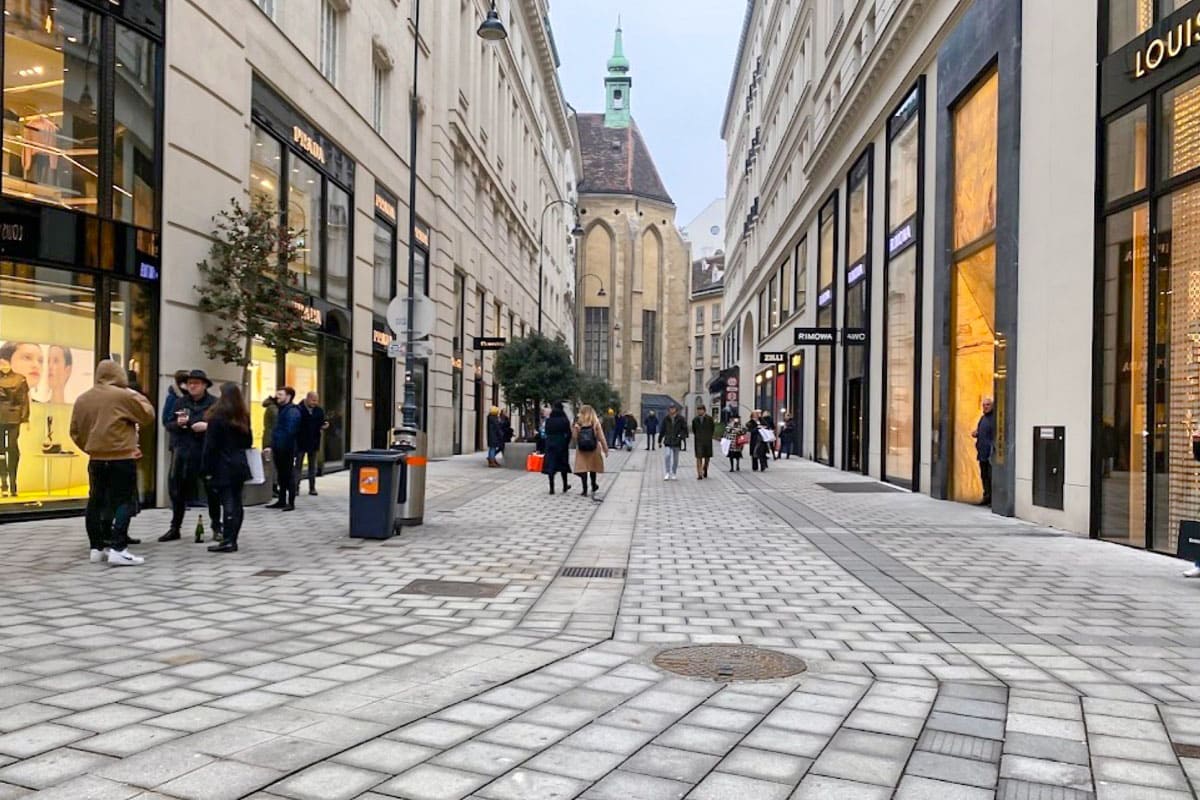
This urban form is one of the quarter’s main strengths. A visitor can walk through Tuchlauben, turn into Seitzergasse or Bognergasse, continue toward Am Hof and then connect naturally with Kohlmarkt, Graben or Herrengasse. The shopping experience is inseparable from Vienna’s historic street network. Window-shopping works as well as active purchasing because the façades, storefronts and street spaces remain visible even when boutiques are closed.
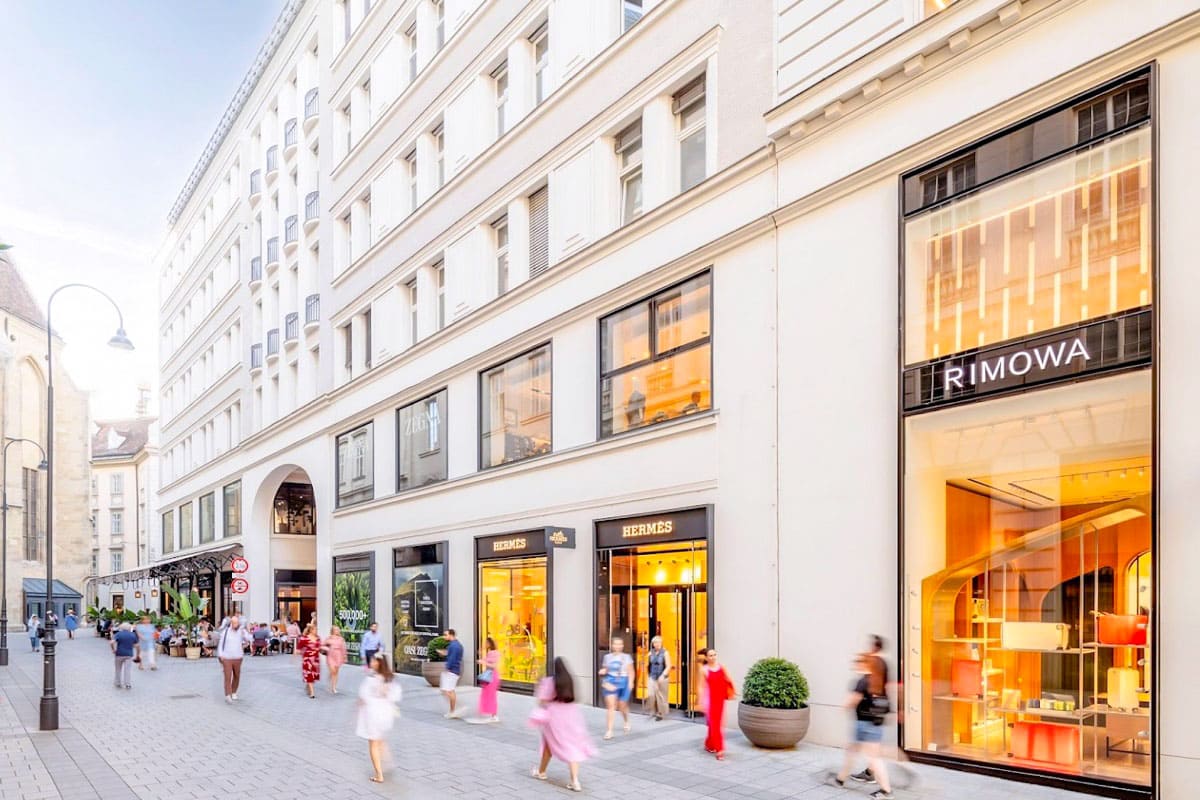
The current official tenant list shows how the district is structured. Dior occupies Tuchlauben 3; Bottega Veneta, Etro and Valentino are listed at Tuchlauben 5–7; Miu Miu and Zimmermann at Tuchlauben 7; Giorgio Armani and Pomellato at Tuchlauben 7a; Prada and Brunello Cucinelli on Bognergasse; and several brands including Emporio Armani, Rimowa and Zegna on Seitzergasse. These addresses show that Goldenes Quartier is a network of storefronts rather than one building with a central directory board.
The luxury focus is clear but not completely uniform. The official site also lists home and lifestyle retail such as Lederleitner Home, while the wider area includes cafés, restaurants and hotel uses. This makes it easier to spend time in the quarter without shopping continuously. A traveller accompanying someone who wants to browse boutiques can still enjoy the streets, architecture and nearby squares.
The most practical way to navigate is by target store rather than by the district name alone. If a specific brand is the reason for visiting, note its exact street address and opening hours before setting out. If the goal is atmosphere, begin at Tuchlauben and allow the street network to lead toward Am Hof, Bognergasse and Kohlmarkt. The district is compact enough that a slight detour usually adds to the experience rather than causing a serious problem.
A focused purchase can take under an hour, while a luxury-shopping circuit with appointments, café stops and nearby central sights can fill half a day. Goldenes Quartier has no fixed visit duration because it is urban fabric, not a timed attraction.
Goldenes Quartier in Vienna, Austria — view 2
Vienna guide
Historic buildings, protected fabric and the modern redevelopment
The architectural interest of Goldenes Quartier lies in adaptation rather than reconstruction from scratch. HNP architects identifies the Tuchlauben complex as a protected building ensemble used for commerce, offices and residences. The project had to retain historically valuable elements while introducing modern building services and contemporary retail spaces. The renovation period given by the architects runs from 2010 to 2015, reflecting the scale of adapting a large inner-city block under heritage protection.
One of the most important surviving features is the façade of the Hochholzerhof, which HNP dates to the first half of the seventeenth century. Other parts of the complex were created between roughly 1910 and 1922 and are notable as early reinforced-concrete construction. These layers explain why the quarter cannot be reduced to historic-looking retail decoration. The buildings contain fabric from different periods, and the redevelopment had to work with those inherited structures.
The Am Hof side adds another layer. The former bank building now occupied by Park Hyatt Vienna was restored during the wider project and reopened as a hotel in 2014. Hyatt’s own opening announcement described the property as a former bank that underwent a two-year restoration while preserving historic character. Its position on Am Hof places hotel, retail and public-square life within the same Goldenes Quartier environment.
Public-space changes were equally important. Seitzergasse and Bognergasse were converted into pedestrian zones during the redevelopment period, helping connect the retail blocks with existing central pedestrian routes. That intervention matters to visitors because the luxury district is experienced mainly on foot. The quality of the shopping walk depends as much on street design and reduced traffic as on the boutiques themselves.
The Tuchlaubenhof passage provides another example of how the redevelopment uses internal circulation to extend the street network. It allows visitors to move through the block rather than around it, adding a passage experience to the shopping district. Passages and courtyards also break up the long retail façades and create transitions between streets with different scale and character.
Architecture-focused visitors should look above the shop windows. Façades, cornices, window proportions and changes in materials reveal far more history than the ground-floor retail fit-outs alone. The luxury stores are the most visible layer, but the mixed-use quarter continues vertically through offices, hotel functions and residences.
The strongest architectural reading comes from comparison. Tuchlauben has a narrower historic-street feel, Bognergasse and Seitzergasse show the effect of pedestrianisation, and Am Hof opens into a larger public square. Walking all three in sequence explains why Goldenes Quartier functions as a district rather than a single restored building.
Goldenes Quartier in Vienna, Austria — view 3
Vienna guide
Flagship boutiques and the role of international luxury brands
The tenant mix is the most visible reason Goldenes Quartier attracts international visitors. Vienna Tourism highlights Dior, Prada, Bottega Veneta, Giorgio Armani, Emporio Armani, Balenciaga, Valentino, Miu Miu, Alexander McQueen, Etro, Pomellato and Brunello Cucinelli. The official Goldenes Quartier site adds brands such as Zegna, Rimowa, Kiton, Hublot and Zimmermann. This concentration places the district within Vienna’s broader luxury-shopping corridor that continues along Kohlmarkt and Graben.
Dior is one of the most architecturally prominent stores. The brand’s own current material describes its Vienna Tuchlauben boutique as occupying more than 1,000 square metres in a historic building and presenting fashion, accessories, jewellery, Maison lines and fragrance. The store uses a contemporary luxury interior that deliberately contrasts with the historic shell. For travellers interested in retail design, this is a clear example of how an international brand adapts a flagship to local architecture.
The district is not an outlet centre. Prices are not reduced simply because many luxury labels sit close together. Its appeal is service, concentration and the ability to compare flagship stores while staying in the historic centre. Personal-shopping appointments, limited-edition product availability and collection launches should be checked directly with each brand.
Non-European Union visitors may be eligible for VAT refund procedures on qualifying purchases, but those rules are national and transaction-specific rather than a Goldenes Quartier service. Travellers should ask the retailer for the correct paperwork at the time of purchase and keep goods, receipts and documents available for customs validation when required.
Window-shopping has its own value. The pedestrian environment and concentrated flagship façades make it possible to experience luxury retail culture without buying. Storefronts change with collections and seasons, turning display design into part of the street scene. This can be particularly interesting around major fashion seasons or holiday periods.
Tenant lists can change. The current 2026 official list is strong and active, but leases, relocations and brand strategies are more volatile than the buildings. A current travel page should therefore identify the district and representative active brands while directing travellers to the official shopping page for the latest full list.
The district also connects naturally with traditional Viennese luxury shopping beyond its own boundaries. Kohlmarkt adds jewellers and established international houses, while Graben provides another premium pedestrian axis. Goldenes Quartier is best experienced as one node in that larger central retail network.
Goldenes Quartier in Vienna, Austria
Vienna guide
The 2026 sale process and what it means for visitors
Goldenes Quartier entered a new ownership phase in 2026 because of the wider Signa insolvency process. On 27 May 2026, CBRE Austria announced the start of a formal sale process for the property and described it as one of the most exclusive real-estate assets in Europe. The property was marketed with around 18,200 square metres of lettable area and an active tenant base of international luxury brands.
For travellers, the important point is what the sale does not mean. A real-estate sale process is not the same as a retail closure. Vienna Tourism continues to promote Goldenes Quartier, the official website remains active, and the current shopping page lists occupied boutiques. The district should therefore be treated as operational while ownership is being resolved.
The sale matters editorially because older descriptions tied closely to Signa ownership can become outdated. A current guide should focus on the place, buildings, tenants and visitor experience rather than presenting the former corporate owner as a permanent part of the attraction’s identity. Real-estate ownership can change without altering the district’s public name or its role in Vienna’s luxury-shopping geography.
Individual lease arrangements are still more changeable during any ownership transition. A traveller crossing Vienna for one store should verify that store directly, especially if the desired product requires an appointment or if renovation work is possible. This is ordinary retail planning but becomes more important when the property itself is changing hands.
The heritage fabric is less volatile than the ownership structure. Protected buildings, pedestrianised streets and the central location remain defining characteristics regardless of the eventual buyer. This is why Goldenes Quartier has destination value beyond a current corporate portfolio.
The 2026 sale also demonstrates how modern luxury districts can be both urban places and large investment assets. Visitors see shop windows and historic façades; investors see income-producing property. Understanding both layers helps explain why ownership news can be prominent even when the day-to-day shopping experience continues normally.
There is no practical reason for a 2026 visitor to avoid the quarter because of the sale process. The sensible response is simply to distinguish long-term place identity from short-term ownership and to verify store-level details as part of normal trip planning.
Goldenes Quartier in Vienna, Austria — view 2
Vienna guide
Opening-hour strategy, transport and the best way to visit
There is no reliable single set of opening hours for every part of Goldenes Quartier. The official district site lists stores but does not impose one common timetable. The public pedestrian streets are available as part of the city, while boutiques, restaurants and services set their own schedules. Most luxury retail in central Vienna operates Monday to Saturday and closes Sunday, but that pattern should be confirmed brand by brand rather than copied into a false universal clock time.
This is particularly important on public holidays. Austrian retail closures can affect boutiques even when the streets remain busy with tourists. A traveller who wants only to walk through the quarter can visit at any time, but a traveller who wants to shop should use the individual brand’s current store page or appointment system.
Public transport is easy. U3 Herrengasse is convenient for Am Hof and the western side of the district, while U1/U3 Stephansplatz is useful for approaching from Graben. The quarter also sits within walking distance of the Hofburg, Michaelerplatz, Freyung and many central bus and tram connections. Most visitors will find walking and public transport more efficient than driving.
The best walking route depends on the wider itinerary. From Stephansplatz, continue along Graben and Kohlmarkt before turning toward Tuchlauben and Am Hof. From the Hofburg or Herrengasse side, approach through Am Hof and move east toward Tuchlauben. Both routes make the luxury district part of a larger city-centre walk.
Driving is possible but rarely advantageous for tourists. The Innere Stadt has paid parking and extensive pedestrian priority. Luxury purchases can often be delivered or collected with assistance from the retailer, which may be easier than trying to park immediately beside a boutique.
Late morning or early afternoon Monday to Saturday is the safest period if shopping is the goal because the highest number of stores is likely to be open. Sunday is still useful for architecture and a quiet walk, but visitors should expect most retail doors to be closed.
Visitors with appointments should build in a small buffer because the district has several similarly prestigious streets and entrances. An address on Tuchlauben is not interchangeable with one on Bognergasse or Seitzergasse. Checking the exact storefront before leaving the hotel avoids unnecessary backtracking.
Goldenes Quartier in Vienna, Austria — view 3
Vienna guide
Accessibility and a practical visitor strategy
Goldenes Quartier’s pedestrianised streets are an advantage because traffic conflicts are reduced and much of the district can be explored at street level. However, the quarter spans multiple protected buildings and independently operated stores, so accessibility cannot be summarised accurately with one yes-or-no label.
Some modernised retail entrances and lifts may be step-free, while historic thresholds or internal level changes can still exist. A visitor who needs an accessible fitting room, toilet, lift or transfer space should contact the exact boutique. The district’s official pages do not provide a complete accessibility matrix for every property.
The same applies to passages and courtyards. They add architectural interest and can shorten walking routes, but opening conditions may be tied to the businesses inside. A public-street route is the safest assumption when a specific internal passage matters to mobility planning.
Visitors who tire easily should remember that Goldenes Quartier connects directly with Graben, Kohlmarkt and other central shopping streets, making it easy to accumulate distance without noticing. Build café or seating breaks into the itinerary rather than treating the whole luxury-shopping circuit as one continuous walk.
Photography is normally easiest in the public realm. Boutique interiors may have individual rules, and travellers should ask before photographing merchandise or staff inside stores. Window displays and façades can be enjoyed from the street without entering.
The most efficient visit begins with a simple decision: shopping or sightseeing. Shoppers should pre-check store hours and appointments, then follow a route between selected boutiques. Sightseers can focus on Tuchlauben, the pedestrianised lanes, Am Hof and the heritage buildings. Both approaches are valid.
A third option is to use Goldenes Quartier as a connective piece in a larger Innere Stadt route. Freyung, Palais Ferstel, Am Hof, Kohlmarkt, Graben and the Hofburg are all close enough to combine. This produces more historical context than a stand-alone shopping visit and helps explain how luxury retail has been inserted into Vienna’s established central urban fabric.
Goldenes Quartier in Vienna, Austria
Vienna guide
How Goldenes Quartier fits into Vienna’s wider luxury-shopping geography
Goldenes Quartier makes most sense when it is compared with the other premium shopping streets immediately around it. Vienna Tourism describes Kohlmarkt as one of the city’s densest concentrations of luxury brands, while Graben mixes international labels with established Viennese retail and café culture. Goldenes Quartier extends that circuit north and west through Tuchlauben, Bognergasse, Seitzergasse and Am Hof. The practical result is a walkable luxury district larger than the formal property boundary: a visitor can move between several prestige streets without using public transport.
This wider context helps explain why the Goldenes Quartier redevelopment mattered to central Vienna. The project did not create luxury shopping in the city from nothing; Kohlmarkt and Graben were already established addresses. What it did was add a concentrated set of flagship spaces inside refurbished historic properties and strengthen pedestrian connections between older retail axes. The conversion of Bognergasse and Seitzergasse to pedestrian priority was therefore as important to the visitor experience as any single boutique opening.
For travellers, the distinction between the formal Goldenes Quartier property and the surrounding luxury circuit is mostly relevant when researching exact tenants. A brand may sit on Kohlmarkt or Graben and still feel like part of the same shopping outing without being a tenant of Goldenes Quartier. Conversely, the official Goldenes Quartier list identifies stores that belong to its own streets and buildings. Keeping those boundaries clear prevents outdated guides from attributing every nearby luxury store to the same property owner.
The district also works well for travellers interested in adaptive reuse. Many luxury-shopping areas around the world occupy purpose-built modern malls; Goldenes Quartier instead relies on historic urban fabric that has been adapted to contemporary commercial needs. The visitor can compare seventeenth-century and early twentieth-century architectural elements with highly controlled twenty-first-century retail interiors in a matter of metres. That contrast is a major part of the quarter’s character even for people who do not intend to buy anything.
Seasonal shopping periods change the atmosphere without changing the district’s basic structure. Advent brings heavy pedestrian traffic to the Innere Stadt, while fashion launches and holiday window displays alter storefront presentation. Those periods can be visually rewarding but less efficient for focused shopping. Visitors who want calm personal service should consider weekday mornings or early afternoons, while those who prefer atmosphere may enjoy the busier late-afternoon city-centre flow.
The quarter’s central location also makes it easy to separate the retail visit into stages. A traveller can browse Tuchlauben, stop at Am Hof or Freyung for architecture and food, then return through Kohlmarkt later. There is no need to complete every luxury street in one continuous walk. This flexibility is especially useful for mixed groups in which only one person wants extensive shopping.
Taken together, these factors make Goldenes Quartier more than a list of expensive stores. It is a modern commercial layer inside Vienna’s historic core, connected to older shopping streets, palace districts and public squares. The strongest visitor experience comes from reading those layers together rather than treating the quarter as a self-contained mall.
Goldenes Quartier in Vienna, Austria — view 2
Traveller insights
Community Ratings & Reviews
—
☆☆☆☆☆
No traveller ratings yet
5★0%
4★0%
3★0%
2★0%
1★0%
Filter by:
Traveller reviews
Loading reviews…
No reviews yet. You can be the first to share a helpful experience.



Community Ratings & Reviews
No traveller ratings yet
Traveller reviews
Loading reviews…
No reviews yet. You can be the first to share a helpful experience.