A 76-room luxury boutique hotel in a protected historic building steps from St. Stephen’s Cathedral, blending Baroque restoration, theatrical design and a highly central first-district address.
76 rooms; 154 beds listed by Vienna Tourism·2022 after major restoration·15:00 / 12:00
Introduction
The Leo Grand — Baroque-Inspired Boutique Hotel at Bauernmarkt
A 76-room luxury boutique hotel in a protected historic building steps from St. Stephen’s Cathedral, blending Baroque restoration, theatrical design and a highly central first-district address.
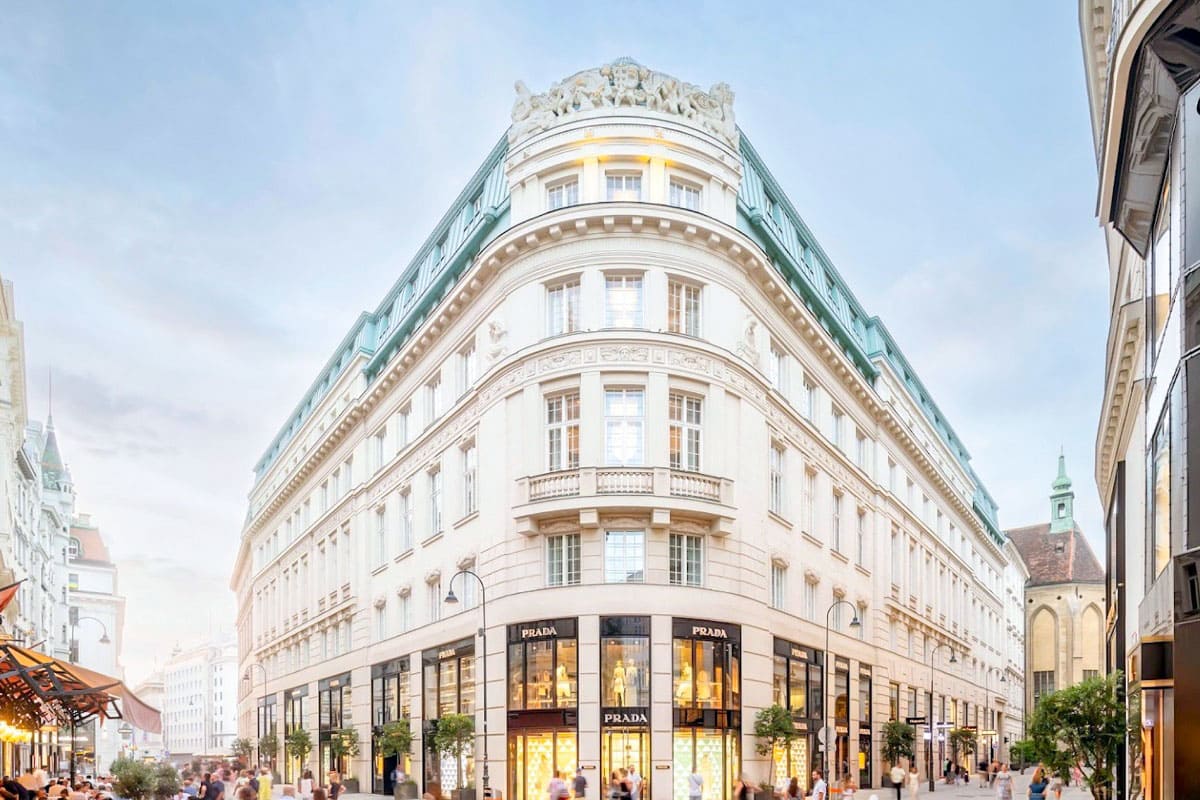
The Leo Grand occupies Bauernmarkt 1 in Vienna’s first district, only a few minutes from St. Stephen’s Cathedral, Graben and Petersplatz. The hotel opened in 2022 after a long restoration of a protected historic building whose fabric reaches back through several phases of Vienna’s history. The current hotel narrative connects the property with Emperor Leopold I, court financier Samuel Oppenheimer and later intellectual and merchant families, using those stories as inspiration for a bold interior concept rather than a conventional restrained luxury aesthetic. Pink, patterned fabrics, Baroque references and contemporary installations make the hotel deliberately theatrical. That style is the first thing travellers should understand before booking. The Leo Grand is not trying to imitate a quiet nineteenth-century grand hotel; it uses Vienna’s Baroque history as material for a modern, playful boutique experience.
Vienna Tourism currently lists 76 rooms and 154 beds. The hotel itself divides accommodation into multiple room and suite categories including Royal, Deluxe, Patio Deluxe, Grand Deluxe, Sky Royal, Grand Royal, Majesty Suites and the Leopold Suite. Several categories can connect, and the current FAQ states that combinations of up to four bedrooms can be arranged in selected categories with confirmation from reservations. That makes the hotel more flexible for families and groups than its boutique positioning first suggests. The historic structure still influences layouts, especially in attic rooms and suites, so a room photograph should be read as category-specific rather than generic. Guests who need a particular view, ceiling height or connecting layout should request confirmation before arrival.
Service is organised around a 24-hour reception, confirmed by the hotel’s current room directory and 2026 booking listings. Check-in starts at 15:00 and checkout is by 12:00 according to the hotel’s current FAQ and booking information. Breakfast is served daily from 07:00 to 12:00, giving leisure travellers an unusually long morning window. Whether breakfast is included depends on the chosen rate. Room service is available, and the first minibar selection is currently complimentary under the hotel’s room-directory information, with later refills charged. The hotel does not have its own spa or swimming pool; its FAQ explicitly directs interested guests toward nearby wellness and fitness options. Travellers comparing central luxury hotels should regard this as a meaningful difference, not a minor missing amenity.
Parking is handled through valet service and a partner garage. The current hotel page lists valet drop-off or pickup at €8 per movement, parking at €49 per day and valet service hours daily from 08:00 to 18:00. Guests who need their car outside those hours can use the partner garage around six minutes away on foot. This is useful for road travellers, but most city visitors will find public transport easier. Stephansplatz U1/U3 is only a few minutes away, and the hotel states that U1 reaches Hauptbahnhof in about ten minutes. From the airport, CAT takes around sixteen minutes to Wien Mitte, followed by two U3 stops to Stephansplatz or a roughly fifteen-minute walk. The centrality is one of the hotel’s biggest practical strengths because major first-district sights are reached without a transport plan at all.
Accessibility is better than the historic building might suggest but not universal. Vienna Tourism currently classifies The Leo Grand as fully wheelchair accessible, while the hotel’s own FAQ says accessible rooms exist but notes that not all rooms are fully wheelchair accessible and not all parts of the hotel are completely barrier-free. The operator’s statement is more specific and should guide booking: guests who need step-free circulation should reserve an accessible room and confirm the exact route. Pet policy is less clear. Vienna Tourism currently lists pets allowed, while several current 2026 booking sources say pets are not permitted, and the hotel’s own FAQ does not presently publish a clear pet rule. Travellers with animals should confirm directly before booking. For guests without that requirement, The Leo Grand’s strongest reasons to stay are the extraordinary address, historic building, design personality and long breakfast window.
The lack of an in-house spa also makes room choice and location more important. Guests are paying for a heritage building, design, service and immediate access to the Old Town rather than resort facilities. The hotel’s own concierge can suggest nearby wellness options, but a traveller who plans to swim every morning should choose another property instead of trying to retrofit that expectation after arrival. Conversely, guests who value a long breakfast, late bar, dramatic interiors and the ability to walk everywhere may find the missing spa largely irrelevant.
At a glance
Quick Facts
Essential context and practical details for planning your visit.
Rooms76 rooms; 154 beds listed by Vienna Tourism
Opened as hotel2022 after major restoration
Check-in / check-out15:00 / 12:00
BreakfastDaily 07:00–12:00
Spa/poolNo in-house spa or swimming pool
Vienna guide
Two Thousand Years of Layers at Bauernmarkt 1
The hotel’s own history page presents Bauernmarkt 1 as a site with nearly two thousand years of documented occupation. Archaeological excavations uncovered traces connected with Roman Vindobona. Medieval and early modern merchant families later occupied the address, while court financier Samuel Oppenheimer lived and worked here during the reign of Leopold I. A major fire in 1700 destroyed much of the earlier building, after which the property was rebuilt as a Baroque city palace by 1715. These layers help explain why the hotel treats history as a narrative rather than focusing on one single construction date.
The nineteenth and twentieth centuries added further social and political history. The hotel’s documentation links the building with elite Viennese families and intellectual circles, while the Nazi period brought dispossession and disappearance of Jewish residents. The current operator addresses that dark chapter directly rather than reducing the building’s past to decorative imperial nostalgia. Restoration work from 2012 to 2022 preserved historic roof structures, vaults and Baroque fabric while adapting the property for hotel use.
This long timeline gives The Leo Grand unusually rich historical content for a boutique hotel. Guests do not need to study every period, but understanding that the building has been repeatedly destroyed, rebuilt, occupied and reinterpreted makes the bold contemporary interior easier to appreciate. The hotel is not pretending to be frozen in 1715; it is another layer in a long sequence.
The hotel’s treatment of the Nazi period is important because it prevents the building history from becoming a purely glamorous narrative. A central Viennese property with centuries of elite occupancy inevitably intersects with political upheaval, dispossession and war. By documenting those layers alongside Roman archaeology and Baroque reconstruction, the operator gives guests a more complete framework for the house. Travellers interested in architecture or Jewish history may find that context more meaningful than the usual luxury-hotel origin story built only around emperors and aristocrats.
The Leo Grand in Vienna, Austria — view 2
Vienna guide
Why the Interior Is Deliberately Extravagant
The current design concept draws heavily on Leopold I, Baroque spectacle and Vienna’s historical encounters with France and the Ottoman world. Oversized headboards, patterned fabrics, rich colours and theatrical motifs are used to create a story rather than neutral luxury. The hotel’s own narrative calls this a dialogue between eccentricity, extravagance and exotic influence. Travellers who love design may find the result memorable; guests who prefer beige minimalism may find it intentionally too much.
The restoration won international heritage and design recognition, including a FIABCI World Silver award in the heritage category. That matters because the design did not simply cover the old building with a new theme. Historic vaults, roof structures and façade elements were restored under monument-protection constraints, while new interiors and a covered courtyard were inserted around them. The best spaces therefore show old and new together rather than separately.
Guests should explore the public areas rather than moving only between entrance and room. The courtyard, staircases, restaurant spaces and historic fabric explain the concept more clearly than any single bedroom. The hotel also keeps a book titled “Layers of Time” in rooms, documenting the property’s past and restoration.
The covered courtyard is one of the clearest examples of how the restoration works. It creates a usable contemporary interior room while allowing historic façades and fabric to remain legible around it. Similar interventions throughout the hotel separate preservation from imitation: new elements are designed to be confidently modern rather than pretending to be original Baroque work. For design-minded guests, that makes the property more interesting than a restoration that simply reproduces period ornament without showing where the twenty-first-century hotel begins.
The Leo Grand in Vienna, Austria — view 3
Vienna guide
Seventy-Six Rooms, Suites and Connecting Configurations
Vienna Tourism currently lists 76 rooms. The hotel’s categories range from attic Royals to larger Grand rooms and suites. The Leopold Suite sits at the top of the inventory and emphasises views and representative living space, while Majesty Suites and other categories offer different layouts across the historic structure. Air conditioning is standard and cots or extra beds can be requested subject to room and category limits.
Connecting rooms are unusually flexible for a boutique property. The hotel says selected Deluxe, Grand Deluxe, Grand Royal, Majesty Suite and Leopold Suite configurations can combine up to four bedrooms, but only by request and confirmation. This makes The Leo Grand a serious option for families or small groups who want to remain in the first district without booking separate apartments.
Historic geometry still matters. Some rooms occupy attic levels or unusual corners, and not all accessible or connecting combinations exist in every category. Booking by square metre alone can therefore be misleading. Guests should choose according to view, accessibility, number of beds and floor preference, then let the reservation team confirm what is physically possible.
Families using connecting configurations should book through direct reservations rather than assume that two separately booked rooms will automatically connect. The hotel specifically says selected categories can form combinations of up to four bedrooms when confirmed in advance. That can create an unusually central multi-room arrangement for extended families, but inventory is limited by the historic floor plan. Accessibility can further narrow the options, so groups with both connecting and step-free requirements should resolve both needs in one conversation before paying.
The Leo Grand in Vienna, Austria — view 4
Vienna guide
Long Breakfast Hours and the Hotel’s Dining Identity
Breakfast runs from 07:00 to 12:00 every day. The hotel currently serves it à la carte and mixes classic Viennese ideas with modern urban dishes. The long service window is particularly convenient for leisure guests who return late from concerts or bars. Breakfast inclusion depends on rate, so the room price should be checked before assuming it is part of the booking.
The hotel’s restaurant concept has evolved through 2026. Current pages promote Cosmo Kitchen and Le Fou cocktail bar, while the summer of 2026 included a temporary SEKKI pop-up. This demonstrates that food concepts can change faster than the hotel itself. A durable travel guide should therefore emphasise the current official restaurant page rather than preserve old restaurant names indefinitely.
Le Fou currently opens Monday through Saturday from 16:00 to 02:00, giving the property a late-night bar identity. Guests sensitive to nightlife atmosphere should ask about room orientation if quiet is a priority, although the bar is part of the hotel’s attraction for travellers who want an evening venue without leaving the building.
The evolving restaurant programme is another reason to verify current names close to travel. The hotel has used pop-ups and changing concepts in 2026, while breakfast and Le Fou bar remain stable operational anchors in the current public material. Guests should therefore book dinner using the live restaurant page rather than an older review mentioning a concept that has already ended. This is particularly important in a boutique hotel where one restaurant change can materially alter the in-house dining experience.
The Leo Grand in Vienna, Austria — view 5
Vienna guide
Stephansplatz Access, Airport Connections and Valet Parking
The hotel sits only a few minutes from Stephansplatz U1/U3. U1 provides a direct route from Hauptbahnhof, while U3 connects toward Wien Mitte for airport rail services. The hotel estimates a roughly thirty-minute taxi ride from Vienna Airport and a sixteen-minute CAT journey to Wien Mitte before the short city-centre connection. Private transfers can be arranged.
Valet parking costs €49 per day plus the published €8 drop-off or pickup service charge, with valet hours from 08:00 to 18:00 daily. A partner garage around six minutes away is the better option if guests need their vehicle outside those hours. First-district street parking is short-term and restricted, so leaving a car casually on nearby streets is not a realistic plan.
For sightseeing, walking is the default. St. Stephen’s Cathedral, Peterskirche, Hofburg, Graben and many museums are nearby. The hotel’s location allows guests to return during the day without losing much time, which is especially useful for families, shoppers or anyone changing for an evening performance.
Road travellers should also think about timing before using valet service. The 08:00–18:00 valet window does not cover every possible early departure or late return, which is why the partner garage remains relevant even for hotel guests. A visitor who expects to drive out for an evening excursion should either arrange the vehicle during service hours or park directly in the garage. For a typical Vienna sightseeing stay, the simplest solution is to leave the car parked and use U-Bahn or walking until departure day.
The Leo Grand in Vienna, Austria — view 6
Vienna guide
Accessibility and the Unresolved Pet Policy
Accessibility sources require careful reading. Vienna Tourism lists the hotel as fully wheelchair accessible, while The Leo Grand’s own FAQ says accessible rooms are available but not every room is fully wheelchair accessible and the property is not barrier-free in all areas. The hotel’s own wording is more operationally useful. Guests who use wheelchairs should reserve an accessible room explicitly and ask which restaurants, bars and event areas can be reached without steps from that room.
The pet policy is currently inconsistent across public sources. Vienna Tourism says pets are allowed. Several live 2026 booking platforms say they are not. The hotel’s own FAQ does not currently contain a clear pet rule. The correct advice is to contact The Leo Grand directly and obtain confirmation before booking a non-refundable rate.
Smoking is allowed only in exterior areas according to the official FAQ. The hotel has no own spa or pool, though the concierge can arrange nearby wellness or fitness options. Those practical limits should be understood alongside the strengths: centrality, design, breakfast, service and heritage.
Because the official accessibility wording is more cautious than the Vienna Tourism directory flag, the hotel’s own statement should control practical planning. An accessible room may solve bedroom and bathroom needs while some historic common areas still involve more complicated routes. Guests should ask about the exact restaurant, bar and breakfast paths they expect to use. This is a stronger approach than reducing the entire property to one yes-or-no accessibility label.
The Leo Grand in Vienna, Austria — view 7
Vienna guide
Who Will Get the Most from The Leo Grand
The Leo Grand suits travellers who want the first district directly outside the front door and who enjoy bold design. Couples on a city break, architecture enthusiasts, luxury travellers who dislike conventional hotel styling and families using connecting configurations are natural fits. The long breakfast service and 24-hour reception make the property operationally easy.
It is less ideal for guests who require a full in-house spa, swimming pool or quiet minimalist aesthetic. Guests with complex mobility requirements should confirm exact routing, and pet owners must resolve the current policy conflict before booking. Drivers should also budget significant daily parking costs.
For the right guest, the hotel’s combination of location and character is difficult to duplicate. Many Vienna hotels have history; fewer use that history as openly and theatrically while still placing guests within a two- or three-minute walk of the cathedral. The best stay embraces both the building and the city rather than treating one as a substitute for the other.
The hotel also appeals to travellers who treat their accommodation as part of the cultural itinerary. Reading the house history, noticing restored fabric and spending time in the courtyard or bar can add value that would be lost on a guest who returns only to sleep. That makes The Leo Grand particularly suitable for shorter luxury breaks, when guests want the hotel to contribute to the sense of being in Vienna even during downtime.
The Leo Grand in Vienna, Austria — view 8
Traveller insights
Community Ratings & Reviews
—
☆☆☆☆☆
No traveller ratings yet
5★0%
4★0%
3★0%
2★0%
1★0%
Filter by:
Traveller reviews
Loading reviews…
No reviews yet. You can be the first to share a helpful experience.




Community Ratings & Reviews
No traveller ratings yet
Traveller reviews
Loading reviews…
No reviews yet. You can be the first to share a helpful experience.