Italian National Dishes
Bombette Pugliesi

Recipe at a glance
Bombette Pugliesi
Key recipe details from the source.
- Yield
- 12 bombette, 4 substantial servings
- Preparation
- 25 minutes
- Cooking
- 22 minutes
- Passive time
- 5 minutes
- Total
- 52 minutes
- Approximate calories per serving
- 330 kcal
- Equipment
- Smooth meat mallet · Baking paper · Four metal skewers · Wire rack set over a roasting tray · Long tongs · Instant-read food thermometer
Bombette Pugliesi — Puglian Capocollo Rolls with Canestrato Cheese
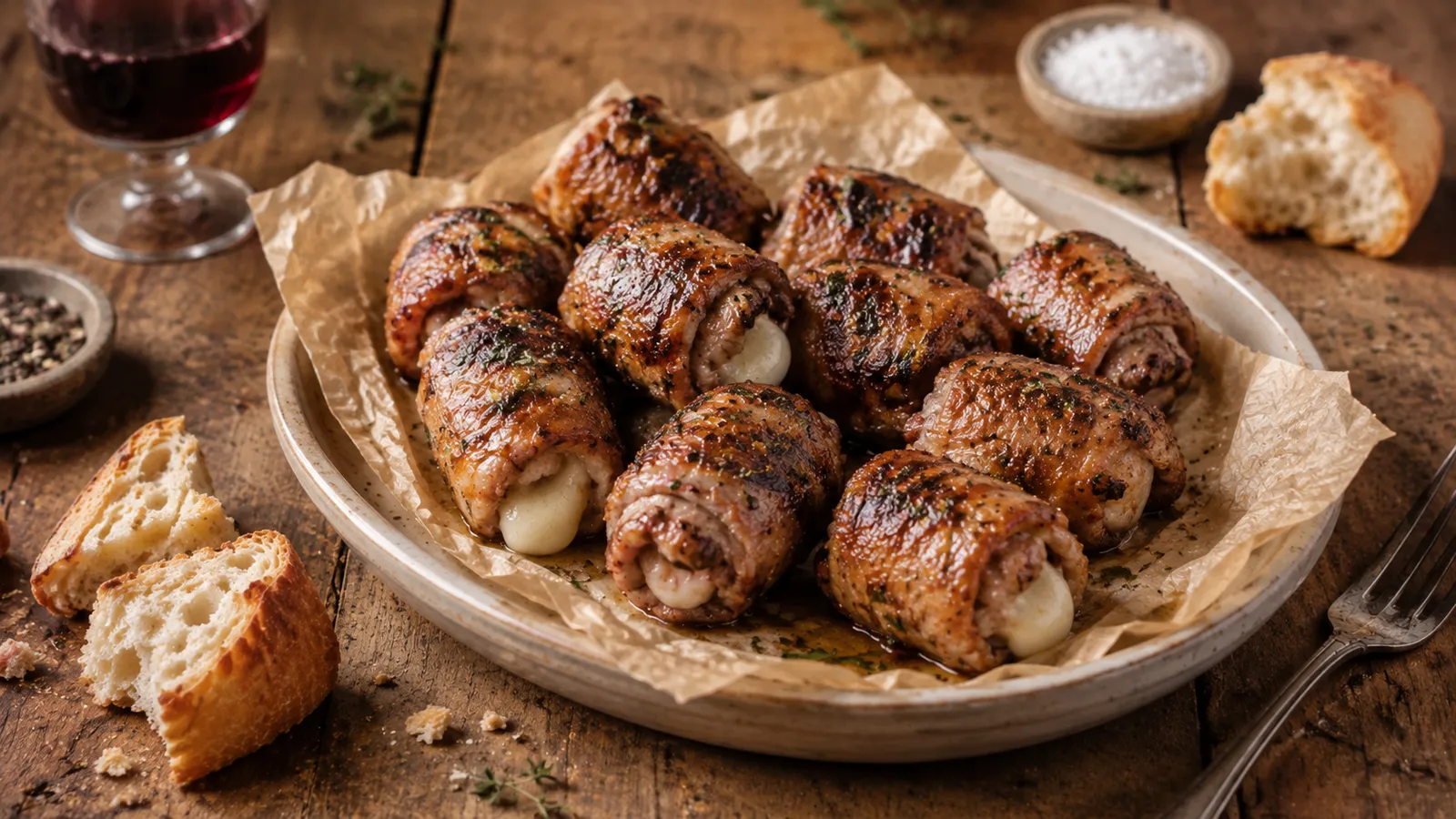
Small pork capocollo rolls from Puglia filled simply with Canestrato cheese, black pepper and a restrained amount of salt, then cooked at high heat until browned and juicy.

01 · Overview
Overview
Bombette pugliesi are compact pork involtini built for intense heat. Thin slices of capocollo wrap around cheese, then cook until the outer pork browns and the centre turns molten. Their small round form explains the playful name — little bombs — but the important culinary idea is practical: a marbled shoulder-neck cut protects a small cheese-filled roll from drying while it cooks quickly over strong heat.
The dish is particularly associated with Valle d'Itria and nearby parts of Puglia, where butcher shops with fornelli cook skewered meat for customers. The regional PAT description is strikingly concise. It identifies rounded rolls of pork capocollo, generally around 3–5 cm and 30–35 g, filled with Canestrato Pugliese, salt and pepper. That minimal core is the basis for this recipe.
Contemporary bombette can be more elaborate. Pancetta may line the pork, caciocavallo can replace Canestrato, and parsley, garlic, herbs or breadcrumbs can enter the filling. Those versions are well established and often delicious, but they obscure how much flavour is already present in the core combination of marbled pork, aged sheep's-milk cheese and black pepper. Keeping this batch simple also makes the rolling and cooking behaviour easier to control.
Capocollo is important because the cut carries enough intramuscular fat to stay tender under high heat. The slices need to be thin and even, but not pounded until they tear. Each receives a narrow cheese baton set away from the edge. Folding the long sides inward before rolling is the most useful defence against leakage: molten cheese then encounters overlapping meat rather than an open seam.
A Puglian fornello gives radiant heat and characteristic browning that a domestic oven does not reproduce perfectly. The home method therefore uses two stages: a hot 210 °C roast on a rack, followed by a brief grill finish only if more colour is needed. Elevating the skewers keeps the rolls out of their rendered fat and exposes more surface to heat.
Pork doneness should be measured rather than guessed from cheese leakage or exterior colour. For whole pork cuts, 63 °C followed by at least a 3-minute rest is the modern safety target. Bombette are small enough that they can overshoot rapidly, so checking a representative centre near the end of roasting protects both safety and juiciness.
02 · Ingredients
Ingredients
Bombette
- 360 g
- boneless pork capocollo, cut into 12 very thin slices of about 30 g each
- 80 g
- Canestrato Pugliese, cut into 12 slim batons
- 2 g
- fine salt
- 1.5 g
- freshly ground black pepper
03 · Directions
Directions
Shape
Even the pork
Place each capocollo slice between sheets of baking paper and tap only the thicker areas with a smooth meat mallet. Aim for an even, flexible slice without holes.
Season lightly
Sprinkle the slices with the measured salt and black pepper. Keep the salt restrained because Canestrato is already seasoned.
Position the cheese
Place one narrow baton of Canestrato near a short edge of each slice, leaving at least 1 cm clear around the sides.
Fold and roll
Fold both long side edges inward over the ends of the cheese, then roll the pork firmly from the filled edge. Place seam-side down.
Skewer in groups
Thread three bombette onto each metal skewer with a small gap between rolls. The spacing lets hot air reach the sides instead of steaming the contact surfaces.
Cook
Preheat strongly
Heat a conventional oven to 210 °C. Set a wire rack over a roasting tray so rendered fat can fall away.
Roast on the rack
Arrange the skewers on the rack and roast for 15–18 minutes. Turn once around the halfway point. The pork should brown at the edges and the cheese should be softening inside.
Check the centre
Insert an instant-read thermometer into the centre of a representative roll, avoiding the cheese where possible. The pork should reach at least 63 °C.
Finish under the grill if needed
If the centre is safe but the outside is pale, put the skewers under a hot grill for 2–4 minutes, turning once. Watch continuously because exposed cheese can scorch quickly.
Rest before eating
Move the skewers to a warm plate and rest for at least 3 minutes, preferably 5. The cheese will stop bubbling aggressively and the whole-pork safety rest will be satisfied.
04 · Control points
Control points
Lean, thick slices dry before the centre is ready.
This contains the cheese far better than simply rolling from one end.
The grill is for colour after the pork is essentially cooked, not for extending the roast blindly.
| Problem | Guidance | Adjustment |
|---|---|---|
| Most of the cheese leaks out | The batons are too large or the side edges were left open. Reduce the cheese width and fold both sides inward before rolling. | |
| The pork is dry | The slices are too lean, too thin at the edges or the oven was too cool and extended the cook. Use marbled capocollo and strong heat. | |
| The rolls open on the skewer | They were threaded through the wrong axis or not rolled firmly. Pass the skewer through the seam side so it physically pins the roll closed. | |
| The outside is pale but the pork is already at temperature | Do not keep roasting. Use 2–4 minutes of direct grill heat instead. |
05 · Practical
Practical
Cooking over charcoal
A charcoal grill is closer to the Puglian fornello experience. Set the skewers over hot embers rather than open flame and turn regularly until deeply browned. Because bombette are small, measure a central roll early. The same 63 °C minimum plus 3-minute rest applies.
Canestrato or caciocavallo?
Canestrato Pugliese gives a firm, savoury sheep's-milk filling that fits the regional PAT core. Semi-aged caciocavallo is a common practical alternative. It melts more elastically and tends to taste slightly sweeter. Use the same 80 g total and keep the batons narrow.
Variations
Pancetta, parsley, garlic and breadcrumbs all appear in contemporary bombette. They can be useful, but adding them changes more than flavour. Pancetta increases fat and salt; breadcrumbs absorb cheese fat; herbs can char at exposed seams. It is better to master the minimal roll before adding several fillings at once.
Make-ahead
Bombette can be shaped and skewered up to 8 hours before cooking. Keep them covered in the refrigerator. They can go directly from refrigeration to the preheated oven; a very cold batch may need a few additional minutes before reaching 63 °C.
Leftovers
Refrigerate leftovers within 2 hours and use within 3–4 days. Reheat at moderate oven heat until the centre reaches 74 °C. Cover loosely for most of the reheat, then uncover at the end; high heat from the beginning can force the cheese out before the pork is hot.
Allergens and food safety
This recipe contains milk from Canestrato Pugliese. Raw pork should be kept separate from ready-to-eat foods. Wash hands and clean the board, mallet, knife and any surface touched by raw meat before using them for cooked food. Cook a representative bombetta to at least 63 °C in the pork and rest the cooked rolls for a minimum of 3 minutes. Refrigerate leftovers within 2 hours and reheat them to 74 °C.
06 · FAQ
FAQ
Are bombette always filled with pancetta?
No. Pancetta is common in many modern recipes, but the regional PAT description gives a simpler core of capocollo, Canestrato Pugliese, salt and pepper.
Can bombette be cooked without skewers?
Yes. They can be placed seam-side down on a rack and turned carefully with tongs. Skewers are useful because they secure several small rolls and make high-heat turning easier.
Why use a rack in the oven?
It keeps the pork above its rendered fat, exposes more surface to circulating heat and produces a drier, better-browned exterior.
07 · Nutrition
Nutrition
- Serving size
- 3 bombette
- Calories
- approximately 330 kcal
- Carbohydrates
- 1 g
- Protein
- 28 g
- Fat
- 24 g
- Fibre
- 0 g
- Sodium
- approximately 720 mg
- Serving size: 3 bombette - Calories: approximately 330 kcal - Carbohydrates: 1 g - Protein: 28 g - Fat: 24 g - Fibre: 0 g - Sodium: approximately 720 mg The estimate depends on the fat content of the capocollo, how much fat renders onto the tray and the salt level of the cheese.