

Borders imagined, identities performed
Micronations: Sealand, Liberland and the Borders of Belonging
From a North Sea fort to a disputed Danube floodplain, self-declared countries reveal how powerfully people want to name a place, write its rules and belong to a story.
A travel-minded investigation of statehood, spectacle and the legal boundaries that make real-world visits possible—or impossible.
A country normally appears on maps before a traveler reaches it. Its borders are negotiated, its passports are recognized, and its laws have institutions capable of enforcing them. A micronation reverses that order. First comes the declaration, then the flag, the anthem, the stamps, the cabinet titles and the website. Recognition may never come at all. The result can look like political theatre, conceptual art, local satire, a family enterprise or a serious ideological experiment, depending on who is speaking and where the claimed territory sits.
Two projects dominate the modern imagination. Sealand occupies Roughs Tower, a former wartime sea fort off England, and has spent decades turning isolation into a durable legend. Liberland claims Gornja Siga, a wooded parcel beside the Danube in a sensitive Croatia–Serbia border zone, and presents itself as a digital, libertarian state-in-waiting. Neither is recognized as a sovereign state. Their similarity therefore lies less in law than in narrative skill: each takes an ambiguous-looking place and builds a complete political mythology around it.
Travel adds a necessary reality check. A website can make an invented country feel open and borderless, but a visitor still moves through recognized jurisdictions, regulated waterways and private or protected land. Sealand is not a public attraction with scheduled ferries. Gornja Siga is not a consequence-free frontier. By contrast, projects such as Molossia, Seborga and the Conch Republic operate as planned encounters within the law of the country that surrounds them. The most rewarding way to explore micronations is therefore to enjoy their imagination without confusing performance with legal authority.
The legal threshold
When a Country Is Not a State
Micronations borrow the visible language of sovereignty, but international law asks harder questions about territory, population, government and external capacity.
The word micronation is informal rather than a legal status. It describes an entity that proclaims itself independent and imitates the institutions of a state without receiving ordinary diplomatic recognition. The imitation can be elaborate: constitutions are drafted, ministries announced, currencies designed and ceremonial passports printed. Yet these objects do not acquire legal force simply because they resemble the documents of recognized countries. A passport works because other states agree to accept the issuing authority, not because the booklet has a coat of arms and a machine-readable line.
The Montevideo Convention of 1933 supplies the most familiar checklist in discussions of statehood. Its first article names a permanent population, a defined territory, a government and the capacity to enter into relations with other states. The convention was adopted in an inter-American setting, but its formulation has become a standard point of reference. Micronations often emphasize whichever criterion appears easiest to claim—an address, members called citizens, an online cabinet—while minimizing the decisive question of whether they exercise effective and lawful authority over people and territory.
Recognition adds another layer. Legal scholars debate whether a state exists primarily because it meets objective conditions or because other states recognize it, but in practical travel the distinction narrows quickly. Without recognition, an entity cannot normally issue documents accepted at borders, join the systems that organize aviation and shipping, or expect foreign governments to treat its decrees as law. A micronation may enter relationships with clubs, municipalities or other micronations, yet those contacts are not equivalent to diplomatic relations between states.
Territory is particularly revealing. Land that looks empty is almost never legally ownerless. It may be public land, private property, a military installation, a river corridor, a protected area or a place affected by competing boundary interpretations. The absence of houses does not erase cadastral records, policing authority or treaty claims. This is why the phrase terra nullius should trigger caution. It has a specific and contested history in international law; it is not a travel hack that allows the first person with a flag to acquire sovereignty.
Micronations nevertheless deserve more than a dismissive laugh. They provide unusually clear demonstrations of how states communicate legitimacy. Their founders reproduce ceremonies, symbols and bureaucratic language because those forms are persuasive. A stamp makes a claim portable. A border post turns a driveway into a threshold. A cabinet photograph converts friends into officials. Seen this way, micronations are laboratories of political aesthetics: small enough to study closely, but built from the same visual grammar used by much larger powers.
Their cultural meanings also differ. Some are anti-tax protests, some are neighborhood festivals, some are art works, and some are businesses selling titles or memorabilia. A responsible account should not flatten all of them into one category of eccentricity. It should ask who controls the site, who benefits from the story, whether local residents consent, and whether the project invites harmless play or encourages visitors to disregard real law.
Online membership alone does not create a settled population.
An unoccupied appearance is not proof that land is unclaimed.
Titles and constitutions are not substitutes for enforceable administration.
Micronation-to-micronation recognition has no ordinary diplomatic effect.
North Sea · off the English coast
Sealand
A former wartime fort became the most enduring micronation story of the modern era by combining maritime isolation, family continuity and a shrewd command of symbolism.
Legal reality: a self-declared principality on Roughs Tower, without recognition as a sovereign state and within the United Kingdom’s territorial sea.

Why it endures
Isolation turned into political theatre
Roughs Tower stands offshore as an object that seems designed for legend. Built during the Second World War as part of Britain's defensive network, the structure consists of two large concrete legs supporting a deck above the water. Its severe geometry, exposed position and lack of ordinary civic surroundings make it easy to imagine as a world apart. That visual separateness is central to Sealand's appeal: photographs rarely show the coast, customs offices or any neighboring settlement, only a compact man-made platform against an apparently boundless sea.
Roy Bates occupied the abandoned fort in 1967 after involvement in offshore pirate radio and proclaimed the Principality of Sealand. He and his family developed the project far beyond a temporary broadcasting stunt. They created a constitution, flag, anthem, stamps, coins and titles, and presented family succession as governmental continuity. The project survived its founder, which is one reason it has outlasted many micronations created as jokes or short campaigns. Sealand's history is not the history of an internationally accepted country, but it is the history of a remarkably persistent private claim.
Its legal mythology often turns on a 1968 court case and the location of the platform beyond the United Kingdom's then three-nautical-mile territorial limit. The court declined jurisdiction over a firearms incident because of where it occurred at that time. Supporters later treated the decision as evidence of independence, but a jurisdictional ruling is not diplomatic recognition. The context changed further when the Territorial Sea Act 1987 extended the United Kingdom's territorial sea to 12 nautical miles. Roughs Tower consequently lies within that maritime zone; Sealand's website and ceremonial institutions do not displace British law.
The famous 1978 episode, when rivals briefly occupied the platform and Michael Bates was held, gave the story the drama of a miniature coup. A German diplomat's involvement in resolving the detention of one participant was subsequently framed by Sealand as a form of recognition. States, however, distinguish sharply between practical consular intervention and recognizing a new sovereign. Germany did not establish diplomatic relations with Sealand, and the episode remains an example of how micronational narratives convert an improvised solution into constitutional folklore.
For visitors, the romance must yield to logistics. Sealand has no scheduled ferry, public pier, visitor center or ordinary ticketing system. Access depends on explicit permission from the operators, a capable vessel, suitable sea conditions and safe transfer to an exposed structure. Seeing Roughs Tower from a lawful charter at sea is different from boarding it. No traveler should assume that purchasing a title, identity card or souvenir produces a right of entry. The North Sea is not a themed attraction, and a private invitation does not eliminate maritime safety responsibilities.
Sealand's contemporary economy is primarily symbolic. Titles, merchandise, commemorative documents and media attention turn the story into revenue. This does not make the project fraudulent by definition; many cultural attractions sell participation in a narrative. The essential distinction is what the buyer understands. A Sealand title can be an entertaining gift, but it does not confer nobility recognized by the United Kingdom. A novelty identity document is not a travel document. A coin may have collector value without being legal tender in ordinary commerce.
What makes Sealand important is therefore not a secret legal loophole but endurance. It demonstrates that a micronation can remain culturally vivid for decades if it has a memorable site, a family archive, repeated rituals and an audience willing to suspend disbelief. The platform's physical reality gives the story weight, while the absence of normal public access preserves mystery. Sealand sits at the boundary between heritage object, private enterprise and political performance—and its power comes from never fully resolving that ambiguity.
Danube border zone · Croatia–Serbia
Liberland
A libertarian declaration on Gornja Siga became a global online movement, but digital citizenship cannot override the recognized authorities controlling a sensitive river border.
Legal reality: no UN member state recognizes Liberland; Croatia rejects the claim that Gornja Siga is terra nullius and enforces access in the area.

The central tension
A borderless community attached to a contested place
Liberland was proclaimed in 2015 by Czech politician and activist Vít Jedlička on Gornja Siga, a wooded area beside the Danube. The claim drew attention because the Croatia–Serbia boundary dispute produces different interpretations of where parts of the border should run. Liberland's founders argued that the parcel had been left unclaimed and could therefore be occupied as terra nullius. The visual language was immediate and confident: a flag, constitution, citizenship portal and libertarian programme appeared around a place with no functioning settlement.
Croatia's official position is unambiguous in the point most relevant to travelers. It says the territory is not ownerless and that the border dispute will be resolved between Croatia and Serbia under international law. In the meantime, Croatian authorities apply law and border control in the area. Serbia has not adopted Liberland as a sovereign neighbor. The disagreement between two states over a boundary does not automatically create a third state, and a private declaration cannot settle which recognized jurisdiction has the better claim.
Liberland's ideology is more developed than its administration on the ground. It presents a vision of minimal government, voluntary taxation, personal liberty and digital systems, and it has built an international network of supporters. Online registration, events, tokens and political titles give participants a sense of membership. This makes Liberland an interesting example of a networked micronation: its most stable territory is arguably the digital community rather than the riverside parcel. The model resembles an association or movement even while its language insists on statehood.
That distinction matters when passports and citizenship are discussed. A person can be recognized as a member under Liberland's internal rules, just as an organization can issue membership cards, but the document does not replace a passport issued by a recognized government. Airlines and border officers rely on state-approved systems, security standards and diplomatic responsibility. No amount of blockchain verification can compel another country to admit the holder. Buyers should understand the difference between identity within a voluntary community and nationality in international law.
Physical access is the most sensitive part of the story. Attempts by supporters to reach or occupy Gornja Siga have produced confrontations, detentions and removals. Conditions along a river border can change, and the legal consequences are real even when a visitor regards the journey as symbolic. The responsible advice is simple: do not attempt an unauthorized crossing by boat, kayak, bicycle or on foot. Do not rely on a micronation's map to interpret border law. Use recognized crossings, comply with police instructions and treat any project event as subordinate to Croatian and Serbian requirements.
Liberland's enduring significance may lie in the questions it asks rather than the country it has not created. Can a community formed online develop meaningful institutions without a resident population? Can voluntary association reproduce some services traditionally supplied by states? How does a movement maintain accountability when leaders, citizens and assets are dispersed? These are legitimate political questions. They do not depend on pretending that a disputed floodplain is legally empty, and they can be explored without encouraging risky territorial stunts.
For travelers, the best encounter may therefore be indirect: attend a lawful conference, examine the constitutional proposals, compare the movement's claims with official border documents, and visit the wider Danube region through recognized routes. That approach preserves curiosity while respecting residents and authorities who live with the consequences of border politics. Liberland is compelling precisely because it exposes the distance between an elegant theory of freedom and the messy, historically layered reality of land.
Nevada · United States
The Republic of Molossia
Molossia turns a private Nevada property into a carefully staged diplomatic visit, offering one of the clearest examples of a micronation that works as lawful participatory theatre.
Visitor model: reservation-only tours on private property, conducted within the laws of Nevada and the United States.

Why it works
A clear invitation into a carefully built civic fiction
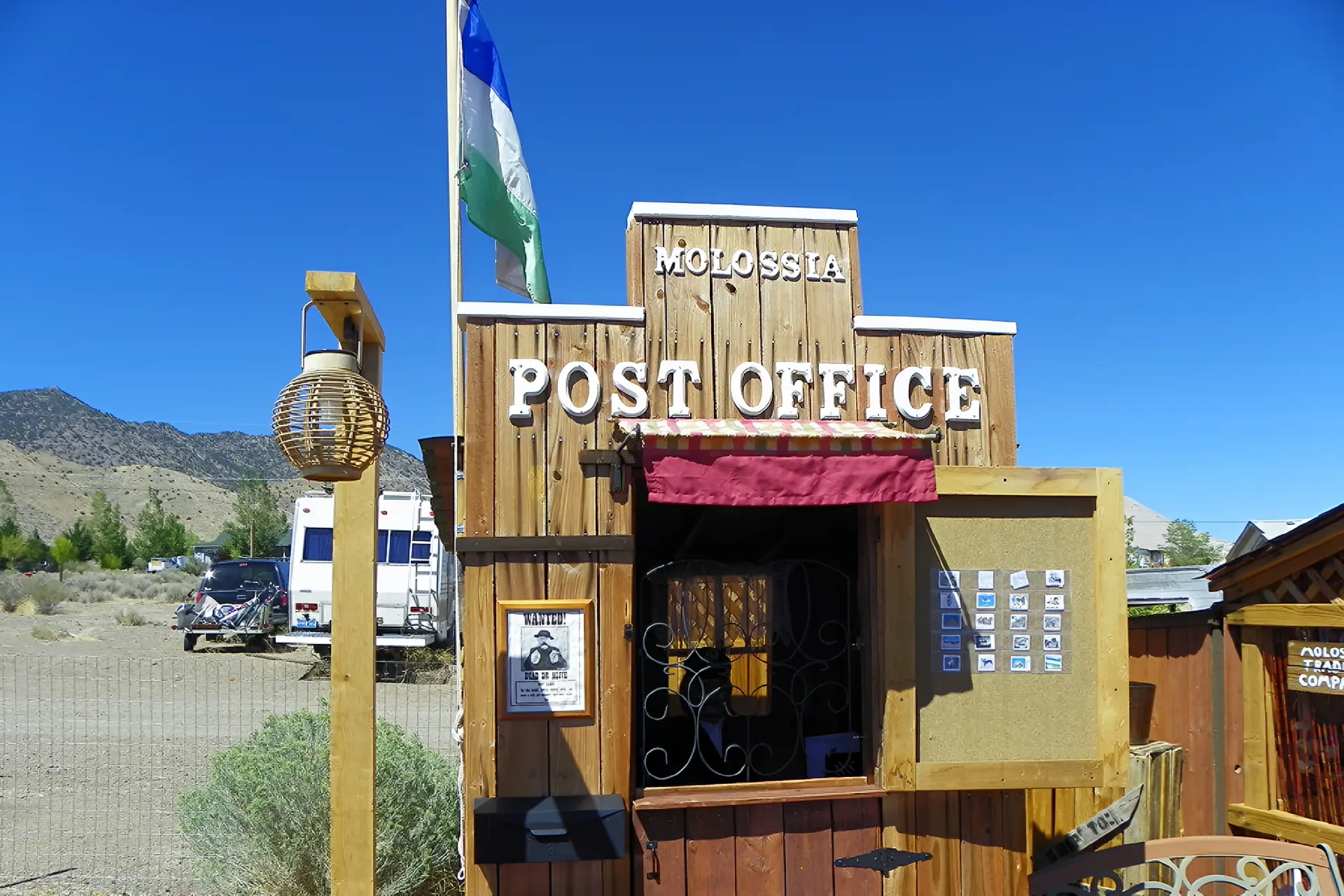
Molossia occupies a very different place on the micronational spectrum. Its territory is a private home and surrounding property near Dayton, Nevada, presented as an independent republic by Kevin Baugh and his family. The site uses border signs, official greetings, a post office, currency exchange and other miniature institutions to transform an ordinary address into a ceremonial destination. Unlike attempts to exploit a disputed border, the experience depends on invitation and property rights rather than a claim that visitors may ignore public law.
The republic's elaborate continuity is part of the attraction. Molossia maintains a calendar, government offices, national symbols, diplomatic jokes and a playful foreign policy. Its internal history reaches backward through earlier names and phases, giving the project the texture of a long-running fictional universe. Visitors are not merely shown a collection; they enter a scripted encounter in which passports can be stamped, money exchanged and state rituals performed at human scale.
The official visitor information is unusually clear about practical limits. Tours are scheduled on selected dates, advance reservations are required, and the visit is time-bounded. Guests are expected to behave respectfully, remain with the group and follow directions. Those rules are not bureaucratic decoration: they are the conditions under which a private household can welcome strangers. The result is safer and more honest than an open-ended invitation to 'cross a border' that the host has no lawful authority to control.
Molossia also demonstrates that acknowledging the United States does not ruin the fantasy. In fact, the joke works because everyone understands the layers. The republic can declare a whimsical ban, operate a tiny customs desk or wage a fictional conflict while emergency services, road law, taxation and criminal jurisdiction remain those of Nevada and the United States. The performance gains trust by not requiring a visitor to mistake play for immunity.
As a travel experience, Molossia resembles a hybrid of living-history interpretation, outsider art and an appointment-only home museum. Its appeal comes from the founder's attention to detail and willingness to inhabit the role consistently. That consistency turns handmade objects into a coherent civic world. It also creates a social exchange: the host explains the institutions, visitors ask questions, and both sides participate in the transformation of scale.
The ethical lesson is useful. Micronational tourism works best when it is consensual, transparent and locally grounded. The host should have the right to welcome people; the visitor should know what is symbolic; neighbors should not bear hidden costs; and nobody should be encouraged to trespass or evade recognized authorities. Under those conditions, a pretend border can become a serious conversation about what borders do. Molossia offers that conversation with humor rather than legal brinkmanship.
Walk-ins are not the normal visitor model.
The experience depends on the host's consent and house rules.
Published conditions should be checked for the current season.
The micronational performance does not create legal immunity.
Field guide
From Village Ritual to Conceptual Territory
Beyond the headline projects lies a varied landscape of festivals, neighborhoods, private estates and art works that use micronational language for very different purposes.
Seborga, in the Ligurian hills of Italy, presents itself as a principality through elected ceremonial leadership, symbols and local storytelling. Visitors encounter a real village with restaurants, churches and residents rather than a sealed compound. The micronational layer functions as civic folklore and destination identity. It can add pleasure to a visit, provided the village is approached as a living community rather than a stage set whose inhabitants owe every traveler a performance.
The Conch Republic emerged in Key West in 1982 as a satirical response to a U.S. Border Patrol roadblock that disrupted access to the Florida Keys. Its mock secession became an annual civic tradition, complete with flags, events and a proudly comic diplomatic style. Here micronational language is protest memory and tourism branding at once. The story is inseparable from Key West's larger identity as a place that values eccentricity, performance and distance from mainland convention.
Užupis, an artists' district in Vilnius, celebrates a republic with an inventive constitution displayed in many languages. Its articles mix tenderness, absurdity and philosophical permission: the constitution is less a legal code than a public poem about dignity and freedom. Visitors can cross the river, read the plaques and join events without pretending to leave Lithuania. The republic succeeds as urban culture because its symbolic border opens attention rather than closing territory.
Ladonia, associated with artist Lars Vilks and sculptures at Kullaberg in Sweden, shows the more difficult relationship between conceptual territory and protected landscape. The work invites reflection on authority, art and place, but a visitor must still respect reserve rules, trail conditions and safety. An artwork's claim to a kingdom does not cancel conservation management. This is a recurring principle: the more fragile or regulated the setting, the more important it is to separate artistic narrative from actual permission.
Other projects are primarily ceremonial or local. The Saugeais in eastern France has a long-running republican story tied to regional identity. The Kingdom of Redonda is a literary tradition attached to an uninhabited Caribbean island and a succession of writers. Piel Island's 'king' is linked to the landlord of a pub on an English island. These cases are enjoyable precisely because sovereignty is not the only measure of meaning. They show how a title can preserve memory, strengthen local belonging or create a shared joke across generations.
Before visiting any such place, identify its real-world category. Is it a municipality, private property, protected landscape, commercial attraction, festival or artwork? Who publishes access rules? Does the project operate only on certain dates? Is there a fee, reservation, difficult trail or weather risk? A micronation's own website explains the story; the recognized local authority explains the law. Responsible travelers consult both.
Six different ways a micronation can inhabit a place
Seborga
A living Ligurian village whose principality story functions as local folklore, ceremony and tourism identity.
Conch Republic
Key West's satirical secession survives through civic festivals, humor and the memory of a real transport dispute.
Užupis
An artists' republic in Vilnius where a playful constitution turns a neighborhood walk into a reflection on freedom.
Ladonia
A conceptual micronation linked to outdoor sculpture; reserve regulations and trail safety remain the governing reality.
Saugeais
A regional ceremonial republic sustained by local identity rather than a serious attempt to replace French sovereignty.
Piel Island
An island pub tradition in which a ceremonial king adds folklore to a destination still governed by ordinary English law.
Symbols for sale
The Business of Sovereignty
Stamps, titles, currencies and digital citizenship are not incidental decorations; they are the practical economy through which many micronations fund themselves and recruit believers.
A small project rarely has a tax base, public utilities or an export industry, so it monetizes what it can produce: story, membership and collectible objects. A stamp compresses a whole national fantasy into a few centimeters. A coin suggests economic autonomy. A noble title lets the buyer place themselves inside the narrative. These products can be charming and well designed, but their value is cultural or collectible rather than governmental.
The distinction between souvenir and official document should always be explicit. A micronational passport may be crafted to resemble a genuine travel document, yet resemblance is precisely what can cause difficulty. Presenting it at a border as though it were valid can confuse officials or raise concerns about fraudulent documentation. Travelers should carry only documents issued or accepted by recognized authorities and keep micronational papers in the same category as theatrical props, membership cards or commemorative certificates.
Digital systems have expanded the market. Projects can register thousands of supporters, hold online votes, distribute tokens and maintain elaborate records without controlling a town hall or resident population. This enables genuine experimentation in community governance, but it also creates familiar risks: opaque finances, concentrated leadership, speculative assets and promises that exceed legal reality. The language of blockchain does not answer who is accountable when a project fails or a participant loses money.
Media attention is another currency. A daring landing, royal wedding, cabinet appointment or diplomatic-looking meeting generates photographs and headlines. The spectacle can sustain a project long after the original grievance or joke has faded. That incentive explains why legal ambiguity is sometimes exaggerated: uncertainty attracts attention. A careful traveler or writer should resist repeating promotional claims as fact and should distinguish what the micronation says about itself from what recognized authorities and independent sources confirm.
None of this removes the possibility of sincere community. People may find friendship, creative purpose or political education through a micronation. The healthiest projects are transparent about what participation means, avoid selling legal fantasies, and allow humor and criticism. Their symbols become conversation pieces rather than counterfeit authority. In that form, the business of sovereignty can support art and local culture without misleading anyone about the power attached to the purchase.
| Micronational item | Plausible value | What it cannot normally do |
|---|---|---|
| Stamp | Collectible design, project fundraising, commemorative use | Pay postage in a recognized national postal system unless separately authorized |
| Coin or note | Souvenir, artwork, token or collector object | Compel shops or banks to accept it as legal tender |
| Passport or ID | Membership symbol or novelty document | Replace a recognized passport at an international border |
| Noble title | Gift, role-play or participation in the project narrative | Create a legally recognized hereditary rank or public privilege |
| Digital token | Community voting tool, membership record or speculative asset | Create statehood, deposit insurance or automatic legal protection |
Responsible curiosity
How to Visit Without Crossing a Line
The best micronation journeys combine skepticism with play: they take the story seriously enough to research it, but never so literally that law, safety or local consent disappear.
Begin with the recognized map. Confirm the country, municipality, landowner, protected-area manager and border authority responsible for the place. Then read the micronation's account. This order prevents the project from defining the entire legal setting in its own terms. It is especially important around rivers, coasts and disputed boundaries, where a line that appears informal on a promotional map may be actively monitored.
Obtain permission that is real rather than ceremonial. A visa printed by a micronation may be part of the fun, but the meaningful permission comes from the property owner, tour operator or public authority. Reservation-only sites should not be approached as surprise visits. Private homes deserve the same privacy whether or not a flag flies above them. If an event is cancelled or access is denied, a travel investment does not create a right to enter.
Treat transport as a separate safety decision. Offshore structures, tidal islands, mountain trails and riverbanks have hazards unrelated to politics. Use licensed or demonstrably competent operators, assess weather, and understand rescue limitations. A founder's enthusiasm is not a substitute for a skipper's judgment, park guidance or local emergency planning. Turning back is not a failure to complete the story; it is part of responsible travel.
Spend in ways that benefit the actual place. In a village micronation, use local accommodation and businesses rather than treating the flag as the only attraction. In an artists' district, respect residents and support galleries or community events. In a protected landscape, pay required fees and remain on approved routes. The surrounding community often maintains the roads, waste systems and heritage that make the micronational experience possible.
Finally, keep the tone proportionate. Micronations can illuminate serious subjects—self-determination, borders, taxation, identity—but not every ceremonial presidency is an oppressed state, and not every joke should be mocked as delusion. Ask precise questions. Who recognizes the claim? Who owns the land? What powers are actually exercised? What is the project's cultural purpose? Those questions allow wonder and accuracy to coexist.
Are micronations legal?
Creating a club, artwork, private ceremony or political statement is often lawful, but specific acts such as trespass, document fraud, unauthorized construction or illegal border crossing are governed by the recognized jurisdiction.
Can a micronational passport be used for travel?
It should not be treated as a substitute for a passport issued or accepted by recognized states. Carry the documents required by the countries through which you travel.
Can Sealand or Liberland grant real citizenship?
They can define membership under their own project rules, but that status is not equivalent to nationality recognized by other states and does not create ordinary consular or immigration rights.
Which micronations are easiest to experience responsibly?
Projects with clear public events, lawful private tours or neighborhood traditions—such as Molossia, the Conch Republic, Seborga or Užupis—are generally more straightforward than disputed or inaccessible territorial claims.
The wider view
A micronation is most revealing when the map and the story are read together.
Sealand shows how a physical site, family continuity and disciplined branding can sustain a political legend for generations. Liberland shows how quickly a digital community can form around a theory of unclaimed space—and how firmly recognized jurisdictions can reject that theory. Molossia shows a third path, in which the border is openly theatrical and the visitor experience is made possible by consent, clarity and ordinary law.
The lesson is not that flags and constitutions are meaningless. They are powerful because people use them to organize memory and belonging. Micronations reveal that power in concentrated form. Their founders take the tools of state symbolism out of grand capitals and place them on a sea fort, a family property, a neighborhood bridge or a festival stage. The scale changes, but the emotional response can be surprisingly strong.
For travelers, the richest approach is neither credulous nor cynical. Enjoy the passport stamp that is clearly a souvenir. Listen to the founder's version of history, then read the treaty and the local rules. Support the people who maintain the place. Refuse invitations to trespass or test a border. A micronation may not be a country, but it can still be a valuable destination for thinking about why countries—and the stories they tell—matter.