

Travel photography
25 of the World's Most Photogenic Places — and How to See Them Responsibly
A destination is not 'Instagrammable' because it resembles a set. It becomes memorable when geography, culture, light and human life remain visible in the frame.
Twenty-five independent profiles examine what makes each place visually distinctive, how access shapes the photograph and where responsibility must override the urge to stage a shot.
The language of social media has turned 'Instagrammable' into a shorthand for places that communicate instantly: a blue dome against the Aegean, a line of balloons over eroded valleys, a reflective salt flat or a neon crossing filled with movement. Yet instant recognition can flatten a destination. It encourages travellers to repeat a single angle, compress a complex place into a prop and mistake visual popularity for permission. This guide keeps the useful part of the idea — close attention to light, form and atmosphere — while rejecting the assumption that a photograph matters more than the setting that makes it possible.
The destinations are not ranked by hashtag totals or presented as promises of empty viewpoints. They represent different photographic problems: vertical cities, fragile reefs, archaeological landscapes, sacred spaces, inhabited villages and weather-driven wilderness. In each, the practical task is to understand access, timing and scale before reaching for a camera. A scene becomes stronger when the viewer can sense why the architecture sits where it does, how a community uses the street, or what environmental conditions produced the colour in the water.
Photography also concentrates demand. A geotag can send thousands of visitors toward one staircase, private terrace, reef edge or roadside pull-off. The answer is not to stop making travel images, but to make them with better judgment. That means staying within legal routes, asking before photographing identifiable people, refusing dangerous poses, protecting wildlife and accepting that a closed path or private doorway is not a creative obstacle to overcome.
Treat the profiles as field notes rather than shot lists. They identify a destination's visual grammar, then explain how to work with it without claiming ownership of the place. Current opening systems, transport controls, weather and local rules still need to be verified close to travel. The reward is a collection of images that look less generic precisely because they are more accurate, more patient and more connected to the world outside the frame.
Editorial method
Before the camera comes the place
Photogenic travel begins with research, not a preset. The goal is to understand the subject well enough that composition becomes interpretation rather than imitation.
The same destination can produce radically different images depending on whether the photographer treats it as a landmark, a landscape, a neighbourhood or a living heritage site. A wide view may explain geography; a close detail may reveal craft; a sequence of ordinary gestures may show how a famous street actually functions. Deciding which story matters prevents the camera from defaulting to the most familiar pose.
Light is not only a technical resource. It changes visitor pressure, access and social behaviour. Dawn can reduce crowds, but early arrival does not make a residential lane public property. Sunset can offer colour, but it can also create dangerous congestion at cliff edges. Night photography may reveal a city, yet tripods and long setups can obstruct circulation. The right time is therefore the moment when visual conditions and responsible access overlap.
Editing should preserve that honesty. Correcting exposure or colour is different from manufacturing wildlife, removing safety barriers or presenting a private resort space as an untouched island. Captions should identify seasonal conditions and unusual access when those details materially shape the image. The aim is not documentary austerity; it is to avoid encouraging an audience to chase a fiction.
Finally, a photograph becomes part of the destination's future. Location data, captions and viral replication can influence where people stand and how they behave. Share precise coordinates only when a site can absorb attention and when managers actively support public access. For fragile or residential locations, a broader place name often gives enough context without directing a crowd to one vulnerable point.
Four questions before pressing the shutter
What makes this location itself?
Look for geography, use, history and atmosphere rather than a detachable decorative motif.
Am I allowed to stand here?
Confirm paths, property boundaries, permits and equipment rules before setting up.
Who carries the cost of this image?
Do not block residents, expose vulnerable subjects or turn work and worship into spectacle.
What behaviour might this post encourage?
Avoid captions or framing that normalise trespass, wildlife contact or unsafe poses.
Cyclades · Greece
Santorini
White villages, volcanic cliffs and a caldera that changes character with every hour of light.
Best for: the strongest photographs connect oia, fira or imerovigli to the scale of the flooded caldera rather than isolating a single blue dome

Field perspective
How to photograph the place without reducing it to a backdrop
The strongest photographs connect Oia, Fira or Imerovigli to the scale of the flooded caldera rather than isolating a single blue dome. This is why the destination survives repetition: the familiar motif is only the first layer, and the landscape or city continues to change with weather, season, tide and human use. A successful photograph establishes where the viewer stands, what gives the scene its scale and why the place could not be exchanged for a visually similar backdrop elsewhere.
Walk the caldera path early, use side streets after day-trippers leave, and treat church roofs and private terraces as boundaries rather than ready-made sets. The practical advantage of arriving with a plan is not simply that the light may be better. It creates time to notice edges, foregrounds, movement and small local details instead of reproducing the same compressed viewpoint used by everyone else. Keep a flexible lens choice, protect highlights, and leave room for the conditions to determine the final image.
Santorini is a lived island under pressure from concentrated visitation. Waiting for a clear frame is more responsible than blocking lanes, climbing walls or staging photographs on property that belongs to residents. Social platforms reward immediacy, but travel photography has consequences outside the frame. The responsible approach protects access, avoids deception about risk or privacy, and does not encourage followers to repeat behaviour that residents, site managers or ecosystems cannot absorb. The most durable image is usually the one that makes beauty inseparable from place, history and care.
Bali · Indonesia
Bali
Rice terraces, Hindu temples, volcanic horizons and coastal light create several distinct visual languages on one island.
Best for: bali rewards photographers who move beyond a checklist: irrigation landscapes around ubud, temple courtyards, village processions and surf coasts each require different timing and conduct

Field perspective
How to photograph the place without reducing it to a backdrop
Bali rewards photographers who move beyond a checklist: irrigation landscapes around Ubud, temple courtyards, village processions and surf coasts each require different timing and conduct. This is why the destination survives repetition: the familiar motif is only the first layer, and the landscape or city continues to change with weather, season, tide and human use. A successful photograph establishes where the viewer stands, what gives the scene its scale and why the place could not be exchanged for a visually similar backdrop elsewhere.
Arrive before tour groups, carry a sarong where required, ask before photographing worship or ceremonies, and remember that some famous 'reflection' images rely on staging rather than natural water. The practical advantage of arriving with a plan is not simply that the light may be better. It creates time to notice edges, foregrounds, movement and small local details instead of reproducing the same compressed viewpoint used by everyone else. Keep a flexible lens choice, protect highlights, and leave room for the conditions to determine the final image.
The island's beauty is inseparable from religion, agriculture and community life. A respectful image gives context to those systems instead of reducing people and sacred spaces to decorative props. Social platforms reward immediacy, but travel photography has consequences outside the frame. The responsible approach protects access, avoids deception about risk or privacy, and does not encourage followers to repeat behaviour that residents, site managers or ecosystems cannot absorb. The most durable image is usually the one that makes beauty inseparable from place, history and care.
Central Anatolia · Türkiye
Cappadocia
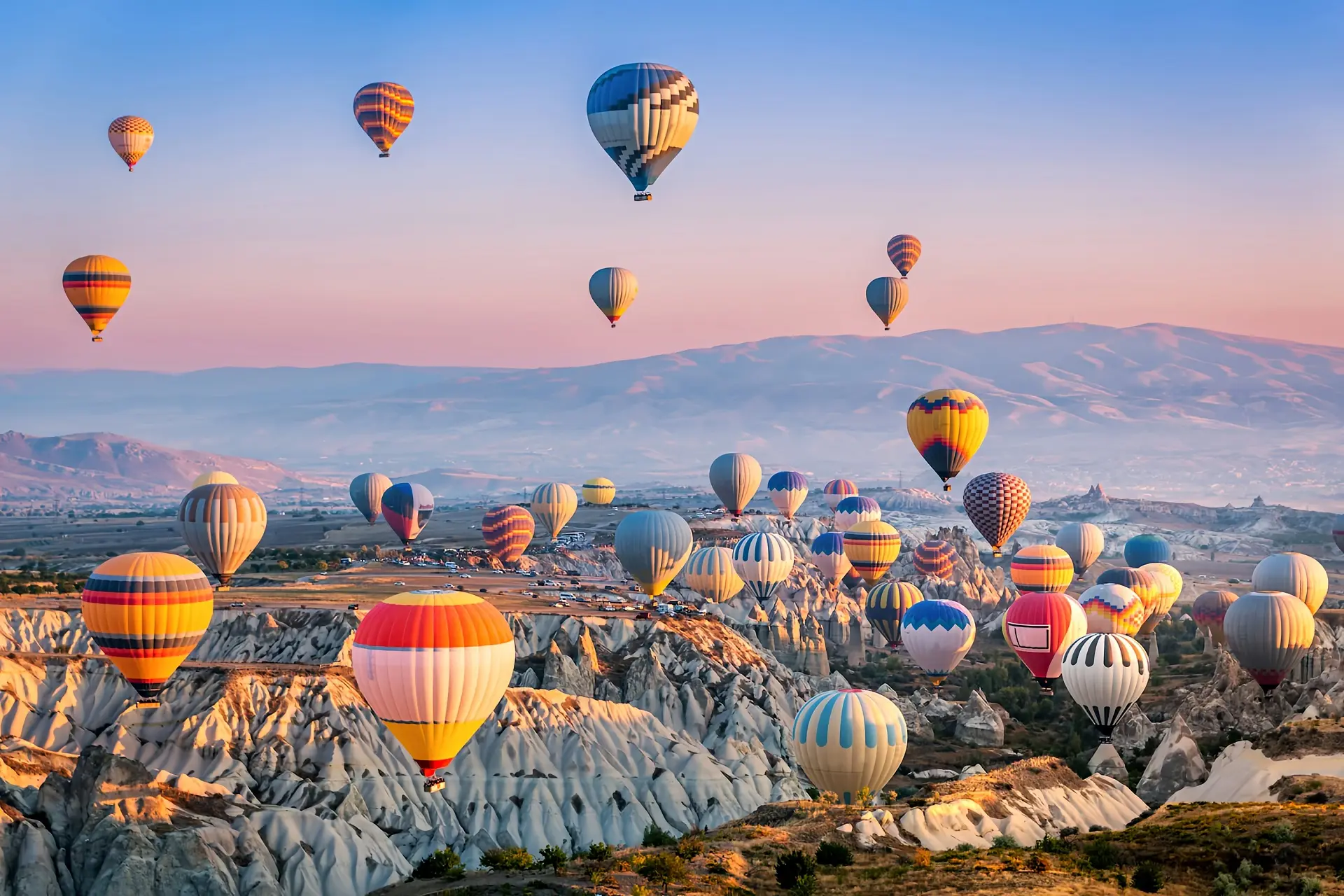
Eroded valleys, rock-cut settlements and dawn balloon flights form one of travel photography's most recognisable combinations.
Best for: the balloons are weather-dependent, but cappadocia does not become visually empty when flights are cancelled: rose valley, uçhisar, cave façades and volcanic tuff remain compelling subjects

Field perspective
How to photograph the place without reducing it to a backdrop
The balloons are weather-dependent, but Cappadocia does not become visually empty when flights are cancelled: Rose Valley, Uçhisar, cave façades and volcanic tuff remain compelling subjects. This is why the destination survives repetition: the familiar motif is only the first layer, and the landscape or city continues to change with weather, season, tide and human use. A successful photograph establishes where the viewer stands, what gives the scene its scale and why the place could not be exchanged for a visually similar backdrop elsewhere.
Plan at least two mornings, watch the launch from an authorised viewpoint on one day and consider a flight on another. Keep clear of landing areas and follow operator instructions inside the basket. The practical advantage of arriving with a plan is not simply that the light may be better. It creates time to notice edges, foregrounds, movement and small local details instead of reproducing the same compressed viewpoint used by everyone else. Keep a flexible lens choice, protect highlights, and leave room for the conditions to determine the final image.
The region is not an amusement-park backdrop. Rock-cut churches and fragile interiors need low-impact visitation, and drones or tripods may be restricted at protected sites. Social platforms reward immediacy, but travel photography has consequences outside the frame. The responsible approach protects access, avoids deception about risk or privacy, and does not encourage followers to repeat behaviour that residents, site managers or ecosystems cannot absorb. The most durable image is usually the one that makes beauty inseparable from place, history and care.
Dubai · United Arab Emirates
Dubai
A city of reflective towers, engineered waterfronts and desert edges where scale is the dominant photographic idea.
Best for: dubai works best when its contrasts remain visible: old creek districts beside vertical skylines, metro lines beneath towers, or desert light meeting glass and steel

Field perspective
How to photograph the place without reducing it to a backdrop
Dubai works best when its contrasts remain visible: old creek districts beside vertical skylines, metro lines beneath towers, or desert light meeting glass and steel. This is why the destination survives repetition: the familiar motif is only the first layer, and the landscape or city continues to change with weather, season, tide and human use. A successful photograph establishes where the viewer stands, what gives the scene its scale and why the place could not be exchanged for a visually similar backdrop elsewhere.
Use legal observation decks, public promenades and designated desert excursions. Security rules, private-property restrictions and drone regulations are taken seriously and can change. The practical advantage of arriving with a plan is not simply that the light may be better. It creates time to notice edges, foregrounds, movement and small local details instead of reproducing the same compressed viewpoint used by everyone else. Keep a flexible lens choice, protect highlights, and leave room for the conditions to determine the final image.
The polished surface is only one part of the city. Stronger work acknowledges labour, climate and neighbourhood life instead of presenting every space as an empty luxury stage. Social platforms reward immediacy, but travel photography has consequences outside the frame. The responsible approach protects access, avoids deception about risk or privacy, and does not encourage followers to repeat behaviour that residents, site managers or ecosystems cannot absorb. The most durable image is usually the one that makes beauty inseparable from place, history and care.
Kansai · Japan
Kyoto
Temple roofs, garden design, wooden streets and seasonal colour reward patience more than rapid landmark collecting.
Best for: fushimi inari's torii, arashiyama's bamboo and the lanes of higashiyama are famous, yet kyoto's most memorable frames often come from rain, shadow and carefully observed detail

Field perspective
How to photograph the place without reducing it to a backdrop
Fushimi Inari's torii, Arashiyama's bamboo and the lanes of Higashiyama are famous, yet Kyoto's most memorable frames often come from rain, shadow and carefully observed detail. This is why the destination survives repetition: the familiar motif is only the first layer, and the landscape or city continues to change with weather, season, tide and human use. A successful photograph establishes where the viewer stands, what gives the scene its scale and why the place could not be exchanged for a visually similar backdrop elsewhere.
Start early, use public transport, obey no-photography signs and never obstruct shrine approaches or residential streets. In geisha districts, local rules and privacy expectations must come before the picture. The practical advantage of arriving with a plan is not simply that the light may be better. It creates time to notice edges, foregrounds, movement and small local details instead of reproducing the same compressed viewpoint used by everyone else. Keep a flexible lens choice, protect highlights, and leave room for the conditions to determine the final image.
Kyoto's heritage is active rather than frozen. Worshippers, craftspeople and residents are not performers, and respectful distance usually produces more truthful photographs than intrusive close-ups. Social platforms reward immediacy, but travel photography has consequences outside the frame. The responsible approach protects access, avoids deception about risk or privacy, and does not encourage followers to repeat behaviour that residents, site managers or ecosystems cannot absorb. The most durable image is usually the one that makes beauty inseparable from place, history and care.
Indian Ocean · Maldives
The Maldives
Low coral islands, luminous lagoons and long horizons make simplicity the defining visual strength.
Best for: the familiar overwater-villa image is only one perspective

Field perspective
How to photograph the place without reducing it to a backdrop
The familiar overwater-villa image is only one perspective. Local islands, dhoni boats, reef edges and changing monsoon skies give the archipelago a broader sense of place. This is why the destination survives repetition: the familiar motif is only the first layer, and the landscape or city continues to change with weather, season, tide and human use. A successful photograph establishes where the viewer stands, what gives the scene its scale and why the place could not be exchanged for a visually similar backdrop elsewhere.
Use a polarising filter carefully, protect equipment from salt and humidity, and choose reef-conscious operators for underwater work. Conditions differ sharply between atolls and seasons. The practical advantage of arriving with a plan is not simply that the light may be better. It creates time to notice edges, foregrounds, movement and small local details instead of reproducing the same compressed viewpoint used by everyone else. Keep a flexible lens choice, protect highlights, and leave room for the conditions to determine the final image.
Coral is living habitat, not a foothold. Never stand on reefs, chase wildlife or remove marine life for a photograph; buoyancy control matters as much as camera technique. Social platforms reward immediacy, but travel photography has consequences outside the frame. The responsible approach protects access, avoids deception about risk or privacy, and does not encourage followers to repeat behaviour that residents, site managers or ecosystems cannot absorb. The most durable image is usually the one that makes beauty inseparable from place, history and care.
North Atlantic · Iceland
Iceland
Waterfalls, lava fields, glaciers and rapidly shifting weather produce a landscape that rarely repeats itself.
Best for: iceland's drama comes from scale and change

Field perspective
How to photograph the place without reducing it to a backdrop
Iceland's drama comes from scale and change. A modest human figure can establish distance, while cloud, spray or winter darkness may carry more atmosphere than a perfectly clear sky. This is why the destination survives repetition: the familiar motif is only the first layer, and the landscape or city continues to change with weather, season, tide and human use. A successful photograph establishes where the viewer stands, what gives the scene its scale and why the place could not be exchanged for a visually similar backdrop elsewhere.
Check road and weather services, keep well back from surf and waterfall edges, and use marked parking rather than stopping on narrow roads. Aurora forecasts describe probability, not a promise. The practical advantage of arriving with a plan is not simply that the light may be better. It creates time to notice edges, foregrounds, movement and small local details instead of reproducing the same compressed viewpoint used by everyone else. Keep a flexible lens choice, protect highlights, and leave room for the conditions to determine the final image.
Moss and geothermal ground are easily damaged. Leaving paths for a cleaner composition can create scars that remain long after the photograph has disappeared from a feed. Social platforms reward immediacy, but travel photography has consequences outside the frame. The responsible approach protects access, avoids deception about risk or privacy, and does not encourage followers to repeat behaviour that residents, site managers or ecosystems cannot absorb. The most durable image is usually the one that makes beauty inseparable from place, history and care.
Campania · Italy
The Amalfi Coast
Villages stacked above the Mediterranean create a vertical landscape of terraces, roads and sea.
Best for: positano supplies the iconic amphitheatre of houses, but ravello, amalfi and smaller settlements offer quieter compositions shaped by gardens, stairways and changing elevation

Field perspective
How to photograph the place without reducing it to a backdrop
Positano supplies the iconic amphitheatre of houses, but Ravello, Amalfi and smaller settlements offer quieter compositions shaped by gardens, stairways and changing elevation. This is why the destination survives repetition: the familiar motif is only the first layer, and the landscape or city continues to change with weather, season, tide and human use. A successful photograph establishes where the viewer stands, what gives the scene its scale and why the place could not be exchanged for a visually similar backdrop elsewhere.
Travel by ferry or public transport when practical, photograph from established viewpoints, and allow extra time because roads and paths are slow. Midday haze can flatten the coast; morning and late light restore depth. The practical advantage of arriving with a plan is not simply that the light may be better. It creates time to notice edges, foregrounds, movement and small local details instead of reproducing the same compressed viewpoint used by everyone else. Keep a flexible lens choice, protect highlights, and leave room for the conditions to determine the final image.
Homes, hotel terraces and church steps are not public studios. The coast's narrow spaces work only when visitors keep passages clear and accept that some desired angles are private. Social platforms reward immediacy, but travel photography has consequences outside the frame. The responsible approach protects access, avoids deception about risk or privacy, and does not encourage followers to repeat behaviour that residents, site managers or ecosystems cannot absorb. The most durable image is usually the one that makes beauty inseparable from place, history and care.
Ma'an Governorate · Jordan
Petra
A sandstone city approached through a narrow gorge, where anticipation is as important as the Treasury itself.
Best for: the siq controls the visual story: compressed rock walls gradually reveal carved architecture, while longer walks expose tomb façades, high places and the wider nabataean landscape

Field perspective
How to photograph the place without reducing it to a backdrop
The Siq controls the visual story: compressed rock walls gradually reveal carved architecture, while longer walks expose tomb façades, high places and the wider Nabataean landscape. This is why the destination survives repetition: the familiar motif is only the first layer, and the landscape or city continues to change with weather, season, tide and human use. A successful photograph establishes where the viewer stands, what gives the scene its scale and why the place could not be exchanged for a visually similar backdrop elsewhere.
Begin early, carry water, prepare for extensive walking and use licensed local services. Light changes rapidly on the façades, and the site deserves more than a rushed entrance photograph. The practical advantage of arriving with a plan is not simply that the light may be better. It creates time to notice edges, foregrounds, movement and small local details instead of reproducing the same compressed viewpoint used by everyone else. Keep a flexible lens choice, protect highlights, and leave room for the conditions to determine the final image.
Do not climb carved monuments or stage risky ledge shots. Petra is an archaeological landscape and a place of work for local communities, not an obstacle course for dramatic content. Social platforms reward immediacy, but travel photography has consequences outside the frame. The responsible approach protects access, avoids deception about risk or privacy, and does not encourage followers to repeat behaviour that residents, site managers or ecosystems cannot absorb. The most durable image is usually the one that makes beauty inseparable from place, history and care.
Cusco Region · Peru
Machu Picchu
Stone terraces and Andean ridges form a composition so balanced that it can disguise the site's physical complexity.
Best for: classic overlooks establish the citadel, but cloud, agricultural terraces, masonry details and mountain transitions reveal how carefully the inca settlement occupies its ridge

Field perspective
How to photograph the place without reducing it to a backdrop
Classic overlooks establish the citadel, but cloud, agricultural terraces, masonry details and mountain transitions reveal how carefully the Inca settlement occupies its ridge. This is why the destination survives repetition: the familiar motif is only the first layer, and the landscape or city continues to change with weather, season, tide and human use. A successful photograph establishes where the viewer stands, what gives the scene its scale and why the place could not be exchanged for a visually similar backdrop elsewhere.
Entry routes, circuits and permitted equipment are regulated. Acclimatise before the visit, follow the assigned circuit and confirm current access rules rather than relying on older travel accounts. The practical advantage of arriving with a plan is not simply that the light may be better. It creates time to notice edges, foregrounds, movement and small local details instead of reproducing the same compressed viewpoint used by everyone else. Keep a flexible lens choice, protect highlights, and leave room for the conditions to determine the final image.
The famous viewpoint is not worth damaging walls, crossing barriers or delaying others. A slower, guided reading of the site creates photographs with more meaning than repeated poses at a single terrace. Social platforms reward immediacy, but travel photography has consequences outside the frame. The responsible approach protects access, avoids deception about risk or privacy, and does not encourage followers to repeat behaviour that residents, site managers or ecosystems cannot absorb. The most durable image is usually the one that makes beauty inseparable from place, history and care.
Society Islands · French Polynesia
Bora Bora
Mount Otemanu, a ring of motu and a lagoon of changing blues create a naturally layered island composition.
Best for: wide views explain the lagoon's geometry, while water-level photographs reveal coral heads, boats and reflections

Field perspective
How to photograph the place without reducing it to a backdrop
Wide views explain the lagoon's geometry, while water-level photographs reveal coral heads, boats and reflections. The mountain provides orientation from almost every side. This is why the destination survives repetition: the familiar motif is only the first layer, and the landscape or city continues to change with weather, season, tide and human use. A successful photograph establishes where the viewer stands, what gives the scene its scale and why the place could not be exchanged for a visually similar backdrop elsewhere.
Work with local guides for lagoon access, protect cameras from spray and ask before using private resort facilities. Weather can shift from crystalline sun to heavy tropical cloud within minutes. The practical advantage of arriving with a plan is not simply that the light may be better. It creates time to notice edges, foregrounds, movement and small local details instead of reproducing the same compressed viewpoint used by everyone else. Keep a flexible lens choice, protect highlights, and leave room for the conditions to determine the final image.
Marine encounters should remain on the animals' terms. Avoid feeding, touching or crowding wildlife, and choose operators that explain reef protection rather than promising theatrical contact. Social platforms reward immediacy, but travel photography has consequences outside the frame. The responsible approach protects access, avoids deception about risk or privacy, and does not encourage followers to repeat behaviour that residents, site managers or ecosystems cannot absorb. The most durable image is usually the one that makes beauty inseparable from place, history and care.
Île-de-France · France
Paris
Monuments, boulevards and ordinary street life offer a visual range that extends far beyond a single tower.
Best for: the eiffel tower, seine bridges and montmartre remain strong anchors, but paris becomes more personal through markets, métro entrances, courtyards and changing neighbourhood light

Field perspective
How to photograph the place without reducing it to a backdrop
The Eiffel Tower, Seine bridges and Montmartre remain strong anchors, but Paris becomes more personal through markets, métro entrances, courtyards and changing neighbourhood light. This is why the destination survives repetition: the familiar motif is only the first layer, and the landscape or city continues to change with weather, season, tide and human use. A successful photograph establishes where the viewer stands, what gives the scene its scale and why the place could not be exchanged for a visually similar backdrop elsewhere.
Scout viewpoints rather than copying exact social-media poses, respect museum and tripod rules, and keep paths clear around busy landmarks. Blue hour often gives better balance between architecture and city lights than full darkness. The practical advantage of arriving with a plan is not simply that the light may be better. It creates time to notice edges, foregrounds, movement and small local details instead of reproducing the same compressed viewpoint used by everyone else. Keep a flexible lens choice, protect highlights, and leave room for the conditions to determine the final image.
Street photography has ethical and legal dimensions, especially when a person is identifiable or vulnerable. Gesture, distance and consent matter more than the possibility of a viral frame. Social platforms reward immediacy, but travel photography has consequences outside the frame. The responsible approach protects access, avoids deception about risk or privacy, and does not encourage followers to repeat behaviour that residents, site managers or ecosystems cannot absorb. The most durable image is usually the one that makes beauty inseparable from place, history and care.
Alberta · Canada
Banff National Park
Glacial lakes and Rocky Mountain walls create colour and scale that can look unreal even without heavy editing.
Best for: lake louise and moraine lake are celebrated, but forest paths, river valleys and changing weather broaden the story beyond two viewpoints

Field perspective
How to photograph the place without reducing it to a backdrop
Lake Louise and Moraine Lake are celebrated, but forest paths, river valleys and changing weather broaden the story beyond two viewpoints. This is why the destination survives repetition: the familiar motif is only the first layer, and the landscape or city continues to change with weather, season, tide and human use. A successful photograph establishes where the viewer stands, what gives the scene its scale and why the place could not be exchanged for a visually similar backdrop elsewhere.
Transport and parking systems at popular lakes change as the park manages demand. Reserve required shuttles, carry bear-aware habits and prepare for cold or snow in any shoulder season. The practical advantage of arriving with a plan is not simply that the light may be better. It creates time to notice edges, foregrounds, movement and small local details instead of reproducing the same compressed viewpoint used by everyone else. Keep a flexible lens choice, protect highlights, and leave room for the conditions to determine the final image.
Wildlife needs distance, and roadside stopping can be dangerous. Never bait, approach or surround animals; a longer lens protects both the subject and the credibility of the image. Social platforms reward immediacy, but travel photography has consequences outside the frame. The responsible approach protects access, avoids deception about risk or privacy, and does not encourage followers to repeat behaviour that residents, site managers or ecosystems cannot absorb. The most durable image is usually the one that makes beauty inseparable from place, history and care.
Marrakech-Safi · Morocco
Marrakech
Earth-coloured walls, tiled interiors, garden greens and dense market streets produce a rich but demanding visual environment.
Best for: the medina is strongest as a sequence of thresholds: shaded lanes, carved doors, courtyards and sudden squares

Field perspective
How to photograph the place without reducing it to a backdrop
The medina is strongest as a sequence of thresholds: shaded lanes, carved doors, courtyards and sudden squares. Riads and gardens provide controlled geometry, while souks depend on observation and patience. This is why the destination survives repetition: the familiar motif is only the first layer, and the landscape or city continues to change with weather, season, tide and human use. A successful photograph establishes where the viewer stands, what gives the scene its scale and why the place could not be exchanged for a visually similar backdrop elsewhere.
Ask before photographing people, especially artisans at work, and be prepared to accept refusal. Verify permission for private interiors and avoid blocking trade in narrow passages. The practical advantage of arriving with a plan is not simply that the light may be better. It creates time to notice edges, foregrounds, movement and small local details instead of reproducing the same compressed viewpoint used by everyone else. Keep a flexible lens choice, protect highlights, and leave room for the conditions to determine the final image.
A camera can intensify the imbalance between visitor and resident. Buying fairly, learning basic courtesies and showing context make the work less extractive and usually more interesting. Social platforms reward immediacy, but travel photography has consequences outside the frame. The responsible approach protects access, avoids deception about risk or privacy, and does not encourage followers to repeat behaviour that residents, site managers or ecosystems cannot absorb. The most durable image is usually the one that makes beauty inseparable from place, history and care.
Kantō · Japan
Tokyo
Neon intersections, elevated railways, compact alleys and quiet shrines make contrast the city's most useful photographic principle.
Best for: shibuya and shinjuku supply the spectacle, but tokyo's depth appears in neighbourhood transitions: a vending machine beside a temple wall, dawn at a fish market or evening reflections after rain

Field perspective
How to photograph the place without reducing it to a backdrop
Shibuya and Shinjuku supply the spectacle, but Tokyo's depth appears in neighbourhood transitions: a vending machine beside a temple wall, dawn at a fish market or evening reflections after rain. This is why the destination survives repetition: the familiar motif is only the first layer, and the landscape or city continues to change with weather, season, tide and human use. A successful photograph establishes where the viewer stands, what gives the scene its scale and why the place could not be exchanged for a visually similar backdrop elsewhere.
Use observation decks and public spaces, follow tripod restrictions and do not obstruct commuters. Many small bars, shops and residential lanes are private environments despite appearing open from the street. The practical advantage of arriving with a plan is not simply that the light may be better. It creates time to notice edges, foregrounds, movement and small local details instead of reproducing the same compressed viewpoint used by everyone else. Keep a flexible lens choice, protect highlights, and leave room for the conditions to determine the final image.
People are not anonymous design elements. Photograph crowds from a respectful distance, avoid intrusive lenses on trains and obtain permission when a person becomes the unmistakable subject. Social platforms reward immediacy, but travel photography has consequences outside the frame. The responsible approach protects access, avoids deception about risk or privacy, and does not encourage followers to repeat behaviour that residents, site managers or ecosystems cannot absorb. The most durable image is usually the one that makes beauty inseparable from place, history and care.
Upper Austria · Austria
Hallstatt
A narrow lakeside village backed by steep mountains, composed almost like a theatre set but functioning as a real community.
Best for: the familiar elevated view explains the settlement's shape, while lake-level photographs, winter mist and details of timber houses offer alternatives to the single postcard angle

Field perspective
How to photograph the place without reducing it to a backdrop
The familiar elevated view explains the settlement's shape, while lake-level photographs, winter mist and details of timber houses offer alternatives to the single postcard angle. This is why the destination survives repetition: the familiar motif is only the first layer, and the landscape or city continues to change with weather, season, tide and human use. A successful photograph establishes where the viewer stands, what gives the scene its scale and why the place could not be exchanged for a visually similar backdrop elsewhere.
Arrive by public transport when possible, stay within marked paths and avoid entering residential terraces. Early morning is quieter, but silence still does not grant access to private property. The practical advantage of arriving with a plan is not simply that the light may be better. It creates time to notice edges, foregrounds, movement and small local details instead of reproducing the same compressed viewpoint used by everyone else. Keep a flexible lens choice, protect highlights, and leave room for the conditions to determine the final image.
Hallstatt has become a case study in the pressure created by concentrated image tourism. The responsible photograph accepts limits and leaves space for residents to move through their own village. Social platforms reward immediacy, but travel photography has consequences outside the frame. The responsible approach protects access, avoids deception about risk or privacy, and does not encourage followers to repeat behaviour that residents, site managers or ecosystems cannot absorb. The most durable image is usually the one that makes beauty inseparable from place, history and care.
Rif Mountains · Morocco
Chefchaouen
Blue-washed lanes create an instantly coherent palette, but the town's mountain setting and daily life give it substance.
Best for: the medina changes from cool morning blue to warmer afternoon tones

Field perspective
How to photograph the place without reducing it to a backdrop
The medina changes from cool morning blue to warmer afternoon tones. Doorways, stairs and small squares work best when shown as connected spaces rather than isolated colour samples. This is why the destination survives repetition: the familiar motif is only the first layer, and the landscape or city continues to change with weather, season, tide and human use. A successful photograph establishes where the viewer stands, what gives the scene its scale and why the place could not be exchanged for a visually similar backdrop elsewhere.
Ask before photographing residents or shop interiors, avoid elaborate setups in passageways and give way to deliveries and households. Rain can deepen the blue but makes stone steps slippery. The practical advantage of arriving with a plan is not simply that the light may be better. It creates time to notice edges, foregrounds, movement and small local details instead of reproducing the same compressed viewpoint used by everyone else. Keep a flexible lens choice, protect highlights, and leave room for the conditions to determine the final image.
The town is not an open studio. Images that include craft, geography and respectful human scale are more honest than those that erase the community in pursuit of an empty background. Social platforms reward immediacy, but travel photography has consequences outside the frame. The responsible approach protects access, avoids deception about risk or privacy, and does not encourage followers to repeat behaviour that residents, site managers or ecosystems cannot absorb. The most durable image is usually the one that makes beauty inseparable from place, history and care.
Siem Reap Province · Cambodia
Angkor Wat
Monumental towers, long causeways and forested temple complexes reveal different scales of the Khmer capital.
Best for: sunrise silhouettes are only an introduction

Field perspective
How to photograph the place without reducing it to a backdrop
Sunrise silhouettes are only an introduction. Bas-reliefs, galleries, reservoirs and less-visited temples show how architecture, water management and landscape were planned together. This is why the destination survives repetition: the familiar motif is only the first layer, and the landscape or city continues to change with weather, season, tide and human use. A successful photograph establishes where the viewer stands, what gives the scene its scale and why the place could not be exchanged for a visually similar backdrop elsewhere.
Use the official pass system, dress for active religious spaces and follow route or climbing restrictions. Heat and distance make an unhurried multi-day visit more productive than a single rushed circuit. The practical advantage of arriving with a plan is not simply that the light may be better. It creates time to notice edges, foregrounds, movement and small local details instead of reproducing the same compressed viewpoint used by everyone else. Keep a flexible lens choice, protect highlights, and leave room for the conditions to determine the final image.
Do not touch carvings, climb closed structures or position people in ways that interrupt worship. Temple conservation and community respect should guide both composition and movement. Social platforms reward immediacy, but travel photography has consequences outside the frame. The responsible approach protects access, avoids deception about risk or privacy, and does not encourage followers to repeat behaviour that residents, site managers or ecosystems cannot absorb. The most durable image is usually the one that makes beauty inseparable from place, history and care.
Lika · Croatia
Plitvice Lakes National Park
A linked system of lakes, waterfalls and forest where movement through the landscape is tightly choreographed by boardwalks.
Best for: the visual pleasure comes from layers: water moving beneath timber paths, pale limestone, submerged branches and forest reflected in changing green and blue

Field perspective
How to photograph the place without reducing it to a backdrop
The visual pleasure comes from layers: water moving beneath timber paths, pale limestone, submerged branches and forest reflected in changing green and blue. This is why the destination survives repetition: the familiar motif is only the first layer, and the landscape or city continues to change with weather, season, tide and human use. A successful photograph establishes where the viewer stands, what gives the scene its scale and why the place could not be exchanged for a visually similar backdrop elsewhere.
Use official routes, reserve entry when required and expect spray, shade and slippery surfaces. Water levels and route availability vary by season, so a famous angle may not always be accessible. The practical advantage of arriving with a plan is not simply that the light may be better. It creates time to notice edges, foregrounds, movement and small local details instead of reproducing the same compressed viewpoint used by everyone else. Keep a flexible lens choice, protect highlights, and leave room for the conditions to determine the final image.
Boardwalk barriers protect both visitors and habitat. Drones, swimming and off-trail shortcuts can disturb wildlife or undermine the very landscape the photograph is meant to celebrate. Social platforms reward immediacy, but travel photography has consequences outside the frame. The responsible approach protects access, avoids deception about risk or privacy, and does not encourage followers to repeat behaviour that residents, site managers or ecosystems cannot absorb. The most durable image is usually the one that makes beauty inseparable from place, history and care.
Altiplano · Bolivia
Salar de Uyuni
A vast salt surface that alternates between geometric crust and a shallow seasonal mirror.
Best for: dry conditions emphasise polygonal texture and horizon; wet conditions dissolve the boundary between ground and sky

Field perspective
How to photograph the place without reducing it to a backdrop
Dry conditions emphasise polygonal texture and horizon; wet conditions dissolve the boundary between ground and sky. Both are authentic, and neither can be guaranteed on a fixed date. This is why the destination survives repetition: the familiar motif is only the first layer, and the landscape or city continues to change with weather, season, tide and human use. A successful photograph establishes where the viewer stands, what gives the scene its scale and why the place could not be exchanged for a visually similar backdrop elsewhere.
Travel with an experienced operator, protect equipment from salt and prepare for altitude, cold and long distances. Perspective tricks are optional; scale and silence can carry the image without props. The practical advantage of arriving with a plan is not simply that the light may be better. It creates time to notice edges, foregrounds, movement and small local details instead of reproducing the same compressed viewpoint used by everyone else. Keep a flexible lens choice, protect highlights, and leave room for the conditions to determine the final image.
The salt flat is part of a sensitive high-altitude environment and an industrial region, not an infinite blank studio. Vehicles should follow established practice and waste must leave with the group. Social platforms reward immediacy, but travel photography has consequences outside the frame. The responsible approach protects access, avoids deception about risk or privacy, and does not encourage followers to repeat behaviour that residents, site managers or ecosystems cannot absorb. The most durable image is usually the one that makes beauty inseparable from place, history and care.
Dalmatia · Croatia
Dubrovnik
Limestone walls, terracotta roofs and the Adriatic create a compact cityscape with unusually clear edges.
Best for: the wall circuit supplies the overview, while stradun, harbour approaches and upper residential lanes reveal how the historic city works at ground level

Field perspective
How to photograph the place without reducing it to a backdrop
The wall circuit supplies the overview, while Stradun, harbour approaches and upper residential lanes reveal how the historic city works at ground level. This is why the destination survives repetition: the familiar motif is only the first layer, and the landscape or city continues to change with weather, season, tide and human use. A successful photograph establishes where the viewer stands, what gives the scene its scale and why the place could not be exchanged for a visually similar backdrop elsewhere.
Begin early or later in the day, prepare for exposed heat and stairs, and check cruise schedules if crowd levels matter. Filming fame should not replace the city's own history. The practical advantage of arriving with a plan is not simply that the light may be better. It creates time to notice edges, foregrounds, movement and small local details instead of reproducing the same compressed viewpoint used by everyone else. Keep a flexible lens choice, protect highlights, and leave room for the conditions to determine the final image.
Respect homes visible from the walls, avoid photographing through windows and keep moving on narrow sections. The Old City is both a heritage site and a neighbourhood. Social platforms reward immediacy, but travel photography has consequences outside the frame. The responsible approach protects access, avoids deception about risk or privacy, and does not encourage followers to repeat behaviour that residents, site managers or ecosystems cannot absorb. The most durable image is usually the one that makes beauty inseparable from place, history and care.
Queensland · Australia
The Great Barrier Reef
A vast marine system whose colour and detail depend on water clarity, depth, weather and responsible access.
Best for: underwater images should show habitat rather than only spectacle: coral structure, schooling fish, seagrass and the scale of the reef platform all contribute to the story

Field perspective
How to photograph the place without reducing it to a backdrop
Underwater images should show habitat rather than only spectacle: coral structure, schooling fish, seagrass and the scale of the reef platform all contribute to the story. This is why the destination survives repetition: the familiar motif is only the first layer, and the landscape or city continues to change with weather, season, tide and human use. A successful photograph establishes where the viewer stands, what gives the scene its scale and why the place could not be exchanged for a visually similar backdrop elsewhere.
Choose accredited operators, secure equipment, control buoyancy and listen to site briefings. Surface conditions, visibility and access vary, while some zones have special protections. The practical advantage of arriving with a plan is not simply that the light may be better. It creates time to notice edges, foregrounds, movement and small local details instead of reproducing the same compressed viewpoint used by everyone else. Keep a flexible lens choice, protect highlights, and leave room for the conditions to determine the final image.
Never touch coral, pursue animals or use marine life as a prop. The most valuable photograph communicates the reef's living complexity and vulnerability without adding stress. Social platforms reward immediacy, but travel photography has consequences outside the frame. The responsible approach protects access, avoids deception about risk or privacy, and does not encourage followers to repeat behaviour that residents, site managers or ecosystems cannot absorb. The most durable image is usually the one that makes beauty inseparable from place, history and care.
Hunan · China
Zhangjiajie
Sandstone pillars, forest and mist create depth through repetition rather than a single dominant landmark.
Best for: high viewpoints reveal the vertical field of peaks, while cableways, forest paths and changing cloud produce more intimate sequences

Field perspective
How to photograph the place without reducing it to a backdrop
High viewpoints reveal the vertical field of peaks, while cableways, forest paths and changing cloud produce more intimate sequences. Mist can simplify the scene instead of ruining it. This is why the destination survives repetition: the familiar motif is only the first layer, and the landscape or city continues to change with weather, season, tide and human use. A successful photograph establishes where the viewer stands, what gives the scene its scale and why the place could not be exchanged for a visually similar backdrop elsewhere.
Allow for queues and weather, use official paths and check current park transport arrangements. Wide lenses show scale, but a telephoto often separates layered pillars more effectively. The practical advantage of arriving with a plan is not simply that the light may be better. It creates time to notice edges, foregrounds, movement and small local details instead of reproducing the same compressed viewpoint used by everyone else. Keep a flexible lens choice, protect highlights, and leave room for the conditions to determine the final image.
Cliff-edge barriers are not compositional inconveniences. Staying within protected routes prevents erosion and keeps photography compatible with a heavily visited mountain landscape. Social platforms reward immediacy, but travel photography has consequences outside the frame. The responsible approach protects access, avoids deception about risk or privacy, and does not encourage followers to repeat behaviour that residents, site managers or ecosystems cannot absorb. The most durable image is usually the one that makes beauty inseparable from place, history and care.
Liguria · Italy
Cinque Terre
Five coastal villages occupy steep folds of land shaped by terraces, footpaths and the railway.
Best for: manarola and vernazza provide iconic harbour views, but the full story includes dry-stone terraces, vineyard slopes and the practical links between villages

Field perspective
How to photograph the place without reducing it to a backdrop
Manarola and Vernazza provide iconic harbour views, but the full story includes dry-stone terraces, vineyard slopes and the practical links between villages. This is why the destination survives repetition: the familiar motif is only the first layer, and the landscape or city continues to change with weather, season, tide and human use. A successful photograph establishes where the viewer stands, what gives the scene its scale and why the place could not be exchanged for a visually similar backdrop elsewhere.
Use trains and authorised trails, check closures before hiking and wear suitable footwear. Evening light can be beautiful, but returning paths may be dark and steep. The practical advantage of arriving with a plan is not simply that the light may be better. It creates time to notice edges, foregrounds, movement and small local details instead of reproducing the same compressed viewpoint used by everyone else. Keep a flexible lens choice, protect highlights, and leave room for the conditions to determine the final image.
Terraces are agricultural infrastructure, not viewing platforms. Stay off cultivated land, keep lanes open and spend locally rather than treating each village as a quick photograph between trains. Social platforms reward immediacy, but travel photography has consequences outside the frame. The responsible approach protects access, avoids deception about risk or privacy, and does not encourage followers to repeat behaviour that residents, site managers or ecosystems cannot absorb. The most durable image is usually the one that makes beauty inseparable from place, history and care.
New York · United States
New York City
A vertical city where skyline, street grid, water and human movement can be read at radically different scales.
Best for: observation decks clarify geography, but street corners, bridges, parks and subway entrances give the city its rhythm

Field perspective
How to photograph the place without reducing it to a backdrop
Observation decks clarify geography, but street corners, bridges, parks and subway entrances give the city its rhythm. Weather and reflected light continually redraw familiar architecture. This is why the destination survives repetition: the familiar motif is only the first layer, and the landscape or city continues to change with weather, season, tide and human use. A successful photograph establishes where the viewer stands, what gives the scene its scale and why the place could not be exchanged for a visually similar backdrop elsewhere.
Use legal public viewpoints, keep tripods out of pedestrian flow and check property rules for privately managed public spaces. Dawn and blue hour offer atmosphere without requiring empty streets. The practical advantage of arriving with a plan is not simply that the light may be better. It creates time to notice edges, foregrounds, movement and small local details instead of reproducing the same compressed viewpoint used by everyone else. Keep a flexible lens choice, protect highlights, and leave room for the conditions to determine the final image.
Street subjects deserve dignity and context. Avoid turning homelessness, distress or private moments into visual novelty, and seek consent when an individual becomes central to the frame. Social platforms reward immediacy, but travel photography has consequences outside the frame. The responsible approach protects access, avoids deception about risk or privacy, and does not encourage followers to repeat behaviour that residents, site managers or ecosystems cannot absorb. The most durable image is usually the one that makes beauty inseparable from place, history and care.
Practical craft
From a recognisable shot to a meaningful series
A single landmark photograph proves that the traveller arrived. A coherent series shows that the traveller paid attention.
Begin with an establishing frame that gives the viewer orientation, then work inward. A second image might show material or texture; a third can introduce human scale; a fourth can register weather, transport or ritual. This progression avoids the common problem of returning with dozens of nearly identical wide views while missing the details that make one destination different from another.
Travel light enough to remain mobile. A standard zoom covers most city and landscape situations, while a modest telephoto helps separate mountain layers, compress architecture or keep distance from wildlife. A fast small prime can be useful after dark. More equipment does not create more access, and large tripods or drones may be prohibited where a handheld camera is welcomed.
Keep technical choices subordinate to the scene. High dynamic range can rescue difficult contrast, but aggressive processing can erase the atmosphere of mist, dusk or heat. Saturation should not turn glacial water, painted walls or coral into colours the place never displayed. Viewers increasingly recognise visual exaggeration, and accuracy is part of an image's authority.
Captions complete the work. Name the location accurately, acknowledge a guide or community where relevant, explain unusual seasonal conditions and avoid presenting managed experiences as spontaneous discoveries. A responsible caption can also direct readers toward official access information without turning the post into an instruction manual for reaching a fragile ledge.
Establish the setting
Make one frame that explains geography, architecture or the protected landscape before concentrating on details.
Change distance, not only angle
Move from overview to texture, human scale and environmental conditions so the series gains narrative depth.
Record access conditions
Note season, route, permit or operator details that materially affected what could be photographed.
Edit for fidelity
Balance exposure and colour without manufacturing conditions, removing safety context or misleading the audience.
Caption with consequence in mind
Share enough context to be useful while avoiding directions that could intensify pressure on a vulnerable point.
Beyond the feed
The world's most photogenic places deserve more than the world's most repeated photographs.
The destinations in this guide are visually famous for good reasons: volcanic geology, inherited craft, monumental planning, intense urban movement or extraordinary ecosystems. Their recognisability is an invitation to look more closely, not a requirement to reproduce the exact frame that made them famous.
A thoughtful photographer accepts weather, access and other people as part of the place. That acceptance produces better work because it replaces control with observation. It also leaves the destination intact — physically, socially and culturally — for residents, future visitors and the next image that has not yet been imagined.
The practical measure of success is therefore not likes alone. It is whether the photograph communicates where it was made, whether the process respected the people and environment outside the frame, and whether the resulting story encourages curiosity without encouraging harm.