

Kyoto · living performing culture
The work begins long before the white makeup
A day in Kyoto’s geiko and maiko world is shaped by lessons, relationships and obligations—not by a single romantic timetable.
This feature uses “geiko” for Kyoto’s fully fledged professional artists, “maiko” for apprentices, and “geisha” only when discussing the wider Japanese term or English-language usage.
In the early evening, a visitor in Gion may see a figure in formal kimono move quickly between a doorway and a waiting car. The encounter can last seconds. It is also the least informative part of the working day. The visible costume arrives after years of training, hours of rehearsal, the coordination of an okiya, teachers, dressers, hairstylists, textile specialists and teahouse staff, and a professional obligation to be punctual for guests who have booked an engagement. Treating that walk as the whole story reduces a demanding artistic career to street scenery.
The phrase “a day in the life of a geisha” promises a clock: wake at this hour, apply makeup at that hour, perform until midnight. Kyoto’s kagai culture does not fit that device. A maiko’s day differs from a geiko’s. A performer preparing for a major annual dance has a different workload from someone with private evening engagements. Lessons, rehearsals, greetings, ceremonies and seasonal events shift across the year. Each of Kyoto’s five kagai also maintains its own institutions and performance traditions.
A more honest day-in-the-life account therefore follows the shape of the work rather than inventing a universal schedule. Morning often belongs to instruction and practice. Afternoon may be divided between rehearsals, errands, rest and preparation. Evening brings public performances or private ozashiki engagements. Afterward, costumes, instruments, correspondence and the next day’s obligations remain. For an established geiko, greater professional autonomy does not mean the training ends; it means responsibility for maintaining an artistic reputation shifts more fully onto her.
This is also a visitor guide, but not a spotting guide. Kyoto offers legitimate ways to encounter kagai culture through theatres, museums, annual dances and properly arranged events. Waiting in a residential lane with a camera is not one of them. Understanding the work should lead to better behaviour: attention instead of pursuit, a ticket instead of an ambush, and respect for the boundary between a public performance and somebody’s commute.
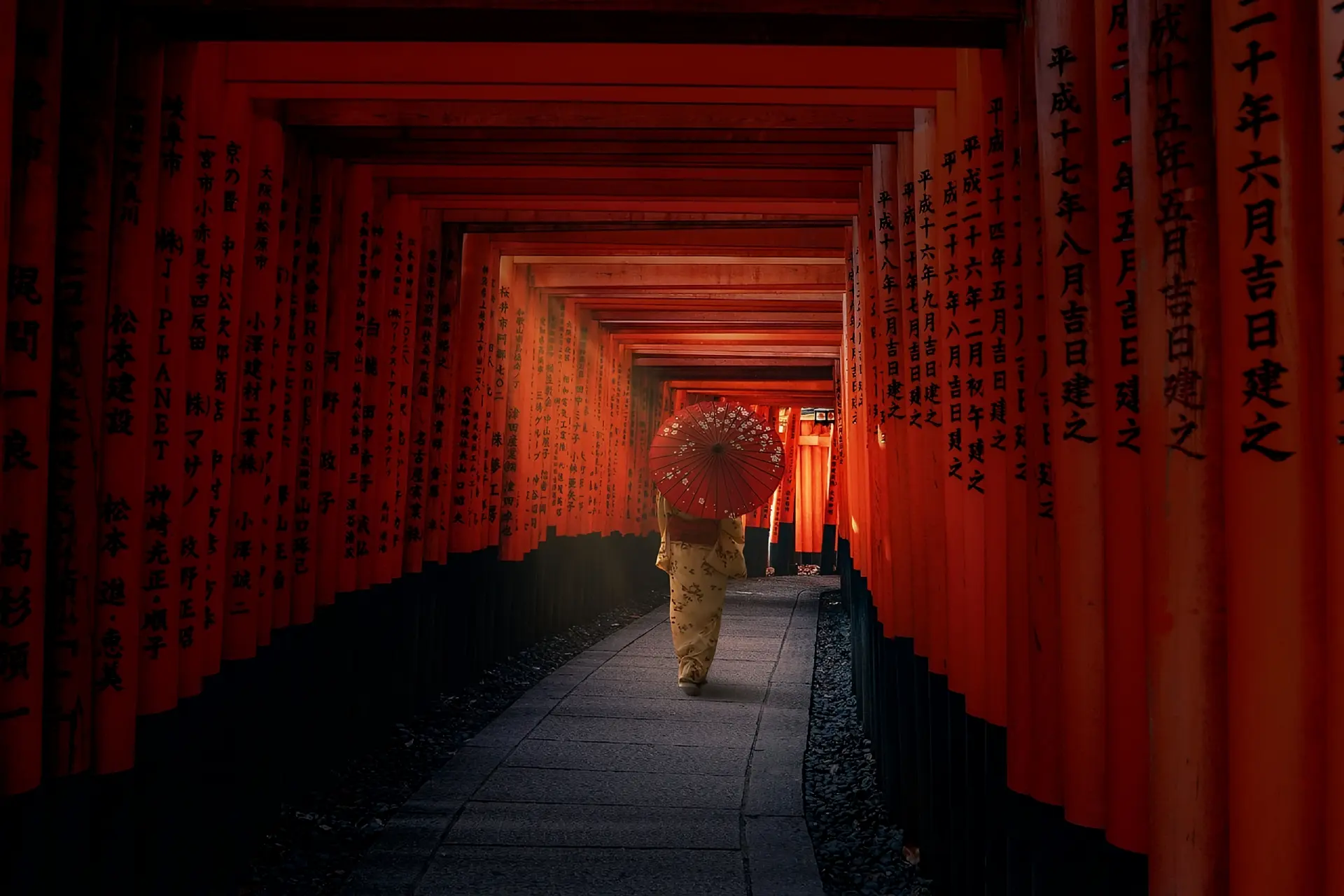
Language before spectacle
Geiko and maiko are professional statuses, not interchangeable looks
Kyoto’s vocabulary reveals the structure of the work.
“Geisha” is widely understood outside Japan and is used in several regions, but Kyoto’s own institutions use geiko for a fully fledged professional and maiko for an apprentice. The written forms matter: geiko is 芸妓, maiko is 舞妓. The distinction is not simply adult versus teenager, subdued kimono versus colourful kimono, or wig versus natural hair. It marks a different point in training, professional responsibility and artistic identity.
A maiko has already passed through preparatory stages before her formal debut. Kyoto City’s cultural heritage guidance gives the sequence as shikomi → minarai → misedashi → maiko → erikae → geiko. In Gion Kobu, the Gion Kagai Art Museum’s recruitment information describes roughly a year as shikomi followed by about a month as minarai before debut, but those figures should be understood as a district’s published model rather than a universal law for every house and every era.
Shikomi is not performance in costume. It is the period of entering the social and practical world of the kagai: living in an okiya, assisting the household, learning greetings and forms of conduct, absorbing Kyoto kagai speech, and beginning serious dance instruction. Minarai literally indicates learning by watching. A minarai starts entering professional settings with senior guidance, observing how an evening is paced and how an experienced artist reads a room.
Misedashi is the formal debut as a maiko. It does not signal the end of training; it marks the point at which apprenticeship becomes public work. Lessons expand rather than disappear. Ookini Zaidan lists dance, shamisen, hayashi instruments, multiple vocal traditions and tea among the arts studied, alongside the less easily catalogued craft of hospitality. The transition to geiko is marked by erikae, the “turning of the collar,” but an established geiko continues to rehearse and refine her repertoire.
Kyoto City also distinguishes two broad artistic roles among geiko. Tachikata specialise primarily in dance. Jikata take responsibility for song and instruments such as shamisen and percussion. These are not rigid labels for every moment of a career, but they correct a common visual bias: the person at the centre of a photograph is not necessarily the only or even the senior artistic presence in a room. A musician seated to the side may carry the rhythmic and vocal architecture of the performance.
Maiko
Learning remains central. Public work and formal lessons advance together, under the guidance of the okiya, teachers and senior artists.
Geiko
A fully fledged performer and host who continues training while taking greater responsibility for repertoire, bookings and reputation.
Geisha
A valid broader Japanese and English-language term, but not the preferred local designation when discussing Kyoto’s professional community.
The setting is equally important. Kyoto’s active professional districts are collectively known as the five kagai, or Gokagai: Gion Kobu, Miyagawacho, Pontocho, Kamishichiken and Gion Higashi. They are linked by a shared cultural system, but they are not one homogeneous “geisha district.” Each has its own associations, performance venue, artistic lineage and annual stage traditions.
Gion Kobu, south and north of Shijo within its historic area, is associated with the Inoue school and the Miyako Odori. Miyagawacho maintains the Wakayagi tradition and Kyo Odori. Pontocho is associated with the Onoe school and Kamogawa Odori. Kamishichiken, near Kitano Tenmangu, follows the Hanayagi school and presents Kitano Odori. Gion Higashi follows the Fujima school and is known for the autumn Gion Odori. Performance dates and venues change, but the existence of distinct district repertoires is a durable part of Kyoto’s cultural landscape.
Miyako Odori
Inoue school; the largest and most internationally recognised kagai.
Kyo Odori
Wakayagi school; a district extending south from the Shijo area.
Kamogawa Odori
Onoe school; a narrow entertainment quarter between Kamo River and Kiyamachi.
Kitano Odori
Hanayagi school; Kyoto’s northwestern kagai near Kitano Tenmangu.
Gion Odori
Fujima school; a distinct kagai north of Shijo in the wider Gion area.
The shape of a working day
A day can be described without pretending it runs by stopwatch
The sequence is recognisable; the clock is personal.
A fabricated timetable creates certainty where the profession contains variation. It encourages readers to imagine that every maiko wakes at the same hour, cleans the same rooms, takes the same lessons and attends the same number of banquets. The official sources describe stages, institutions and disciplines, but they do not publish a universal daily rota. That absence is not a gap to fill with fantasy. It is a boundary around individual lives and around a profession organised through changing bookings, rehearsal periods and district calendars.
The daily rhythm is nevertheless legible. Daytime is when technique is built and maintained. A trainee may combine household responsibilities with lessons in dance, music, speech and etiquette. A maiko who is already working continues formal study. A geiko rehearses repertoire, prepares for annual performances, coordinates professional obligations and may support younger members of her community. Public performances introduce another schedule entirely: theatre rehearsals, costume calls and ensemble work can dominate the weeks before a major dance.
Afternoon is a hinge rather than empty space. It can hold more practice, visits connected with the district’s social calendar, errands, rest, hair appointments and the beginning of dressing. The visible transformation is collaborative. Traditional hair is maintained by specialists; formal dressing requires technical knowledge; kimono, obi and kanzashi encode season, occasion and professional stage. What looks effortless in a doorway has been assembled through skilled labour.
Evening is when artistic training meets hospitality. A booking may involve dance, song, instrumental accompaniment, conversation, drinking games and constant attention to the atmosphere of the room. The performers do not simply deliver a set and leave. They read the guests, adjust pace, create transitions and work with teahouse staff and one another. Some evenings are private. Others take place on public stages, in cultural programmes or at events arranged for visitors.
After the visible engagement, the day continues in less photogenic forms: returning costumes, caring for instruments, removing makeup, reviewing the next day, maintaining professional relationships and resting. The most important correction is simple. The day is not divided between “ordinary girl” and “mysterious geisha.” It is one professional life moving between study, preparation, performance and recovery.
An arc, not an itinerary
Four recurring phases of the work
This panel describes common functions documented by Kyoto institutions. It is deliberately not labelled with exact hours, because actual days vary by artist, district, season and booking calendar.
Study and rehearsal
Dance, shamisen, song, hayashi, tea, speech and etiquette are learned through repetition and correction, not a short pre-show warm-up.
Community obligations
Greetings, errands, ceremonies and work within the okiya or kagai maintain the relationships that make performances possible.
Preparation and travel
Hair, makeup, kimono and seasonal details are coordinated before moving to a theatre, ochaya, restaurant or other arranged venue.
Performance and reset
Evening work is followed by costume care, removal of makeup, planning and rest; public visibility ends before professional responsibility does.
Morning and the long apprenticeship
The day’s quietest hours carry the heaviest cultural work
Repetition turns inherited forms into a living practice.
Dance is central to the public image of Kyoto’s kagai, but even a short dance contains years of accumulated instruction. The performer must control weight, line, gaze, fan and the relationship between movement and musical phrase. In a small tatami room, a gesture cannot rely on theatrical distance; it must remain legible at close range. On a large kaburenjo stage, that same discipline expands into ensemble spacing, entrances and a seasonal programme.
Music is not secondary decoration. Ookini Zaidan’s account of maiko training names shamisen, hayashi instruments and vocal traditions alongside dance and tea. A future jikata develops the ability to support dancers and shape the emotional temperature of an evening through sound. Even artists who become known primarily for dance need musical understanding, because movement, song and accompaniment are parts of one performance language.
Training also includes conduct that cannot be separated from artistry. Kyoto City’s heritage material specifically mentions manners and Kyoto speech. A maiko must learn how to greet, enter a room, position herself, respond to seniority and communicate within the distinctive social conventions of the kagai. This is not a finishing-school accessory. Hospitality depends on timing, listening and the ability to make formality feel natural rather than stiff.
The shikomi period introduces that entire environment. Gion’s official recruitment material describes living in an okiya, helping the house and attending dance lessons while learning rules and manners. The long hours described there are part of a published recruitment explanation, not a licence for outsiders to romanticise hardship. The essential point is that apprenticeship joins domestic community, artistic study and professional socialisation.
Minarai changes the mode of learning. Observation moves into the workplace. A trainee sees how a senior artist handles silence, a difficult conversational turn, the arrival of food, a guest who wants to participate, or the transition from dance to a game. These are not skills easily taught through a checklist. They are absorbed through attention and later tested through responsibility.
After misedashi, the maiko’s colourful public identity can obscure the fact that she is still an apprentice. The official career sequence makes the opposite clear: debut is the beginning of a more demanding stage. She is working in front of guests while continuing lessons and being evaluated by teachers, the okiya and the professional community. The visible costume signals her place in that process; it is not a reward that ends it.
Geiko continue to study because traditional performance is not a museum object repeated without renewal. Repertoire changes by season and production. Annual district dances require ensemble rehearsal. Senior artists refine specialities, teach informally or formally, and preserve stylistic distinctions between kagai. The profession survives only if technique is practised after it has become familiar.
Afternoon preparation
The polished appearance is a collective work of Kyoto craft
Hair, textile and dressing carry information before a dance begins.
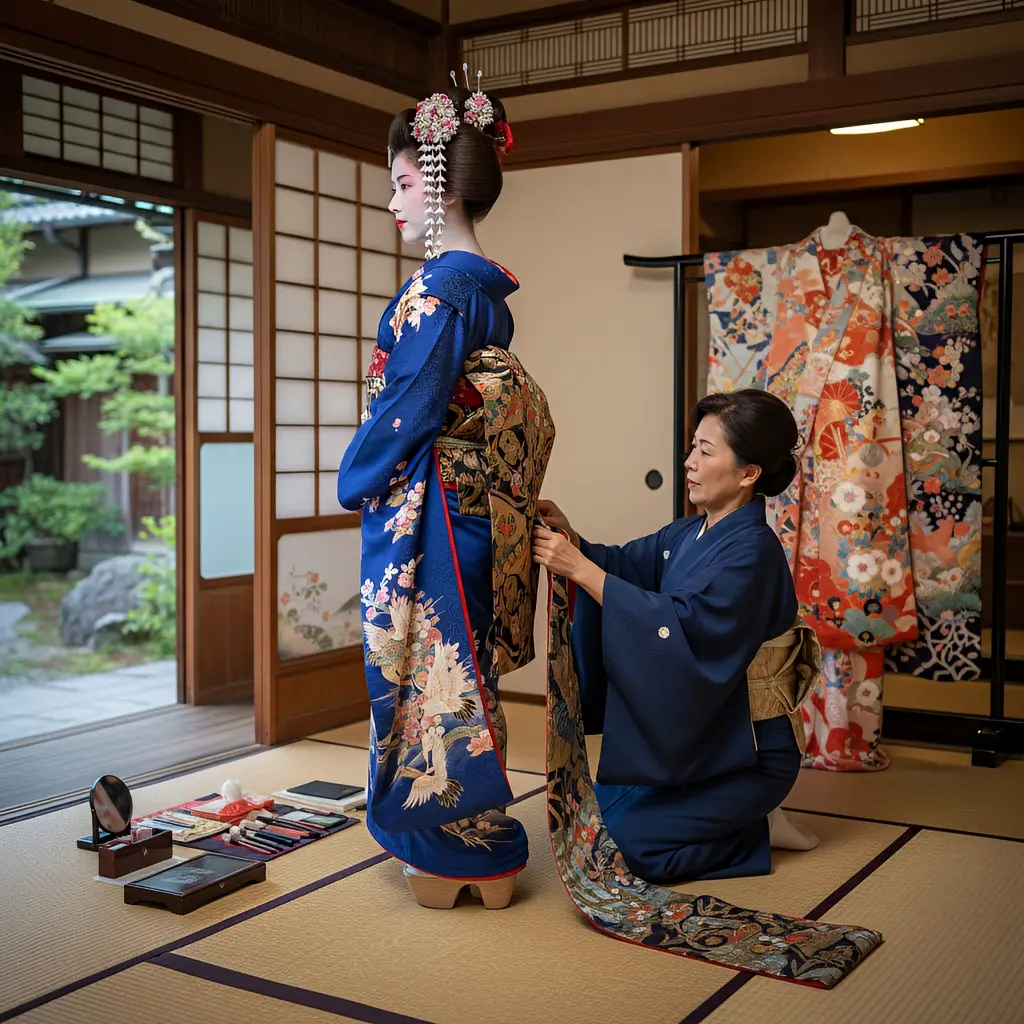
A maiko does not construct her public appearance alone. Gion’s official museum and recruitment material describes a network of specialists: the otokoshi, a professional dresser responsible for forming the distinctive kimono and long obi; the kamiyui, who creates and maintains traditional hairstyles; kimono merchants; and kanzashi makers whose ornaments change with the months. The okiya coordinates these relationships and holds knowledge about what is appropriate for season, rank and event.
This network changes how the viewer should look. The kimono is not simply “beautiful clothing.” Its textile, motif and form belong to Kyoto industries and to a calendar of use. The obi is not a decorative strip attached at the end. It requires physical skill to tie and affects posture and movement. Kanzashi do not merely add colour. Their seasonal imagery places the wearer within a particular month and stage of apprenticeship.
Gion’s published pathway notes that a minarai’s appearance differs from that of a fully debuted maiko: the obi and sleeves are shorter, and lipstick is applied only to the lower lip. It also states that after roughly a year as a maiko, colour may be added to the upper lip. Such details are meaningful within the community, but visitors should resist turning them into a street-identification game. District customs, formal occasions and individual stage can complicate the visual rules, and people in rental costume may imitate some of them.
The strongest difference between professional dress and tourist transformation is not the quality of the photograph. It is the continuity between appearance and skill. A maiko’s hairstyle affects how she sleeps and moves. Formal kimono changes the scale of her steps. Sleeves and obi become part of the choreography. The costume does not sit on top of the work; it trains the body that performs it.
Preparation is also mental. The performer is moving from lessons, household life or private time into a role that demands sustained attentiveness. The evening may include guests she has met before, first-time participants introduced through a trusted intermediary, a public audience, a translator, or a formal district event. The work is to enter each room prepared without making that preparation visible.
For an established geiko, the visual register is often more restrained than a maiko’s, but “restrained” should not be mistaken for simple. A mature kimono, an instrument, a dance fan and the timing of an entrance can communicate professional authority with fewer obvious signs. Visitors tend to notice the apprentice first because the maiko’s public dress is more elaborate. Within the performance, seniority may be heard in a musician’s phrase or felt in the person who controls the conversation.
The afternoon therefore links Kyoto’s craft economy to its performing arts. A single evening mobilises skills held by people who may never appear before the guests. When visitors pay for an authorised performance or museum, they are not only purchasing access to a photogenic figure. They are supporting a system in which textile, music, dance, etiquette, architecture and hospitality remain connected.
Evening engagements
An ozashiki is not a recital with dinner placed beside it
Performance and hospitality are designed as one social art.
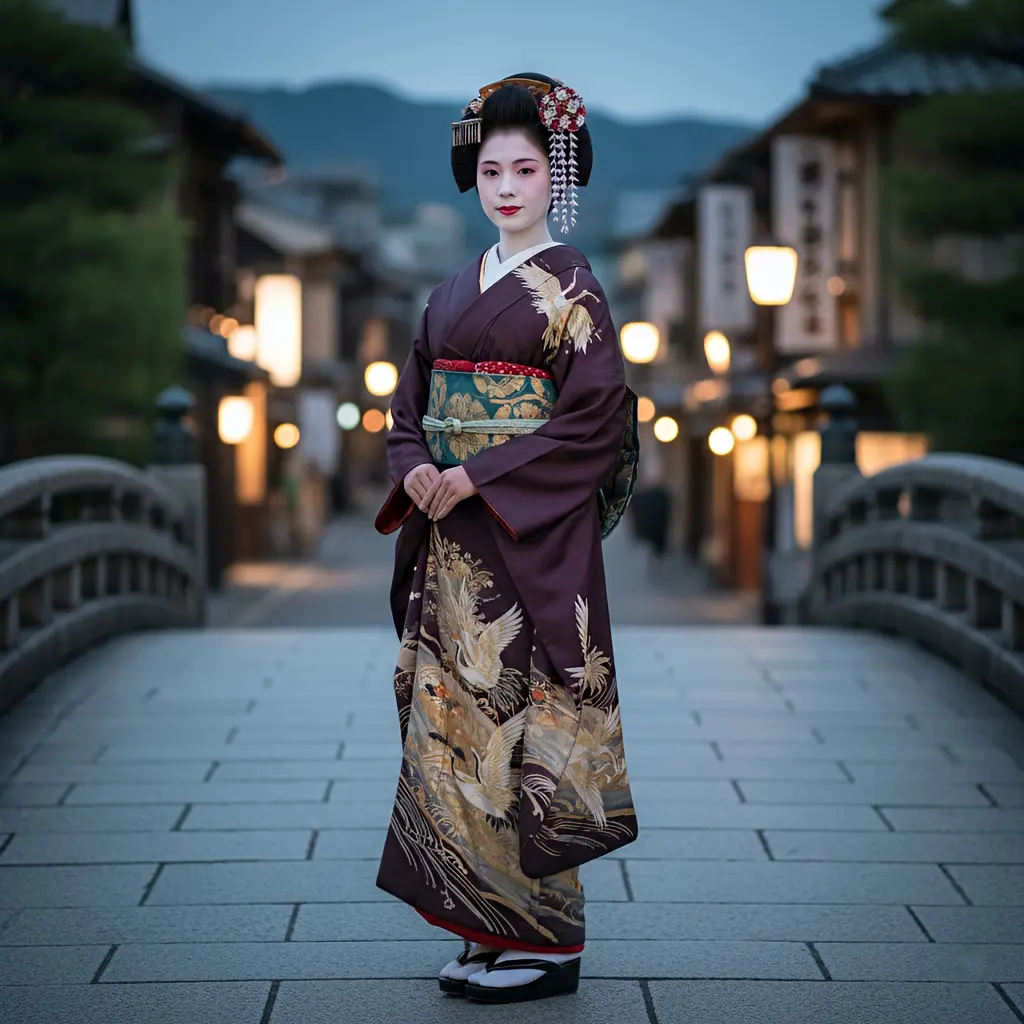
The word ozashiki refers to the tatami-room setting and, by extension, the private banquet or gathering that unfolds there. A traditional ochaya coordinates the occasion, but it is not an ordinary restaurant into which any passer-by can walk. Kyoto’s official tourism guidance explains that trusted-client introductions have historically structured access. Today, visitors may encounter the culture through a hotel, licensed guide, specialist intermediary or organised programme, but the principle remains: entry is arranged through a relationship that carries responsibility.
Inside, the sequence depends on the host and the occasion. Dance may be the formal centre, accompanied by song and shamisen. Conversation may take more of the evening than performance. Guests may join traditional games. Food and drink arrive through the teahouse or associated kitchen. The geiko and maiko work with the room rather than performing at a sealed distance from it.
That interaction explains why conversation is a professional skill. The task is not to flatter mechanically. It is to notice who is comfortable, who needs explanation, when to change pace and how to create shared attention among people who may differ in age, status, language and familiarity with the customs. A translator or guide can support international guests, but the performers’ own timing still structures the encounter.
A maiko brings the energy of apprenticeship. Her dance may be a principal attraction, and guests may be interested in her seasonal appearance, but she is not there as a silent ornament. She is learning how performance and hosting fit together. A senior geiko may guide the flow, take the lead in conversation, dance, sing or provide instrumental support. In some ensembles, the most experienced contribution is the least visually conspicuous.
Tachikata and jikata show why the English shorthand “hostess” is inadequate. A tachikata’s dance uses codified technique developed for intimate rooms and stage performance. A jikata’s voice and shamisen do not merely accompany; they create tempo, phrasing and atmosphere. The social art works because these specialities are coordinated.
The evening can also take place in a theatre. Public dance performances make visible the collective discipline of a kagai: multiple generations, district style, musicians, stagecraft and seasonal repertoire. Gion Corner offers a compact introduction in which Kyomai appears among several Japanese performing arts. The major odori performances allow visitors to see a district’s own ensemble on a much larger scale. Neither is a lesser substitute for an “authentic” secret dinner. They are authentic public forms with different purposes.
Private and public settings should not be collapsed. An ozashiki depends on responsive intimacy; a theatre performance depends on rehearsed ensemble and stage composition. A museum demonstration may focus attention on one dance and allow structured photography. Each reveals a different part of the profession. The respectful visitor chooses the form that is genuinely available rather than treating access restrictions as a puzzle to defeat.
Tachikata
Dance as the visible line of the evening
A tachikata concentrates on dance and the precise use of body, gaze, fan and space. The apparent economy of movement is the result of sustained training.
- In an ozashiki: movement is calibrated for a small room and close viewing.
- On stage: individual technique becomes part of an ensemble and district style.
- Across a career: repertoire and interpretation continue to develop after apprenticeship.
Jikata
Music as structure, atmosphere and memory
A jikata specialises in song and instrumental accompaniment. Her contribution may be physically quieter but is fundamental to rhythm, transitions and emotional tone.
- Shamisen and voice: support dance while carrying their own artistic demands.
- Hayashi: percussion and flute traditions add colour and formal structure.
- Professional authority: musical leadership may guide the entire room without occupying its visual centre.
The infrastructure of the art
No geiko or maiko works as a self-contained image
The kagai is a network of homes, venues, schools, crafts and trust.
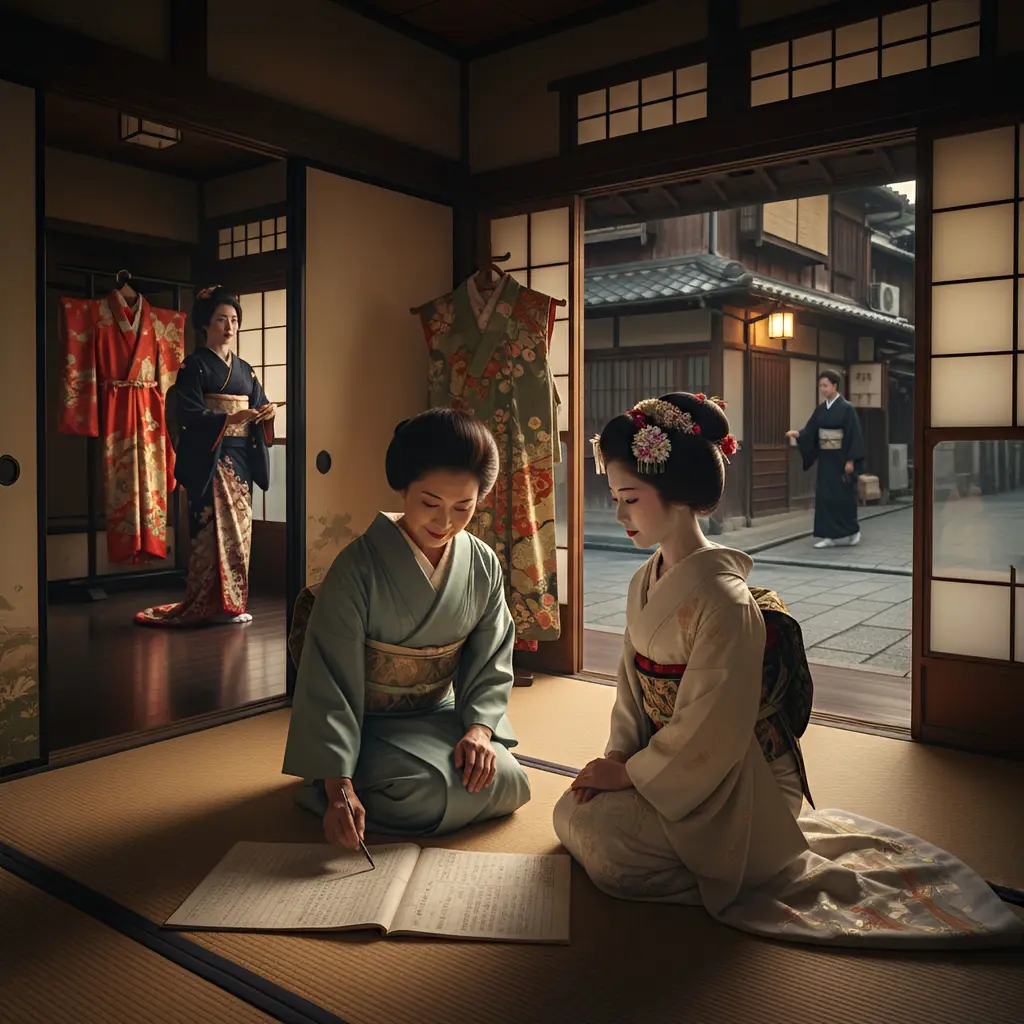
The okiya is the organisational and residential centre of apprenticeship. Official Gion material describes aspiring maiko living in an okiya under the care of its okaasan, helping the household, learning its rules and receiving support toward debut. The family vocabulary—mother, older sister, younger sister—expresses relationships of guidance and seniority, but outsiders should not assume it maps neatly onto either a biological family or a modern corporation. It is a professional household with its own history and obligations.
The ochaya is a hospitality venue able to call geiko and maiko for an engagement. The word is often translated as “teahouse,” which can mislead visitors into expecting a casual café. Its central function is coordination: knowing the client, arranging the performers, working with food and drink providers, keeping accounts and protecting the standards of the district. Trust matters because the evening may be billed through established relationships rather than handled as an anonymous transaction.
The kaburenjo or related training and performance institutions connect lessons to public stage life. They provide spaces where district repertoire is taught, rehearsed and presented. In Gion Kobu, the Yasaka Nyokoba Gakuen and Gion Kobu Kaburenjo are integral to the training and performance environment described by official sources. Other kagai maintain their own venues and artistic schools.
Then there are the craftspeople: dressers, hairstylists, kimono merchants, dyers, weavers, fan makers, kanzashi makers and instrument specialists. Their work is not background decoration. A dance’s line changes with sleeve and hem. A seasonal ornament signals calendar and status. A shamisen depends on maintenance. A theatre’s visual language relies on textile and stagecraft developed far beyond the performer’s dressing room.
The network also includes teachers and senior artists who transmit style through correction. Traditional arts survive because somebody notices the angle of a wrist, a rushed phrase, an imprecise bow or a conversational habit that disrupts the room. The process is personal and repetitive. It cannot be compressed into a makeover session or copied from video alone.
This ecosystem helps explain controlled access. A tourist may see a beautiful wooden building and imagine that entering would support tradition. Entering without permission does the opposite: it interrupts a home or workplace and disregards the relationships that sustain it. The public can support kagai culture most effectively through institutions that are designed to receive visitors—performances, museums, official events and reputable arranged experiences.
Residence, guidance and professional formation
The household in which a trainee learns the practices of the kagai and receives support from the okaasan and senior members.
Hospitality and trusted coordination
A traditional venue that arranges private engagements and manages the relationships among guests, performers and supporting services.
Lessons, rehearsal and public performance
Institutions where district styles are transmitted and where seasonal or annual productions are prepared for the stage.
The skills that make the visible role possible
Textile, dressing, hair, ornaments, instruments, music and dance all depend on specialists whose work extends beyond the performer.
Encounter without intrusion
The best way to see the culture is to go where it has chosen to meet the public
A ticketed seat can reveal more than an evening spent waiting in an alley.
Visitors often approach Gion with the wrong hierarchy of experiences. A chance street sighting is treated as “real,” while a theatre or museum is dismissed as staged. The distinction should be reversed. The street encounter shows a person travelling to work. The arranged performance shows the work itself. Kyoto’s public institutions have created several ways to see dance, costume, music and hospitality without turning a commute into a spectacle.
Gion Corner is the most accessible overview. Its programme presents Kyomai alongside other Japanese arts in a compact theatre format. The maiko dance is not a simulated tourist costume segment; it is presented by apprentices from Gion Kobu within a foundation-run cultural programme. The format is introductory and necessarily brief, but it places Kyomai beside tea, music and theatre, helping visitors understand that kagai culture belongs to a wider performing-arts world.
The Gion Kagai Art Museum provides a different type of attention. Its exhibitions present kimono, Nishijin-woven obi, seasonal kanzashi and makeup objects with explanations. It also offers scheduled Kyomai performances by a geiko or maiko and, when available, an official photo session. The significance of that photo session is not merely convenience. It creates consent, time and a designated setting, replacing the unequal street dynamic in which a working person is photographed without agreement.
The annual odori performances are the richest public view of district identity. Each kagai’s event brings together dancers, musicians, teachers, costume teams and stage crews. The audience sees the product of concentrated rehearsal and can compare styles across districts over multiple visits. Dates and ticket systems must be checked for the specific year, but the durable planning principle is to treat these performances as primary cultural events, not optional substitutes for private access.
A properly arranged meal or tea gathering can offer conversation and closer performance. Kyoto’s official tourism guidance points visitors toward intermediary-supported experiences, some with licensed guides or translators. Hotels and specialist organisers may have the relationships required to arrange a legitimate encounter. Before booking, confirm who will attend, what the programme includes, whether interpretation is provided, what photography is permitted and how cancellation works. Avoid any seller whose marketing promises uncontrolled access to “secret geisha streets” or encourages pursuit.
A makeover studio is a separate product. It may be enjoyable as costume photography and can involve skilled makeup and dressing, but it does not provide geiko or maiko training, affiliation or performance. The ethical issue is not that visitors should never dress in kimono. It is that the experience should be described accurately. A person in white makeup posing for a photograph is participating in a transformation session, not becoming a maiko for the afternoon.
The most rewarding visit may combine forms. Begin at the museum to learn how to read textile and seasonal detail. Attend Gion Corner for a concise view of Kyomai in a broader performing-arts context. If the travel dates align, reserve an annual dance. Arrange a private experience only when the provider can explain the cultural structure and conditions clearly. This sequence replaces the hunger for a “sighting” with informed attention.
Introductory stage
Gion Corner
A compact programme combining Kyomai by maiko with several other Japanese performing arts. Verify current dates, times, closures and tickets.
Check the official programmeObjects and close viewing
Gion Kagai Art Museum
Exhibits on kimono, obi, kanzashi and makeup, with scheduled dance and consent-based photo opportunities when offered.
Check museum accessDistrict tradition
Annual odori performances
The fullest public expression of each kagai’s dance school, ensemble training and seasonal stage identity. Dates and venues require annual verification.
Check Ookini Zaidan eventsGion is a neighbourhood and workplace
Photography rules begin with recognising another person’s right to keep walking
Respect is not measured by how quietly a camera shutter operates.
Southern Gionmachi’s current visitor guidance is unusually direct because repeated nuisance behaviour has made general politeness insufficient. The district asks visitors not to stop, touch, follow or take unauthorised photographs or video of geiko and maiko. It warns against entering private property and obstructing roads or pavements. Residents may call police when behaviour crosses legal boundaries.
The practical rule is broader than “no flash.” A telephoto lens used from across the street can still turn a worker into a target. Walking behind somebody for several blocks is still following even if no words are spoken. Standing in a doorway to wait for a photograph still blocks a workplace. Asking a person who is clearly hurrying to stop for “just one picture” still places the visitor’s desire above her schedule.
Public streets do not make every action acceptable. Some lanes and properties are private; posted signs must be followed. Temples and shrines have their own photography and behaviour rules. Roads in Gion carry residents, deliveries, taxis and emergency access. A group that spreads across the street to create a portrait can obstruct traffic even when the architecture looks pedestrian-scaled.
Consent must be meaningful. A geiko or maiko moving between appointments is not in a setting where she can negotiate with every camera. Silence, a lowered gaze or continued walking is not permission. The official museum’s arranged photo session demonstrates the alternative: a defined place, an understood purpose and an agreed moment.
The same principle applies inside performances. Photography may be prohibited, limited to designated moments or allowed only for personal use. Follow the venue’s current rules rather than assuming that a ticket includes unlimited image rights. During an ozashiki or arranged event, ask the host or guide before recording. A respectful guest can experience an entire dance without turning the screen into the main field of vision.
Street etiquette also changes the quality of the visit. Once the goal is no longer to capture a maiko, the district becomes visible as a real neighbourhood: the relationship between shrine approach and entertainment quarter, the scale of machiya facades, the delivery work behind restaurants, the transition between daytime commerce and evening appointments. The culture becomes less “mysterious” because the visitor has stopped forcing it to perform on demand.
Southern Gionmachi guidance
Four rules to apply before raising a camera
Do not stop, follow or touch
A geiko or maiko walking through the district is travelling between obligations, not offering a spontaneous meet-and-greet.
No unauthorised photo or video
Follow posted restrictions and seek images through performances or official sessions where permission is built into the experience.
Stay on public routes
Do not enter private lanes, homes, teahouses, temple areas or other property simply because a door is open or a map shows a path.
Keep streets and doorways clear
Gion is not a pedestrian film set. Residents, vehicles, businesses and emergency services need to move through it.
A living profession in a changing city
The culture survives through adaptation, not by remaining frozen for visitors
Modernity is not evidence that tradition has failed.
Popular portrayals often place geiko and maiko outside ordinary time. They appear as survivors from an untouched Kyoto, moving through streets without phones, contracts, transport problems or modern career choices. This image is convenient for tourism because it turns cultural continuity into visual atmosphere. It is also false. Kagai culture has always depended on contemporary patrons, changing entertainment economies, new recruits, institutional support and decisions about what can be shared publicly.
The first myth to remove is that geiko are sex workers. Kyoto’s official institutions define them through traditional dance, music, hospitality and performance. The persistence of the sexual stereotype has historical and media causes, but repeating it today obscures professional artistry and encourages visitors to treat working women as available characters. Respectful writing should not need a sensational detour through rumours to explain what the occupation is.
The second myth is that maiko are simply younger geiko with brighter clothes. Apprenticeship is an educational and professional stage with its own duties, supervision and visual language. A maiko may be publicly recognisable, but recognition does not make her public property. Her visibility can increase vulnerability precisely because visitors believe they already know her role from films and photographs.
The third myth is that exclusivity exists only to manufacture mystique. Trust-based access has practical functions. Ochaya coordinate clients, performers and costs within a relationship of accountability. Okiya protect trainees and manage professional formation. Private spaces remain private because people live and work in them. Modern public programmes are not evidence that the old system has become fake; they are ways of creating access without destroying its boundaries.
The fourth myth is that a “real” day must be austere, secret and identical across generations. Official sources show a structured career, but they also show active recruitment, public museums, translated programmes, online reservations and annual stage productions marketed to contemporary audiences. These developments do not erase tradition. They can provide revenue, visibility and new routes for understanding, provided the community controls how the encounter is organised.
Kyoto City identifies succession as a challenge. The work demands long training, and not every apprentice continues to geiko status or remains long enough to become fully independent. Supporting continuity therefore means valuing the mature artist as much as the photogenic apprentice, the musician as much as the dancer, and the teacher and craftsperson as much as the person on stage.
Tourism can help when it pays attention to the art. A visitor who buys a theatre ticket, learns the names of the five kagai, listens to shamisen rather than waiting only for a pose, and follows local photography rules participates in a healthier exchange. Tourism harms when it rewards harassment with viral images, confuses rental costume with professional identity, or demands “secret access” as proof of authenticity.
The future of the culture will not be decided by preserving a perfect nineteenth-century picture. It will be decided by whether training remains possible, performances remain valued, young artists can build sustainable careers, senior knowledge is transmitted, and residents can live in the districts without being overwhelmed by spectators. The visitor’s role is modest but real: choose encounters that reinforce those conditions.
Myth
“The most authentic encounter is a chance street photograph.”
A street sighting shows a commute. A stage, museum or arranged ozashiki reveals dance, music, hospitality and the work the visitor came to understand.
Better frame
Public programmes are part of living continuity.
Annual dances, Gion Corner and the Gion Kagai Art Museum are community-connected forms of access, not imitations of private culture.
Myth
“A maiko is defined by makeup and colourful kimono.”
Appearance communicates apprenticeship, but professional identity comes from training, okiya and kagai affiliation, formal debut and actual work.
Better frame
The art is a network, not an individual costume.
Teachers, musicians, teahouses, okiya, dressers, hairstylists and textile artisans all participate in the evening a guest sees.
What one day can teach
The mystery disappears when the work comes into focus—and the culture becomes more impressive, not less.
A responsible account of Kyoto’s geiko and maiko does not need an invented wake-up time, private dialogue or a camera waiting in a lane. It needs the documented structure of apprenticeship, the continuing labour of professional artists, the five kagai and their distinct traditions, the skilled network behind dress and performance, and the boundaries that allow a residential culture to remain alive. Visitors can enter that story through the doors Kyoto has opened: a museum, a theatre, an annual dance or an honestly arranged encounter. The rest of the day belongs to the people living it.