

Africa’s largest country by area
Algeria: Geography, History and Surprising Facts
Algeria is often reduced to the Sahara or to a single chapter of colonial history. In reality, it is a Mediterranean, Amazigh, Arab, African and Saharan country whose landscapes and historical layers resist simple labels.
These facts are organized as connected themes rather than trivia, so geography, language, heritage and modern economic life can explain one another.
Algeria occupies a scale that is difficult to understand from the Mediterranean coast alone. Northern cities, agricultural plains and mountain systems contain most of the population, while the vast south opens into Saharan plateaus, dunes, massifs and oasis networks. The contrast is not a division between “real Algeria” and empty desert. It is a relationship shaped by water, trade, energy, mobility and state infrastructure. Coastal ports connect the country to the Mediterranean, mountain regions preserve distinctive cultural histories, and southern routes have linked communities across the Sahara for centuries.
The country’s historical depth is equally broad. Ancient Numidian kingdoms, Phoenician and Roman cities, Amazigh communities, Islamic dynasties, Ottoman rule, French colonization, a violent war of independence and post-independence state building all contribute to the present. Arabic and Tamazight are official languages, while French remains widely used in parts of education, business, media and everyday communication. Algerian identity is therefore not a neat sequence in which one layer replaced another. It is an ongoing negotiation among languages, regions, memories and institutions.
North Africa · Mediterranean and Sahara
Algeria
A continental-scale state where a densely inhabited Mediterranean north meets one of the world’s great desert regions.
Best understood through: geography, Amazigh and Arab cultural plurality, archaeological depth, revolutionary memory and the relationship between energy wealth and diversification
Editorial overview
A nation too large for a single stereotype
Algeria stretches from the Mediterranean deep into the Sahara, sharing borders with Tunisia, Libya, Niger, Mali, Mauritania, Western Sahara and Morocco. Its size makes broad statements hazardous. The green coastal hills around parts of the north, the high plateaus, the Kabylie and Aurès mountains, the stone formations of the Tassili and the great dune fields of the south belong to different environmental systems. Most Algerians live in the northern band, where rainfall, cities, ports and transport networks are concentrated. The Sahara dominates the map but not the distribution of population.
Algiers, the capital, rises in layers above the sea. Its urban identity includes the historic Casbah, French-period boulevards, modern infrastructure and expanding metropolitan districts. Oran has its own western Mediterranean character and a strong place in music and cultural history. Constantine is defined by dramatic gorges and bridges, while cities such as Tlemcen, Annaba, Béjaïa, Ghardaïa and Tamanrasset open different regional narratives. Algeria cannot be represented accurately by one city, and regional identities matter strongly in speech, food, architecture and memory.
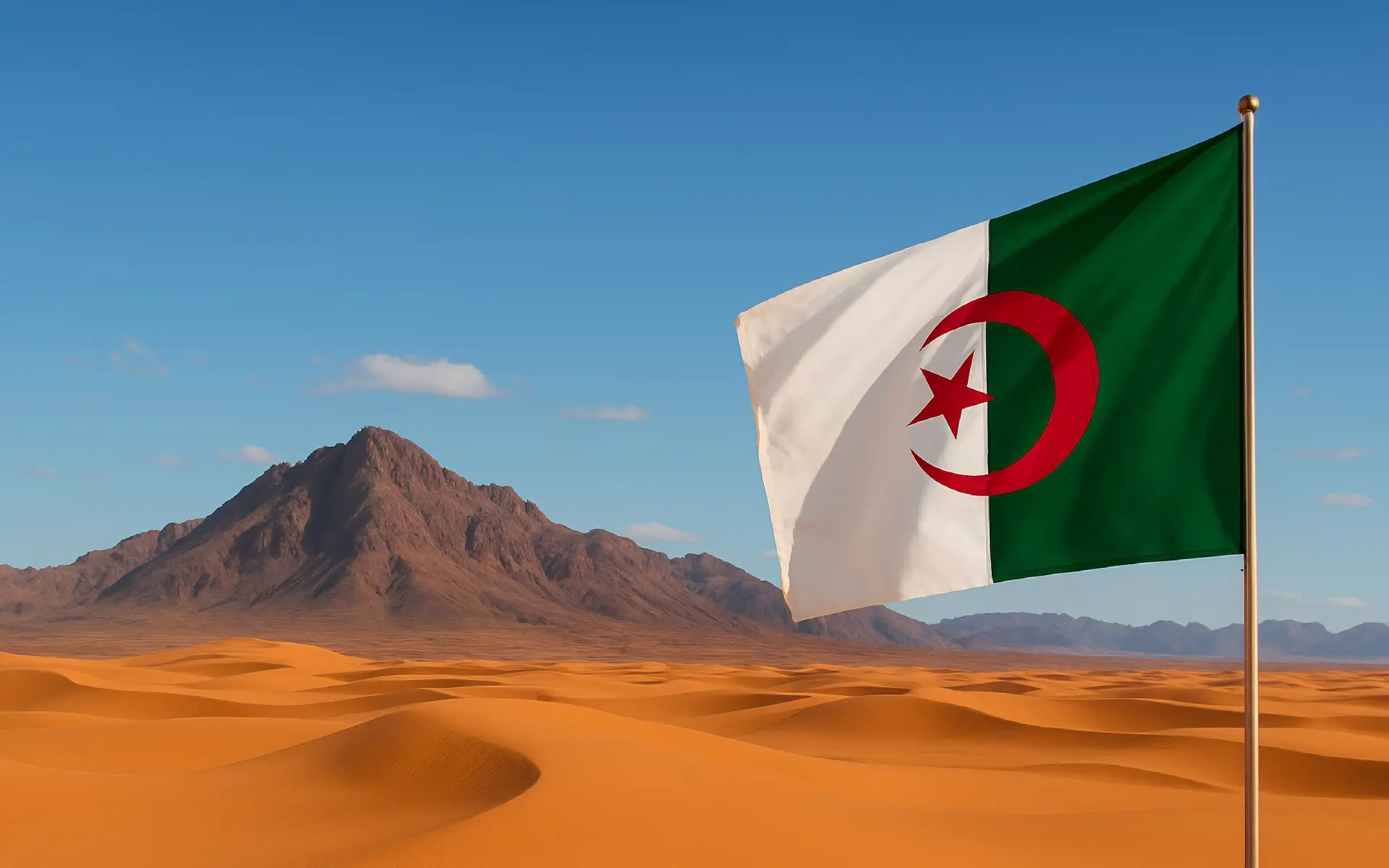
The state’s official name, the People’s Democratic Republic of Algeria, reflects the revolutionary legitimacy established after independence in 1962. The national flag’s green and white fields, red crescent and star are widely read through Islamic and national symbolism, but symbols should not substitute for history. The modern republic emerged from a long and devastating anti-colonial struggle whose memory remains central to public institutions, diplomacy and political language.
Algeria’s population is young by the standards of many European countries, highly urbanized and connected through education, media and migration networks. Exact demographic figures change and should be updated from official or multilateral sources. What remains stable is the importance of the northern urban corridor and the pressure this concentration places on housing, employment, transport and water. Migration links with France and other countries also shape families, language and cultural production without making Algerian society simply an extension of the diaspora.
Religious life is predominantly Sunni Muslim, while historical and contemporary minorities form part of the country’s story. The state regulates religious institutions, and social practice varies by family, region and generation. Visitors should avoid treating visible clothing, café culture or public ritual as a complete measure of belief. As elsewhere, religious identity operates alongside profession, locality, language, gender and personal choice.
The most useful introductory fact is that Algeria contains several worlds at once. It is Mediterranean but not only coastal, Saharan but not mostly nomadic, Arabic-speaking but not linguistically uniform, resource-rich but economically constrained, and deeply marked by colonialism without being reducible to it. Each apparent contradiction becomes clearer when scale and history are considered together.
Physical setting
The Sahara is enormous, but the north carries most daily life
Mountains, plateaus, coast and desert determine where people live, how water is managed and why regional experiences differ.
The Tell Atlas and associated northern ranges help form a Mediterranean zone where rainfall supports forests, agriculture and dense settlement. Coastal plains and valleys hold major cities and productive land, although urban growth competes with agriculture and increases pressure on water. The Mediterranean is therefore not merely a scenic edge. It is a transport corridor, climatic influence, fishing ground and historical route connecting Algeria with southern Europe and the wider basin.
South of the northern ranges, the High Plateaus create a transitional environment before the Saharan Atlas and the desert. Steppe landscapes support pastoral practices and towns adapted to lower rainfall. This middle belt is easily overlooked because international imagery jumps from Algiers directly to dunes. Yet it is important to livestock, transport and the geography of regional cities. It also demonstrates that the Sahara does not begin as a single sudden line.
The Sahara itself is diverse. Sand seas are only one form. Gravel plains, rocky plateaus, dry valleys, volcanic massifs and dramatic sandstone landscapes cover vast areas. The Hoggar around Tamanrasset and the Tassili n’Ajjer near Djanet have distinct geology, cultural histories and travel conditions. Temperatures vary by altitude and season, and winter nights can be cold. A photograph of dunes cannot represent the whole southern landscape any more than a beach can represent the whole north.
Water structures settlement. Oases depend on complex relationships among groundwater, traditional irrigation, modern pumping and agricultural demand. In the M’Zab Valley, settlement planning, social organization and water management developed in response to an arid environment. Modern Algeria also relies on dams, groundwater, desalination and distribution systems. Climate change, drought and rising demand make water a national issue rather than a background environmental concern.
Distance has political and economic consequences. Roads, airports and energy infrastructure link southern towns to the north, while border areas may be subject to security controls and travel restrictions. Communities in the Sahara are not isolated relics; they participate in national institutions, regional trade, tourism and modern communications. At the same time, the cost of providing services across such territory is high. Algeria’s size is therefore both a source of resources and an enduring administrative challenge.
The country’s natural hazards include earthquakes in the tectonically active north, flash flooding, drought, heat and desert conditions. Visitors and residents experience these risks differently by region. Responsible travel information should avoid presenting the Sahara as an unrestricted playground. Routes, weather, permits, vehicle preparation and local expertise matter, particularly far from established towns.
Rainfall, ports and infrastructure are concentrated here.
An important pastoral and transport zone between coast and desert.
Includes massifs, plateaus, valleys and gravel plains as well as dunes.
Urban growth, agriculture and climate pressures make management essential.
Infrastructure must connect settlements across continental scale.
Long chronology
From Numidia to independence and beyond
Algeria’s past is not a simple chain of foreign rulers; local societies repeatedly shaped, resisted and transformed wider systems.
Ancient North Africa was home to Amazigh societies and kingdoms whose political agency is essential to the story. Numidia emerged as a significant power in the western Mediterranean, interacting with Carthage and Rome. King Massinissa is often remembered for consolidating Numidian rule during the second century BCE, though ancient alliances and identities were more complex than later national narratives suggest. The important correction is that the region did not begin historically with Roman occupation.
Roman control produced cities, roads, farms and military frontiers across northern Algeria. Archaeological sites such as Timgad, Djémila and Tipasa reveal urban planning, religious change, commerce and adaptation to varied terrain. These were not empty European enclaves. Their populations and economies were embedded in North African landscapes and included people of different legal statuses and cultural backgrounds. Christianity also developed strongly in Roman North Africa, with figures such as Augustine of Hippo connected to the region.
From the seventh century onward, Islamic conquest and subsequent political change brought Arabic, new religious institutions and integration into wider networks. Islamization and Arabization unfolded over long periods and did not erase Amazigh societies. Berber-led dynasties played major roles across the Maghreb and Iberia, while regional powers rose and fell. Tlemcen became an important intellectual and commercial centre under the Zayyanids. The history is better understood as interaction and synthesis than as a one-way cultural replacement.
Ottoman Algiers entered the imperial system in the sixteenth century while retaining distinctive local institutions and considerable autonomy. Maritime conflict, diplomacy, trade and corsair activity connected the regency to Europe and the Mediterranean. European accounts often reduced the period to piracy, but the political economy was broader. Ottoman influence was strongest in parts of the north and uneven across the interior, where local authorities and communities retained different degrees of autonomy.
France invaded Algiers in 1830 and gradually imposed settler colonial rule through military violence, land seizure, legal inequality and major demographic change. Resistance continued in many forms, including the struggle led by Emir Abdelkader. Colonial infrastructure and cities cannot be separated from dispossession and unequal citizenship. Millions of European settlers came to Algeria, while indigenous Muslim Algerians faced discriminatory systems. This history shaped land, language, education and political memory long after formal colonial rule ended.
The war of independence began in 1954 and involved guerrilla warfare, repression, torture, attacks on civilians, mass displacement and political struggle in Algeria and France. Independence was achieved in 1962 after the Evian Accords and a referendum. The human cost remains contested in exact numbers, but its scale and trauma are beyond dispute. Independence triggered the departure of most European settlers and many Harkis, while the new state faced the task of building institutions after 132 years of colonial domination.
Post-independence Algeria developed a centralized state with a strong role for the National Liberation Front and the military. Hydrocarbon nationalization, industrial ambitions, education expansion and non-aligned diplomacy were important themes. Political opening in the late 1980s was followed by a cancelled electoral process and a devastating conflict in the 1990s, often called the Black Decade. That period remains a sensitive memory with unresolved questions about violence, accountability and reconciliation.
The protest movement known as the Hirak began in 2019, mobilizing large numbers of Algerians against a fifth presidential term for Abdelaziz Bouteflika and for broader political change. The movement demonstrated the strength of peaceful civic action and the continuing importance of revolutionary language, now used to demand renewal rather than simply celebrate the past. Its later trajectory was affected by repression, institutional politics and the pandemic. Modern Algeria continues to negotiate between stability, reform, memory and generational expectation.
Eight centuries cannot fit one slogan
Numidia
Amazigh kingdoms were active Mediterranean powers, not a preface to Roman history.
Roman North Africa
Cities and farms reveal local adaptation within a wider imperial system.
Islamic and Amazigh dynasties
Islamization and Arabization unfolded through interaction, state formation and regional diversity.
French Algeria
Settler colonialism transformed land, law, cities and education through structural inequality.
War of independence
The violence and political mobilization of 1954–1962 remain central to national memory.
Post-independence state
Hydrocarbon development, political control, conflict and civic protest shape the modern republic.
Cultural plurality
Arabic, Tamazight and French occupy different spaces
Language in Algeria expresses history, education, region, generation and politics rather than a simple trilingual formula.
Modern Standard Arabic is an official language and is used in state institutions, formal education, news and public communication. Everyday Algerian Arabic, often called Darja, differs in vocabulary, pronunciation and structure from the formal standard. It includes influences accumulated through Amazigh languages, Ottoman Turkish, French, Spanish and other contacts. Speakers move between registers according to setting, and written forms of Darja appear increasingly in digital communication and popular culture.
Tamazight is also an official language, reflecting long activism and the recognition of Algeria’s Amazigh foundations. It is not a single uniform spoken variety. Kabyle, Chaoui, Mozabite, Tuareg varieties and others have distinct regional communities and linguistic features. Standardization, education and script choice involve cultural and practical debates. Recognition has symbolic importance, but the vitality of each variety depends on intergenerational use, schooling, media and local institutions.
French has no constitutional status as an official language, yet it remains widely used in sectors of higher education, medicine, business, administration, publishing and urban conversation. Its presence is inseparable from colonial history, but contemporary use cannot be explained only as colonial residue. For many Algerians it is a practical language, a professional resource or part of family speech. For others, reducing dependence on French is connected to sovereignty and cultural policy. The resulting debate is political because language distributes access and opportunity.
Code-switching is normal. A conversation may move among Darja, French and an Amazigh variety, with Modern Standard Arabic reserved for a formal reference or quotation. This flexibility can confuse outsiders who expect each language to occupy a separate population. In reality, multilingual competence varies by region, education and social network. A visitor should not assume that French will be understood everywhere or that Arabic phrases alone capture local speech.
Literature and music make this plurality audible. Algerian writers have worked in Arabic, French and Tamazight, often exploring memory, exile, gender and violence. Raï emerged from western Algeria and became internationally known, while chaabi, Kabyle music, Andalusian traditions, hip-hop and regional forms continue to evolve. Cultural production does not simply preserve heritage; it argues with the present. Songs and novels can reveal tensions that official statistics cannot.
Language domains, not isolated boxes
Modern Standard Arabic
Used in official communication, education and formal media.
Algerian Arabic
A diverse spoken continuum shaped by regional history and multilingual contact.
Tamazight varieties
Official recognition covers distinct regional languages and cultural movements.
French
Widely used in professional and educational domains without official-language status.
Heritage map
Seven UNESCO properties reveal an unusually broad chronology
The World Heritage list ranges from prehistoric Saharan art and living settlement traditions to Roman cities and the Casbah of Algiers.
Tassili n’Ajjer is Algeria’s only mixed World Heritage property, recognized for both cultural and natural values. Its sandstone landscape contains an extraordinary concentration of rock art that documents changing environments, animals and human activity over long periods. The images are not a simple illustrated timeline, and interpretation requires archaeological context. The landscape is fragile, remote and subject to regulated travel conditions. Visitors should use authorized local expertise and avoid touching or tracing rock surfaces.
The M’Zab Valley contains fortified settlements developed by the Ibadi community from the eleventh century onward. Its architecture, settlement hierarchy and water-conscious planning show adaptation to an arid environment. Ghardaïa is the best-known urban centre, but the property’s significance lies in the valley system rather than one photogenic market. It remains a living cultural landscape, so respectful dress, photography and local guidance matter more than the visitor’s desire for unrestricted access.
Al Qal’a of Beni Hammad preserves the remains of the first capital of the Hammadid dynasty, established in the eleventh century in a mountainous setting. Its ruins demonstrate medieval Islamic urbanism and political ambition away from the better-known coastal centres. The site’s monumental remains, including a large mosque, challenge the idea that Algeria’s heritage is dominated only by Roman antiquity or the colonial period.
Djémila and Timgad are both Roman cities, but they should not be treated as duplicates. Djémila adapted its plan to rugged terrain, producing a dense urban composition framed by mountains. Timgad is famous for its gridded foundation and later expansion, which reveal the difference between planned military-colonial origins and organic urban growth. Each site also contains evidence of religious and social change across centuries.
Tipasa combines archaeological remains with a Mediterranean coastal setting. Phoenician, Roman, early Christian and indigenous elements overlap, and nearby monuments connect the wider landscape. Its scenic position has made it especially vulnerable to being appreciated only as a ruin by the sea. Conservation pressures, urban development and coastal conditions make official access guidance important.
The Casbah of Algiers is a living historic urban district rather than an archaeological field. Its dense lanes, houses, mosques and Ottoman-period urban fabric carry layers of social and political memory. The Casbah faces serious conservation and housing challenges, and visitors should avoid romanticizing deterioration. A knowledgeable local guide can improve navigation and explain buildings without turning residents’ daily life into spectacle.
Together, the seven properties show why Algeria cannot be summarized as Roman ruins plus desert. They include prehistoric expression, medieval dynasties, an Ibadi settlement system, several forms of classical urbanism and an Ottoman-Mediterranean city. The list is selective rather than complete; important sites and traditions remain outside it. UNESCO status is a conservation framework, not a ranking of all heritage.
| Property | Type | Primary lens | What it complicates |
|---|---|---|---|
| Al Qal’a of Beni Hammad | Cultural | Medieval Hammadid capital | The idea that major heritage is only coastal or Roman |
| Djémila | Cultural | Roman city adapted to mountain terrain | The assumption that Roman planning was uniform |
| M’Zab Valley | Cultural | Living fortified settlements and water-conscious planning | The separation of architecture from community institutions |
| Tassili n’Ajjer | Mixed | Rock art and Saharan sandstone landscape | The image of the desert as empty |
| Timgad | Cultural | Planned Roman foundation and later expansion | The idea that a grid remained static |
| Tipasa | Cultural | Layered coastal archaeology | A single-period reading of Mediterranean Algeria |
| Casbah of Algiers | Cultural | Living Ottoman-era urban fabric | The treatment of heritage as uninhabited monument |
Modern structure
Hydrocarbons provide strength and vulnerability
Oil and natural gas have financed state capacity and exports, while diversification remains a central economic and political challenge.
Algeria is a major producer and exporter of natural gas and oil. Hydrocarbon revenue has supported infrastructure, subsidies, public employment and foreign-exchange reserves. It also gives the country strategic importance in Mediterranean energy markets. Exact production and export figures change with investment, maintenance, domestic demand and global prices, so they should be drawn from current official data rather than fixed in a general article.
Dependence creates exposure. When energy prices fall, public finances and import capacity come under pressure. When prices rise, the immediate relief can reduce urgency for structural reform. Diversification is therefore not a slogan about replacing energy overnight. It involves improving productivity, supporting private enterprise, modernizing agriculture and manufacturing, expanding digital and service sectors, and creating predictable rules for investment.
The state retains a large economic role. Public companies, regulated prices and public-sector employment shape daily life, while private businesses range from small family enterprises to major industrial groups. Bureaucracy and access to finance can constrain entrepreneurship, yet informal and adaptive economic activity is widespread. A visitor sees only fragments of this system in retail prices or construction; the deeper structure involves currency policy, imports, subsidies and regional employment.
Agriculture is important in the north and in selected Saharan zones where irrigation supports dates and other crops. Algeria produces cereals, vegetables, fruit, olives and livestock, but climate variability and water constraints affect output. Desert agriculture can appear technologically triumphant while raising questions about groundwater sustainability. Food security therefore connects trade policy, rural development, climate adaptation and consumer prices.
The country’s large domestic market and educated population create opportunities, but youth unemployment and underemployment remain serious concerns. Degrees do not always align with available jobs, and housing or business formation can be difficult. These pressures help explain migration aspirations and public demands for accountable governance. Economic statistics are most meaningful when connected to the time required for young adults to build independent lives.
Renewable energy has obvious potential given solar resources, but implementation depends on grid investment, financing, regulation and industrial strategy. Hydrocarbons will remain important for the foreseeable future even as energy transition changes markets. Algeria’s challenge is to use current resource advantages to build resilience rather than assume that geology alone guarantees long-term prosperity.
Revenue supports the state but ties finances to global markets.
Requires institutions, skills, finance and predictable rules, not one replacement sector.
Food production depends on rainfall, irrigation and trade.
Education gains do not automatically produce suitable jobs.
Infrastructure and policy determine whether resources become capacity.
Everyday heritage
Cuisine, music and sport connect regions without erasing difference
National symbols such as couscous matter, but Algeria’s cultural life is most revealing in regional variations and contemporary reinvention.
Couscous is a shared North African tradition with many Algerian forms. Grain size, broth, vegetables, meat and ceremonial context vary by region and household. Its inclusion in a multinational UNESCO intangible-heritage inscription reflects a practice that crosses modern borders rather than belonging exclusively to one nation. Calling it simply “the national dish” is convenient but incomplete. The preparation is a family technique, a social occasion and a field of regional identity.
Chorba is another broad category rather than one fixed soup. Tomato, grain, herbs, pulses and meat can appear in different combinations, especially during Ramadan. Rechta, a fine noodle dish associated strongly with Algiers and surrounding areas, is often served with a light sauce, chickpeas and chicken or meat. Chakhchoukha uses pieces of flatbread with a rich stew and has regional associations in the east. These dishes demonstrate how texture and method can be as important as a list of ingredients.
Bread accompanies daily meals in multiple forms, from baguettes shaped by colonial history to traditional flatbreads and semolina loaves. Pastries and sweets draw on almonds, honey, dates, orange blossom and regional techniques. Makrout, often made with semolina and date paste, is widely recognized, but recipes and frying or baking methods differ. Coffee and tea cultures also vary, with mint tea particularly associated with Saharan hospitality.
Music offers one of Algeria’s most influential international contributions. Raï developed in western Algeria, especially around Oran, drawing on local song traditions and modern instrumentation. It has expressed love, social frustration and generational change, sometimes provoking political or moral controversy. Chaabi is deeply associated with Algiers, while Andalusian-derived traditions, Kabyle song, Tuareg music and contemporary rap create a much wider field. No single genre can stand for the country.
Football is the most widely shared sporting passion. National-team victories produce intense public celebration, and Algerian players have long participated in European and regional leagues. Yet sport also includes athletics, boxing, handball and local clubs with strong civic identities. Stadium culture can reveal class, neighbourhood and political expression as well as competition.
Literature and cinema repeatedly return to colonial memory, the independence war, gender, migration and the violence of the 1990s. Writers working in Arabic, French and Tamazight address different audiences and traditions. Algerian cinema has achieved major international recognition while facing production and distribution challenges. Cultural life should not be presented as heritage frozen in folklore; it is a continuing argument over language, history and the future.
Culture as practice, not inventory
Couscous
A family of techniques and regional forms rather than a single national recipe.
Rechta and chakhchoukha
Noodles and torn flatbread show contrasting textures and local identities.
Raï
A western Algerian genre that became global while remaining socially contested.
Chaabi
An Algiers-centred form with its own poetic and musical lineage.
Football
A shared arena for celebration, local identity and public emotion.
Literature and cinema
Artists revisit memory, migration, violence, language and gender.
Social change
Education and representation coexist with persistent inequality
Algerian society has changed substantially since independence, but progress differs across law, employment, family life and region.
The post-independence state expanded education and health services, producing major gains in literacy and professional training. Women participate strongly in education and in professions including medicine, law, teaching and public administration. Current proportions should be checked before publication, because enrolment and employment indicators change. The important point is that high educational participation does not automatically translate into equal labour-force participation, pay, leadership or freedom from unpaid care burdens.
Family law has been a central field of debate. Reforms have altered parts of the legal framework, but activists continue to criticize provisions and practices that produce unequal outcomes. Legal text, court application and household reality can differ. A general article should therefore avoid declaring either complete emancipation or total stasis. Women’s experiences vary by class, region, age, family and profession.
Political representation has also changed through quota policies and institutional reforms, yet the number of women in elected bodies can rise or fall. Representation does not by itself reveal policy influence or the safety of public participation. Civil-society organizations, lawyers, journalists and activists have worked on violence, employment, legal reform and memory, sometimes under restrictive political conditions.
Young Algerians negotiate expectations around marriage, housing, work and migration in a difficult economic environment. Social media and transnational family networks widen cultural reference points, while unemployment and housing costs can delay independence. Generational change is visible in language, music, entrepreneurship and protest, but it does not move uniformly. Rural and urban contexts, as well as regional traditions, shape the options available.
The safest conclusion is that Algerian society cannot be measured by one indicator. Education, law, employment, political representation and everyday autonomy must be examined separately. Current data from national and international institutions can provide a framework, but qualitative voices are necessary to understand how those structures are lived.
Beyond dunes
Mediterranean forests, wetlands and Saharan ecosystems support distinctive species
Algeria’s biodiversity follows its environmental range and faces pressure from habitat loss, water stress, fire and climate change.
The northern mountains and forests support species that do not fit the common desert image. The Barbary macaque survives in parts of Algeria and Morocco and is Africa’s only native macaque north of the Sahara. Its populations face habitat fragmentation and human pressures. Wild animals should not be fed or handled for photographs, because habituation changes behaviour and can increase conflict.
The fennec fox is a widely recognized national animal symbol, adapted to desert environments through features including large ears and nocturnal activity. Its symbolic popularity should not justify captivity or wildlife encounters marketed without welfare standards. Seeing tracks, habitat and ecological relationships with a qualified guide can be more meaningful than forcing a close sighting.
Wetlands along migration routes provide habitat for flamingos and many other birds. Chotts and coastal wetlands can change dramatically with rainfall and season. Their apparent emptiness may conceal ecological value, while water diversion, pollution and disturbance threaten breeding and feeding areas. Birdwatching requires distance and timing that avoids disruption.
Saharan massifs and plateaus contain specialized plants and animals adapted to extreme conditions. The desert is not biologically uniform, and small changes in altitude, substrate or water availability create different niches. Climate change may intensify heat and alter already scarce water. Tourism has a limited footprint compared with industrial pressures, but off-road driving, waste and uncontrolled camping can damage fragile surfaces and archaeological contexts.
Forest fires are a serious northern hazard during hot, dry conditions. They affect communities, biodiversity and air quality. Travellers should follow local restrictions and avoid any activity that could ignite vegetation. Conservation in Algeria is inseparable from livelihoods and land use; protected status alone does not remove the need for resources, enforcement and community participation.
Habitat pressure and feeding by people can threaten wild behaviour.
Wildlife welfare matters more than a close photograph.
Seasonal water bodies can be ecologically rich despite an austere appearance.
Off-road travel and waste can damage surfaces that recover slowly.
Heat, drought and human activity create severe seasonal risk.
Visitor perspective
How to approach Algeria without turning scale into spectacle
The country rewards preparation, regional focus and respect for living communities more than a rushed attempt to cross the map.
A first visit should usually concentrate on one or two regions. Algiers and nearby coastal or archaeological sites can form a northern introduction. Constantine and eastern Roman sites create another coherent route. Ghardaïa and the M’Zab Valley require cultural sensitivity and current local guidance. Tamanrasset or Djanet opens a Saharan journey that depends on permits, transport and experienced operators. Combining all of these in a short trip underestimates distance and reduces each place to a photograph.
Visa requirements vary by nationality and can involve advance documentation. Border zones and parts of the Sahara may be restricted or require organized travel. Security advice differs among governments and changes over time. Visitors should consult Algerian diplomatic missions, local authorities and current official travel guidance rather than relying on old forum reports. A legal route with a qualified local operator is not a limitation on adventure; it is part of responsible desert travel.
French may be useful in many urban and professional contexts, while Arabic phrases can improve everyday interaction. In Amazigh-speaking regions, awareness of local language identity is appreciated. Visitors should not use language as a test of authenticity or assume that everyone wants to discuss colonial history. Curiosity is most respectful when it allows people to choose the terms of conversation.
Photography requires judgment. Government, military, energy and transport infrastructure may be sensitive. In markets, religious spaces and residential districts, permission should be sought before photographing people. Saharan communities are not costumes, and the Casbah is not an abandoned set. A good guide can explain both formal restrictions and local etiquette.
Clothing norms vary, but modest dress is a practical default, especially in smaller towns and religious or conservative settings. Ramadan changes daily rhythms, restaurant availability and public etiquette; visitors should plan carefully while recognizing that practices differ. Alcohol is available in limited contexts but is not central to public social life in the way it may be in some destinations.
The reward for preparation is access to a country that remains underrepresented in mass tourism. That relative absence should not be romanticized as “untouched.” Algerians travel, modernize, debate and build businesses within global networks. The visitor’s privilege is not discovering an unknown place but being invited to understand a complex one on more accurate terms.
Choose a region
Build around one northern, eastern, M’Zab or Saharan focus rather than attempting the whole country.
Confirm legal access
Check visas, permits, border restrictions and operator requirements through official channels.
Use local expertise
Guides add historical context, language support and practical knowledge, especially in the Casbah and Sahara.
Ask before photographing
Treat people, homes, religious spaces and sensitive infrastructure with care.
Leave statistical claims flexible
Recheck prices, transport, population and economic figures close to publication or travel.
Fact-checking
Replace easy superlatives with connected facts
The most interesting facts are those that correct a common simplification and reveal a larger system.
“Algeria is mostly desert” is geographically true in a broad territorial sense but socially incomplete. Most people live in the north, where Mediterranean climate, mountains, cities and agriculture shape daily life. The Sahara is central to national territory, energy and cultural imagination, yet it should not erase the populated coastal and high-plateau regions.
“Algerians speak Arabic and French” omits Tamazight’s official status and regional vitality, and it also confuses Modern Standard Arabic with everyday Algerian Arabic. A more accurate fact is that many Algerians navigate several linguistic registers, with usage shaped by place, education and context. Multilingualism is not a temporary disorder waiting to be simplified; it is part of the country’s social reality.
“Roman ruins are Algeria’s main ancient heritage” ignores Numidian political history, Saharan rock art and later Islamic urbanism. The Roman cities are exceptional, but their significance increases when placed within a longer North African chronology. Algeria’s UNESCO list itself demonstrates this range.
“Oil makes Algeria rich” confuses national resource wealth with uniform household prosperity or economic resilience. Hydrocarbons provide major state revenue and strategic power, but dependence exposes public finances to global prices and does not automatically generate enough diverse employment. The more useful fact concerns the relationship between resource income, the state and diversification.
“Hugetourism potential means the country is waiting to be discovered” turns local communities into scenery and ignores infrastructure, conservation and political choice. Algeria may expand tourism, but scale alone does not make every landscape suitable for rapid visitor growth. Heritage protection, water, waste, local benefit and access rules are part of the question.
Is Algeria the largest country in Africa?
Yes by land area. Its population, however, is concentrated mainly in the Mediterranean north rather than spread evenly across the territory.
How many UNESCO World Heritage properties does Algeria have?
UNESCO lists seven: six cultural properties and the mixed cultural-natural property of Tassili n’Ajjer.
What are Algeria’s official languages?
Arabic and Tamazight are official. French remains widely used in several professional, educational and everyday contexts but is not an official language.
Is Algeria only an Arab country?
Algeria is part of the Arab world, but Amazigh history, languages and identities are foundational. Mediterranean, African, Saharan and Islamic connections also matter.
Can travellers visit the Sahara independently?
Access conditions vary. Some routes or areas require permits, authorized operators or current security checks, so official guidance is essential.
The wider view
Algeria becomes more surprising as its parts are connected.
Its continental scale explains why a Mediterranean capital, Roman mountain city, fortified Saharan valley and remote rock-art landscape can belong to the same country. Its history explains why Arabic, Tamazight and French carry different forms of authority and memory. Its energy wealth explains both strategic influence and the urgency of diversification. The facts are not isolated curiosities; they form a system.
The most responsible way to learn about Algeria is to resist the single image. The Sahara is immense but not empty, the Roman past is important but not the beginning, independence is foundational but not the end of political debate, and cultural tradition is active rather than frozen. Seen on those terms, Algeria is not merely little known. It is a country whose complexity has too often been compressed.