

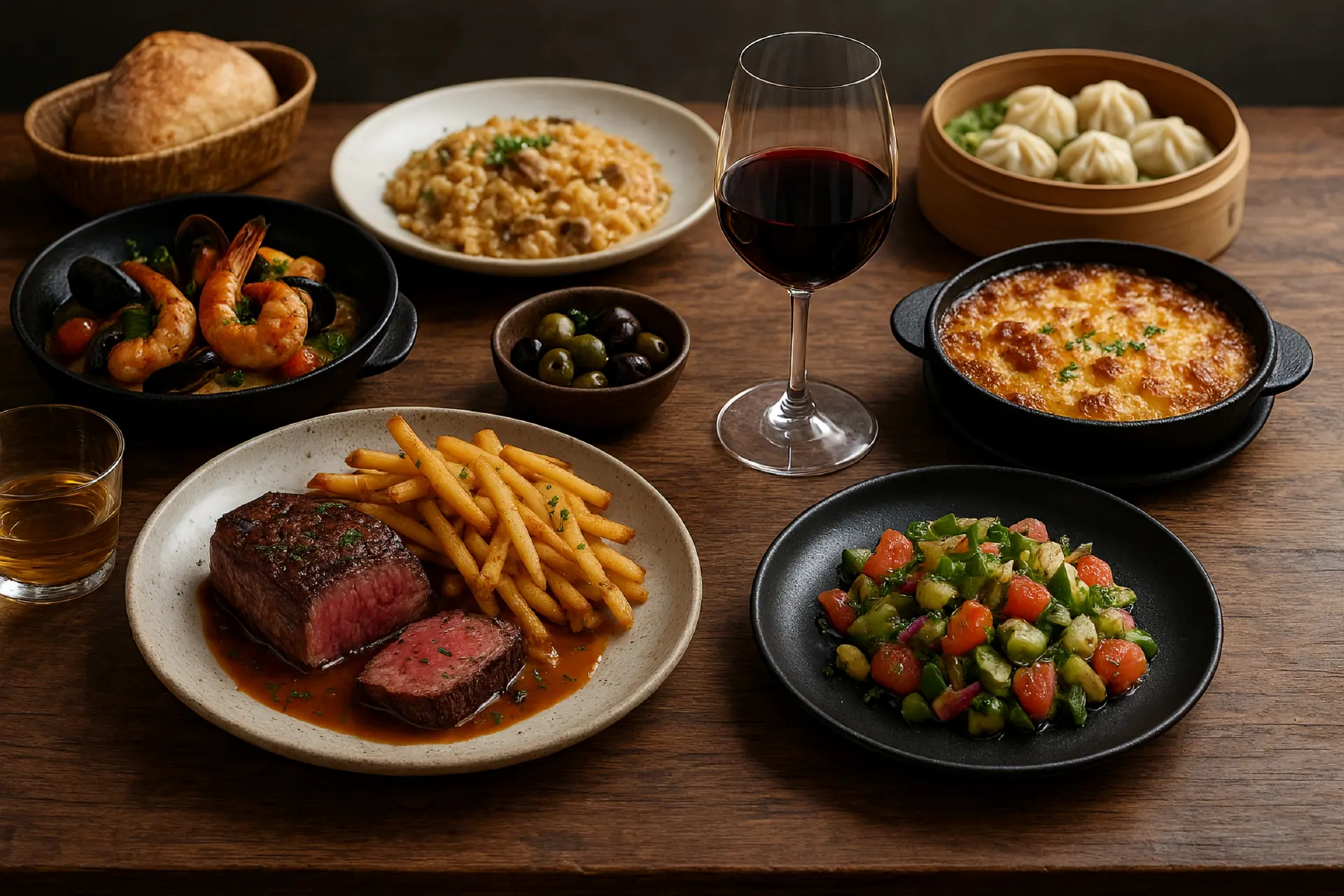
A world arranged by appetite
The World’s Best Gastronomy Trips
Nine cities show why food travel is most rewarding when flavor is connected to markets, migration, craft and everyday life.
This is a comparative editorial guide, not a ranking. Each city is treated as an independent culinary destination.
The most rewarding food journeys do not begin with a checklist of famous dishes. They begin with attention: to the hour when a market changes character, to the difference between a snack eaten standing and a meal that unfolds across an evening, and to the way a city’s geography shapes what appears on the table. A bowl of noodles, a skewer from a charcoal grill or a plate of raw fish is never only a recipe. It carries the habits of workers, the memory of migration, the availability of ingredients and the etiquette of the place where it is served.
This guide brings together nine cities whose food cultures reward that kind of patient exploration. They are not presented as a competitive ranking. Mexico City and Lima reveal the depth of Indigenous ingredients transformed through centuries of exchange; Tokyo, Osaka and Kyoto show three sharply different expressions of Japanese eating; San Sebastián turns compact bars into an edible social map; Bangkok and Istanbul make the street itself part of the dining room; Marrakech leads from spice-scented markets to slow-cooked domestic traditions. Each destination deserves its own pace rather than a hurried attempt to consume a national cuisine in miniature.
A successful gastronomy trip balances appetite with context. Markets are best understood as working systems, not theatrical backdrops. Street food is often safest and most enjoyable when a stall is busy, ingredients are moving quickly and cooking is visible. Formal restaurants can illuminate technique, but family-run counters, bakeries, tea rooms and neighborhood cafés often explain how residents actually eat. Asking what is seasonal, what a dish is called locally and whether a portion is intended for sharing usually leads to better choices than chasing an online list.
Food travel also asks for humility. Culinary traditions are never frozen, and no city speaks with one voice. A dish may have multiple regional versions, a market may serve tourists and residents at the same time, and a celebrated ingredient may be linked to labor, water use or unequal access. The aim here is not to declare an authentic winner. It is to notice how flavor, place and people meet—and to spend money in ways that support the cooks, growers, vendors and small businesses sustaining that meeting.
Practical details change quickly, so the article avoids fixed prices and opening hours. Reservations, market days, seasonal closures, health advice and entry requirements should be checked close to departure. What follows is a durable framework: nine cities, the food traditions that make them legible, and a method for tasting them without reducing them to souvenirs.
Before the first bite
How to build a food journey that goes deeper than a restaurant list
The best itinerary leaves room for markets, ordinary meals, conversation and recovery.
Begin by choosing a small number of neighborhoods rather than a large number of restaurants. Food cities are usually experienced through clusters: a morning market and nearby bakery, a lunch counter beside a commercial street, an afternoon café and an evening district where bars or stalls come alive. Grouping meals geographically reduces transit, reveals how one area changes through the day and creates space for unscripted discoveries. It also prevents the common mistake of booking every meal so tightly that appetite becomes a logistical obligation.
Research dishes by category, not just by fame. Look for one staple that residents eat regularly, one preparation associated with a particular season or ceremony, one market snack, one bread or sweet, and one drink with its own social ritual. That mix gives a broader picture than ordering only the item most photographed online. It also makes comparison meaningful: a city’s everyday breakfast may explain more about its food system than its most expensive tasting menu.
Treat vendors and servers as experts, while remembering that hospitality work is work. A concise question—what is best today, how spicy a dish is, whether it contains a specific allergen—usually produces useful guidance. Photographing people, kitchens or merchandise should never be assumed to be acceptable. Ask first, avoid blocking trade, and buy something when a vendor has given time or information. In heavily visited markets, respectful behavior is part of preserving the place as a functioning food environment.
Finally, build moderation into the route. Share portions where local custom allows, alternate rich meals with simpler ones, drink enough water and keep one meal each day flexible. The goal is not maximum consumption but sustained curiosity. A trip that includes a supermarket aisle, a neighborhood fruit seller or a quiet bowl of soup can be as revealing as one organized around landmark reservations.
Map neighborhoods
Cluster markets, bakeries, cafés and dinner areas so the day has a natural geographic rhythm.
Choose culinary lenses
Research staples, seasonal foods, snacks, sweets and drinks instead of relying on a single famous dish.
Reserve selectively
Book only the experiences that truly require it and protect time for spontaneous meals.
Check health and access
Review current food-safety advice, dietary communication, market schedules and local transport before departure.
Mexico · Central Highlands
Mexico City
A vast capital where Indigenous ingredients, regional migration and street-side ingenuity meet at every scale.
Best for: markets, maize traditions, neighborhood antojitos and contemporary Mexican cooking

How to taste the capital
Follow the daily rhythm before chasing the famous address
Mexico City is less a single culinary destination than a gathering place for the country’s regional foodways. Maize, beans, squash, chiles, tomatoes, cacao and herbs with deep Indigenous histories remain structural ingredients, while migration from Oaxaca, Puebla, Yucatán, Veracruz and beyond continually reshapes what the capital eats. UNESCO’s recognition of traditional Mexican cuisine emphasizes the living system behind the food—farming, ritual, community knowledge and techniques such as nixtamalization—rather than treating a few dishes as isolated icons.
Markets offer the clearest introduction. A morning can move from fruit and fresh cheese to prepared-food counters serving soups, stews or tacos built around a daily guisado. Tortillas should be understood as fresh food, not a neutral wrapper: their aroma, texture and color vary with maize, milling and handling. At street stands, tacos al pastor, suadero, carnitas and barbacoa represent different methods and social rhythms. Ordering one or two at a time allows comparison and keeps the exchange moving at busy counters.
The city also rewards attention to antojitos—small maize-based foods whose names describe specific structures rather than interchangeable snacks. Tlacoyos are thick, often bean-filled ovals; quesadillas may or may not contain cheese depending on local usage; sopes, gorditas and huaraches differ in form, thickness and toppings. Sauces are part of the craft. Their color does not reliably predict heat, so tasting cautiously is wiser than assuming green is mild or red is fierce.
Beyond the street, Mexico City’s cooks have built influential restaurants that reinterpret regional ingredients without severing them from context. The most useful contrast is not traditional versus modern, but everyday versus ceremonial, quick versus slow, and neighborhood versus destination dining. Leave room for pan dulce with coffee, a seasonal fruit drink, a bowl of pozole or a simple comida corrida. Those ordinary formats reveal how the capital organizes its day and why its food culture cannot be compressed into one headline meal.
Peru · Pacific Coast
Lima
Cold current, desert coast and layered migration give Peru’s capital one of the world’s most articulate seafood cultures.
Best for: ceviche, Nikkei and chifa traditions, coastal produce and market-led lunches

A useful rule
Make lunch the anchor and let freshness set the schedule
Lima’s food identity begins with an apparent contradiction: a coastal metropolis built in a desert, nourished by river valleys and the cold, nutrient-rich Pacific. Fish and shellfish arrive beside potatoes, maize, ají peppers, herbs and fruits drawn from Peru’s sharply varied ecological zones. The capital’s restaurants therefore express far more than coastal cooking. They also reflect Andean and Amazonian ingredients, Spanish colonial exchange, Afro-Peruvian history and major Chinese and Japanese migrations.
Ceviche is the essential study in balance, but it should be treated as a preparation rather than a trophy. Fresh fish is cut and dressed close to service with citrus, salt, chile and onion; the surrounding leche de tigre carries both acidity and savor. Many Limeños favor ceviche at lunch, when the day’s seafood is at its freshest. Texture matters as much as sharpness: firm fish, crisp onion, soft sweet potato and large kernels of choclo create a deliberate sequence rather than random garnish.
Two migration-shaped traditions broaden the picture. Chifa developed through Chinese-Peruvian exchange, producing dishes and restaurant customs that are now thoroughly part of Lima’s daily life. Nikkei cooking grew through Japanese-Peruvian histories and an especially precise engagement with seafood, acidity and chile. Neither should be reduced to fashionable fusion. They are long, evolving traditions formed by communities negotiating ingredients, identity and belonging over generations.
A thoughtful Lima itinerary moves between a market, a cevichería, a modest chifa, a bakery or anticuchería, and perhaps one contemporary restaurant that works explicitly with Peru’s biodiversity. Anticuchos—often associated with beef heart—carry Afro-Peruvian history and the direct pleasure of smoke and chile. Picarones, made from a squash-and-sweet-potato dough and served with syrup, offer a very different register. Together these meals show a capital confident enough to be both intensely local and unmistakably connected to the wider world.
Japan · Kantō
Tokyo
Scale is the story: a city where tiny specialist counters, department food halls and neighborhood dining rooms coexist.
Best for: sushi, soba, tempura, specialist restaurants and extraordinary ingredient literacy

Dining approach
Choose one serious meal, then learn from the ordinary ones
Tokyo’s culinary power lies partly in specialization. A restaurant may devote itself to one form of noodles, one style of eel, a particular cutlet or a narrow sequence of sushi. That focus rewards diners who notice detail: the temperature of rice, the thickness of a noodle, the clarity of broth, the way batter protects rather than smothers an ingredient. The city is equally capable of formal ritual and efficient everyday eating, and the contrast between them is central to its appeal.
Sushi is an obvious reference point, but Tokyo offers many levels of access. Standing counters, neighborhood shops and reservation-only restaurants operate with different expectations, pacing and price structures. What connects the strongest experiences is attention to season, handling and the relationship between neta and shari—the topping and seasoned rice. Diners unfamiliar with counter etiquette need not perform expertise. Arriving on time, avoiding strong fragrance, following the restaurant’s pace and asking concise questions are more useful than imitating rules without understanding them.
Soba, tempura, yakitori, tonkatsu, unagi and monjayaki each open another route into the city. Department-store basement food halls reveal an astonishing spectrum of prepared foods, confectionery and regional specialties, while convenience stores show how much craft can be applied to quick meals. Tsukiji’s outer market remains a place of food businesses and visitors, but it should be approached with awareness: narrow lanes must function for workers, and eating while blocking shopfronts erodes the experience for everyone.
Tokyo is too large for a single food district to summarize it. Build days around neighborhoods and one main reservation, then use breakfast, snacks and casual dinners to explore. A bowl of soba after a museum, grilled skewers beneath railway tracks or seasonal wagashi with tea can provide the connective tissue. The lesson is not that Tokyo has everything, although it nearly seems to; it is that precision can flourish in the smallest formats when a city values repeated practice.
Japan · Kansai
Osaka
Direct, social and deeply satisfying, Osaka makes eating feel like a form of public conversation.
Best for: takoyaki, okonomiyaki, kushikatsu and a lively culture of casual dining

Beyond the neon
Use Dotonbori as a doorway, not the entire room
Osaka’s reputation for wholehearted eating is often summarized by the word kuidaore, commonly interpreted as spending oneself into ruin through food. The phrase can become a cliché, yet it points toward something real: eating here is public, convivial and comparatively unpretentious. Counters are close, griddles are visible and conversation with staff or neighboring diners may be part of the meal. The city’s mercantile history and access to goods helped establish it as a kitchen for the wider region.
Takoyaki demonstrates how much technique can hide inside a snack. Batter, octopus and heat must be managed quickly in rounded molds to create a crisp exterior and molten center. Okonomiyaki, cooked on a flat griddle, varies in composition and method; Osaka-style versions generally integrate cabbage and batter before toppings and sauces complete the dish. At specialist shops, watching the cook is part of understanding why these foods are not simply heavy combinations of starch and condiment.
Kushikatsu—breaded, fried skewers associated strongly with Shinsekai—offers another communal format. Traditional sauce practices and house rules vary, especially as businesses update service methods, so diners should follow the current instructions rather than repeating old etiquette as universal law. Elsewhere, udon, pressed sushi and comforting preparations such as kitsune udon reveal a quieter city beneath the neon shorthand.
Dotonbori is useful for orientation but can become an obstacle when treated as the whole destination. Walk side streets, visit a covered shopping arcade and reserve time for a neighborhood where residents are eating after work. Osaka’s pleasure comes from repetition and comparison: two takoyaki stands with different textures, an okonomiyaki counter followed by a small bar, or a morning market visit that explains the ingredients encountered later. The city rewards confidence, but it rewards curiosity more.
Japan · Kansai
Kyoto
Seasonality, restraint and craft turn the former imperial capital into a study of how food can express time and place.
Best for: kaiseki, temple cuisine, tofu, pickles, tea sweets and Nishiki Market

The central discipline
Notice timing, texture and restraint rather than spectacle
Kyoto’s food is often described through refinement, yet refinement here is not synonymous with luxury. It may appear in the precise cut of a vegetable, a broth designed to reveal rather than dominate, or a sweet shaped to suggest a flower that has just come into season. The city’s court, temple, tea and artisan histories all contribute to a cuisine in which presentation carries meaning, but the underlying discipline is practical: use the best moment of an ingredient and do not obscure it.
Kaiseki is the most formal expression of that principle, unfolding through a sequence of dishes attentive to season, vessel and temperature. It is worth experiencing when budget and interest permit, but Kyoto should not be reduced to elite dining. Shōjin ryōri, associated with Buddhist temple traditions, demonstrates the depth possible in plant-based cooking. Yudōfu, simmered tofu, makes texture and water quality central. Obanzai, a broad term often linked to Kyoto home-style side dishes, points toward resourcefulness, vegetables and foods prepared for daily life.
Nishiki Market offers pickles, tea, sweets, dried goods, fish preparations and many ready-to-eat items. Its popularity has created pressure on a narrow street built for commerce, so visitors should respect shop-specific rules and avoid treating the passage as an unrestricted dining hall. The most meaningful purchase may be a small packet of spice, a seasonal confection or a conversation with a specialist rather than a rapid sequence of samples.
Tea culture gives Kyoto’s sweets and meals another dimension. Wagashi are designed with bitterness, season and visual suggestion in mind; matcha is not simply a flavoring for desserts but part of a disciplined cultural practice. A balanced day might pair one formal experience with a tofu lunch, a neighborhood café and a modest noodle meal. Kyoto becomes most legible when the traveler slows enough to notice transitions—the coolness of a bowl, the first bamboo shoots, the shift from cherry blossom motifs to summer water.
Basque Country · Spain
San Sebastián
A compact coastal city where pintxos turn bar-hopping into a highly social form of culinary study.
Best for: pintxos, Basque seafood, cider traditions and concentrated neighborhood exploration

Pintxos etiquette
Order lightly, move often and pay attention to each house
San Sebastián, or Donostia, has an international fine-dining reputation disproportionate to its size, but the city’s most democratic pleasure is the pintxos route. Pintxos are not one recipe or level of complexity. They can be skewered bites set on bread, portions displayed along a counter or hot dishes ordered from a board and cooked to order. The bar is both kitchen and social space, and movement between establishments creates a meal assembled across the city.
Official local guidance encourages a simple rhythm: one or two pintxos and a drink in each place, then move on. That pattern protects appetite and reveals specialization. One bar may be known for anchovy, another for mushrooms, another for tortilla or a particular hot plate. Ask what should be ordered rather than assuming everything visible is the whole menu. In crowded rooms, clarity helps—know the order, keep track of what has been served and make space once finished.
The wider Basque larder is inseparable from the experience. The Bay of Biscay supports a strong seafood culture; salt cod, hake, squid, anchovies and shellfish appear in traditional and contemporary forms. Peppers, beans, Idiazabal cheese and txakoli wine connect coastal meals with inland farms and hills. Cider houses represent a different setting and season, often structured around shared tables and a fixed sequence of robust dishes; current opening patterns and booking requirements need checking.
The city’s fame can tempt visitors into collecting only celebrated bars. A better approach is to choose one district at a time—Parte Vieja, Centro or Gros—and leave room for quieter counters. Lunch at a market-area restaurant, a walk along the water and a restrained evening route create a more sustainable pace than nonstop grazing. San Sebastián’s achievement is not simply density of good food. It is the way culinary ambition remains embedded in ordinary social movement.
Thailand · Chao Phraya Plain
Bangkok
Heat, smoke, sourness and late-night energy make the Thai capital one of the world’s great cities for eating in public.
Best for: street-side cooking, noodles, curries, Chinese-Thai heritage and market exploration

How to navigate
Let time of day, heat and neighborhood shape the menu
Bangkok is often introduced through the intensity of its street food, but the deeper story is a city of regional Thai cuisines, Chinese-Thai traditions, royal influences, Muslim communities and constant urban adaptation. A single block may hold a noodle cart, a curry-and-rice shop, a specialist dessert seller and a restaurant serving dishes associated with another part of the country. The apparent informality rests on repetition, prep work and an exact understanding of heat.
Balance is a useful lens, though not a rigid formula. Sour, salty, sweet, bitter, aromatic and spicy elements may appear across a meal rather than in equal measure within every dish. Boat noodles, grilled meats, som tam, stir-fried dishes and coconut-based sweets each express different structures. Diners should state tolerance for chile clearly, but also remember that reducing heat can alter the intended balance. Starting cautiously and adding condiments where appropriate is better than treating spice as a contest.
Yaowarat, Bangkok’s Chinatown, becomes especially animated after dark. Its food reflects generations of Chinese settlement and Thai transformation, from seafood and noodles to peppery soups and sweets. The district is popular and dense, so a selective route works better than joining every queue. Markets and food courts elsewhere can offer calmer introductions, often with strong turnover and transparent preparation. Busy stalls are not automatically safe, but visible cooking, hot food served hot and clean handling are useful signs.
Bangkok rewards strategic timing. Early mornings suit markets and breakfast dishes; midday heat may favor an indoor food court or restaurant; evening brings grills and woks onto the street. Rain, traffic and air quality can change plans, so keep the route compact. Above all, resist the urge to call every inexpensive meal a hidden gem. Vendors are professionals serving local customers. Their food deserves the same attention to technique, context and fair payment as any formal dining room.
Türkiye · Bosphorus
Istanbul
Between seas and continents, Istanbul builds meals from bread, fish, grills, vegetables, sweets and long habits of hospitality.
Best for: breakfast, meze, fish, kebabs, markets, tea and layered urban food history

Travel across the city
Cross the water and compare neighborhoods, not stereotypes
Istanbul’s geography is not decorative background. The Bosphorus, the Golden Horn, the Sea of Marmara and routes linking the Black Sea and Mediterranean have shaped ingredients, trade and settlement for centuries. Ottoman court traditions form one strand, but so do the kitchens of migrants from across Anatolia, the Balkans, the Caucasus and former imperial territories. The result is not a seamless bridge between East and West; it is a metropolis of specific neighborhoods and communities.
Breakfast can function as a map of the larder: cheeses, olives, tomatoes, cucumbers, eggs, preserves, honey, bread and tea arranged for sharing. Later, soups, pide, börek, köfte, kebabs, vegetable dishes in olive oil and stuffed preparations reveal different regional lineages. Fish sandwiches and grilled fish are linked to the waterfront, yet quality and season matter more than the romance of a particular view. Asking what is fresh today remains the best guide.
The Spice Bazaar is visually powerful, but it should not define the entire food journey. Visit neighborhood bakeries, produce markets and lokantas—restaurants where prepared dishes can be seen and selected. Meze are best understood as a social sequence rather than a random collection of dips. Raki, when chosen, belongs to a meal and a particular pace; alcohol availability and custom vary by establishment and neighborhood, and no visitor should assume it is central to every Turkish dining experience.
Istanbul’s sweets deserve more than a final sugar rush. Baklava depends on pastry, fat, nuts and syrup being balanced rather than merely abundant. Lokum varies enormously in quality, while milk puddings and seasonal fruit desserts offer quieter pleasures. Turkish coffee and tea structure conversation throughout the day. A thoughtful itinerary crosses the water, compares districts and leaves room to sit. In a city so frequently described through grand metaphors, an ordinary lunch can be the most honest encounter.
Morocco · Haouz Plain
Marrakech
Market abundance and slow-cooked depth meet in a city where spices are important, but technique matters more than perfume.
Best for: tagines, couscous, breads, preserved ingredients and the evening energy of Jemaa el-Fna

Look beyond the square
The city’s strongest flavors are built slowly and understood in context
Marrakech announces itself through color and aroma, which makes it easy to mistake spice for the whole story. Moroccan cooking depends just as much on controlled heat, patient preparation, bread culture, preserved ingredients and the balance between savory and sweet. Cumin, saffron, ginger, cinnamon, paprika and pepper may appear, but their purpose is to build coherence. A well-made tagine tastes integrated rather than dusted with an exotic label.
Tagine refers both to a vessel and a family of dishes, and the result varies with meat, vegetables, fruit, olives, preserved lemon and regional habit. Couscous has its own social and temporal associations and should not be treated as an automatic side dish. Harira, pastilla, grilled meats, salads and slow-cooked tanjia widen the repertoire. Bread is an utensil, staple and marker of hospitality; neighborhood communal ovens can reveal the infrastructure behind what appears at the table.
Jemaa el-Fna is at its most theatrical in the evening, when smoke rises from food stalls and the square becomes a shifting performance of commerce and gathering. It is also a high-pressure tourist environment. Compare stalls, confirm prices before ordering, watch hygiene and avoid allowing urgency to dictate the meal. The surrounding medina contains many other food experiences, from small restaurants and juice sellers to spice shops where quality and intended use matter more than photogenic piles.
A cooking class can be valuable when it includes market literacy, technique and a respectful account of domestic traditions rather than a simplified recipe performance. Elsewhere, tea service, pastries and a slow breakfast provide necessary pauses from the medina’s intensity. Marrakech rewards visitors who move between spectacle and quiet: the famous square, a shaded courtyard, a bakery lane and a meal where the lid of a tagine is lifted only after time has done its work.
Practical judgment
Food safety, dietary needs and the ethics of appetite
Confidence should come from observation and preparation, not from pretending that risk does not exist.
Travel food advice should be calibrated to destination, traveler and current public-health information. The United States Centers for Disease Control and Prevention recommends attention to water quality, food temperature, hand hygiene and the condition in which food is stored and served. In practical terms, choose food cooked thoroughly and served hot, favor stalls with steady turnover, wash or sanitize hands before eating, and be cautious with raw foods or ice where water safety is uncertain. These principles matter without turning local food into an object of suspicion.
People with allergies, celiac disease or other medically significant restrictions need more than a translated ingredient list. Cross-contact, stocks, sauces, frying oil and garnishes may not be visible. Carry a clearly written explanation in the local language, name the ingredient and the consequences, and ask before ordering. A dish traditionally made without an allergen may still be prepared differently in one kitchen. When communication is uncertain, choosing a simpler meal is a reasonable decision rather than a failure of adventurousness.
Responsible food travel includes waste and labor. Order in stages, especially in markets and small-plate cultures, so that curiosity does not produce abandoned food. Pay listed or agreed prices without turning every exchange into a performance of bargaining. Tip according to local norms, not imported assumptions. When taking a tour, look for operators who compensate vendors, limit group size and explain the neighborhood rather than merely using it as a backdrop.
Animal welfare, fisheries and ingredient sourcing can be difficult to judge from a menu, but questions still matter. Seasonal seafood guidance, protected species rules and local environmental conditions change. Avoid dishes built around wildlife of uncertain legality and be skeptical of claims that rarity guarantees authenticity. A food culture is not honored by consuming it indiscriminately.
The most useful principle is simple: pleasure and responsibility are not rivals. Eating carefully protects the traveler, while curiosity grounded in respect protects the quality of the encounter. Verify live guidance, listen to local expertise and remember that every memorable plate exists inside a larger system of land, water, work and knowledge.
Is a long queue proof that a street-food stall is safe?
No. Turnover can be encouraging, but visible hygiene, proper cooking temperature, clean utensils and safe water practices still matter.
Should every famous dish be tried?
No. Dietary needs, ethics, season and simple preference are valid reasons to choose differently. A city is always larger than one required order.
How many major meals make sense in one day?
Usually fewer than an ambitious itinerary suggests. One anchored meal plus flexible snacks and a lighter second meal preserves appetite and attention.
The lasting flavor
The best gastronomy trips teach a way of looking.
Mexico City, Lima, Tokyo, Osaka, Kyoto, San Sebastián, Bangkok, Istanbul and Marrakech offer radically different food landscapes. What links them is not a single standard of excellence. It is density of knowledge: techniques repeated until they appear effortless, ingredients understood through season and place, and social customs that turn eating into more than refueling.
A traveler does not need to master every code before arriving. Attention is enough to begin. Watch how people order, ask what is good today, learn the name of an ingredient, leave room for an ordinary meal and accept that the most famous address may not become the most meaningful memory. Gastronomy travel is at its richest when it replaces consumption with relationship.
Plan the essential reservations, verify the details that can change and then protect time for surprise. The point is not to return with proof of having eaten the world. It is to return with a sharper sense of how many worlds can exist inside a market aisle, a bowl, a loaf of bread or a table shared for an hour.