
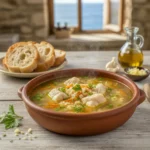
Buncek (Smoked Pork Hock) Croatian Bean Stew

Buncek – Smoked Pork Hock Stew

In continental Croatia, the sight of a smoked pork hock hanging in a butcher’s stall signals the cold season as clearly as the first frost. Under the local name buncek, this cut comes from the lower part of the pig’s leg, between the ham and the foot, and often appears in winter stews across Zagreb, Zagorje, Međimurje, and other northern regions. When markets fill with fermented cabbage, dried sausages, and smoked ribs, buncek quietly anchors many of the most satisfying pots: sauerkraut braises, kale stews, and dense bean soups. Croatian culinary references list buncek among signature pork specialties, often simmered slowly with beans, cabbage, or kale for an everyday meal that feels humble yet deeply rooted in local taste. 

This recipe focuses on grah s buncekom: a smoked pork hock bean stew that sits at the center of many family tables in northern Croatia during the colder months. Home cooks soak sturdy brown or mottled beans overnight, then simmer them together with a single smoked hock, onions, carrots, celery, bay leaf, and paprika. Croatian cooks describe the dish as a classic “peasant” meal, simple in composition yet generous in its warmth and satiety. Similar bean stews with smoked pork appear across the region under names such as grah or pasulj, always tied to winter, long simmering, and economical cuts that reward patient cooking.

Buncek brings more than smoke and salt. Long cooking coaxes gelatin and collagen from the skin and connective tissue, which slightly thickens the broth and lends a silky feel that clings to the beans. When handled with care—parboiling or rinsing if it tastes extremely salty, and simmering gently rather than at a rolling boil—the hock yields tender meat that pulls away from the bone in large, satisfying pieces. Croatian recipes often recommend a slow simmer of 1½ to 2 hours for the hock itself, timing that lines up neatly with the time needed for dried beans to soften. 

The flavor profile of this stew balances several distinct notes. The buncek provides deep smoke and a pronounced cured-meat savor. The beans contribute a creamy, mild base that catches paprika, garlic, and onion. Carrots and celery round out the sweetness in the background, while bay leaf and black pepper bring structure. A spoonful of tomato paste gives gentle acidity and color without pushing the dish toward tomato soup. Some Croatian cooks finish bean stews with a flour-based roux; others prefer a lighter version where the beans themselves provide body. This recipe follows the latter approach, closer to versions from home cooks who describe their grah as vegetable-forward and free from heavy roux. 

What sets this particular version apart is a double focus: first on controlled saltiness, second on texture balance. Smoked hocks vary widely in salt content, so the method begins with a brief pre-simmer or long soak for the buncek, which helps avoid an over-salty pot. At the same time, the recipe keeps the bean-to-liquid ratio fairly tight, yielding a stew that is spoonable and rich rather than brothy. Potatoes appear in modest quantity to thicken the base naturally and add gentle sweetness, while the vegetables are cut small enough to melt into the beans without turning to mush.

From a practical standpoint, this is a flexible, forgiving dish. It works on a slow afternoon or weekend, rewards reheating, and suits both casual family meals and informal gatherings. In many Croatian households, a pot of grah s buncekom might serve as the main course with crusty bread and pickled vegetables, or share the table with sauerkraut, mashed potatoes, or cornmeal side dishes. 

For cooks interested in Croatian food, buncek stew offers an approachable entry point that relies on accessible ingredients and straightforward technique. The method respects regional practice—long simmering, smoked pork, sturdy beans—while adjusting details such as salt management and vegetable balance for a modern kitchen. The result is a bowl that feels firmly anchored in its origins yet entirely at home on a contemporary table, with deep flavor, tender meat, and beans that hold their shape in a thick, aromatic broth.

Buncek (Smoked Pork Hock) Croatian Bean Stew

Recept készítője Travel S HelperPálya: Konyha: horvátNehézség: Közbülső
Adagok

6

adagok
Előkészítési idő

30

jegyzőkönyv
Főzési idő

150

jegyzőkönyv
Kalória

650

kcal

Hearty buncek (smoked pork hock) Croatian stew with beans and vegetables, slow-cooked for tender meat, deep flavor, and a richly comforting winter meal.

Hozzávalók

  • For the Buncek and Beans
  • Smoked pork hock (buncek), 1 large (about 1–1.2 kg) — Main flavor base; choose a well-smoked, meaty hock.

  • Dried beans, 500 g — Brown, pinto, or mottled beans hold their shape well; soak overnight in plenty of water.

  • Cold water, about 2.5–3 liters — Enough to cover beans and buncek during simmering; add more as needed.

  • Bay leaves, 2 — Classic aromatic for Croatian bean stews.

  • Black peppercorns, 8–10 — Add subtle warmth; complement the smoke.

  • For the Stew Base
  • Lard or neutral oil, 3 tablespoons — Traditional recipes use pork lard; neutral oil works for those avoiding rendered pork fat.

  • Yellow onion, 2 medium (about 250 g), finely chopped — Forms the aromatic base and sweetness.

  • Garlic, 4–5 cloves, finely minced — Adds depth that suits smoked meat and beans.

  • Carrots, 2 medium (about 150 g), diced small — Bring sweetness and color; small dice helps them soften evenly.

  • Celery stalks, 2, diced small — Adds aromatic backbone and gentle bitterness.

  • Potatoes, 2 medium (about 250 g), peeled and cut into 2 cm cubes — Help thicken the stew and round the flavor.

  • Sweet paprika, 2 teaspoons — Key flavor note in Croatian bean stews; use good-quality, fresh paprika.

  • Hot paprika or chili flakes, ¼–½ teaspoon, to taste — Optional heat; adjust for mild or spicy results.

  • Tomato paste, 1½ tablespoons — Adds body and gentle acidity without overshadowing the smoke.

  • Ground black pepper, ½ teaspoon — Seasoning for the stew base.

  • Só, ízlés szerint — Add only after tasting the cooked buncek broth; smoked hocks can be very salty.

  • For Finishing & Serving
  • Fresh parsley, 2 tablespoons, finely chopped — Fresh herbal note at the end.

  • Apple cider vinegar, 1–2 teaspoons (optional) — A small splash brightens the stew before serving.

  • Crusty bread, to serve — Traditional accompaniment.

  • Pickled peppers or other pickled vegetables (optional) — Cut through richness and smoke.

Útvonalterv

  • Prepare the Beans and Buncek
  • Soak the beans (night before). Rinse the dried beans, place them in a large bowl, cover with plenty of cold water, and leave to soak for 8–12 hours. Drain and rinse before cooking.

  • Pre-soak or parboil the buncek. Rinse the smoked pork hock under cold water. For a milder salt level, cover it with cold water in a pot and bring just to a simmer for 10 minutes, then discard that water and set the hock aside.

  • Start the main pot. Place the soaked, drained beans and the buncek into a large, heavy pot. Add bay leaves and peppercorns, then pour in enough cold water to cover everything by about 4–5 cm.

  • Bring to a gentle simmer. Over medium heat, bring the pot up to a simmer. Skim off any foam that rises to the surface during the first 10–15 minutes.

  • Simmer until beans and hock start to soften. Lower the heat and cook at a gentle simmer for about 60–75 minutes, partially covered, until the beans are just starting to soften and the hock begins to loosen at the edges. Add a little hot water if the level drops too far.

  • Build the Stew Base
  • Prepare the vegetables. While the beans and buncek simmer, finely chop onions and garlic, and dice carrots, celery, and potatoes.

  • Cook the aromatics. In a wide pan, warm the lard or oil over medium heat. Add the chopped onions and cook for 8–10 minutes, stirring often, until soft and pale golden.

  • Add garlic and vegetables. Stir in the garlic, carrots, and celery. Cook for 5–7 minutes, until the vegetables soften slightly and the garlic loses its raw edge.

  • Bloom the paprika. Lower the heat, sprinkle in the sweet paprika and hot paprika or chili. Stir for about 30 seconds, just until fragrant, taking care that the paprika does not darken too much.

  • Add tomato paste. Stir in the tomato paste and cook for 1–2 minutes, until it integrates with the vegetables and turns a deeper red. Remove the pan from the heat.

  • Combine and Finish the Stew
  • Combine with the bean pot. When the beans are just tender, add the sautéed vegetable mixture to the main pot. Stir gently to distribute without breaking the beans.

  • Add potatoes and seasonings. Add the cubed potatoes and ground black pepper. Taste the liquid; if it already tastes quite salty from the buncek, wait before adding any additional salt.

  • Simmer until everything is tender. Continue to cook at a gentle simmer for another 40–50 minutes, partially covered, until the potatoes are tender, the beans are fully soft but intact, and the stew has thickened naturally. Stir occasionally, scraping the bottom to prevent sticking.

  • Adjust consistency. If the stew looks too thick, stir in a little hot water. If it feels too loose, remove the lid and let it simmer uncovered for 10–15 minutes, stirring now and then, until it reaches a spoon-coating consistency.

  • Remove and shred the buncek. Lift the buncek out onto a board. Remove the skin and bone, then shred or cut the meat into bite-sized pieces. Return the meat to the pot and discard skin and bone.

  • Final seasoning. Taste the stew and add salt only as needed. Add a small splash of apple cider vinegar if a brighter finish is desired, then stir in chopped parsley.

  • Pihentesd és tálald. Let the stew rest off the heat for 10–15 minutes. Serve in warm bowls with crusty bread and pickled vegetables on the side.

Tippek, hibaelhárítás és variációk

  • Tálalási javaslatok és párosítások
    Buncek stew pairs well with rye or country-style white bread that can absorb the thick broth. Lightly dressed cabbage or beet salads, pickled peppers, or mixed pickled vegetables cut through the richness and echo Central European table habits. For drinks, dry or off-dry Riesling, Graševina (Welschriesling), or a simple lager-style beer suits the smoky meat and hearty beans without overwhelming them.
  • Tárolás és újramelegítés
    Leftover buncek stew keeps in the refrigerator for up to 4 days in a covered container. The stew thickens as it cools, so a splash of water or stock during reheating helps restore a ladleable consistency. Gentle reheating over low heat on the stovetop preserves the texture of the beans better than vigorous boiling; a microwave works as long as the stew is stirred a few times during reheating. Portions can be frozen for up to 3 months, then thawed overnight in the fridge before reheating.
  • Variációk és helyettesítések
    A sauerkraut version replaces part of the beans with rinsed fermented cabbage, moving the dish closer to buncek with sauerkraut. A lighter version uses half the buncek weight and more vegetables, with extra carrots and celery for sweetness. For a kale or cabbage-and-kale twist, stir in chopped greens during the last 15–20 minutes of simmering. A faster, weeknight-friendly option can rely on canned beans added once the buncek is nearly tender; the beans need far less time, though the flavor depth remains strongest when both simmer together from the start.
  • Séf tippjei
    Cut at least one potato into smaller pieces than the rest, so it breaks down more and naturally thickens the stew. Keep the simmer gentle throughout; aggressive boiling toughens the meat and can cause beans to split. Taste the liquid before adding any salt, since some buncek pieces lean very salty and season the pot on their own. For an even silkier broth, mash a small scoop of beans against the side of the pot near the end and stir them back in.
  • Szükséges felszerelés
    A large, heavy-bottomed pot (such as an enameled cast-iron Dutch oven) helps maintain a steady, gentle simmer and reduces the risk of scorching during long cooking. A wide sauté pan or skillet provides enough surface area to soften onions and vegetables evenly before they go into the main pot. A sharp chef’s knife and sturdy cutting board make it easier to cube vegetables and portion the cooked buncek cleanly. A ladle, wooden spoon, and a small skimmer or spoon for removing foam complete the basic setup; nothing advanced is required, but solid, heat-retentive cookware improves both flavor development and control over texture.

Tápanyagtartalom

Approximate values for one of 6 servings:

TáplálóMennyiség (kb.)
Kalória~650 kcal
Szénhidrátok~35 g
Fehérje~38 g
Zsír~32 g
Rost~10 g
Nátrium~1400 mg
Főbb allergénekNone inherent; check bread or sides for gluten or other allergens
augusztus 8, 2024

A világ 10 legjobb karneválja

A riói szambalátványtól a velencei álarcos eleganciáig fedezzen fel 10 egyedi fesztivált, amelyek bemutatják az emberi kreativitást, a kulturális sokszínűséget és az ünneplés egyetemes szellemét. Fedezd fel…

A 10 legjobb karnevál a világon