
New York City präsentiert sich als Mosaik aus Vierteln, jedes geprägt von seinem eigenen Erbe, seinen Traditionen und seiner Persönlichkeit. Rechtlich besteht die Stadt aus fünf eigenständigen Stadtbezirken – Manhattan, Brooklyn, Queens, der Bronx und Staten Island –, die sich jeweils wie eine eigene Stadt verhalten. Gleichzeitig sind die Grenzen der Viertel nicht starr festgelegt, sodass sie sich organisch entwickelt haben, mit sich überschneidenden Namen und fließenden Grenzen. Ein Neuankömmling mag sich in dieser Stadt der vielen kleinen Viertel zunächst etwas überfordert fühlen, doch dieser Reiseführer soll Ihnen als hilfreicher Wegweiser durch die vielfältigen Stadtteile New Yorks dienen. Sie finden hier historische Höhepunkte, kulturelle Besonderheiten, lokale Legenden und praktische Tipps, die Ihnen helfen, sich wie ein Einheimischer zurechtzufinden.
- Die Geographie und das Bezirkssystem von New York verstehen
- Manhattan: Das Herz von New York City
- Lower Manhattan: Wo New York begann
- Washington Square Park und NYU: Die Rolle des Village in der Bohème- und LGBTQ-Geschichte
- East Village & Lower East Side: Einwanderererbe und Gegenkultur
- Chinatown & Little Italy: Kulturelle Enklaven
- Chelsea und das Meatpacking District: Kunst und Innovation
- Midtown Manhattan: Das Geschäftszentrum
- Upper West Side: Kultur und Flussufercharme
- Upper East Side: Luxus und Museen
- Harlem: Kulturhauptstadt und Renaissance
- Brooklyn: New Yorks bevölkerungsreichster Stadtbezirk
- Brooklyn Heights und DUMBO
- Williamsburg: Hipster-Paradies
- Park Slope: Familienfreundliches Brooklyn
- Coney Island: Strandvergnügungen
- Queens: Der Stadtbezirk der Welt
- Long Island City (LIC): Kunst, Aussichten und Stadterneuerung
- Astoria: Griechisches Erbe und Vielfalt
- Jackson Heights: Globaler Knotenpunkt
- Flushing: Authentische asiatische Kultur
- Die Bronx: Ein authentisches NYC-Erlebnis
- Staten Island: Der vergessene Stadtbezirk
- Die Wahl der richtigen Unterkunft: Vergleich der Stadtviertel
- Nachbarschafts-Lebensmittelführer
- Praktische Besucherinformationen
Die Viertel New Yorks prägen die Identität der Stadt. Denken Sie an Greenwich Village, das über Generationen als das „bohemische Herz“ Manhattans galt, oder an Harlem, das während der Harlem Renaissance zum Symbol afroamerikanischer Kultur wurde. Beim Schlendern durch diese Straßen spürt man an jeder Ecke die Spuren vergangener Epochen. Dieser Reiseführer listet nicht nur Sehenswürdigkeiten auf, sondern erzählt die Geschichte der Entstehung jedes einzelnen Viertels – von den niederländischen Siedlungen des 17. Jahrhunderts in Lower Manhattan bis zu den heutigen internationalen Einwanderergemeinschaften in Queens. Er hilft Ihnen außerdem, sich in der Stadt zurechtzufinden: vom Verständnis des Fünf-Bezirks-Systems bis hin zur Orientierung im strengen Straßenraster Manhattans. Kurz gesagt: Sie erfahren, wohin Sie gehen, was Sie sehen und wie Sie sich in diesem komplexen Stadtbild zurechtfinden.
Die Struktur dieses Reiseführers spiegelt die Logik der Stadt wider. Wir beginnen mit einem allgemeinen Überblick (Stadtteile, Stadtplan, Nahverkehr) und erkunden dann die einzelnen Stadtteile. Jeder Abschnitt behandelt Geschichte, Sehenswürdigkeiten, Kultur, Gastronomie und Reisetipps. Wo möglich, verzichten wir auf persönliche Schilderungen und wählen stattdessen einen journalistischen, sachlichen Ton, der dennoch authentische Erlebnisse vermittelt. Präzise Details werden geboten – beispielsweise, welche U-Bahn-Linien die Stadtteile verbinden oder in welchen Straßen sich die besten kleinen Restaurants und Imbisse befinden. Immer wieder streuen wir Anekdoten und Geschichten über die Stadt ein, wie die Geschichten hinter berühmten Orten wie dem Stonewall Inn oder dem Apollo Theater.
Am Ende dieses Reiseführers wissen Sie nicht nur, wo sich New Yorks berühmte Viertel befinden, sondern auch, warum sie so wichtig sind – was jedes Viertel einzigartig macht und wie Besucher sicher und genussvoll in diese Kultur eintauchen können. Ob Sie Soul Food in Harlem genießen, durch die Brownstones im West Village schlendern oder mit der Fähre nach Staten Island übersetzen möchten – dies ist Ihr umfassender und aktueller Reiseführer. Im Fokus steht die praktische Orientierung, nicht die Werbung. Freuen Sie sich auf historische Hintergründe und Geschichten aus den Vierteln, kombiniert mit Sehenswürdigkeiten, die Sie unbedingt besuchen sollten, und praktischen Tipps – alles zusammengestellt aus den neuesten Quellen und Insiderwissen. New Yorks Komplexität kann überwältigend sein, aber mit dieser Lektüre sind Sie bestens gerüstet, die Stadt wie ein echter New Yorker zu erkunden und sowohl beliebte Wahrzeichen als auch versteckte Juwelen zu entdecken.
Die Geographie und das Bezirkssystem von New York verstehen
Bevor wir uns mit den einzelnen Stadtteilen befassen, ist es hilfreich, den grundlegenden Aufbau New Yorks zu verstehen. New York City besteht offiziell aus fünf Stadtbezirken. Manhattan (New York County), die Bronx (Bronx County), Brooklyn (Kings County), Queens (Queens County) und Staten Island (Richmond County) waren ursprünglich eigenständige Gemeinden, wurden aber 1898 zu einer einzigen Stadt zusammengelegt. Jeder Stadtbezirk entspricht einem County des Bundesstaates New York. Manhattan ist flächenmäßig der kleinste Stadtbezirk, beherbergt aber die höchste Bevölkerungsdichte und die meisten Geschäftsviertel. Brooklyn ist der bevölkerungsreichste und erstreckt sich von den Hochhäusern mit ihren Brownstone-Häusern bis hin zu den Uferparks. Queens umfasst etwa 195 Quadratkilometer Wohngebiete und Vororte. Die Bronx ist New Yorks nördlichster Stadtbezirk mit Parks und kulturellen Einrichtungen. Staten Island wirkt in vielen Teilen eher vorstädtisch oder ländlich und ist durch die kostenlose Staten Island Ferry mit Manhattan verbunden.
Manhattan selbst ist nach einem groben Rasterplan angelegt (dem „Commissioners’ Plan von 1811“). Die meisten Avenues verlaufen in Nord-Süd-Richtung, die Straßen in Ost-West-Richtung. Unterhalb der Houston Street (in Lower Manhattan) löst sich das Raster in ältere, unregelmäßige Straßen auf. Oberhalb der Houston Street verlaufen die nummerierten Straßen von Süden nach Norden (z. B. die 1st Street im East Village bis zur 220th Street in Inwood) und die Avenues von Osten (1st Avenue) nach Westen (z. B. die 12th Avenue/Hudson River). Manhattan wird oft in drei große Gebiete unterteilt: Downtown/Lower Manhattan (südlich der Houston Street), Midtown (von Midtown South über den Times Square bis zum südlichen Rand des Central Parks) und Uptown (das Gebiet nördlich des Central Parks, weiter unterteilt in Upper West Side, Upper East Side und darüber hinaus). Das nummerierte Raster erleichtert die Orientierung, doch die tatsächlichen Grenzen der Viertel überschneiden sich. So steht SoHo offiziell für „South of Houston“ und Tribeca für „Triangle Below Canal“, was eher auf historische Nutzungen als auf strikte Linien auf einer Karte zurückzuführen ist.
Die anderen Stadtbezirke sind weniger klar abgegrenzt. Brooklyn erstreckt sich von einer langen Halbinsel am Atlantik über Hügel und Küsten. Es umfasst alles von den Brownstones in Brooklyn Heights und Park Slope über die Hipster-Viertel Williamsburg und Bushwick bis hin zu den vorstädtischen Küstenregionen wie Bay Ridge und Sheepshead Bay. Queens ist weitläufig und abwechslungsreich: Long Island City und Astoria liegen in der Nähe der Manhattan Bridge, dahinter befinden sich diverse Stadtteile wie Jackson Heights und Flushing sowie das eher vorstädtische östliche Queens. Die Bronx beginnt am Rande Manhattans (jenseits des Harlem River) und erstreckt sich in hügeliges, grünes Land (wie Riverdale) und die vorstädtischen Gebiete im Stil von Ozone Park im Osten. Staten Island schließlich wirkt geografisch am isoliertesten – nur mit der Fähre (oder über eine lange Brücke) mit Brooklyn verbunden – und ist bekannt für seine Parks, die Küste und die ruhige Innenstadt in St. George, wo sich der Fährhafen befindet.
Auch die öffentlichen Verkehrsmittel verbinden diese Viertel. Die New Yorker U-Bahn ist weitverzweigt: Dank des schachbrettartigen Straßennetzes Manhattans verlaufen mehrere U-Bahn-Linien in Nord-Süd-Richtung (z. B. die Linien 1-2-3 auf dem Broadway, die Linien 4-5-6 auf der Lexington Avenue, die ACE auf der 8th Avenue usw.) und verbinden Manhattan mit Brooklyn (über Linien wie die 2-3-4-5 nach Brooklyn Heights oder die Linien 7 und NR auf der 59th Street nach Queens). Brücken und Tunnel verbinden die Stadtbezirke ebenfalls (die Brooklyn Bridge und die Manhattan Bridge nach Brooklyn/Queens, die Queensboro Bridge und die Triboro Bridge nach Queens usw.). S-Bahnen (Long Island Rail Road von Manhattan nach Queens/Long Island, Metro-North von Manhattan in die Bronx und in den Norden des Bundesstaates New York) und Busse schließen Lücken. Kurz gesagt: Manhattans U-Bahn-Knotenpunkte (Grand Central Station, Penn Station, Fulton Street in der Innenstadt) sind Knotenpunkte zu allen anderen Stadtbezirken. Man kann mit den öffentlichen Verkehrsmitteln schnell zwischen den Vierteln reisen.
New Yorks Geografie und seine besonderen Verkehrsstrukturen prägen die Wahrnehmung der Stadtteile durch die Einheimischen. So ist Lower Manhattan (alles südlich der 14. Straße) nicht nur das Finanzzentrum der USA, sondern auch der Ursprung New Yorks (als niederländische Siedlung Nieuw Amsterdam). Die Wall Street und das Financial District sind nach wie vor wichtige Wahrzeichen. Greenwich Village, einst ein Dorf in der Kolonialzeit, liegt nördlich von Soho und wird grob von der 14. Straße, dem Broadway und dem Hudson River begrenzt. Viertel wie Harlem, benannt nach der niederländischen Stadt Haarlem, liegen in Uptown Manhattan oberhalb des Central Parks. In den äußeren Stadtbezirken wurde die Arthur Avenue in der Bronx nach General Arthur aus dem Bürgerkrieg benannt und als „das wahre Little Italy“ von New York City bekannt, während das Little Italy in Manhattan an Bedeutung verlor. In Queens entstand Jackson Heights um Viertel mit hohem Anteil an Einwanderern. Die wichtigste Geschäftsstraße der Bronx ist der Bronx Park, an dem sich der Bronx Zoo und der Botanische Garten befinden.
Dieser Reiseführer ordnet die Stadtteile vorwiegend nach geografischen und nicht nach strengen politischen Grenzen, um Reisenden die Planung ihrer Besuche zu erleichtern. Leser, die sich für Manhattan interessieren, finden Abschnitte über Downtown (Financial District, Battery Park, Tribeca, SoHo), Greenwich/West Village, East Village/Lower East Side, Chinatown/Little Italy, Chelsea/Meatpacking, Midtown, Upper West Side, Upper East Side und Harlem. Anschließend widmen wir uns Brooklyn (Brooklyn Heights/DUMBO, Williamsburg, Park Slope, Coney Island), Queens (Long Island City, Astoria, Jackson Heights, Flushing), der Bronx (Arthur Avenue, Yankee Stadium, Bronx Zoo/Botanical Garden) und Staten Island (St. George Ferry, die historischen Viertel von Staten Island). Abschließend bieten praktische Abschnitte einen Vergleich der Stadtteile für Besucher (Empfehlungen für Erstbesucher, preisgünstige Gegenden, Sicherheitstipps) sowie einen hilfreichen Restaurantführer (beste Pizza, internationale Küche in verschiedenen Vierteln, Restaurants für den späten Abend usw.).
New Yorks Viertel bestechen durch ihre Details: Geschichte, Kultur, Kulinarik und Anekdoten. Wir haben aktuelle Quellen durchforstet, um Ihnen stets die neuesten Erkenntnisse zu präsentieren (zum Beispiel, welche Restaurants sich einen Namen gemacht haben, neue Verkehrslinien eröffnet wurden oder Viertel umbenannt wurden). Fakten werden mit Quellenangaben belegt (z. B. zur Herkunft von Ortsnamen oder berühmten Institutionen), sodass Sie den Informationen vertrauen können. Anekdoten (wie die über die Bäckerei in der Arthur Avenue oder die Beat-Poeten im East Village) stammen aus journalistischen Berichten und der Chronik der jeweiligen Viertel. Der Ton ist informativ und zugleich einladend, sachlich und warmherzig – eine Erzählung von jemandem, der die Stadt in all ihren Facetten kennt.
Damit beginnen wir unsere Tour – wir starten an der Südspitze Manhattans, wo die Geschichte New Yorks ihren Anfang nahm, und arbeiten uns nordwärts durch die Insel und dann über die Brücken in die anderen Stadtteile vor.
Manhattan: Das Herz von New York City
Lower Manhattan: Wo New York begann
An der Südspitze Manhattans liegt Lower Manhattan, der älteste Teil der Stadt. Hier befand sich in den 1620er Jahren Nieuw Amsterdam, ein niederländischer Handelsposten. Heute verschmelzen hier jahrhundertealte Straßen mit hoch aufragenden modernen Wolkenkratzern. Das Finanzviertel (auch bekannt als Wall-Street-Viertel) nimmt einen Großteil dieses Gebiets ein: Namen wie Wall Street und die New Yorker Börse (NYSE) lassen an die globale Finanzwelt denken, doch die Wurzeln reichen zurück bis zur niederländischen „Mauer“, die die Kolonisten im 17. Jahrhundert zum Schutz ihrer Stadt errichteten. Besucher können noch immer enge Gassen aus dem 18. Jahrhundert wie die Stone Street bewundern, gesäumt von historischen Tavernen inmitten gläserner Türme. Ein kurzer Spaziergang nach Süden führt zu Battery Park City und dem Battery Park, grünen Oasen am Hafen. Der Battery Park (ganz im Süden) überblickt den New Yorker Hafen und beherbergt die Abfahrtsorte zur Freiheitsstatue und Ellis Island. Wie der National Park Service erklärt, fahren „Fähren von The Battery, an der Südspitze Manhattans“, zu Liberty Island und Ellis Island, den Symbolen für Einwanderung und Freiheit. Der Park selbst bietet oft öffentliche Kunst, Gärten und einen herrlichen Blick auf den Hafen.
Unweit des Battery Parks befindet sich das 9/11 Memorial & Museum auf dem Gelände des ehemaligen World Trade Centers. Die beiden stillen Wasserbecken (an denen einst die Zwillingstürme standen) sind ein absolutes Muss und gedenken der Opfer der Anschläge von 2001. Das angrenzende Museum bietet anhand von Artefakten und persönlichen Geschichten einen historischen Kontext. Von hier aus kann man auch das One World Trade Center (auch bekannt als Freedom Tower) sehen, den glänzenden neuen Wolkenkratzer, dessen Höhe (541 Meter) bewusst an das Gründungsjahr der USA erinnert.
Nördlich und westlich des Finanzdistrikts erstreckten sich die Viertel Tribeca und SoHo. Tribeca (das „Dreieck unterhalb der Canal Street“) war lange Zeit ein Industriegebiet mit Lagerhallen und Schifffahrtsanlagen. In den letzten Jahrzehnten entwickelte es sich zu einem exklusiven Wohn- und Technologieviertel mit restaurierten Lofts und prominenten Bewohnern. Kunstgalerien und trendige Restaurants prägen die Kopfsteinpflasterstraßen. Östlich von Tribeca liegt SoHo (kurz für „South of Houston Street“). SoHo ist bekannt für seine Gusseisenarchitektur: Viele Fabrikgebäude aus dem 19. Jahrhundert wurden mit dekorativen Gusseisenfassaden errichtet, in denen sich heute Boutiquen und Loftwohnungen befinden. SoHo ist nach wie vor ein Einkaufsparadies für Mode- und Designliebhaber. Tatsächlich entstand der Name „SoHo“ im Rahmen eines innovativen Bebauungsplans in den 1960er-Jahren, und seitdem hat sich das Viertel zu einem weltweit anerkannten Kunst- und Einkaufsviertel entwickelt.
Times Square und Broadway Junction gehören zu Midtown (siehe unten), doch innerhalb von Lower Manhattan markiert der Times Square eine Grenze. Chinatown und Little Italy liegen östlich von Tribeca. Diese kompakten Viertel erinnern an verschiedene Einwanderungswellen: chinesische Einwanderer des 19. Jahrhunderts in Chinatown in den Straßen Mott, Pell und Doyers sowie italienische Einwanderer in Little Italy entlang der Mulberry Street. Manhattans Little Italy ist im Laufe der Zeit geschrumpft, aber es ist immer noch Schauplatz des jährlichen San-Gennaro-Festes im September, einem Straßenfest mit italienischem Essen und Volkskultur. (Für ein authentisches italienisches Essen kann man heutzutage auch mit der Metro-North-Bahn zur Arthur Avenue in der Bronx fahren, wo man noch immer das echte „Little Italy“-Marktflair findet, auf das wir später eingehen werden.)
Washington Square Park und NYU: Die Rolle des Village in der Bohème- und LGBTQ-Geschichte
Greenwich Village und West Village (oft einfach nur „das Village“ genannt) liegen nördlich von SoHo, etwa zwischen der Houston Street und der 14th Street sowie zwischen Broadway und Hudson River. Dieses Viertel war lange Zeit eine eigenständige Stadt (ebenfalls „The Village“ genannt), bevor es von Manhattan eingemeindet wurde. Heute ist es ein Synonym für die kulturelle und gesellschaftliche Aufbruchstimmung des New York des 20. Jahrhunderts. Der Washington Square Park ist das pulsierende Herz des Viertels. Mit seinem ikonischen Bogen und Brunnen im Zentrum wird er oft als „symbolisches Herz von Greenwich Village“ bezeichnet. (Der hohe Marmorbogen Washington Arch, der 1892 fertiggestellt wurde, wurde ursprünglich zur Feier des 100. Geburtstags von George Washington errichtet und dient heute als imposanter Eingang zum Park.) Der Park grenzt an den Campus der New York University, und der Platz ist das ganze Jahr über voller Leben: Studenten, Schachspieler, Straßenmusiker und Festivalbesucher tummeln sich.
Der Washington Square Park, das „symbolische Herzstück“ von Greenwich Village, ist berühmt für seinen Marmorbogen, den zentralen Brunnen und die lebhaften Zusammenkünfte von Studenten, Künstlern und Einheimischen. In den 1950er- und 60er-Jahren trafen sich hier Dichter der Beat Generation (wie Allen Ginsberg) und Jazzmusiker. Später wurde der Park mit der Folkmusikszene in Verbindung gebracht (Bob Dylan trat im nahegelegenen Washington Square Park auf). Auch heute noch hört man Gitarren und sieht ungezwungenes Tanzen unter dem Bogen.
Südlich des Washington Square Parks liegt das Stonewall Inn (53 Christopher Street). Im Juni 1969 widersetzten sich die Gäste dieser unscheinbaren Kneipe in Greenwich Village einer Polizeirazzia. Dieser Stonewall-Aufstand wurde zu einem Wendepunkt in der Geschichte der Schwulen- und Lesbenbewegung, und das Inn gilt heute als Geburtsstätte der modernen LGBTQ+-Bewegung. (Die Stadt New York hat die Christopher Street inzwischen zum „Stonewall National Monument“ erklärt.) Das umliegende West Village ist nach wie vor stark von der queeren Kultur geprägt, mit Regenbogenfahnen, Straßenfesten und einer progressiven Atmosphäre. Die engen, verwinkelten Straßen dieses Viertels (im Gegensatz zum schachbrettartigen Straßennetz von Midtown) beherbergen viele Cafés und Bäckereien; zu den traditionsreichen Adressen zählen die Magnolia Bakery (die erste Bäckerei in der Bleecker Street, bekannt für ihre Cupcakes) und das Corner Bistro (ein beliebter Burgerladen).
Das Village dient auch als Hollywood-Alternative zu Manhattan. Filmfans werden Drehorte wie Carrie Bradshaws Stadthaus (das berühmte Brownstone in der Perry Street aus „Sex and the City“) oder das Apartmentgebäude aus „Friends“ (gegenüber dem Washington Square Park) wiedererkennen. Doch abseits der Popkultur pulsiert das Village mit unabhängigen Theatern, Jazzclubs und Restaurants. Die Bleeker Street und die MacDougal Street sind bekannt für ihre historischen Jazzclubs (Smalls, Café Wha?, The Blue Note) und Comedy-Clubs. Hier findet man auch viele kleine Bistros, Crêperien und Cafés, die bis spät in die Nacht geöffnet haben – typisch für das Village.
Berühmte Drehorte und Restaurants in Greenwich Village
Greenwich Villages filmisches Erbe lädt zu einem entspannten Filmspaziergang ein. In der West 4th Street kann man (von außen) das Brownstone-Haus sehen, das in Woody Allens „Manhattan“ zu sehen war. Die Ecke Bedford und Grove diente als Kulisse für zahlreiche Straßenszenen (sie ist in „Harry und Sally“ und vielen Fernsehserien zu sehen). In der West 10th Street nahe Hudson wurde „Friends“ gedreht (obwohl die Innenaufnahmen in einem Studio entstanden sind, ist die Außenaufnahme echt). Bei einem kurzen Spaziergang erreicht man ein halbes Dutzend Drehorte und kommt dabei an trendigen Geschäften vorbei.
Das Village ist ein wahres Schlaraffenland für Restaurants und Cafés. Der New York Herald Tribune lobte 1958 die Minetta Tavern (an der Ecke MacDougal und Minetta) als „das charmanteste Restaurant mit Backsteinwänden“. Heute ist es ein teures, renommiertes Steakhaus, das seine roten Wände bewahrt hat. In der Nachbarschaft befinden sich Olivia's, ein italienischer Sandwichladen, und John's Pizzeria (in der Bleecker Street) mit ihren im Kohleofen gebackenen Pizzen – das Village gilt mitunter als Geburtsort der New Yorker Pizza (auch wenn die genauen Ursprünge umstritten sind). In der Bleecker Street ist die Bleeker Street Pizza mit ihrem dünnen Boden ein beliebter Treffpunkt, und die Magnolia Bakery (Ecke Bleecker und 11th Street) ist nach wie vor für ihre Cupcakes und ihren Bananenpudding bekannt.
An der südwestlichen Ecke des Washington Square Parks befindet sich Joe's Pizza (gegründet 1975) – hier gibt es klassische New Yorker Pizzastücke. Für Kaffee und Brunch bieten sich das Caffe Reggio (eine Institution im Village seit 1927; angeblich servierte die Bar dort als erste in Amerika Cappuccino), Ferrara's Bakery (seit 1892 bekannt für Cannoli und Gebäck) und unzählige moderne Cafés an, die sich bis auf die Bürgersteige erstrecken. Beim Schlendern zwischen diesen Lokalen spürt man den Charme des alten Village: friedliche Stadthäuser und historische Kirchen, die sich inmitten des geschäftigen Treibens des 21. Jahrhunderts verbergen.
East Village & Lower East Side: Einwanderererbe und Gegenkultur
Östlich von Greenwich Village liegen das East Village und die Lower East Side (LES). Historisch gesehen waren diese Straßen (östlich des Broadway, nördlich bis zur 14. Straße) der erste Schmelztiegel der Kulturen in New York. Im späten 19. und frühen 20. Jahrhundert war die LES dicht mit Mietskasernen bebaut, in denen sich Wellen europäischer Einwanderer niederließen. Zuerst kamen Deutsche (daher der Spitzname „Kleindeutschland“) und Iren. Zu Beginn des 20. Jahrhunderts entwickelte sie sich zum größten jüdischen Viertel der Welt – Heimat jiddischer Theater und koscherer Bäckereien. Heute bewahrt das Tenement Museum in der Orchard Street diese multiethnische Geschichte. Besucher können nachgebaute Wohnungen besichtigen, in denen Einwandererfamilien zwischen 1870 und 1930 lebten, und so etwas über den Alltag und das Überleben auf engstem Raum erfahren. Wie die Website des Museums erklärt, war die Lower East Side seit dem 19. Jahrhundert Heimat einer unglaublich vielfältigen Einwanderergemeinschaft und wurde zeitweise als „Kleindeutschland“ und „größte jüdische Stadt der Welt“ bezeichnet. Auch spätere Zuwanderungswellen von Puertoricanern und Asiaten werden erwähnt. Ein Spaziergang durch die Lower East Side ist somit eine Reise durch die Einwanderungsgeschichte der USA.
Mitte des 20. Jahrhunderts war ein Großteil der Einwanderer weggezogen, und die Lower East Side entwickelte ein neues Gesicht. In den 1950er- bis 70er-Jahren war sie ein Schmelztiegel der amerikanischen Kultur: Beat-Poeten, Punkrocker und Künstler strömten hierher, weil die Mieten niedrig und die Räumlichkeiten (wie Lagerhallen) reichlich vorhanden waren. Der Legende nach befand sich Andy Warhols erstes Studio in dieser Gegend. Punkclubs wie das CBGB (in der Bowery, östlich der Lower East Side) brachten Bands wie die Ramones und die Talking Heads hervor. Auf dem St. Mark's Place – dem Abschnitt der Lower East Side, der sich in etwa in Ost-West-Richtung um die 9th Street erstreckt – ist dieses rebellische Erbe noch immer spürbar. Billige Shisha-Bars, Vintage-Läden und Tattoo-Studios säumen den Block. Ein Spaziergang auf dem St. Mark's Place von der Third Avenue in Richtung Avenue A führt vorbei an legendären Geschäften (wie der St. Mark's Bookshop, bekannt für ihre Literatur der Gegenkultur) und Bars (Jimmy's, Psycho), die Jahrzehnte der alternativen Szene miterlebt haben. In Gassen und an Hauswänden tauchen überall Straßenkunst und Wandmalereien auf. Selbst nachts herrscht hier eine raue, energiegeladene Atmosphäre, die sich deutlich vom eleganten Village unterscheidet.
Auch die kulinarische Tradition ist hier stark ausgeprägt: Das einst jüdische Einwandererviertel beherbergt noch immer berühmte alte Feinkostläden. Katz's Delicatessen an der Ecke Houston Street und East Broadway (direkt südlich von St. Marks) ist eine lebende Legende – seit 1888 serviert es Pastrami auf Roggenbrot, sowohl für Prominente als auch für Einheimische (es hatte sogar einen Auftritt in „Harry und Sally“). Die Leuchtreklame und der Duft von Rinderbrust locken mittags lange Schlangen vor die Tür. Ganz in der Nähe, ebenfalls an der Houston Street (genauer gesagt an der Grenze zum Lower East Side), verkauft Russ & Daughters seit 1914 geräucherten Fisch, Bagels und Knishes. (Übrigens: Das jiddische Wort für „appetitlich“ bezeichnet Läden wie Russ & Daughters, die Frischkäse und Lachs statt Fleisch anbieten.) Yonah Schimmels Knish Bakery an der Houston Street ist ein weiteres hundert Jahre altes Familienunternehmen, das für seine Kartoffelknishes bekannt ist.
Die Lower East Side (LES) entwickelte sich auch zu einem Zentrum für chinesische und hispanische Gemeinschaften. Heute pulsiert Chinatown im äußersten Westen der Lower East Side mit asiatischen Märkten und Restaurants – ein Nachfolger der früheren kantonesischen und fujianischen Einwanderer. (Die Geschichte Chinatowns reicht bis in die 1870er Jahre zurück, als die ersten chinesischen Arbeiter ankamen.) Die East Houston Street markiert das Herzstück von Manhattans Chinatown, durchzogen von den Hauptstraßen (Mott Street, Pell Street, Bowery Street), wo sich Jadeläden, Kräuterläden und Dim-Sum-Restaurants aneinanderreihen. Unmittelbar daneben, in der Canal Street, findet man arabische Läden und kleine Lebensmittelstände (Bodegas), die die puertoricanischen und dominikanischen Gemeinschaften widerspiegeln, die die LES bis heute prägen.
Zusammenfassend lässt sich sagen, dass das East Village/Lower East Side wohl das vielschichtigste Viertel New Yorks ist. Es birgt den Geist der Einwandererwohnungen, die Spuren der Textilfabriken des frühen 20. Jahrhunderts und den rebellischen Reiz der Gegenkultur der 1970er-Jahre in sich. Es zählt nach wie vor zu den dynamischsten Vierteln Manhattans, und ein Spaziergang durch die Gegend ist ein Fest der Kontraste. Das Tenement Museum ist ein Muss, um den Kontext zu verstehen, und ein Bummel entlang der Orchard Street (auch wenn viele der alten Läden verschwunden sind) lässt die Vergangenheit noch erahnen. Derweil pulsiert das Nachtleben rund um den St. Mark's Place.
Chinatown & Little Italy: Kulturelle Enklaven
Chinatown und Little Italy nehmen zwar nur eine kleine Ecke von Lower Manhattan ein, bergen aber eine reiche Kulturgeschichte. Manhattans Chinatown entstand im späten 19. Jahrhundert. Wie der Historiker Richard Eng feststellt, kamen chinesische Einwanderer in den 1870er Jahren nach New York, und das heutige Chinatown entwickelte sich rasant. Bereits 1880 wurde die Gegend um die Mott, Pell und Doyers Street als „Chinatown“ bezeichnet. In den folgenden Jahrzehnten dehnte sich das Viertel nach Norden und Osten aus. Das heutige Chinatown (mit Zentrum entlang der Canal Street und Chrystie Street) ist voller Geschäfte, die alles von getrockneten Meeresfrüchten bis hin zu Heilkräutern anbieten, und Restaurants mit regionalen chinesischen Küchen (kantonesisch, Sichuan, Hunan, Fujian usw.). Für Besucher ist ein Restaurantbesuch in Chinatown ein Erlebnis: Zahlreiche Restaurants bieten Dim-Sum-Brunch, scharfen Feuertopf, gebratene Ente und handgezogene Nudeln an. Die Skyline des Viertels ist geprägt von Pagodendächern und Papierlaternen.
Direkt nördlich von Chinatown liegt Little Italy – doch das „klein“ ist wörtlich zu nehmen: Manhattans Little Italy ist auf etwa zwei Blocks entlang der Mulberry Street geschrumpft. In seiner Blütezeit (Anfang des 20. Jahrhunderts) lebte hier eine viel größere italienische Einwanderergemeinde, doch Gentrifizierung und die Ausdehnung von Chinatown haben sie heute stark verkleinert. Trotzdem findet man in diesem kleinen Viertel noch immer klassische italienisch-amerikanische Restaurants und Cafés. Im September verwandelt das Fest des Heiligen Gennaro die Straße in ein buntes Treiben mit Jahrmarktsspielen und Essensständen – ein Erbe des Heiligenfestes, das erstmals von Einwanderern des 19. Jahrhunderts gefeiert wurde. Restaurants wie Lombardi’s Pizzeria (Amerikas erste lizenzierte Pizzeria, gegründet 1905) und Bäckereien wie Ferrara’s (gegr. 1892) lassen das Flair des alten Viertels wieder aufleben.
Während Little Italy in Manhattan heute touristisch wirkt, zieht es Reisende, die das authentische italienische Flair der alten Welt suchen, oft in den Stadtteil Arthur Avenue in der Bronx („Little Italy der Bronx“), der nach wie vor ein Arbeiterviertel mit italienischen Lebensmittelgeschäften, Bäckereien und Trattorien ist (siehe Abschnitt Bronx weiter unten).
Abgesehen vom Essen zeigen Chinatown und Little Italy, wie sich die ethnische Identität New Yorks gewandelt hat. Einst an einem Ort konzentriert (wie das florierende italienische Viertel in der Mulberry Street), wandern diese Gemeinschaften mitunter ab oder zerstreuen sich (in die Vororte, über Flüsse usw.). Gleichzeitig kommen andere hinzu (Chinesen und später chinesischstämmige Amerikaner prägten diesen Teil der Stadt und machten ihn zu einem der größten Chinatowns des Landes). Heute liegen diese beiden Viertel an der „Schulter“ Manhattans (Lower East Side, Canal Street) und ziehen Touristen mit ihrer einzigartigen Atmosphäre an: schummrig beleuchtete Nudelrestaurants, Märkte und traditionelle italienische Cafés reihen sich dicht aneinander.
Chelsea und das Meatpacking District: Kunst und Innovation
Nördlich von Greenwich Village und westlich des Meatpacking District liegt Chelsea, ein Viertel, das sich im Laufe der Zeit stark verändert hat. Einst geprägt von Fabriken und Reihenhäusern, ist Chelsea heute für seine Kunstgalerien und kreativen Startups bekannt. Die High Line ist Chelseas Prunkstück: eine ehemalige Hochbahntrasse, die in einen öffentlichen Park umgewandelt wurde (die Eröffnung erfolgte etappenweise ab 2009). Heute ist sie ein üppiger, langgestreckter Gartenpark, der sich von der Gansevoort Street bis zur 34. Straße an Manhattans West Side erstreckt. Ein Spaziergang auf der High Line bietet ungewöhnliche Ausblicke auf die Stadt: Man geht unter den Metallunterseiten von Wolkenkratzern hindurch, blickt auf die Dächer der 10th Avenue und wandert zwischen Wildblumen und Installationen. Offiziell wird sie als „2,33 Kilometer langer Hochpark“ beschrieben, der auf einem ehemaligen Gleisanschluss errichtet wurde. Sie verbindet Chelsea mit Hudson Yards und ist ein Beispiel für New Yorker Innovation – die Umwandlung einer stillgelegten Bahntrasse in einen lebendigen öffentlichen Raum. An manchen Stellen kann man hinunter auf das Chelsea der Straße blicken und einen Blick auf das alte Kopfsteinpflaster oder die Backsteinfassaden historischer Lagerhäuser erhaschen.
Entlang der High Line reihen sich Dutzende Kunstgalerien aneinander. Chelsea entwickelte sich in den 1990er-Jahren zu einem Kunstviertel, nachdem sich die Galerien aus SoHo nach Norden ausgedehnt hatten. Heute beherbergt das Viertel zwischen der 10. und 11. Avenue (etwa zwischen der 18. und 28. Straße) Hunderte von Galerien für zeitgenössische Kunst. An Wochenendnachmittagen kann man von einer eleganten Galerie zur nächsten schlendern und Werke von Avantgarde-Künstlern entdecken. Diese Galeriemeile bildet einen Kontrast zu den Hudson Yards, einem in den 2020er-Jahren neu erbauten Komplex aus Wolkenkratzern und Geschäften. Zu Chelsea gehört auch der malerische Chelsea Market (an der 15. Straße), eine ehemalige Nabisco-Fabrik, die heute eine Markthalle beherbergt. Im Inneren verkaufen Dutzende von Händlern Tacos, Sushi, Lobster Rolls, Donuts und handgemachte Cocktails – eine lebhafte und pulsierende Mischung der modernen New Yorker Esskultur unter einem Dach.
Direkt südlich von Chelsea liegt Hell’s Kitchen (auch bekannt als Clinton). Einst berüchtigt für seine raue Art, hat sich Hell’s Kitchen zu einem pulsierenden Zentrum für Gastronomie und Theater entwickelt. Die Restaurantszene entlang der 9. und 10. Avenue (30. und 40. Straße) ist lebendig und bietet alles von thailändischer über italienische Küche bis hin zu Gastropubs. Entlang der 42. Straße (westlich des Times Square) reihen sich Theater aneinander, wodurch Hell’s Kitchen zum Einzugsgebiet des Broadways gehört. Dank dieser Vielfalt ist Hell’s Kitchen oft ein praktischer Wohnort: nah am Broadway, aber in der Regel etwas ruhiger und günstiger als Midtown rund um den Times Square.
Südwestlich von Hell’s Kitchen liegt das berühmte Meatpacking District (zwischen Gansevoort und der 14th Street, etwa zwischen der 9th Avenue und der Hudson Avenue). Einst buchstäblich von Metzgereien und Schlachthöfen geprägt (daher der Name), erlebte das Meatpacking District in den letzten Jahrzehnten einen dramatischen Wandel. In den 1970er- und 80er-Jahren beherbergten einige der verlassenen Industriegebäude Underground-Clubs und ein queeres Nachtleben. Heute ist es ein exklusives Modeviertel. Historischen Aufzeichnungen zufolge eröffnete der erste Fleischmarkt 1879, und Mitte des 20. Jahrhunderts war es ein Zentrum für Schlachthöfe. In den 1990er- und 2000er-Jahren siedelten sich dann „hochwertige Boutiquen an und festigten seinen Ruf als ikonisches und hochmodisches Viertel“. Designerläden (wie der von Diane von Fürstenberg), trendige Rooftop-Bars und Promi-Treffpunkte säumen heute die Kopfsteinpflasterstraßen. Das Whitney Museum of American Art, das 2015 in ein glänzendes neues Gebäude an der Gansevoort Street umzog, prägt das kulturelle Leben des Viertels. Doch auch im Meatpacking District finden sich noch Spuren seiner Vergangenheit: Historische Schilder und einige wenige erhaltene Kühlräume zeugen davon und machen das Viertel zu einem Ort, der sowohl von Erinnerung als auch von Luxus geprägt ist.
Midtown Manhattan: Das Geschäftszentrum
Midtown ist der breite mittlere Teil Manhattans (ungefähr zwischen der 14. und 59. Straße). Hier konzentrieren sich viele der touristischen Attraktionen der Stadt – und es ist oft das geschäftigste Zentrum für Geschäfte und Hotels. Zu den wichtigsten Vierteln in Midtown gehören: Times Square, Herald Square, das Grand Central Terminal und Sehenswürdigkeiten entlang der Fifth Avenue. Wir heben die bekanntesten Punkte hervor:
- Times SquareMöglicherweise die berühmteste Kreuzung in New York City. Dieses Rechteck (42.–47. Straße zwischen Broadway und Seventh Avenue) ist von riesigen elektronischen Werbetafeln und Bildschirmen bedeckt. Sie wird oft als „Der Knotenpunkt der Welt“Wie der Wikipedia-Eintrag verrät, ist der Times Square mit jährlich rund 50 Millionen Besuchern „eine der verkehrsreichsten Fußgängerzonen der Welt“. Er ist das Herzstück des Broadway-Theaterviertels (der Broadway verläuft in Nord-Süd-Richtung hindurch) und Schauplatz der traditionellen Silvester-Ball-Drop-Show. Besucher finden hier riesige Geschäfte (M&M’s, Disney usw.), Filialen bekannter Ketten und den TKTS-Schalter für vergünstigte Theaterkarten. Leuchtende Neonlichter und kostümierte Figuren (z. B. Elmo, Iron Man) prägen das Bild. Fotografen fangen die Szenerie nachts in einem Lichtermeer ein. Kurz gesagt: Der Times Square verkörpert das urbane Spektakel New Yorks.
- Herald SquareRund um die 34. Straße und den Broadway, dominiert vom großen Kaufhaus Macy’s, befindet sich auch das Empire State Building, nur einen Block südlich an der Fifth Avenue. Der Herald Square selbst ist ein wahres Einkaufsparadies (Einkaufszentren und Flaggen säumen den Platz). Ein markantes Gebäude ist das New York Life Insurance Building mit seinem vergoldeten Pyramidendach an der Madison Avenue/34. Straße, sichtbar von der Penn Station aus. (Ja, die Penn Station und der Madison Square Garden liegen direkt westlich zwischen der 33. und 34. Straße.)
- Empire State Building und Rockefeller CenterDiese Wolkenkratzer prägen die Skyline von Midtown. Das Empire State Building (5th Avenue & 34th Street) ist ein 102-stöckiger Art-déco-Turm aus dem Jahr 1931, dessen silberne Spitze zu Feiertagen in verschiedenen Farben beleuchtet wird. Es bietet Aussichtsplattformen über der Stadt. Im Jahr 2019 wurde es von rund 4 Millionen Menschen besucht. Nur wenige Blocks nördlich befindet sich das Rockefeller Center (erbaut in den 1930er-Jahren von der Familie Rockefeller), ein Komplex aus 14 Gebäuden zwischen der 48. und 51. Straße. Hier sind die NBC Studios (mit einem gut sichtbaren Nachrichtentisch auf der Rockefeller Plaza) und das berühmte Radio City Music HallIm Winter locken die Eisbahn und der Weihnachtsbaum unter der Neonstatue des Atlas zahlreiche Besucher an.
- Times Square–42nd Street U-Bahn / Grand CentralZwei wichtige Verkehrsknotenpunkte. Der Grand Central Terminal an der Ecke 42nd Street und Park Avenue ist ein historischer Bahnhof (fertiggestellt 1913), der für seine majestätische Decke in der Haupthalle und die Uhr mit Opalglas bekannt ist. „eine der zehn meistbesuchten Touristenattraktionen der Welt“Sie befördern täglich Hunderttausende Pendler. Direkt darüber befinden sich das Chrysler Building und die Bürotürme der East Side.
- Unterkünfte in MidtownViele Besucher entscheiden sich aus praktischen Gründen für ein Hotel in Midtown. In der Nähe des Times Square gibt es große Hotels (oft teurer) und ruhigere Hotels im Osten der Stadt (z. B. Murray Hill, Sutton Place). Murray Hill (etwa 34.–40. Straße Ost, Midtown East) wird beispielsweise oft als etwas ruhigere Gegend für Touristen empfohlen. (Familienfreundlich: Es gibt Parks und die Gegend liegt in der Nähe wichtiger Verkehrslinien.) Das Zentrum von Midtown in der Nähe des Theaterviertels ist lebhaft und farbenfroh, kann aber mitunter sehr reizüberflutend sein; ein Hotel einen Block weiter östlich oder nördlich ist möglicherweise günstiger und ruhiger. Auch Apartments und Airbnb-Unterkünfte in Murray Hill oder Tudor City können überraschend preiswerte Alternativen zu Hotels am Times Square sein.
Upper West Side: Kultur und Flussufercharme
North of Midtown is the Upper West Side (UWS), roughly 59th to 110th Streets between Central Park West and the Hudson River. This leafy, more residential area is known for its cultural institutions, peaceful parks, and a family-friendly atmosphere. Its eastern boundary is the wooded paths of Central Park (from 59th St up to 110th). Along Central Park West are towering pre-war apartment buildings (Dakota, Beresford, etc.). The western side of UWS runs along the Hudson River waterfront, where Riverside Park (59th to 125th) offers jogging paths, tennis courts, and Hudson views.
Prominent landmarks on the UWS include Lincoln Center (at 66th St and Broadway) – a huge performing arts complex housing the Metropolitan Opera, New York City Ballet, and New York Philharmonic, plus PBS station WNET. Every year thousands attend ballets, orchestras, operas, and Broadway previews here. A few blocks north is the American Museum of Natural History (Central Park West at 81st), one of the world’s great museum collections of dinosaurs, gems, and anthropological exhibits. The annual Late Show at Lincoln Center and starry Planetarium shows make it special for families.
Aside from Lincoln Center and the museum, the UWS has neighborhood points of interest. Historic brownstone blocks (like the “Museum Blocks” on West 77th) give a village feel. Columbia University’s athletic campus extends into Manhattanville (125th St area). The UWS was traditionally Jewish middle-class, and you’ll still find classic “bagel and lox” delis and Jewish bakeries along Broadway (Good Enough to Eat, Barney Greengrass on 86th St).
UWS vs Upper East Side: It’s natural to compare these two residential Uptown areas. Broadly speaking, the Upper East Side (UES, east of Central Park) is known for its stately museum row and grand avenues (Museum Mile on 5th Avenue, Park Avenue’s co-ops, and Madison Avenue boutiques). The UWS by contrast is slightly less formal – it has a bit more woodsy vibe with Riverside and Central Parks framing it, and a somewhat more bohemian history. One travel observer notes: “The Upper East Side offers a peaceful oasis of high-end shops and world-class museums, whereas the Upper West Side offers a lively cultural scene with easy park access and a more relaxed vibe.” Indeed, residents often say the UWS feels more “neighborhoody” – you’ll see many families pushing strollers on the sidewalk at lunchtime – while the UES feels more sleek and museum-oriented.
Dining on the UWS is excellent. Arthur Avenue (past 182nd, ironically) is in the Bronx, but on Manhattan side: Cafe Luxembourg on 70th St (American bistro), Jacobs Pickles (comfort food), and Levain Bakery (famous cookies) stand out. On Broadway around 72nd or 86th you’ll find countless cafes, from Ethiopian (Meskerem) to French (Bistro Cassis). Cafes along Amsterdam Ave and Columbus Ave are also very neighborhood-oriented (wood-fired pizza at Patsy’s on 87th, baby greens at Hu Kitchen, Middle Eastern plates at Cafe Sabarsky on 86th).
Upper East Side: Luxus und Museen
East of Central Park is the Upper East Side (UES), stretching roughly 59th Street to 96th (though the “Upper” often goes higher). This area is synonymous with New York’s grand old-money culture. Fifth Avenue along the park (the “Museum Mile”) is world-famous: the Metropolitan Museum of Art (on 82nd), the Guggenheim (on 89th), the Frick Collection (on 70th) and others all reside here. The houses, apartments, and avenues are many times more costly than on the UWS. Fifth and Madison Avenues are lined with luxury flagship stores – think Tiffany’s, Louis Vuitton, Gucci. Park Avenue boasts the city’s most exclusive co-op residences.
For a visitor, the UES offers the Metropolitan Museum (Met) and the Guggenheim as anchors. The Met’s steps are an iconic meeting spot, and its vast encyclopedic art collection draws crowds year-round. The Guggenheim, a Frank Lloyd Wright-designed cylinder, is an architectural icon as well. Along Lexington and Third Avenues (east of 5th), the neighborhood transitions to shops, cafes, and more ordinary city life – restaurants of all kinds, from deli diners to Japanese sushi bars.
The UES does not lack in dining: Madison Avenue is dotted with Michelin-starred restaurants and upscale brunch spots. Popular local places include Alice’s Tea Cup (for scones and tea), and Pascalou (French bistro). East 86th has Sistina (Italian classics) and RedFarm (innovative Chinese dim sum). Families often pick the UES as a hotel base for easy access to the Met and Central Park Zoo. However, because it’s so residential, it can feel quieter in the evenings compared to Midtown or the Village.
A notable contrast: whereas Upper West Side is sometimes dubbed “More Lively Arts Scene / Families”, the UES is “More Stately / Museums / Upscale Shopping”. On a sunny Central Park day, one can easily walk from Fifth Avenue’s Met across the park to Sheep Meadow and Bethesda Terrace – experiencing both borough’s gems in one afternoon.
Harlem: Kulturhauptstadt und Renaissance
North of Central Park, above 110th Street, lies Harlem, Manhattan’s historically African-American neighborhood. For decades, Harlem has been central to Black culture and history. In the 1920s–30s it was the nexus of the Harlem Renaissance, an artistic and intellectual movement where writers, musicians, and thinkers like Langston Hughes, Zora Neale Hurston, Duke Ellington, and many others created new forms of art and literature. The legacy persists in street names and institutions.
One icon here is the Apollo Theater on 125th Street (its marquee plainly visible). The Apollo, opened in 1913, became famous for its “Amateur Night” performances, launching careers of artists like Ella Fitzgerald and James Brown. It was declared a National Historic Landmark. Today the marquee and neon still burn bright, and frequent jazz, soul, and gospel shows draw crowds. A short walk west is Marcus Garvey Park (Madison Square Park), featuring an amphitheater where summer concerts are held.
Harlem’s main commercial street is 125th Street. The blocks around there have shops selling African-American art, books, and clothing. A famous photo-op is the bronze Duke Ellington Pavilion near the west end, celebrating the jazz legend who grew up in Harlem. Another landmark is the Schomburg Center for Research in Black Culture (Lenox Ave at 135th St), part of the NYPL system, focusing on African diaspora history. These sites underline Harlem as a cultural heritage zone.
Soul food and gospel are part of Harlem’s soul. The neighborhood is known for its soul-food restaurants. Sylvia’s Restaurant of Harlem, opened in 1962 by “Sylvia Woods – Queen of Soul Food,” is famous nationwide. Even President Barack Obama (and Nelson Mandela, Oprah Winfrey) dined at Sylvia’s. On 125th, Sylvia’s invites patrons with its purple façade. One block south, Amy Ruth’s (Frederick Douglass Blvd at 114th) is another staple for fried chicken and waffles. Street fairs (like Harlem Week in August) celebrate the cuisine with shrimp & grits, oxtail, pancakes, and peach cobbler on offer.
Harlem also has celebrated Black churches. For example, Abyssinian Baptist Church (at 138th & Lenox) – founded in the early 19th century – became a center of community and gospel music. Sunday morning services (with choir) can be attended by visitors (suitably quiet and respectful) to experience the rich musical tradition. St. John’s Baptist and Mother African Methodist Episcopal also host powerful gospel concerts on special occasions.
Architecturally, Harlem mixes rowhouses (like in Sugar Hill by St. Nicholas Ave) with more modern buildings. The north part of Harlem around 145th St and above has large housing projects built mid-century. Recently, Harlem has gentrified substantially: new condos and chain restaurants share blocks with classic mom-and-pops. The message, however, is clear: Harlem remains a pillar of New York’s Black identity, from Langston Hughes writing poetry here to headliner music acts passing through the Apollo. In brief: a visitor should feel the pride of Harlem – it’s a true cultural capital.
Brooklyn: New Yorks bevölkerungsreichster Stadtbezirk
Brooklyn, across the East River, is now New York’s largest borough by population. It offers a mix of history and hipster innovation. We’ll highlight a few key neighborhoods:
Brooklyn Heights und DUMBO
Directly over the Brooklyn Bridge from Manhattan is Brooklyn Heights, one of the first commuter suburbs in the U.S. Its grid of quiet, leafy streets is lined with well-preserved 19th-century brownstones. Many homes date to the mid-1800s, giving an old-world charm. Front stoops and lanterns make it feel almost village-like. Of course, the star attraction here is the Brooklyn Heights Promenade – an elevated walkway along the Esplanade (between Hudson Ave and the BQE) offering “spectacular views of Downtown Manhattan, the East River and the Brooklyn Bridge”. Locals jog or picnic here, soaking in sunsets behind the skyscrapers. The promenade edge is lined by grand houses, a reminder that Brooklyn Heights became an affluent district by the mid-1800s when steam ferries made commuting to Lower Manhattan possible. Today, it remains one of the safest and most residential parts of New York. Cheaper than Midtown hotels yet minutes from Manhattan, it’s often recommended for visitors who want ambiance: tree-lined Henry St. and Clark St. host plenty of restaurants (Italian at Colonie, burgers at Hometown Bar-B-Que) and cafes for a leisurely brunch.
The Brooklyn Heights Promenade offers “spectacular views of Downtown Manhattan, the East River and the Brooklyn Bridge,” with stately historic townhouses lining the path. From it you can trace the arc of the Brooklyn Bridge’s cables into Manhattan. Nearby, the historic Brooklyn Bridge Park extends along the waterfront, with playgrounds, piers, and lawns. On car-free Sundays, families cycle and sunbathe here; joggers use the path with skyscrapers on the horizon. This waterfront park and promenade together make Brooklyn Heights a scenic urban retreat.
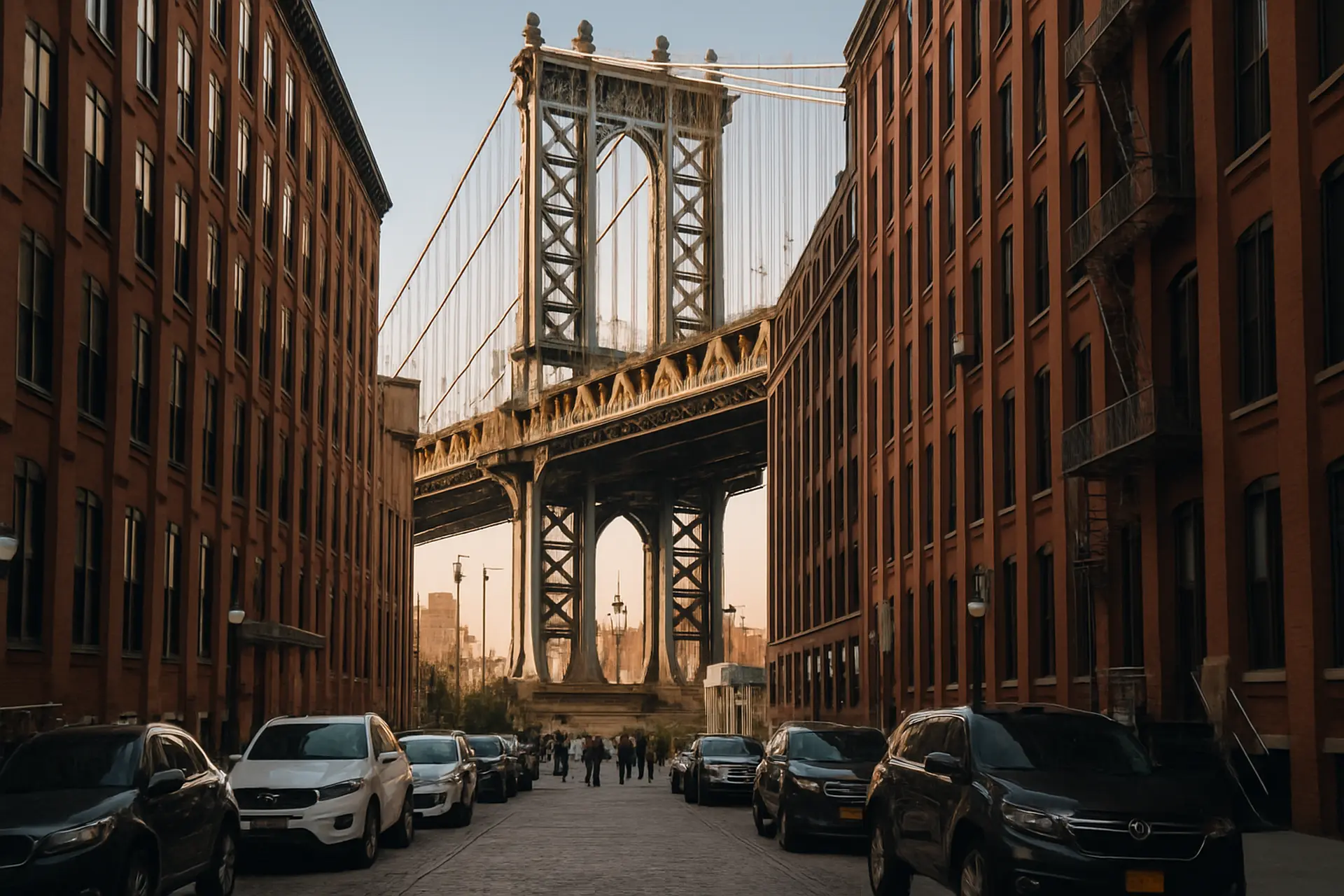
East of Brooklyn Heights (through the Archway beneath the Manhattan Bridge) lies DUMBO (“Down Under the Manhattan Bridge Overpass”). Once an acronym for an industrial zone of flour mills and warehouses, DUMBO has become an artsy, entrepreneurial enclave. Its cobblestone streets and converted lofts now host tech start-ups, art galleries, and boutiques. It also offers arguably the most dramatic view of the Manhattan Bridge framed against the Empire State Building – a photographer’s favorite spot on Washington St (at Front and Water Streets). On summer weekends, the area buzzes with people from the Brooklyn Flea (an antiques/art market on Saturdays) or visitors walking the old streets.
DUMBO (Down Under the Manhattan Bridge Overpass) “is one of Brooklyn’s most visited neighborhoods, attracting visitors with its cobblestone streets, dramatic architecture, great dining and dreamy views across the river.” This magnet draws crowds to the scenic waterfront. Indeed, one of DUMBO’s most whimsical sights is Jane’s Carousel, the 1920s vintage merry-go-round housed in a clear glass pavilion on the waterfront (visible from the photo above). Built in 1922 in Chicago and relocated here in 2011, Jane’s Carousel is exactly 100 years old and still delights families.
Dining in DUMBO capitalizes on its views. The neighborhood boasts a high-end restaurant scene (The River Café, tucked under the bridge, is a longstanding Michelin-starred spot with skyline views). More casual are pizza legends: Juliana’s and Grimaldi’s (coal-oven pizza) thrive here, drawing lines of hungry Brooklynites. For lighter fare, the Time Out Market (recently opened in a refurbished watch factory) houses dozens of food vendors under one roof with a rooftop overlooking Manhattan. Across the river, countless hip restaurants in Cobble Hill and Downtown Brooklyn are a 10-minute drive away, making DUMBO a strategic base for a full Brooklyn experience.
Williamsburg: Hipster-Paradies
Just north of the Brooklyn Bridge (over the Navy Yard) and extending into Long Island City (Queens) is Williamsburg – Brooklyn’s epicenter of “hipster” culture in the 2000s. Once an industrial warehouse district, Williamsburg’s waterfront and Bedford Avenue corridor have blossomed with warehouses converted to condos, boutiques, and nightlife venues.
Williamsburg’s allure is in its blend of young creatives and reclaimed urban spaces. The East River State Park (now called Marsha P. Johnson State Park) provides another postcard view of Manhattan’s skyline and hosts Smorgasburg, a huge weekly outdoor food market with dozens of vendors. Along Bedford Avenue and its side streets, one finds everything from artisanal bakeries (like Bakeri and Blue Bottle Coffee) to indie clothing shops (opening Ceremony, Uniqlo, etc.). Thrift stores and record shops cater to the vintage aesthetic. At night, the streets thrum with music venues: rock clubs, punk bars, and large concert spaces like Brooklyn Bowl (a bowling alley with live music).
For budget dining in New York, the guide suggests, explore ethnic neighborhoods: areas like Williamsburg’s nearby Smorgasburg offer inventive eats at lower prices. In fact, Los Tacos No. 1 (an acclaimed taco stand from NYC’s Chelsea Market) has a location in Williamsburg’s Smorgasburg market, drawing lines in both boroughs. Also along Bedford are tiny, excellent restaurants: Fette Sau (for craft BBQ), Mehana (for Turkish coffeehouse vibe), and Peter Luger Steak House (an old-school high-end steakhouse on Bedford; Brooklyn’s answer to Manhattan’s cut?). The area is particularly known for creative cocktails and local brews (Williamsburg pioneered microbreweries like Brooklyn Brewery and bars like Egg, though some early spots have moved away in recent years).
Street art abounds: murals and wheatpastes can be found on Bedford, North 6th, and even under the BQE ramp on Wythe Avenue. Music and fashion events often pop up in warehouses. The Williamsburg Bridge (opened 1903) carries loads of rush-hour traffic to Manhattan from here – its pedestrian walkway is popular for running across. Politically, Williamsburg has also been a hotbed of activism (with landmark May Day marches since the 1980s) – a reflection of its young, diverse demographic.
Park Slope: Familienfreundliches Brooklyn
Further south in Brooklyn lie Park Slope and nearby neighborhoods, known for brownstones and families. Park Slope (centering around 7th–8th Avenue and Flatbush Ave) is often ranked among New York’s best neighborhoods for families. It has many public and private schools, playgrounds, and the enormous Prospect Park (designed by the same architects as Central Park). Besides the park, Grand Army Plaza (at 7th Ave & Flatbush) and its Soldiers’ and Sailors’ Arch is a local landmark.
Park Slope’s dining and shopping scene caters more to locals: organic cafes, toy shops, and the occasional kid-friendly breweries (Brooklyn Brewery is nearby in Gowanus). It’s relatively quiet in the evenings, and crime is very low (one study in 2024 cited Park Slope as among NYC’s safest and most family-friendly).
Brooklyn Heights, DUMBO, Williamsburg, and Park Slope together showcase how Brooklyn has gone from modest neighborhood to sought-after urban borough over recent decades. It offers a more residential, spacious contrast to Manhattan’s density, while still being fully part of the city’s fabric.
Coney Island: Strandvergnügungen
At Brooklyn’s southern shore lies Coney Island, an old-fashioned seaside amusement area that feels worlds away from the skyscrapers. The famous Boardwalk (built 1923) runs a couple of miles along the Atlantic Ocean. Along it are the Cyclone (a classic wooden roller coaster from 1927, still in operation) and the Wonder Wheel (a Ferris wheel dating to 1920, partly on rails). Luna Park (the modern iteration of the 19th-century amusement park) has roller coasters, fun houses, and midway games. In summer, thousands descend on Coney for the beach, the rides, and Nathan’s Famous hot dogs (the original stand is on Surf Avenue, running the annual July 4 hot-dog eating contest).
Coney Island is part of Brooklyn but so distinctive that it merits special mention. Amusement parks and seaside architecture give it a historic, Americana vibe. The New York Aquarium and the still-standing Parachute Jump tower add to its landmarks. At night, lights from the rides and neon signs flicker, echoing the old postcards of joyrides. Many New Yorkers mark the end of summer by one last Coney swim or ride.
Queens: Der Stadtbezirk der Welt
The borough of Queens is famously the most ethnically diverse urban area on Earth. It is vast: skyscrapers of Long Island City sit just beyond Midtown, but farther east the borough stretches into suburbs. We’ll highlight a few neighborhoods known for their unique qualities:
Long Island City (LIC): Kunst, Aussichten und Stadterneuerung
Long Island City is Queens’ closest point to Manhattan, immediately across the East River from Midtown. For a century it was an industrial waterfront, but starting in the early 2000s it became a boomtown of condos and art spaces. Today dozens of high-rises along the river offer apartments with skyline views. The waterfront (Gantry Plaza State Park) has walkways and piers for sunset-watching (notably, the lit Pepsi-Cola sign is an LIC icon).
LIC is also an arts hub. MoMA PS1, run by the Museum of Modern Art, occupies a former schoolhouse and is one of the world’s largest contemporary art spaces. It stages experimental exhibitions and a popular summer music festival (‘Warm Up’). Throughout the neighborhood, galleries and studios have sprouted; even new art hotels house contemporary artworks. Industrial turn-of-the-century factories have been repurposed into office lofts and theaters (for example, the Culture Lab inside an old piano factory on 42nd Ave).
Emerging in recent years is Long Island City’s coffee and brew scene: local roasters like Fat Cat and Eagle Rare, microbreweries like Fifth Hammer. The food scene includes everything from Bengali to Polish: Vernon Blvd’s restaurants range widely, reflecting the immigrant mix.
Astoria: Griechisches Erbe und Vielfalt
To the north of LIC lies Astoria, a longtime center of Greek-American life. Its 30th Avenue is known for olive shops, ouzo bars, and old-school tavernas (the neighborhood brochure quips it’s “the third city of Greece”). One can still find spanakopita and gyros around Steinway Street and Ditmars Blvd. However, Astoria is highly diverse today: large populations of Egypt, Brazil, and South Asia add to the mix, and no fewer than a dozen languages can be heard on any given block.
Astoria’s cultural attractions include the Museum of the Moving Image (Astoria Blvd, at the old Astoria movie studio lot). This interactive museum (moved to its own building in 2020) examines film, television, and digital culture with hands-on exhibits. Nearby is the Noguchi Museum, in a modern pavilion amid sculpture gardens, reflecting the work of Japanese-American artist Isamu Noguchi (who lived and worked in Long Island City).
Astoria Park, along the East River, provides another scenic Manhattan overlook – here one sees the Hell Gate and Triborough Bridges crossing the river. Astoria has at least half a dozen parks, more than many parts of Manhattan. The Ditmars Blvd subway (N/W line) offers quick commutes to Midtown, making Astoria popular with young professionals looking for lower rents.
Culinary note: Astoria has many ethnic food clusters. For example, the triangle around Steinway & 31st is a hub for Middle Eastern cuisines (Lebanese, Egyptian) with hookah bars and falafel joints. Ditmars Blvd has Burmese and German spots alongside Greek. In short, Astoria exemplifies a Queens staple: neighborhoods where one can eat specialties from many continents just blocks apart.
Jackson Heights: Globaler Knotenpunkt
Jackson Heights (northern Queens, around 74th St and Broadway) is often cited as a quintessentially diverse NYC neighborhood. Numerous immigrant communities co-exist here. For decades it has been known as “Little India,” with an especially large South Asian (Indian, Bangladeshi, Nepali, Pakistani) presence. 74th Street is lined with sari shops, Bollywood DVD stores, and dozens of curry restaurants. In recent years, other waves arrived: Bangladeshi residents expanded around “Bangladesh Bazaar” on 74th, and there’s a growing Tibetan community as well. At the same time, there’s a prominent Latin American (especially Colombian) population in parts of Jackson Heights, as well as many Filipino and Chinese families.
The insider perspective is that every ethnicity brings its own food legacy: Business Insider describes Jackson Heights as having “Little India, Bangladesh Street, and Little Colombia side by side, serving fuchka and arepas”. (Fuchka is a street food of stuffed fried dough balls from Bengal; arepas are corn cakes from Colombia/Venezuela.) On any afternoon you can see Colombian bakeries next to Nepali momos stands. Given this mix, Jackson Heights has become a food-lover’s paradise: NYC’s most affordable and genuine global eats are found in these blocks. For example, Tortilleria Nixtamal is famous for its Salvadoran quesadillas and pupusas, and SriPraPhai on 37th Ave is world-renowned for Thai cuisine (drawn by Queens’ Thai community).
Jackson Heights also has beautiful historic architecture in parts: tree-lined Garden Apartments (once the dream of early 20th-century housing reformers) and old subway token booths. The main shopping stretch, Roosevelt Avenue (72nd–74th Street), is a riot of color, sound, and languages. Subways (E, F, R, etc.) and buses make this an accessible international bazaar for adventurous diners and shoppers.
Flushing: Authentische asiatische Kultur
Even farther east in Queens is Flushing, arguably Queens’ largest Chinatown (beyond Manhattan’s). The center is near Main Street and Roosevelt Ave in northern Queens, opposite Citi Field (home of the New York Mets) and Queens Botanical Garden. Flushing’s Chinese community is one of the fastest-growing in the city. Unlike Manhattan’s Chinatown, which was predominantly Cantonese, Flushing has a broad mix of Chinese immigrant subgroups (Cantonese, Mandarin, Fuzhounese, Shanghainese, etc.) as well as many Korean and South Asian residents. One estimate calls Flushing “a culinary destination” built by its Chinese and Korean communities.
Walking down Main Street Flushing feels like being in a big city in Asia. There are endless dim sum palaces and noodle shops. The 100+ restaurants include Szechuan hot pots, Peking duck houses, Taiwanese bubble tea stands, and halal Chinese-Muslim lamb noodle counters. Koreans have concentrated along Northern Blvd (the part sometimes called Koreatown), with Korean BBQ joints and bakeries.
Cultural attractions in Flushing include: the Flushing Town Hall (a historic music venue housed in an 1862 building), the Queens Botanical Garden (Japanese Hill-and-Pond Garden), and Flushing Meadows–Corona Park right adjacent (the site of the 1939 and 1964 World’s Fairs). Citi Field (home of the Mets) at the park’s south edge also draws tens of thousands.
In summary, Queens neighborhoods reflect the global nature of NYC: each enclave, from LIC’s modern art scene to Jackson Heights’s block-party vibe, shows how immigrants and innovators shaped the city. While Manhattan often grabs headlines, locals know that New York’s soul often sits in these up-borough communities, a subway ride away.
Die Bronx: Ein authentisches NYC-Erlebnis
The Bronx, on Manhattan’s north shore, offers a different slice of the city’s character. It is home to two major “must-sees” as well as some authentic local neighborhoods:
- Arthur Avenue (the Bronx’s Little Italy): In the Belmont section of the Bronx lies Arthur Avenue (Arthur Ave and surrounding blocks). This area is sometimes called “the real Little Italy” of New York. Unlike Manhattan’s small Mulberry Street, Arthur Avenue still has family-owned Italian delis, bakeries, pasta shops, and butcheries. If one strolls along Arthur Ave in the morning, one can buy mozzarella made that day or a pint of freshly blended espresso at the bar. The streets here are lined with green and white awnings; names like Calabria Pork Store or Dominick’s Market have operated for decades. Visitors come for tasks like choosing prosciutto at Reginelli’s or picking Italian pastries at Madonia. Authentic eateries are abundant: Zero Otto Nove (pizzeria and restaurant) and Roberto’s (set menus of veal, seafood, homemade lasagna) are acclaimed. Arthur Ave is classic old-school Italian-American – tie-sporting locals gossiping outside salumerias, mafia movie posters, and every sign in Italian or English. Side note: the Bronx’s large Armenian community also surrounds this area, so one can find Armenian bakeries next door to Italian cafes.
- Yankee Stadium and the South Bronx: The Bronx’s identity is inextricably linked to the New York Yankees. The current Yankee Stadium sits near 161st Street in the South Bronx (opened in 2009). It replaced the original Yankee Stadium (1923–2008), borrowing its facade style. A visit to a Yankees game or even just a walk around the stadium is a popular Bronx experience. Nearby is River Avenue with shops and sports bars. Just south of the stadium is the low-income neighborhood of Longwood and Morrisania – areas with high poverty rates but also strong community ties. The Bronx was historically a working-class borough (factories in Hunts Point, garment shops in Melrose), and these neighborhoods still show that heritage. (Today, renovations and new housing are slowly changing parts of the South Bronx.)
- Bronx Zoo and New York Botanical Garden: In central Bronx, two world-class attractions share acres of parkland. Bronx Zoo, founded 1899, is “one of the largest zoos in the United States by area” (265 acres) and the largest metropolitan zoo in the country. With over 650 species and 4,000 animals, it is a leading conservation institution. Visitors can spend a whole day traversing African savannah exhibits (with giraffes, lions), the Congo Gorilla Forest, and snow leopard habitats. It draws over 2 million visitors annually. Just across the road in Bronx Park sits the New York Botanical Garden (NYBG). NYBG is on 250 acres and “contains a landscape with over one million living plants; the Enid A. Haupt Conservatory… and is a National Historic Landmark”. (The conservatory’s Victorian glass dome is itself iconic.) Seasonal highlights include the holiday train show (model trains through a miniature NYC made of natural materials) and springtime cherry blossoms in the Rose Garden.
Bronx Park environs (Pelham Parkway to Fordham Road) thus offer major attractions. Unlike the Bronx’s southern neighborhoods, here the surroundings are green, wide, and residential. Many local families picnic on lawns or rent bikes. This part of the Bronx is sometimes called Bronx’s “museum mile” (because of the zoo and garden) and is family-friendly.
Beyond the parks, other Bronx neighborhoods each have their own flavor. Riverdale in the far northwest (bordering Yonkers) is suburban with some estates and commuter trains into Manhattan. Fordham Road, the Bronx’s main shopping drag (home to Fordham University and The Hub) is busy with diverse street vendors and passersby. The borough’s demographic is majority Latin American and African-American, which is reflected in its food: Dominican restaurants abound (the Bronx has the largest Dominican population of any NYC borough), as do Puerto Rican ropas viejas spots, African bakeries, and even a rising Bronx Latin disco scene along Sheridan Blvd.
We have already mentioned Arthur Ave above; another lively street is Nostrand Ave in Kingsbridge (Northwest Bronx) with a Latin American supermarket, or City Island Road (in eastern Bronx) which leads to a tiny nautical village (with seafood restaurants and views of the Throgs Neck Bridge). The overall sense of the Bronx is that of a city in a city: it has borough-scale attractions (zoo, ballpark) and micro-neighborhood enclaves that are intensely local.
Staten Island: Der vergessene Stadtbezirk
Often called “the forgotten borough,” Staten Island has a more suburban character. Yet it too has points of interest for visitors:
- St. George and the Ferry: Staten Island connects to Manhattan via the Staten Island Ferry, a free service that runs 24/7 between Whitehall Terminal (Lower Manhattan) and St. George Terminal (Staten Island’s northeast tip). The 25-minute ride offers great views of the Statue of Liberty and the Lower Manhattan skyline. Once on Staten Island, St. George is the small downtown around the ferry. It recently underwent some revival with new condos and restaurants facing the waterfront. Visitors can walk up to the Staten Island Museum or see the Staten Island Yankees minor-league ballpark (not the MLB Yankees). A short hike up Victory Boulevard from the ferry takes you to Fort Wadsworth, a park with historic old batteries and yet another skyline view (from the Verrazzano Bridge).
- Historic Richmond Town: A 17th-century village preserved in the island’s interior. This living history museum comprises dozens of original buildings (farmhouses, a church, a school) relocated here or reconstructed on site, dating from the 1600s through the early 1900s. Costumed reenactors demonstrate crafts like shoemaking, printing, and farming methods. It provides a window into rural colonial and post-colonial life in New York. The site even runs a seasonal farmer’s market and craft festivals.
- Other Highlights: Staten Island’s Silver Lake and Snug Harbor neighborhoods offer Victorian homes and a Chinese scholar’s garden (on Snug Harbor’s grounds, which was once a retirement home for sailors). There is also a small Staten Island Mall in New Springville. However, Staten’s true visitor attraction is its feel: quiet streets, a bit greener, and the ferry ride itself. Tourists often combine Staten Island with a day of seeing the harbor.
Die Wahl der richtigen Unterkunft: Vergleich der Stadtviertel
Given so many options, choosing where to lodge can be daunting. Here are some guidelines:
First-time visitors often gravitate to Midtown Manhattan for convenience (Times Square, Broadway, Fifth Avenue). Staying there means easy access to subway lines (1,2,3, A,C,E, etc.) and being in the tourist buzz. However, Midtown hotels can be expensive and crowded. For a quieter first stay, neighborhoods like Murray Hill (Midtown East) or Battery Park City (Downtown) are often recommended. Battery Park City (near the Statue of Liberty ferry) has peaceful parks and low crime and is literally on the world’s biggest financial campus – great for families. Upper West Side and Upper East Side also have some hotels; these are especially good if museum or park access is a priority and high-rise views appeal.
- Most affordable hotel districts: Generally, Manhattan is priciest. As one guide suggests, staying in outer boroughs can save money. Long Island City (Queens) Und Downtown Brooklyn have seen a hotel-building boom; rates there are often 30–40% lower than Manhattan equivalents. Queens hotels near JFK airport (Jamaica) or near the LIRR at Woodside tend to be budget-friendly for tourists who don’t mind a longer subway ride (though Times Square is still under an hour away). Within Brooklyn, the closer-to-Manhattan hotels (DUMBO, Williamsburg) are moderately cheaper than Midtown; going further (e.g. Park Slope, Brooklyn Heights) is even more affordable, but then daily transit back to Manhattan intensifies travel time.
- Safest neighborhoods: New Yorkers often joke that Manhattan feels safer (because it’s crowded) but crime exists citywide. Up-to-date data indicates many Manhattan neighborhoods (Battery Park City, Tribeca, Chelsea, Murray Hill) have low crime. Brooklyn Heights, Park Slope, Forest Hills (Queens), and parts of Staten Island also rank as very safe. In contrast, some travel sites advise avoiding parts of the Bronx like Hunts Point or Brownsville (Brooklyn) at night – though daytime visitor-oriented Bronx (zoo, Arthur Ave, etc.) is generally fine. Regardless, standard urban caution applies: at night, stick to well-lit main streets, and always keep personal items secure on subways.
- Family-friendly neighborhoods: As mentioned, Park Slope (Brooklyn) and Battery Park City (Manhattan) are frequently cited for families. They have parks, playgrounds, and quiet residential blocks. Other family-friendly choices include Lincoln Center area (UWS, with its large park and kid-friendly museums like Natural History) and the Upper East Side near Central Park zoo. For those with children, proximity to parks and museums can outweigh the appeal of being in Times Square’s hustle.
- Budget tips: To save overall, lodging in Queens or Brooklyn plus a MetroCard (or two-week unlimited ride card) can be cheaper than a Manhattan hotel. Even Manhattan travelers can cut costs by heeding these tips: stay off-peak (winter or weekday stays are cheaper), eat in non-touristy neighborhoods, and use public transport or walk whenever possible. (The Staten Island ferry is free, and many museums have pay-what-you-wish hours.)
Nachbarschafts-Lebensmittelführer
New York is famously multicultural, and each neighborhood has its culinary claims:
- Best Pizza: Pizza is a citywide obsession, so pick your style. For classic New York slices, Lombardi’s (Little Italy, est. 1905) and Joe’s Pizza (Greenwich Village) are venerable spots. For coal-oven pies with a crusty char, DUMBO’s Juliana’s Und Grimaldi’s regularly top the “best pizza” lists. For Detroit-style or other varieties, try slice shops in Queens (e.g. Rockaway Pizza), Brooklyn (Paulie Gee’s for gourmet slices, Denino’s for thin crust), or Manhattan (Prince Street Pizza’s thick Sicilian squares in SoHo). No matter what, every neighborhood has at least one contender claiming “best pizza in NYC” — the abundance of pizzerias makes NYC a pizza pilgrim’s paradise.
- Ethnic Food by Neighborhood: As noted, ethnic enclaves abound. A few highlights: In Chinatown (Manhattan): dim sum at Nom Wah Tea Parlor, soup dumplings at Joe’s Shanghai, Peking duck at Peking Garden. In Flushing, Queens: dim sum at East Ocean Palace, Taiwanese at Hand Pulled Noodles, Muslim Chinese at Xi’an Famous Foods. In Jackson Heights, Queens: Indian street food at Jackson Diner, Nepalese momos at Cafe Himalayan, Colombian arepas at Arepas Cafe. In Astoria, Queens: Greek gyro shops and seafood at Taverna Kyclades. In Arthur Avenue (Bronx): Italian sub shops like Enzo’s, full meals at Mario’s (old-school red-sauce pasta), and fresh mozzarella at Bronx Cheese Company. In Harlem: soul food at Sylvia’s and Amy Ruth’s, Caribbean at Miss Lily’s (135th & Lenox). In West Village: Middle Eastern at Mamoun’s Falafel, French bistro at Buvette, Italian at L’Artusi. Lower East Side has its Jewish deli classics (Katz’s, Russ & Daughters) and new Asian fusion restaurants (Ivan Ramen, etc.) side by side.
- Brunch: New Yorkers brunch nearly every weekend. Trendy areas like Williamsburg, West Village, and the East Village have long lines at brunch spots (pancakes, eggs benedict, and coffee). The Upper West Side has family-friendly diners for brunch (Jacob’s Pickles). Many Midtown hotels offer substantial breakfast buffets. Food markets like Chelsea Market, Essex Market, and Dekalb Market Hall (Downtown Brooklyn) also have great casual brunch counters (smoothie bowls, gourmet bagels, etc.).
- Spätabendessen: Some neighborhoods really shine after dark. The East Village has late-night ramen spots and pizza by the slice. Koreatown (midtown Manhattan around 32nd St) has 24-hour barbecue joints. Chinatown (Manhattan) has many bakeries and bars open until 2–4 AM (fresh egg tarts, congee). Times Square’s tourist zone has all-night diners (e.g. Junior’s), and the UWS has some late-night Pho restaurants on 82nd St. In Brooklyn, after shows in Williamsburg or Bushwick, many bars serve pizza or dumplings until the wee hours.
New York truly has something for every palate and schedule. The trick is to venture a few subway stops beyond your hotel zone. Some of the best and most authentic meals are often one train ride away in culturally rich neighborhoods. As one money-saving guide notes, “restaurants in Chinatown, Flushing, Jackson Heights, and Sunset Park offer authentic meals at a fraction of tourist-area prices”. (For example, a full Chinese banquet for six can cost less in Flushing than a two-topping pie in Midtown.)
Praktische Besucherinformationen
Verbindungen zwischen Stadtvierteln
New York’s transportation network is a guide in itself. Most visitors rely on the MTA Subway. A single ride is $2.90 (as of 2025) and a 7-day unlimited MetroCard ($34) pays off if you take more than 13 trips. The subway runs throughout all five boroughs (including Staten Island via the S Staten Island Railway, though that’s separate fare). Important tip: it operates 24/7, so you can catch trains (A, C, E to Brooklyn/Queens; 2,3 to Bronx; F, R to Queens) at any hour, which is unique among world cities. Bus service fills in areas without subways (for example, the Bx1 runs along Fordham Road in the Bronx, the M14 runs across 14th Street in Manhattan between rivers). Yellow taxis and app services (Uber/Lyft) are convenient but can be slow in heavy traffic. Many locals, however, walk surprisingly far. Manhattan’s walkable grid means neighborhoods like the Village to Soho (south) or Midtown to the Upper West Side (north) can be reasonable on foot if one is up for miles.
Ferry routes also connect neighborhoods: the Staten Island Ferry (free) between Manhattan and Staten Island; the NYC Ferry has routes linking Manhattan with Brooklyn’s Dumbo/Brooklyn Heights, Long Island City, and Astoria, plus a route to Yankee Stadium. The Roosevelt Island Tram (like a small aerial gondola) shuttles between Manhattan and Roosevelt Island (between Midtown and Queens).
Finally, airports: JFK Airport (the big international hub) is in Queens; the AirTrain connects it to the subway and LIRR (costing around $10.75 total from Manhattan) – a popular budget choice. Newark Airport (in New Jersey) is another option, reachable by train or car but outside NYC. LaGuardia is in Queens (with Q70 Select Bus for $2.75).
Stadtrundgänge nach Stadtteilen
Many neighborhoods can be explored on foot. For example, Lower Manhattan can be seen on a walking route from the 9/11 Memorial to Battery Park to Wall Street in a couple of hours. The Village and Soho can easily fill a morning stroll: start around Washington Square and wander west and south along cobblestones and brownstones. The High Line is a nice walking tour; you can start at Gansevoort Street (Meatpacking) and walk north to Chelsea Market or even Hudson Yards (passing art installations and gardens). Brooklyn Bridge Park and the Promenade can be combined with walking the Brooklyn Bridge for an all-day adventure: cross over from Manhattan to Brooklyn, then walk the water’s edge.
For self-guided tours, there are many routes online (one example in Manhattan: the MTA.com has downloadable maps, and organizations like freeToursbyFoot offer guided tips). Seasonal walking tours are also popular: e.g. a Spring Blooms walk through the West Village, a holiday light walk around Dyker Heights (Brooklyn).
Saisonale Überlegungen
Weather varies by season. Summer (June–Aug) is hot and humid in NYC; neighborhoods near water (Battery Park, Dumbo, Coney Island) can be pleasant breezes. This is peak tourist season, so plan museum visits early (timeslot reservations at major museums help). Autumn brings mild weather and is one of the nicest times for walking (especially in parks – Central and Prospect are brilliant with fall foliage by late Oct). Winter can be cold (occasional snow) and some tours slow down. However, winter holidays light up the city: Rockefeller Center Christmas tree, Dyker Heights lights, Harlem Nutcracker performances, etc. If visiting then, warm clothing and waterproof shoes are recommended.
Spring is lovely (flows of cherry blossoms at Brooklyn Botanic Garden and elsewhere). Shoulder seasons (spring and fall) often have lower hotel rates than summer. Notably, January–February often have bargain rates (though extra coat needed)!.
Spartipps
- Stay in outer boroughs if Manhattan prices are too steep. As noted, hotels in Long Island City or Downtown Brooklyn can be 30–40% cheaper than Manhattan. They still have easy subway rides in. Some visitors use Airbnb or hostels in Brooklyn/Queens to save even more.
- Eat like a local: ethnic neighborhoods as mentioned (Chinatown, Flushing, Jackson Heights, Sunset Park) are gold mines for cheap, authentic food. Street food and food halls (like Queens Night Market in summer, or Smorgasburg in Williamsburg) offer cheap global bites. Shop grocery stores (Trader Joe’s, Fairway, Key Food) to make sandwiches and skip overpriced hotel breakfasts.
- Free and cheap attractions: Many museums have days with suggested or free admission (e.g. Museum of Modern Art Friday nights, MET pay-what-you-wish certain hours, etc.). Central Park, Brooklyn Bridge Park, High Line, and Bryant Park are all free to wander in. Staten Island Ferry rides are free. Walking across iconic bridges and through Grand Central (free!) gives a sense of the city. The New York Public Library on 42nd has a beautiful reading room to see. If you have kids, check for museum free days; for example, the American Museum of Natural History is pay-what-you-wish on certain evenings.
- Transport: Always buy a 7-day MetroCard if you plan to take more than a dozen subway rides. It pays for itself and avoids having to swipe at each turnstile. Walking when possible saves money and often time (two nearby neighborhoods might be a 2-block walk rather than a 10-minute train ride). The Water Taxi and East River ferries (via NYC Ferry) cost about $4 but can be scenic alternatives for some trips. The Roosevelt Island Tram is $2.75 (same as subway) but gives a brief aerial ride worth the novelty.
By blending these cost-saving practices, even a budget traveler can experience much of what the city offers. At the same time, splurges can be reserved for key experiences (like a Broadway show or upscale dining in a special neighborhood).