
Tirana’s Independence Monument stands in Rinia Park beside Rruga Myslym Shyri and the capital’s central boulevard, commemorating the centenary of Albania’s declaration of independence on 28 November 1912. Unveiled on 28 November 2012, the work is a large contemporary steel structure rather than a conventional heroic statue. It suits travelers interested in modern public art and Albanian national history, especially because it can be seen while walking between Rinia Park, Skanderbeg Square, Blloku and the boulevard. The main limitation is interpretation: recent visitors repeatedly note that the symbolism is difficult to understand without reading about the design first, and on-site explanation is limited.
The monument was created for one of Albania’s most important modern anniversaries. On 28 November 1912, delegates in Vlorë declared Albania independent from the Ottoman Empire. A century later, Tirana marked the anniversary with this new memorial in Rinia Park. The placement was deliberate: the monument sits in a highly visible public park rather than behind a fence or inside a formal memorial complex.
Kosovar architect and artist Visar Obrija and German architect Kai Roman Kikla are credited with the design in Tirana Municipality’s current tourism page. Visit Tirana says the structure was fabricated in Austria. Published dimensions differ slightly between official and tourism sources: Visit Tirana describes it as about 6.5 metres high, 5.5 metres wide and weighing around 15 tonnes, while the municipality describes an approximately eight-metre-high steel structure. The safest way to understand it is simply as a monumental, building-scale piece of public art.
Its form resembles a house or tower cut along its axes and pulled apart into two large sections. Obrija’s explanation, preserved by Visit Tirana, presents the two halves as a metaphor for repression and opening. Joined together they would make a more enclosed rectangular tower; separated, they create an open form associated with freedom and independence. The symbolism is conceptual rather than immediately figurative.
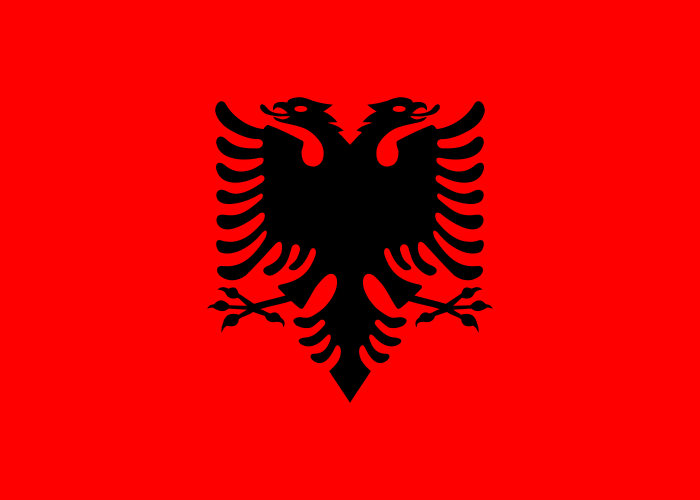
National signs are built into the structure. Tirana Municipality notes the double-headed Albanian eagle and the text of the Declaration of Independence engraved inside. These elements reward closer inspection, because from a distance the monument can look like two dark geometric walls. Walking between or around the two halves makes the imagery easier to notice.
The memorial is also intended as a tribute to people who fought for Albanian independence. That broader national message explains why the design does not focus solely on Ismail Qemali, the statesman most directly associated with the 1912 declaration. A separate Ismail Qemali statue stands along the same broader central boulevard, allowing travelers to compare two very different approaches to commemorating the same historical turning point.
Rinia Park gives the monument an informal setting. Children, office workers and tourists move around it as part of ordinary city life, and the monument shares space with lawns, paths, cafés and fountains. This is very different from a ceremonial plaza where visitors are directed toward a single viewpoint. The memorial is something most people encounter while crossing the center.
Recent visitor reactions show that the abstraction can divide opinion. A May 2026 Tripadvisor visitor said the monument needs better explanation because the symbolism is not obvious on first sight. Other recent reviewers find the heavy geometric form visually severe. These are subjective reactions, but they make a useful practical point: reading the design concept before or during the visit changes the experience substantially.
There is no admission fee and no opening schedule. Rinia Park is public outdoor space, so the monument can be approached at any time. Daylight is best for examining the eagle, inscriptions and structural form, while evening lighting can give the dark metal surfaces a different appearance. Visitors should not expect staffed interpretation or guided entry.
The location is extremely easy to integrate into sightseeing. Skanderbeg Square is a short walk away, Blloku lies to the south, and Postbllok and the Ismail Qemali statue can be incorporated into a broader twentieth-century or independence-themed walk. Ten to twenty minutes is enough for the monument itself, though Rinia Park invites a longer pause.
Accessibility depends mainly on park paths and the immediate paved area. The monument is outdoors and has no ticket barrier, but no formal accessibility audit of the installation was found in current sources. Visitors with mobility needs can still approach it at street level from the park.
The Independence Monument is most useful as a compact lesson in how contemporary Albania represents national memory. It does not narrate 1912 in detail and cannot replace a history museum. Instead, it turns the centenary into an abstract urban form built around enclosure, separation and opening. Read the symbolism first, walk around both halves and use its central location to connect the memorial with Tirana’s other national and political landmarks.
The monument benefits from being viewed from several angles: the split form, double-headed eagle and interior inscription are not equally visible from one approach. That partly explains why people who only pass it quickly can miss the design’s intended message.


Community Ratings & Reviews
No traveller ratings yet
Traveller reviews
0 published reviews
No reviews yet. You can be the first to share a helpful experience.