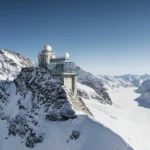
All this high-society drama is set in an exceptionally beautiful natural stage. The Engadin Valley itself is a singular environment. St. Moritz lies in the Upper Engadin of canton Graubünden, surrounded by 3,000–4,000 m peaks of the Albula and Bernina ranges. Towering glaciers (e.g. Morteratsch) and ski mountains (Diavolezza, Piz Nair, Corvatsch) loom over the village. Five large lakes – including St. Moritz, Silvaplana and Sils – dot the valley floor, freezing solid each winter into the world’s most scenic playground. When the famed Maloja wind blows through the pass, it sweeps the ice of Lake Silvaplana with sailwinds even in midwinter; on calmer days the whole frozen surface of Lake St. Moritz hosts polo and racing.
The climate is as crisp as the scenery is wide. Summers are short and cool, but thanks to its favorable location St. Moritz enjoys over 300 days of sunshine a year. Winters are bright and cold – daytime highs around 0–5 °C with abundant snow, nights well below freezing. The resort’s altitude (village center ~1,820 m) means thin air that skiers prize for dry snow conditions, but it also helps give St. Moritz that mythic light. The sun shining on fresh snow can dazzle; photographers and painters have long captured the silver-blue glaciers and the ruby-red alpenglow behind pine forests. In fact, the local painters’ school (Segantini especially) built its reputation on the valley’s ethereal light. Even ordinary activities – drinking a local herbal tea, hiking in autumn larch forests, or soaking up rays on a terrace – feel infused with Alpine intensity.
In winter the natural geography adds a final flourish: miles of cross-country ski trails weave through snowy meadows and frozen lakes, and the Engadin Skimarathon (a 42 km mass ski race each March) attracts thousands to streak like a comet across the four lakes. Off-piste mountaineering, ice climbing, and sledging in snow-whitened gullies provide thrills. Then there are quieter pleasures: walking amid the pastel Engadin villages of Bever or Zuoz with their sgraffito houses, or glazing in a carriage through the Bever Gorge. Everywhere the mountains are close, and on clear nights the Milky Way blazes overhead in the high-altitude air. It is this mise-en-scène of sharp light, dry air, snow and scenery that gives every activity – be it skiing, shopping, or spa-going – an added dimension of luxury.
St. Moritz’s very soul is bound up in this harmony of nature and nurture. High society may supply the style, but it is the valley’s panoramic beauty and crisp winter climate that supply the substance. In the words of a Swiss guide, the Engadin’s “many sunny days” and “clear air” make it perfectly suited to winter sports. Here, world-class skiing, high-end cuisine, and cultural glamour all unfold against a sublimely clear and snowy backdrop. The resort’s international prominence – its snow polo, White Turf races, and Olympic history – may draw elite crowds, but even for a novice traveler the effect is spellbinding: you feel cocooned in an Alpine dream that somehow also epitomizes taste and tradition.
In sum, St. Moritz – Winter With Taste is no mere slogan. It is a literal fact: the town serves up winter sports, hospitality and culture on a platter so exquisite that it has long been the envy of the world. From Badrutt’s original vision to today’s gourmet feasts, from Cresta runs to art galleries, every element is curated for connoisseurs of snow and style. Surrounded by the noble Engadin peaks and lakes, St. Moritz remains, as it was in 1864, a place where tradition is honored and every detail – from the way a ski trail is groomed to the soufflé on your plate – is crafted “with taste.”