
Jorden byder på en forbløffende variation af landskaber, der kan føles mere fremmede end velkendte. Langt fra en gimmickagtig overdrivelse efterligner mange af disse steder virkelig andre planeter eller måner på slående måder. Denne guide er til nysgerrige rejsende og sci-fi-entusiaster, der ønsker at se Jordens mest overjordiske scener tæt på – fra Mars-lignende saltflader til Venus' syrebassiner til isørkener direkte fra Voyage to Enceladus. Den kombinerer levende rejsefortællinger med hård videnskab, praktisk rejseplanlægning og fotograferingsråd. Artiklen er organiseret efter tema og placering og starter bredt (hvorfor disse steder føles fremmede) og dykker derefter dybt ned i hvert eneste must-see-landskab (30 steder i alt), logistik (tilladelser, årstider, guider), sikkerhed, etik, plus fototips og endda noter om fankultur. Kort sagt er det en one-stop-håndbog: dels rejseplanlægning, dels astrobiologi-grundbog og dels eventyrerindringer. Uanset om du er en almindelig sci-fi-fan eller en dedikeret "planetarisk analog"-forsker, er alle svar (og citater), du har brug for, her.
- Hvordan og hvorfor landskaber ser "fremmede" ud: Videnskaben gjort enkel
- Geologiske processer
- Biologiske farvestoffer: Termofiler og halofiler
- Atmosfæriske og optiske effekter
- Kanoniske Mars-, Venus- og ismåneanaloger på Jorden
- Mars-lignende: Atacama, Dry Valleys, Salar de Uyuni
- Venuslignende / svovlsyreanaloger: Danakil & Dallol
- Iskalde Måneanaloger: Antarktis' tørre dale og kryogene steder
- Den ultimative liste med 30 steder: Fremmede landskaber, du skal kende
- Danakil-depressionen og Dallol (Etiopien) – Jordens varmeste sure lavland
- Salar de Uyuni (Bolivia) – Det ultimative saltspejl; Stjernernes ørken
- Atacama-ørkenen (Chile) – Mars på Jorden
- Fly Geyser (Nevada, USA) – Neon Alien Hot Springs
- Grand Prismatic Spring (Yellowstone, USA) – Rainbow Hot Spring
- Regnbuebjerget, Peru – Spektakulære lerlag
- Lake Hillier (Middle Island, Australien) – Pink Plankton Lagoon
- Dead Vlei (Namibia) – Spøgelsesagtig akacie i hvid lerpande
- Socotra Island (Yemen) – Fremmed flora og øernes tørhed
- Wadi Rum (Jordan) – “Månedalen” og sæt med den røde planet
- Pamukkale (Tyrkiet) – "Bomuldsslottet" ved de terrasserede kilder
- Tsingy de Bemaraha (Madagaskar) – Skov af stennåle
- Zhangye Danxia (Kina) – De malede bjerge
- Siloli-ørkenen (Bolivia) – Stenskov og klitterne på Altiplano
- Den Hvide Ørken (Egypten) – Kridtsvampeklipper
- Badlands (USA) – Malet ørken og forstenet skov
- Kappadokien (Tyrkiet) – Fe-skorstene og underjordiske byer
- Mono Lake (USA) – Alkaliske tufstårne
- Sossusvlei-klitterne (Namibia) – tårnhøje røde sandhave
- Moeraki-kampesten (New Zealand) – Glatte, fremmede æg på stranden
- Sådan planlægger du: Tilladelser, sæsoner, guider og ture
- Tilladelser til Danakil/Dallol (Etiopien)
- Valg af velrenommerede lokale guider
- Forsikring, Medevac og evakueringsplanlægning
- Kombinering af steder i regionale kredsløb
- Sikkerheds-, sundheds- og juridisk tjekliste for ekstreme steder
- Højdesyge og akklimatisering
- Giftige gasser og varme
- Vandsikkerhed (Pink Lakes, varme kilder)
- Regler, tilladelser og etik for droner
- Ansvarlig og etisk besøg
- Risiko for overturisme og hvordan man undgår det
- Socotra: Skrøbelig biodiversitet og besøgendes ansvar
- Oprindelige lande, hellige steder og tilladelser
- Etik om at efterlade ingen spor
- Fotografi og filmproduktion for sci-fi-fans
- Etik om at efterlade ingen spor
- Kameraindstillinger og kompositions-"Opskrifter"
- Tips til svagt lys / astrofotografering og Mælkevejen
- Undersøgelse af filmlokationer og tilladelser
- Videnskab & Fandom Crossover: Forskning i overjordiske terræner
- Mars analog forskning og instrumenttestning
- Ekstremofiler og astrobiologi forklaret
- Borgervidenskab og hvordan rejsende kan bidrage
- Rejseplaner for sci-fi-fans (flerlængde)
- 7-dages “Mars på en uge” – Sydamerika
- 10-dages “Ild & Syre” – Etiopien Intensiv
- 5-dages amerikansk "Alien"-roadtrip (familievenlig)
- 30-dages verdensturné (Grand Alien Circuit)
- Budgettering og booking: Omkostningsintervaller og tips til at spare penge
- Typiske omkostningsintervaller (pr. region)
- Forsikring og særlige overvejelser
- Tips til at spare penge
- Ofte stillede spørgsmål
Hvordan og hvorfor landskaber ser "fremmede" ud: Videnskaben gjort enkel
Jordens mærkelige terræner er formet af velkendte processer – men i ekstreme situationer. Erosion, vulkanisme, fordampning og biologiske pigmenter kombineres på sjældne måder for at skabe scener, der minder mere om filmkulisser end vandrestier. Dette afsnit (i et letforståeligt sprog) forklarer de vigtigste geologiske, biologiske og optiske faktorer, der får et sted til at se "ikke af denne Jord" ud. Ved at forstå videnskaben kan vi forstå, hvorfor for eksempel Bolivias spejlblanke saltslette eller Tyrkiets forstenede vandfald er lige så ekstraordinære som enhver forestillet planet.
Geologiske processer
Fundamentet for fremmedartede landskaber er ofte tektonik og erosion. For eksempel blev Danakil-depressionen i Etiopien (under havets overflade) dannet ved opsplitning af tre tektoniske plader, hvilket producerede dybe riftbassiner, aktiv vulkanisme, saltsøer og sure kilder. Over millioner af år skabte disse processer saltskorpede sletter og svovlfelter så ekstreme, at de virker udenjordiske. Tilsvarende er smalle dale i Antarktis, som McMurdo Dry Valleys, så kolde og tørre, at forskere beskriver dem som "high-fidelity analoger" til Mars' overflade. Selv bassiner, der engang var under vand, spiller en rolle: mange saltflader (såkaldte playas eller salarer) blev dannet, hvor gamle søer fordampede. Som Britannica bemærker, når ørkenbassiner oversvømmes og derefter fordamper, "koncentreres finkornet sediment og salte" til flade, skorpede pander. Det var, hvad der skete ved Salar de Uyuni i Bolivia: en forhistorisk sø skrumpede og aflejrede en ren saltskorpe over 10.000 km². I dag er det verdens største spejllignende saltflade.
Vulkanisk og hydrotermisk aktivitet skaber også fremmed jord. Steder som Zhangye Danxia i Kina skylder deres regnbuestriber til lag af sandsten og mineraler, der blev løftet op og eroderet. Tyrkiets Pamukkale-vandfald og -bassiner er udskåret af travertin - calciumcarbonataflejringer fra varmt kildevand - hvilket giver et "bomuldsslot" af strålende hvide terrasser. På verdensplan producerer salt-mineralkemi bizarre faste stoffer: Madagaskars Tsingy de Bemaraha er en skov af knivskarpe kalkstenspigge dannet af grundvand, der opløser og eroderer gamle rev. Kort sagt, selvom Jordens grundfjeld er velkendt, skulpturerer den ekstreme koncentration af disse kræfter (varme, mineraler, vulkanisme, ørkenbassiner) landskaber, der ligner fremmed kunst.
Biologiske farvestoffer: Termofiler og halofiler
Livet i sig selv bidrager til paletten. I mange varme kilder og saltsøer farver ekstremofile mikrober vandet i levende regnbuer. For eksempel viser Yellowstones Grand Prismatic Spring koncentriske ringe af orange, gul og grøn – ikke på grund af maling, men på grund af varmeelskende bakterier. Smithsonian rapporterer, at cyanobakterier danner måtter omkring kildens kanter, hvor hver art lever ved en forskellig temperatur og producerer en forskellig farvetone. Tilsvarende var Australiens Lake Hillier berømt for en tyggegummi-lyserød nuance forårsaget af organismer med et højt saltindtag (som algen Dunaliella salina og bakterien Salinibacter ruber), der udskiller carotenoidpigmenter. I 2022 forvandlede ekstrem regn endda Lake Hillier til blågrå ved at fortynde disse mikrober, hvilket fremhæver, hvor sarte sådanne økosystemer er.
Andre eksempler: Nevadas Fly Geyser er delvist menneskeskabt, men stadig biologisk – dens varme vand nærer farverige termofile organismer. Wikipedia bemærker, at gejserens afstrømning er vært for alger, der farver mineralhøjene i klare grønne og røde farver. Og de bizart farvede bassiner i Etiopiens Dallol (svovlkilder) får faktisk deres regnbue af hvid, grøn, gul, orange, rød og lilla fra kemisk oxidation af jern og salte – ikke liv. NASA-støttet forskning viser, at Dallols multi-ekstreme bassiner for det meste er sterile, med farver, der stammer fra mineraludfældninger.
Kort sagt trives mikrobielle måtter i varme eller salt ved at producere pigmenter (ofte carotenoider), og disse farver maler landskaber levende. Uden ekstremofiler ville steder som Yellowstones prismatiske pools eller saltdamme i Afrika se ret triste ud. Men hos disse psykrofiler og halofile møder fremmed økologi fremmed natur.
Atmosfæriske og optiske effekter
Selv himlen og lyset spiller et puds. Ørkener i høj højde (som Chiles Atacama eller Perus Titicacasø-bassin) har meget tynd, tør luft, hvilket gør sollyset usædvanligt skarpt og himlen intenst blå. Dette forstærker farvekontraster og gør fjerne landskaber usædvanligt klare. Nogle overflader bliver superreflekterende: for eksempel bliver Salar de Uyuni, når den er dækket af en tynd film af regnvand, "verdens største spejl", der reflekterer himmel og bjerge over hele sin bredde på 129 km. Denne spejleffekt kan se direkte kosmisk ud, som om jorden og himlen har byttet om. I visse saltflader kan optiske fatamorganaer eller glitrende dis (fra støv eller varme) også give en overjordisk kvalitet. På en anden note kan albedoforskelle på Islands sorte vulkanske sand vs. hvide saltflader eller farverige algeopblomstringer skabe fremmede mosaikmønstre set ovenfra. Selvom de er mindre omtalte, fuldender disse atmosfæriske/optiske faktorer - intens sol, støvdjævle, tusmørkeglød - ofte "science fiction"-illusionen i et landskab.
Kanoniske Mars-, Venus- og ismåneanaloger på Jorden
Forskere og rejsende grupperer ofte steder efter den planet eller måne, de ligner. Dette afsnit sorterer vores must-see destinationer i kategorier som "Mars-analoger" eller "Venus-analoger" med videnskabeligt underbyggede noter.
Mars-lignende: Atacama, Dry Valleys, Salar de Uyuni

High deserts and dry valleys most resemble Mars. Chile’s Atacama Desert (hyper-arid, nearly no rain) is so Mars-like that NASA sent rover tests there. Its salt flats, salt domes, and geysers mimic Martian terrain. Close by, Bolivia’s Salar de Uyuni has a crust of bright salt over red-brown earth – indeed parts of it were used as planet Crait in Star Wars (2017). The Salar’s glassy surface after rain even looks like Mars’s dusty sky reflecting off a flat plain. Meanwhile, Antarctica’s McMurdo Dry Valleys are literally frozen deserts (snow-free by katabatic winds). They are the coldest, driest valleys on Earth – so analog to Mars that since the 1970s NASA has run field tests there. For example, University Valley in Antarctica yielded no detectable life in the permafrost, making it an eerily Mars-like wilderness.
In short, places like the Atacama, the high Andes, and Antarctic dry basins are prime Martian analog sites. Scientists study them to train rovers and instruments; visitors enjoy the superb stargazing (due to dry air) and dramatic expanses of red rock and salt. (For more on research tours and citizen science in such sites, see later sections.)
Venuslignende / svovlsyreanaloger: Danakil & Dallol

Hvis Mars er tør og rød, er denne næste gruppe blændende varm og sur – hvilket minder om Venus' inferno eller Ios svovlfelter. Etiopiens Danakil-depression og dens nabo Dallol er øverst på listen. Danakil er et af de laveste og varmeste steder på Jorden; dagtemperaturerne falder sjældent til under 30°C, og overfladetemperaturerne overstiger ofte 50°C. Dens saltvulkaner og lavasøer (f.eks. Erta Ale-vulkanens vedvarende lavasø) giver en rumalderstemning. Om vinteren er det stadig brutalt varmt, men i det mindste mere tåleligt.
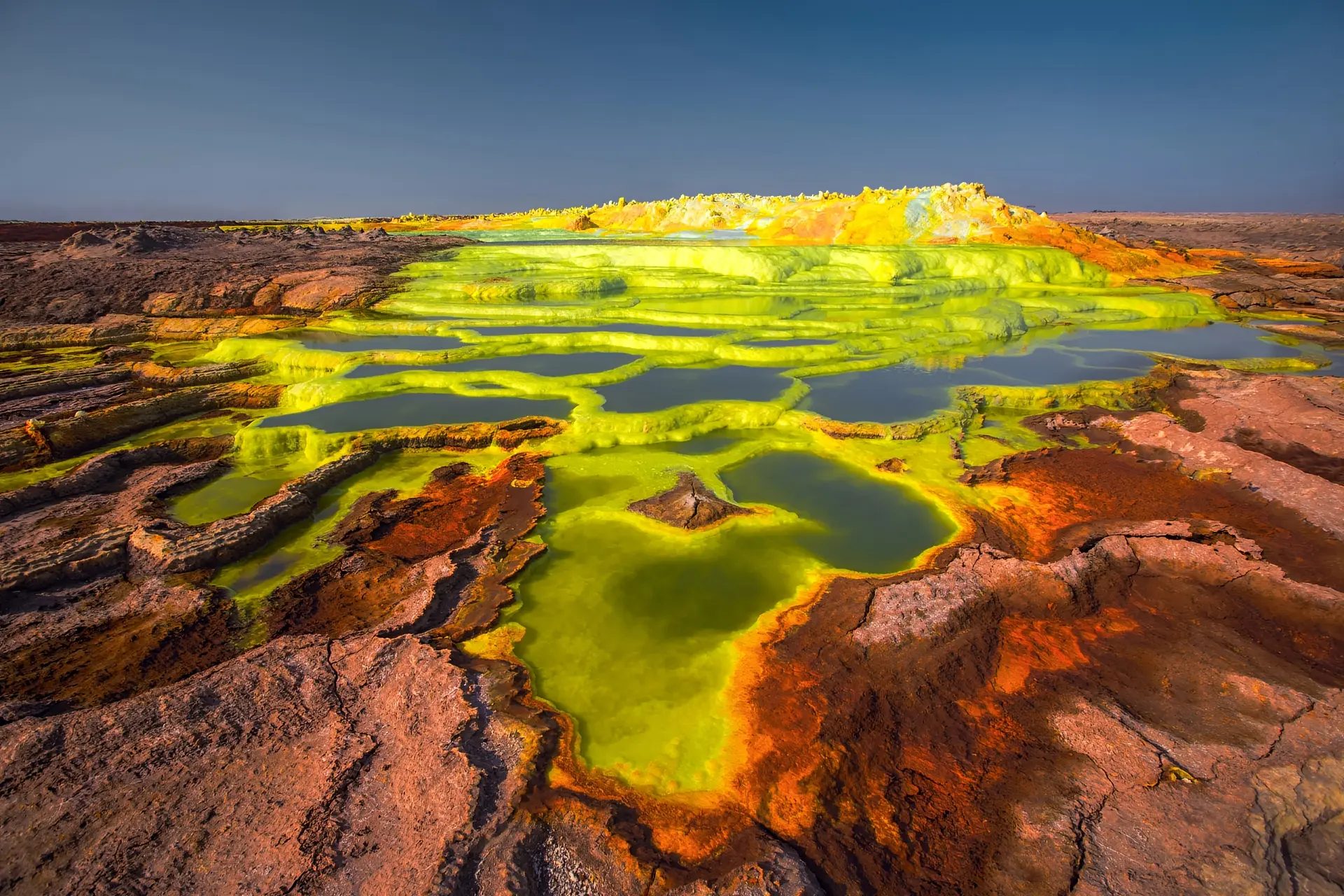
Dallol (beliggende i Danakil) fortjener særlig opmærksomhed: det er et geotermisk felt med de lavest beliggende vulkanske åbninger på Jorden (410 fod under havets overflade). Dets bassiner er hyperacidiske (pH < 0) og når op til 108 °C, boblende med gule, grønne og lyserøde saltlage rige på svovl og jern. Wikipedia bemærker, at Dallols hyperacidiske kilder er “poly-ekstreme” – selv acidofile organismer har svært ved at overleve der. Resultatet er et landskab af neongule svovldamme, okkerfarvede saltsøjler og vinrøde mikrobielle måtter (mikrober kan kun leve ved dammenes kanter). Som feltrapporter beskriver, føles Dallol “som om vi har besøgt Mars og Venus”, med rustgrønne syresøer ved siden af neonterrasser.
Disse steder ser fremmede ud, ikke kun i farve, men også i kemi. De lækker svovldioxid og klorgasser, og deres vand er så saltholdigt og surt, at kontakt er smertefuldt. Besøg kræver sikkerhedsudstyr (masker, beskyttelsesbriller), og turister kan kun tage afsted med bevæbnede guider af sikkerhedsmæssige årsager. Men for sci-fi-fans er gevinsten enorm: Danakil og Dallol er det tætteste, man kan komme på at gå på en venusisk slette eller Saturns måne Io. (Vi dækker tilladelser og ture i planlægningsafsnittet.)
Iskalde Måneanaloger: Antarktis' tørre dale og kryogene steder

For analoger til Europa, Enceladus og andre isverdener, vender vi os mod polarområderne. McMurdo Dry Valleys fungerede allerede som en analog til Mars – men de antyder også forhold på ismåner. Dalene er Antarktis største isfri region og forbliver under frysepunktet året rundt på trods af næsten ingen nedbør. Underjordiske mikrobielle samfund dér lever liv under klipper eller i permafrost, lidt ligesom det, der kunne eksistere under Europas eller Enceladus' overflader.
Det er værd at bemærke, at forskere bruger endnu koldere antarktiske søer som erstatninger for iskolde have. For eksempel nævnes Untersee-søen (Østantarktis) undertiden som model for Enceladus på grund af dens tykke isdække og indfangede gasser. Borehold har testet Mars-lignende rovere i Dry Valleys, og de første IceCore-boremaskiner har udført boreøvelser til at opdage liv, alt sammen i forventning om missioner til ydre planeter. I fremtiden kan ture til isverdenen fokusere på ekstreme gletsjermiljøer på Svalbard, Grønland eller Antarktis. (Sådanne ekspeditioner er meget specialiserede og dyre, men de findes – se "Rejseplaner" og "Rejsetips").
Den ultimative liste med 30 steder: Fremmede landskaber, du skal kende
Nedenfor er en udtømmende og hurtig guide til 30 af de steder på Jorden, der minder mest om udenjordiske ting. Hvert opslag har en kort krog plus underafsnit om, hvorfor det er fremmed, hvordan man besøger det, sikkerhedsproblemer, tilladelser og foto-/filmnoter. (Links i disse kort hopper til dybere information, men vi inkluderer nøglepunkter her.) Listen dækker klassiske stjernevidenskabelige analoger, naturlige vidundere, filmsteder og et par overraskende kuriositeter – fra Etiopiens sure søer til ørkenfortovene i Californiens "Badlands". Bemærk, hvor det er muligt, at velrenommerede kilder (parktjenester, videnskabelige artikler, rejsende rapporter) understøtter fakta nedenfor.
Danakil-depressionen og Dallol (Etiopien) – Jordens varmeste sure lavland

- Hvorfor det føles fremmed: Danakil-depressionen, der ligger i Afar-riften, ligger omkring 125 m under havets overflade. Det er det varmeste sted på Jorden i gennemsnit med konstant vulkansk aktivitet og hydrotermiske felter. Ved Dallol bobler kilder af hypersurt, saltmættet vand (over 108 °C) op af jorden. Disse skaber levende neonfelter: svovlbassiner (gule, grønne), jernrige skorper (rustrøde), saltkløfter og "feskorstene". Mineraler som halit, jarosit, hæmatit og gips udfældes i bizarre former. Geologisk set er det en saltvulkan: underjordisk magma koger op gennem evaporitter til overfladen, opløser mineraler og aflejrer dem in situ. Resultatet ligner et science fiction-set – og astronauter har faktisk trænet her.
- Praktiske forhold (hvornår og hvordan): Kun korte ture fra Mekele (Etiopien) er tilladt med bevæbnet politieskorte. Besøg er generelt begrænset til december-februar (vinter) for at undgå varme på over 50°C. Adgang kræver militærtilladelser og lokale guider; flere etiopiske rejsebureauer specialiserer sig i Danakil-ture (herunder besøg på Erta Ale-vulkanen). Vejene er ujævne 4x4-stier; solorejser er ikke tilladt i dette område. Faciliteterne er grundlæggende (camping på campingpladser eller hoteller i Mekele, Berhale); medbring vand, mad og brændstof til madlavning.
- Sikkerhed og sundhed: Hedeslag, dehydrering og hedeslag er de største farer. Svovlkilderne udsender giftige gasser (H₂S, SO₂), så masker og beskyttelsesbriller anbefales i Dallol. Kilderne er meget sur og farlig at røre ved – Undgå at vade eller plaske. Myg er almindelige omkring saltminelejre om natten. Medicinsk set er højden lav her (under havets overflade), men ekstreme temperaturer dominerer.
- Tilladelser/Guider: Internationale besøgende skal have en tilladelse fra den offentlige myndighed og mindst én (ofte to) militær- eller politivagter. Guider skal være fra afar-stammesamfund. Tip: Book i god tid hos velrenommerede operatører (f.eks. Adventure Specialists, Ethiopian Tours), som inkluderer måltider og soveudstyr. Samlede 3-dages ture koster cirka 300 USD pr. person (højsæson). Spørg altid om forsikring eller evakueringsplaner; Etiopiens Rødehavsdal er afsidesliggende.
- Fotografi og filmnoter: Depressionens fremmede udsigter har tiltrukket filmhold (Giovanni LaPaz' stillbillede fra 2007 var NASAs #EarthToAsteroid til asteroiden Ryugu). For fotos: Midt på formiddagen og sidst på eftermiddagen giver det bedste lys på Dallols farver (hvidt middagslys kan udvaske dem). Brug filtre eller bracket-eksponeringer til den ekstreme kontrast mellem klart salt og mørk lava. På Erta Ale kræver natbilleder af lavasøen lange eksponeringer og gasmasker til dampene. Droneflyvninger er generelt ikke tilladt uden særlig godkendelse fra regeringen (de kan forstyrre minedriftslejre og dyreliv).
Salar de Uyuni (Bolivia) – Det ultimative saltspejl; Stjernernes ørken

- Hvorfor det føles fremmed: Uyuni, der dækker over 10.500 km² i Andesbjergene, er Jordens største saltflade. I den tørre sæson er det en enorm hvid ørken af sekskantede saltsletter. Efter regn (dec-marts) forvandler et tyndt lag vand det til et gigantisk spejl. Lokalbefolkningen siger, at det føles som at gå på skyer. I 3.656 m højde skaber den ultravioletblegede sol og endeløse refleksioner en overjordisk hvidhed om dagen og utrolige stjernemarker om natten. I nærheden tilføjer den røde kratersø Coipasa og Eduardo Avaroa Nationalreservat flamingobassiner og gejsere til det mærkelige landskab.
- Praktiske forhold (hvornår og hvordan): Byen Uyuni (Potosí-departementet) er base for ture. Jeeps med høj frihøjde krydser salar (kun 4WD; private chauffører eller flerdagsture). Bedste besøgstid afhænger af interesse: jun–aug (tørt) for klar blå himmel og den kaktusdækkede Incahuasi-ø; dec–mar (vådt) for spejleffekten. Salar er offentlig, ingen tilladelser kræves, og adgang til hovedområderne er gratis. Klæd dig i lag: om natten kan det falde under frysepunktet; dagene er solrige/meget lyse (risiko for solskoldning!). Vandet på saltet er lavt (<20 cm), så tjek lokale forhold. Rejsende kombinerer ofte Uyuni med nærliggende ørkener (Atacama, Puritama) på flerdagsture.
- Sikkerhed og sundhed: Høj højde (3600 m) betyder risiko for højdesyge – klatre gradvist, drik væske, overvej acetazolamid. UV-eksponering er intens (ingen skygge). Køretøjsnedbrud er almindelige; sørg for reservedæk, brændstof og mad. Saltskorpen kan skjule jordfaldshuller eller saltholdigt mudder – hold dig på sporene. I regnvejr kan kørsel på sala være farlig, og køretøjer sidder nogle gange fast. Intet drikkevand på de flade strækninger; den nærmeste landsby ligger 60 km væk. Om natten kan temperaturen falde, så isoleret sovetøj er nødvendigt.
- Tilladelser/Guider: Der kræves ingen formel tilladelse til selve Salar. Uyuni ligger dog ved en grænseovergang (ved siden af Chile/Argentina); tjek visumregler for enhver grænseoverskridende rejseplan. Licenserede guider/chauffører anbefales af sikkerhedsmæssige årsager; mange ture er tilgængelige fra Uyuni eller La Paz. For Salar-billeder (især billeder taget med et "myreskalerende" perspektiv), skal du respektere kulturarvssteder som den Hvide Kirkegård og Togkirkegården i udkanten af Uyuni.
- Fotografi og filmnoter: Salar de Uyuni er en fotografs legeplads. Til spejlet: brug vidvinkelobjektiv ved vandoverfladen, indstil uendelig fokus og optag ved daggry eller skumring for at opnå pastelfarvede himle. Neutraldensitetsfiltre hjælper med lange eksponeringer i dagtimerne (for at sløre skyer). Middagssolen på det hvide salt kan forårsage skarpe højlys – undereksponer lidt for at bevare detaljerne. Ved solnedgang lyser de flade områder rødt. Incahuasi-øens kæmpekaktus er en sjov forgrund. Til astrofotografering skaber den klare, mørke himmel Mælkevejen spejlet på vandet. Filmen fra 2017 Star Wars: Den sidste Jedi brugte Uyuni som den krystallinske verden Crait – dens sneklædte udseende er filmisk.
Atacama-ørkenen (Chile) – Mars på Jorden

- Hvorfor det føles fremmed: Atacama-øen er et af de tørreste steder på planeten, med nogle dale, der ikke har set regn i hundredvis af år. Dens landskaber - okkerfarvede sletter, saltskorper, svovlgejsere og jernrøde vulkaner - efterligner nøje Mars' terræn. NASA kalder den "en håndterbar Mars-analog" og tester instrumenter der. Saltflader og røde klitter i de udtørrede bassiner ligner direkte taget ud af en sci-fi-film. Livet overlever kun i ekstreme nicher: små laver på klipper og glimt af vindbårne frø. Nogle steder er sollyset så intenst, at jordlagene bager til dødsstilhed.
- Praktiske forhold: San Pedro de Atacama-regionen er turistcentret. Vigtige seværdigheder inkluderer El Tatio-gejserne (aktive ved solopgang, 4300 m høje); Laguna Cejar (en saltsø, hvor man flyder); Stensfærerne ved Silla del Diablo; og Los Flamencos-reservatet. Atacamas høje beliggenhed (gennemsnit ~2500-4000 m) kan forårsage højdesyge. Vand er ekstremt sparsomt; medbring ekstra forsyninger. November-marts har den bedste udsigt (klar himmel), men vinteren (juni-august) er køligere til trekking. Tilladelser er sjældent nødvendige undtagen for visse naturreservater; entrégebyrer og guidede ture gælder i nationalparker (f.eks. Valle de la Luna).
- Sikkerhed og sundhed: UV- og soleksponering er store bekymringer. De store daglige temperaturudsving (varme dage, meget kolde nætter) kræver lagdeling. Højdesyge skal håndteres (maveproblemer, hovedpine). Pludselig oversvømmelse er en sjælden fare i tørre flodlejer. Respekter alle beskyttede områder (nogle oaseområder er skrøbelige).
- Tilladelser/Guider: Det er almindeligt at rejse på egen hånd, men mange attraktioner har private veje eller entré til parken (med køretøj). Det er praktisk at booke via rejsebureauer i San Pedro. Turistbureauer kan arrangere stjernekiggerture, kaktushaveture (som Valle de la Luna) og solopgangsture til Tatio (med guidebriller for at spotte kondorer).
- Fotografi og filmnoter: Atacamas blå himmel og pastelfarvede saltsøer gør det til en favorit for astrofotografer. Den høje højde og tørhed giver minimal atmosfærisk forvrængning. Chajnantors ALMA-område i nærheden bruger Atacamas tørhed til teleskopopstillinger (interessant for videnskabsfans). Solopgangs-solnedgangsfarver fra klitter og røde klipper er dramatiske. Kompositionstip: inkluder en ensom klippe eller kaktussilhuet for skala. Star Wars: Et nyt håb optog Tatooine-scener i det nærliggende Wadi Rum, men Atacamas Valle de la Luna blev faktisk brugt til 2009 Syvende søn (bjergfæstning) og som baggrund i Kvantum af trøst (en chilensk slette erstattede Bolivia).
Fly Geyser (Nevada, USA) – Neon Alien Hot Springs

- Hvorfor det føles fremmed: På privat ranchjord i Nevadas Black Rock-ørken står Fly Geyser – en menneskeskabt, konstant udbrudt geotermisk høj. Skabt af en boreulykke i 1964 sprøjter en 3 meter høj kegle nu over 90°C varmt vand fyldt med opløste mineraler ud. Termofile alger og bakterier farver travertinhøjen i klare grønne, orange og røde lag. Resultatet er en lille, men surrealistisk regnbuekegle mod den udtørrede højørken. Uden lignende farver i nærheden føles det næsten iscenesat af naturen.
- Praktiske forhold: Fly Ranch administreres af Burning Man Project; offentlig adgang er udelukkende via guidet turTure (af Friends of Black Rock) afholdes fra april til oktober og er begrænset til små grupper (COVID-restriktioner gælder). Du skal reservere uger i forvejen. Ranchen har også varme kilder (administreres separat), men selve gejserområdet er forbudt område undtagen på ture. Kørsel kræver firehjulstrækker; faciliteterne er minimale.
- Sikkerhed og sundhed: Det varme vand er skoldhedt; klippekeglen er glat. Turistgrupper holder gæsterne på træstier. Medbring solbeskyttelse; sagebrushsletten tilbyder ingen skygge.
- Tilladelser/Guider: Ingen uafhængige besøg. Book gennem den officielle Fly Ranch-vandretur (donation er en billig løsning). Rangers sørger for farligt gods og sikrer minimal økologisk påvirkning.
- Fotografi og filmnoter: Fly Geyser er fotogen, men svær at få adgang til, så billeder online er for det meste fra ture. De intense farver kræver neutral eksponering (lyse grønne og røde). Droner er ikke tilladt (det er privat jord). Interessant nok har den været vist på tv (programmet). Fremmed motorvej Sci-fi-fans bemærker Fly Geysers optræden i skøre dokumentarer om UFO-hotspots – den er ofte på "Top 10 Bizarre Lands"-listerne.
Grand Prismatic Spring (Yellowstone, USA) – Rainbow Hot Spring

- Hvorfor det føles fremmed: Yellowstones Grand Prismatic Spring (112 meter bred) er berømt for sine livlige ringe af orange, gul, grøn og blå. Regnbueeffekten er ikke maling, men mikrobielle måttefarver: forskellige termofile bakterier lever ved forskellige temperaturer og skaber koncentriske farvede bånd. Ved kanterne er der orangerøde måtter (bakterier ved lavere temperaturer, der producerer carotenoider) og grøn i køligere zoner. Midten bevarer den dybblå farve fra renset varmt vand. Med damp, der stiger op fra en 87°C varm pool og flerfarvede kanter er det et uvirkeligt naturligt kalejdoskop.
- Praktiske forhold: Beliggende i Yellowstone NP (Wyoming) er det let tilgængeligt via strandpromenaden fra parkeringspladsen. Der kræves ingen tilladelse efter parkindgangen. Besøgssæsonen er maj-oktober; om vinteren er strandpromenaderne glatte (parken er åben, men mange veje er lukkede). Stier efter kilden er forbudt område. Området er beskyttet; hold kæledyr i snor, og husk at smide affald eller forstyrre bakteriemåtter.
- Sikkerhed og sundhed: Strandpromenaden er der for sikkerhedens skyld: underliggende sedimenter kan være tynde, og vandet koger (fumaroler og ustabile jordhuller). Hold dig på de anviste stier. Pas på gejserudbrud (ikke hyppige ved denne specifikke kilde) og skadelig svovllugt (nogle er følsomme, men generelt mindre ved Grand Prismatic).
- Fotografi og filmnoter: Lange luftfotos er spektakulære (Yellowstone var også baggrund i Canyonlands-dokumentaren). For optagelser fra jorden: solopgangs-/solnedgangslys varmer de orange måtter op. Polarisationsfiltre reducerer genskin på overfladen. Telefoto er mindre effektivt (detaljer går tabt i det store bassin); brug vidvinkelobjektiv. Dronebrug er forbudt i parken uden FAA-tilladelser (strengt håndhævet for alle geotermiske områder i Yellowstone). Dette forår har medvirket i mange videnskabs- og naturfilm, der fremhæver ekstremofile.
Regnbuebjerget, Peru – Spektakulære lerlag

- Hvorfor det føles fremmed: Vinicunca, også kendt som Regnbuebjerget, har bånd af pastelrøde, gule, grønne og lilla farver. I modsætning til mikrober kommer farven her fra mineralholdig ler, der blev lagdelt og løftet op. Jernoxider giver rød og lyserød; kloritter giver grøn; andre mineraler giver hvide eller lilla nuancer. Efter århundreders erosion ligner bjergets geologi penselstrøg fra en fremmed regnbue. Lokale quechua-folk anser det for helligt, og dets profil tårner sig op over sneklædte tinder i nærheden.
- Praktiske forhold: Turen til toppen (5.200 m højde) starter nær Cusco. Adgang kræver en dagsvandring (eller ridetur) fra Cusco eller udvalgte hytter. Tilladelser: Området er offentligt, men der opkræves entré (lille lokalt gebyr). Det bedste tidspunkt er tørsæsonen (maj-september), når farverne viser sig; i regntiden kan det være mudret eller dækket af sne. Moderat kondition er nødvendig (tynd luft ved højdepasset). Hvis vandreturen er for hård, stopper nogle ture halvvejs for at tage billeder.
- Sikkerhed og sundhed: Lunge-/hjerneødem i stor højde er en risiko her (top >5 km). Akklimatiser i Cusco eller tag ilttilskud. Stierne kan være glatte eller smalle; hyr lokale guider, hvis du er usikker. Pludselig regn kan forårsage jordskred; tjek vejrudsigten. Jorden her er skrøbelig (især sjældne mosser/lithops) – bliv på stierne for at undgå erosion.
- Fotografi og filmnoter: Bjerget er fotogent fra alle vinkler på bjergryggen. Brug en polariseringsfilter til at mætte farverne. Solopgang kan fremhæve båndene med skyggerelief. Droner er blevet brugt af nogle rejsende, men bemærk, at peruviansk lov kræver tilladelser til dronefilmning i nationalparker eller arkæologiske områder. (Vinicunca er ikke i sig selv beskyttet af UNESCO, men vandrere bør stadig respektere skiltningen.)
Lake Hillier (Middle Island, Australien) – Pink Plankton Lagoon

- Hvorfor det føles fremmed: Lake Hilliers tyggegummi-lyserøde vand er verdensberømt. På Middle Island (Recherche Archipelago) får den 600 m lange sø sin farve fra halofile alger og bakterier, der producerer røde pigmenter. Den lyserøde farve er stabil (omgivet af grønne træer og et blåt hav, det er surrealistisk). Klimaforandringer og kraftig regn har dog vist, at den lyserøde farve kan falme til grå, efterhånden som mikrobielle populationer ændrer sig. Alligevel gør søens uhyggelige farvetone den til en "fremmed oase" i en ellers uberørt vildmark.
- Praktiske forhold: Middle Island er afsidesliggende – besøg sker generelt via naturskønne flyveture fra Esperance eller specialiserede ture (ingen regelmæssig færgeforbindelse). Søen ligger i et beskyttet naturreservat, så landgang er reguleret. Der er ingen strand at svømme i (søen er for salt og isoleret). Krydstogter, der går rundt om øen, giver udsigt over luften; nogle kajakture når den sydlige ende (kun tilladt sæsonmæssigt).
- Sikkerhed og sundhed: Ingen offentlige faciliteter. Fly eller både til øen kræver solcreme, hatte og førstehjælp mod søsyge. Søen i sig selv er giftfri, men for salt til at svømme komfortabelt i. Brug flåt-/myggemiddel (bushland).
- Tilladelser/Guider: Bevaringsområder kræver tilladelser. Besøgende bør booke gennem akkrediterede turoperatører, der følger strenge biosikkerhedsforanstaltninger (for at beskytte den sarte økologi og forhindre kontaminering med pigmenterede mikrober).
- Fotografi og filmnoter: Farven fanges bedst ved middagssol (så den lyserøde farve er levende); tusmørket udjævner nuancer. Dronebilleder fra luften (med tilladelse) er blevet almindelige på sociale medier. Lake Hillier har medvirket i rejsedokumentarer; den blev endda kortvarigt udforsket i en sci-fi-kontekst i BBC-serien. Pink: Naturens hemmelighed.
Dead Vlei (Namibia) – Spøgelsesagtig akacie i hvid lerpande

- Hvorfor det føles fremmed: I Namibias Namib-Naukluft Park ligger Dead Vlei, en udtørret lerpande oversået med snesevis af 900 år gamle sorte akacieskeletter. Mod et hvidt, revnet gulv og rød-orange sandklitter (nogle af de højeste i verden) ser de barske silhuetter ud som om de var iscenesat på en anden planet. Fordi træerne blev dræbt af forskydningen af klitter, kan deres træ ikke længere nedbrydes, hvilket bevarer deres skeletter i århundreder – som om livet var på en måne uden forrådnelse.
- Praktiske forhold: Tilgængelig via en ringvej fra Sesriem, efterfulgt af en 1 km gåtur. Der kræves ingen adgangstilladelse ud over parkgebyret (entré til Namib-Naukluft Park). Bedst lys er tidligt om morgenen eller sent på eftermiddagen, når de sorte stammer står i stærkest kontrast til klitterne. Medbring rigeligt med vand og solcreme; der er ingen skygge.
- Sikkerhed og sundhed: Varmen og det reflekterede skær på den hvide lerpande kan være intense. Hold dig på stierne for at bevare den skrøbelige skorpe. På vej til Dead Vlei skal du holde øje med dyrelivet (gemsbok, struds) i Sossusvlei.
- Fotografi og filmnoter: Dead Vlei er ekstremt fotogen, især i clair-obscur. For at understrege drama kan du bruge silhuetter af træer mod klitter i baggrunden. Stedet, der er med i filmen fra 2004. Klit (ikke den nye, men miniserien fra Sci-Fi Channel) for at simulere Arrakis. Den optræder også i astronomiske sammenhænge (en astrokunstner skrev: "Dead Vlei er præcis, hvordan Dune ville se ud, hvis Arrakis fik grønt lys af Kubrick"). Dronebrug er tilladt på visse stier (kontakt parkbetjente), men må ikke forstyrre dyrelivet.
Socotra Island (Yemen) – Fremmed flora og øernes tørhed

- Hvorfor det føles fremmed: I Namibias Namib-Naukluft Park ligger Dead Vlei, en udtørret lerpande oversået med snesevis af 900 år gamle sorte akacieskeletter. Mod et hvidt, revnet gulv og rød-orange sandklitter (nogle af de højeste i verden) ser de barske silhuetter ud som om de var iscenesat på en anden planet. Fordi træerne blev dræbt af forskydningen af klitter, kan deres træ ikke længere nedbrydes, hvilket bevarer deres skeletter i århundreder – som om livet var på en måne uden forrådnelse.
- Praktiske forhold: Tilgængelig via en ringvej fra Sesriem, efterfulgt af en 1 km gåtur. Der kræves ingen adgangstilladelse ud over parkgebyret (entré til Namib-Naukluft Park). Bedst lys er tidligt om morgenen eller sent på eftermiddagen, når de sorte stammer står i stærkest kontrast til klitterne. Medbring rigeligt med vand og solcreme; der er ingen skygge.
- Sikkerhed og sundhed: Varmen og det reflekterede skær på den hvide lerpande kan være intense. Hold dig på stierne for at bevare den skrøbelige skorpe. På vej til Dead Vlei skal du holde øje med dyrelivet (gemsbok, struds) i Sossusvlei.
- Fotografi og filmnoter: Dead Vlei er ekstremt fotogen, især i clair-obscur. For at understrege drama kan du bruge silhuetter af træer mod klitter i baggrunden. Stedet, der er med i filmen fra 2004. Klit (ikke den nye, men miniserien fra Sci-Fi Channel) for at simulere Arrakis. Den optræder også i astronomiske sammenhænge (en astrokunstner skrev: "Dead Vlei er præcis, hvordan Dune ville se ud, hvis Arrakis fik grønt lys af Kubrick"). Dronebrug er tilladt på visse stier (kontakt parkbetjente), men må ikke forstyrre dyrelivet.
Wadi Rum (Jordan) – “Månedalen” og sæt med den røde planet

- Hvorfor det føles fremmed: Wadi Rum, kaldet Månedalen, har et fejende rødt sand, stejle klipper af sandsten og granit og en labyrint af kløfter, der er helt uvirkeligt. Dens karmosinrøde klitter og spidse bjerge har stået i stedet for Mars og Arrakis. Faktisk har Wadi Rum været en arbejdshest i sci-fi-film: The Martian, Rogue One: A Star Wars Story, Star Wars: The Rise of Skywalker, Dune (2021) og andre har optaget scener her. Lokalt blev landskabet hugget ind af vind og lejlighedsvise oversvømmelser over æoner; dens klippevægge er indgraveret med forhistoriske helleristninger. Resultatet er en hjemsøgende rødbrun vidde under en vidtstrakt blå himmel.
- Praktiske forhold: Wadi Rum er et jordansk beskyttet område (UNESCOs verdensarvsområde) med veletableret turisme. Hovedknudepunktet er Wadi Rum Village (syd for Aqaaba-motorvejen). Besøgende kommer ind gennem besøgscentret (entrégebyr gælder). Mulighederne omfatter jeepture, kamelture eller overnatning i beduinlejre (populære til stjernekiggeri). Vejen er asfalteret til Rum Village, hvorefter stier og sandede stier fører ind. Enhver turarrangør kan arrangere tilladelser til beskyttede zoner (som Siq Umm Udiyad-kløften eller Lawrence's House).
- Sikkerhed og sundhed: Det er en ørken: medbring solcreme, vand (det er nemt at blive dehydreret) og robuste støvler (gå på klitter og klipper). Oversvømmelser kan forekomme i regntiden (november-marts) – tjek vejret, før du udforsker kløfter. Sommeren (juni-august) er ekstremt varm (45°C+ om dagen), så forår/efterår er bedst til vandreture. I fjerntliggende områder er der stærk tilstedeværelse af guider/rangere, så du vil ikke være alene, medmindre du begiver dig langt.
- Tilladelser/Guider: Det er muligt at besøge stedet på egen hånd, men vi anbefaler lokale beduinguider for ørkenfærdigheder og kulturel indsigt (de fortæller om områdets historie og flora). Mange 4WD-ture og kamelture er lovlige. Parken er delvist åben for camping (del campingpladser eller book campingpakker). Klatring med ranger-eskorte kræver forudgående aftale.
- Fotografi og filmnoter: Wadi Rums røde sandstensmonolitter gløder ved solopgang/solnedgang. Optag mod den tusmørke himmel for dramatiske silhuetter. Lange eksponeringer af stjernespor her (med en rød klit i forgrunden) er populære (en af de mørkeste himmelstrøg i regionen). For droner: indenlandske regler tillader nu rekreative droner, hvis de er registreret. Strengt ingen flyvning over arkæologiske steder eller uden operatørens tilladelse over lejre. Som filmlokation er Wadi Rum legendarisk: billeder af kløften er blevet sendt rundt på fansider, der sammenligner den med fiktive planeter.
Pamukkale (Tyrkiet) – "Bomuldsslottet" ved de terrasserede kilder

- Hvorfor det føles fremmed: Pamukkales terrasser er bogstaveligt talt forstenede vandfald af funklende hvid calcit. Gennem årtusinder er calciumrigt varmt kildevand strømmet ned ad en bjergskråning og aflejret travertin (kalksten), så bakken ser ud, som om den er draperet i luftig sne eller bomuld. Bassinerne er fyldt med turkise termiske pools (dog kun i historisk tid; i dag er poolene mere symbolske på grund af forvaltningen). Det føles som at være på en frossen, fremmed verden – bortset fra at den er varm. I oldtiden badede folk i disse pools; nu går de barfodet på gangstier (selve poolene er lukket af for at beskytte dem).
- Praktiske forhold: Pamukkale er på UNESCOs verdensarvsliste. Det er nemt at komme dertil fra Denizli med bus eller bil. Der er et enkelt indgangspunkt og en sti, der snor sig op ad bjergsiden på tværs af terrasserne (fodtøj er ikke tilladt på travertinen). Forår og tidlig sommer er bedst; kraftig regn kan misfarve bassinerne. I nærheden ligger den romerske spaby Hierapolis (ruiner i samme park). Tag en tur i den restaurerede Kleopatras dam (ruiner nedsænket i varmt vand) for sjov, men bemærk, at der er et gebyr, og at du deler den med fisk.
- Sikkerhed og sundhed: Overfladen er stenet, så gå forsigtigt (klipklappere anbefales ikke). Skygge er minimal; dæk dig til. Vandet er varmt (op til 35-40 °C), så begræns iblødsætningstiden for at undgå overophedning. Kalkaflejringerne er glatte, når de er våde. Pumpevandet recirkuleres for at beskytte kulturarven – forsøg ikke at komme ned i travertinbassinerne.
- Fotografi og filmnoter: De hvide terrasser gløder i sollyset. De bedste billeder kommer senere på eftermiddagen, når skygger tilføjer dybde. Undgå middagsbilleder mod solen, der udvasker det hvide. Lave vinkler, der inkluderer en horisont af himmel, hjælper med at vise de terrasserede lag. Optagelser på stedet kræver tilladelse fra de tyrkiske myndigheder (der har været utilsigtede skader forårsaget af uautoriseret optagelse). Scener fra Pamukkale har været med i dokumentarfilm om Jordens vidundere; det visuelle ved "Bomuldsslottet" er ikonisk.
Tsingy de Bemaraha (Madagaskar) – Skov af stennåle

- Hvorfor det føles fremmed: Tsingy ("tsingy" betyder "at gå på tæer" på malagassisk) er et karstvidunder: en grænseløs skov af knivskarpe kalkstenstinder, der kan være snesevis af meter høje. Denne "stenskov" er så indviklet, at den ligner stalagmittårne, der er vokset ud i det fri. Hele stedet har UNESCOs verdensarvsstatus. Oprindeligt revaflejringer, har grundvandserosion over æoner formet kalkstenen til labyrintiske pigge og kløfter. Det er et landskab, man forsigtigt skal krydse via rebbroer og tunneler – virkelig fremmed i tekstur og topografi.
- Praktiske forhold: Tilgængelig via landsbyen Bekopaka. Adgang til Tsingy Park sker til fods med officielle guider (lej dem i Bekopaka). Der er to hovedsektorer: Grand Tsingy og Petit Tsingy. Ruterne involverer vandreture, klatring af jernstiger og kabler ("via ferrata"-stil). Medbring gode vandresko, handsker og pandelamper (nogle ture går ind i huler). Den tørre sæson (april-november) er bedst til stier (regn gør klipperne glatte). Dagsture starter typisk ved daggry og inkluderer transport til parken i båd eller firehjulstrækker.
- Sikkerhed og sundhed: Dette er krævende terræn: selv på kabler kan et enkelt fald være alvorligt. Guider udleverer seler. Børn under 10 år er normalt ikke tilladt i Grand Tsingy (en skam, da børnene måske vil elske det). Varmen og fugtigheden i Madagaskars tørre sæson kan være ekstrem - sørg for at drikke væske. Tropiske sygdomme (malaria, dengue) kan forekomme i kyst- eller regnskovsområder, selvom plateauet er relativt køligere. Besøgende må ikke løsne klipper eller forstyrre de skrøbelige endemiske arter (lemurer og unikke planter lurer i sprækkerne).
- Fotografi og filmnoter: Kontrasten mellem den dybblå himmel og de grå nåle er slående. Vidtrækkende panoramaer bør indfange havet af spir; prøv også abstrakte billeder af mønstre (f.eks. at kigge op på en skorsten mod himlen). En GoPro på en stang kan vise dybden af smalle huller. Parken udsteder nu et fotoklistermærke med adgang til kabelbanen – behold det, hvis du vil vise, at du var en del af de få, der betrådte den. Ingen droner inde i den strenge park, men nogle operatører vil filme udendørs. Det er ikke et berømt filmsted, men en perle for dokumentarhold (National Geographic dækkede Madagaskars særheder, herunder Tsingy).
Zhangye Danxia (Kina) – De malede bjerge

- Hvorfor det føles fremmed: I Gansu-provinsens Danxia-landskabspark er der flerfarvede lagdelte bjerge. Højderyggene ser ud malet – striber af rød, orange, gul, hvid og grøn. Disse nuancer stammer fra lag af sandsten og mineraler, der blev aflejret for 24-200 millioner år siden, derefter løftet op af tektonik og delvist eroderet. Formerne er surrealistiske: højderygge foldet og vippet, som om nogen havde placeret et regnbuetæppe på jorden. Mange besøgende siger, at det føles som at gå i et krystalklart eventyrland.
- Praktiske forhold: Det primære udsigtsområde har adskillige platforme omkring Mount Danxia nær byen Zhangye. Det er meget turistet (China High-Speed Rail og motorveje gør det tilgængeligt). En standardrute involverer at gå langs en hævet sti til panoramiske udsigtspunkter. De bedste tidspunkter er sidst på eftermiddagen eller den "gyldne time", når lagene gløder; morgenen kan også være god. Bemærk, at filmtilladelser i Kina er restriktive, så kreativ brug af et stillkamera er nemmest.
- Sikkerhed og sundhed: Meget sikkert efter vestlige standarder (flade træstier). Pas bare på solen og folkemængderne. Der er få faciliteter på selve bakken; medbring vand.
- Fotografi og filmnoter: Dette sted, der er kendt for sin "Regnbuebjerge"-effekt, er i snesevis af rejsefotofeeds. Brug krydspolarisering eller HDR til at håndtere den høje kontrast mellem solbeskinnede højderygge og skyggefulde dale. Det Kinesiske Mur-lignende rækværk er diskret for de fleste vidvinkelbilleder. Ingen droner uden kinesisk tilladelse, men satellitbilleder af Danxia distribueres bredt af medierne. Danxia (det geologiske udtryk) optræder i videnskabelige shows om Kinas geologi.
Siloli-ørkenen (Bolivia) – Stenskov og klitterne på Altiplano

- Hvorfor det føles fremmed: Siloli-ørkenen, en del af Bolivias højtliggende Altiplano, kombinerer klippebuer med malede klitter. Det er ikke ét sted, men en region mellem farverige laguner (som Laguna Colorada) og vulkaner. Sydvest for Uyuni ligger "Arbol de Piedra" (stentræet) en vindskåret klippepiedestal, der ligner et træ med stive børster i silhuet. Omgivende sletter af salt og vulkansk sand fuldender det fremmede tableau. Nattehimlen over Siloli er også ekstremt mørk (højde ~4.000 m).
- Praktiske forhold: Besøges normalt på 4WD-ture fra Uyuni til Salar eller La Paz-Uyuni-ruterne. Der kræves ingen tilladelser ud over nationalparkgebyrer (Eduardo Avaroa Andean Fauna Reserve). Det ligger på kommercielle 4×4-ruter, så ingen camping i den umiddelbare ørken (der er udpegede campingpladser eller refugier). Forår og efterår har det bedste vejr; vinteren er kold om natten; sommeren (januar-marts) byder på regn, som kan forstyrre stierne.
- Sikkerhed og sundhed: Stærk sol og vind kan hurtigt forårsage dehydrering. Den tynde luft (4+ km højde) kan forårsage højdesyge. Vær altid sammen med en gruppe/guide her (redningen er langsom i dette afsidesliggende område). Pas på termik fra vulkansk terræn (f.eks. varme nær gejseren Sol de Mañana).
- Fotografi og filmnoter: Silhuetter af stenbuer ser bedst ud ved solopgang. Billeder af mennesker under Arbol de Piedra dukker ofte op på sociale medier med billedtekster om "fremmede træer". De nærliggende farvede laguner (grønne, røde, hvide) fortjener også billeder, selvom adgangen kan variere efter sæson (fugle og flamingoer er koncentreret om sommeren). En ikonisk filmbrug: scener "på Mars" fra Den genvendte (2015) blev filmet nær Siloli, hvor de røde klitter og klipper blev udnyttet.
Den Hvide Ørken (Egypten) – Kridtsvampeklipper

- Hvorfor det føles fremmed: Egyptens vestlige ørken har et område kaldet Den Hvide Ørken, hvor vind og sand har formet kridt og kalksten til bizarre svampe- og søjleformer. Nedenunder er der en flad saltstrand (Farafra-depression). Toppene, bleget hvide ved sandblæsning, fremstår som abstrakte isbjerge, der stiger op af sandet. UNESCO har ikke opført det, men det er lige så surrealistisk som enhver stenhave.
- Praktiske forhold: Tilgængelig fra Bahariya-oasen via ørken-jeep-ture (en del af Egyptens nedre vestlige ørkenrute). Typisk camperer besøgende natten over blandt kridtklipperne under stjerneskin (teltcamping). Der er ingen faciliteter i selve ørkenen. Guide er nødvendig (beduiner leder ofte turene). April/oktober har moderate temperaturer; midt om sommeren er meget varm, midt om vinteren kan være uventet kold om natten.
- Sikkerhed og sundhed: Ørkenpakkerne minder om enhver anden Sahara-trekking: medbring rigeligt med vand, pas på den febrilske varme, og brug solcreme. Guiden kender stammefolkenes stier; gå ikke afsted i tåge eller nat.
- Fotografi og filmnoter: Hvad angår farvetemperatur, er det tidlige morgenlys på den hvide klippe spøgelsesagtigt; solnedgangen giver et gyldent skær. Der findes mange online timelapses af W Des-udfordringer. Ingen større filmoptagelser her (mangler infrastruktur), men eventyrlystne filmskabere spejder nogle gange efter det (en indie sci-fi-kortfilm blev filmet her).
Badlands (USA) – Malet ørken og forstenet skov

- Hvorfor det føles fremmed: De nordamerikanske Badlands (f.eks. Badlands NP, SD; og Painted Desert i Arizona) er udskåret af erosion til spir, buttes og hoodoos af regnbuefarvet lersten. I Badlands NP hælder gule, røde, lilla og hvide sedimentlag for eksempel i ulige vinkler. De golde, eroderede former ligner en Mars-stribet måneoverflade. På samme måde er Painted Desert en klippe af forstenet træ og bentonitler i farvetæpper.
- Praktiske forhold: Disse er etablerede amerikanske nationalparker med besøgscentre og veje. Badlands NP nær Rapid City, South Dakota, har udsigtspunkter, der er tilgængelige med bil. Petrified Forest/Painted Desert NP i Arizona har en naturskøn køretur med mange afstikkere. Vandring uden for stierne frarådes (sårbar jord). Forår og efterår er behagelige; sommerens middagsvarme er ekstrem.
- Sikkerhed og sundhed: Kløfter og kløftkanter kan være ustabile. Risikoen for pludselige oversvømmelser er lav, men kan forekomme i monsunen. Alle faciliteter (toiletter, vand) er ved de udpegede stoppesteder.
- Fotografi og filmnoter: Klassiske vidvinkelpanoramaer, der bruger lagdelt forgrund, mellemgrund og baggrund, fungerer godt. For eksempel var John Fords Monument Valley (ikke ligefrem Badlands, men i Navajo-ørkenen) scenen for mange westernfilm og Abernes Planet (1968) selvom Badlands selv har optrådt i Cowboys og rumvæsener (2011). Malede lag ser bedst ud i diffust lys (f.eks. efter regn eller i den gyldne time).
Kappadokien (Tyrkiet) – Fe-skorstene og underjordiske byer

- Hvorfor det føles fremmed: Kappadokien-regionen i det centrale Tyrkiet er et andet klassisk "fremmed" sted. Vind og regn har skabt en "skov" af koniske tufsøjler (med øgenavnet feskorstene) og hoodoos. Under overfladen gravede oldtidens folk tunneler i hele byer (for at beskytte sig), der nu ligner månehuler. Topografien er månelignende; farverige varmluftsballoner pryder ofte himlen og bidrager til den surrealistiske stemning. Dette landskab er måske bedst kendt fra fotos af mennesker, der står foran kegleformede klippeskorstene med flokke af balloner over hovedet.
- Praktiske forhold: Kappadokien (Göreme, Ürgüp, Avanos osv.) er veludviklet for turisme. Luftballonture ved solopgang er ekstremt populære (og dyre) – det er det værd for udsigtspunktet. Overfladeturisme omfatter udsigtsområder, korte vandreture (Love Valley, Zelve, Ihlara Canyon) og grottehoteller. Tyrkiske myndigheder administrerer mange steder (entrégebyrer). Forår eller efterår er ideelle (mindre dis, milde temperaturer).
- Sikkerhed og sundhed: Ballonflyvning har risici (vind, udstyrsfejl), men er stærkt reguleret. Til fods: bliv på stierne for at undgå kollapsende skrøbelig vulkansk tuff. Inde i huler: Pas på hovedet, da der er lavt til loftet. Drik ofte væske – det er ørkenklima (dog ikke i høj højde).
- Fotografi og filmnoter: Solopgangsballonbilleder er Instagram-favoritter. Solnedgangen er også smuk, hvis ballonerne ikke er booket. Vidvinkelobjektiver til store landskaber og telefoto til detaljer. Kappadokiens feskorstene er med i Star Wars: Episode I (som en del af Tatooine) og i filmen TidsbanditterDen underjordiske by Derinkuyu blev vist i et segment af Mumien (1999) som en gammel grav.
Mono Lake (USA) – Alkaliske tufstårne

- Hvorfor det føles fremmed: Mono Lake i det østlige Californien er en hypersalin, meget alkalisk sø med mærkelige kalkstenstårne (tufa), der stiger op fra dens lavvandede vand. Tufa dannes under vandet ved at calcium reagerer med karbonat; da vandstanden faldt, blev tårnene blotlagt. De spøgelsesagtige spirer mod turkisblåt vand og bjerge får den til at ligne en marsisk strand. Algeopblomstringer giver søen et grønt-hvidt skær.
- Praktiske forhold: Tilgængelig i bil fra Yosemite/motorvej 395. Mono Lake er offentlig, ingen tilladelse nødvendig udover parkeringsafgifter. Strandpromenader giver mulighed for at se tuftræer tæt på. Søens lugt (svovllugt) om sommeren kan være frastødende, men kortvarig. Fuglekiggere kan lide den (saltvandsfluer, måger og præstekraver trives her).
- Sikkerhed og sundhed: Vandet i sig selv er så ætsende, at det har brændt fødderne på børn, der forsøger at padle; svøm ikke. Der findes parkeringspladser og faciliteter, men skygge er knap.
- Fotografi og filmnoter: Mono har været et sted for Star Trek V: Den sidste grænse (Ilium-feltbillede) og diverse bilreklamer (den mærkelige vej ved siden af Mono ser kosmisk ud). De bedste billeder inkluderer tuftræer som silhuetter ved solnedgang, når søen gløder. Kraftig vind pisker op på søen: medbring ankerklips til kameraudstyr, og vær forsigtig med droner (vindstød).
Sossusvlei-klitterne (Namibia) – tårnhøje røde sandhave

- Hvorfor det føles fremmed: Namibørkenens klitter, især omkring Sossusvlei og Deadvlei, er blandt verdens højeste (300-400 m) og farvet dybt kobberrødt af jernoxidation. Blandt dem skaber White Death, White Cliff og Deadpan-søerne (hvidt ler), skarpe farvekontraster. Atlas Obscura beskriver Sossusvlei som "et mærkeligt og fremmed landskab ... rige røde klitter ... skylder deres farvetone til alderen - sandet er bogstaveligt talt rustet". At bestige disse klitter ved solopgang eller solnedgang (når de kaster lange skygger) er et overgangsritual for fotografer og eventyrere.
- Praktiske forhold: Beliggende i Namib-Naukluft Nationalpark (mod gebyr). Parkens indgang (Sesriem) ligger sydvest for Windhoek. Vejene er firehjulstrækkere (sandstier). Adgang til Sossusvlei kræver en 65 km lang sandvej; det kan gøres med en 4x4-tur eller med en lejebil med høj frihøjde. Besøg ved solopgang for at bestige "Big Daddy"-klitten er populære; der er også en vej til Deadvlei (parkering på pladsen, 4 km gang til lerpande). Parken lukker om natten (ingen camping i klitterne undtagen ved Sesriem-campingpladsen). Den tørre sæson (april-november) er ideel; sommerregn (december-marts) kan oversvømme pandene og lukke stierne.
- Sikkerhed og sundhed: Sandet kan være ekstremt varmt; medbring lukkede sko, og gå tidligt om morgenen eller aftenen. Løst sand gør det svært at gå; hydrering er afgørende. Der er ikke noget vand uden for Sesriem-lejren. Støvstorme med kraftig vind kan feje igennem; beskyt kameraer med linsedæksler.
- Fotografi og filmnoter: Et ikonisk billede er silhuetten af en ensom kamel eller oryx i baggrundsbelysning på toppen af en klit ved daggry. Lange skygger skaber abstrakte geometriske mønstre. Mad Max: Fury Road (2015) filmede dele af jagtsekvensen i Sossusvlei (som “Dry Lake”), og “The English Patient” havde også ørkenscener her. Undgå middagsoptagelser på grund af skarpt lys på sandet. Brug vidvinkel til at strække klitterne, teleobjektiv til at komprimere klitterne i lag.
Moeraki-kampesten (New Zealand) – Glatte, fremmede æg på stranden

- Hvorfor det føles fremmed: På Koekohe Beach (Sydøen) ligger enorme kugleformede kampesten (0,6-2 m i diameter) spredt ud over sandet. Disse konkretioner dannet under jorden for 60 millioner år siden og blev afsløret af kysterosion. De ligner kæmpe dinosauræg eller spredte måner hen over kysten. Denne månelignende udbredelse på en brændingsvasket slette er blevet et populært fotografisk motiv.
- Praktiske forhold: Koekohe Beach er åben adgang; kør langs grusvejen langs kysten. Parker ved udsigtspunktet. Besøges bedst ved lavvande (kampestenene er så helt blotlagte) og solopgang/solnedgang for dramatisk lys.
- Sikkerhed og sundhed: Tidevand kan hurtigt dække klippeblokkene; klatr ikke op, når bølgerne er høje. Vejret i New Zealand kan ændre sig hurtigt; brug lag på.
- Fotografi og filmnoter: Mennesker (eller rumvæsenhjelme!) poseret ved siden af kuglerne tilføjer skala. Kampestenene dukkede op i Spøgelset i skallen (2017) som en "cyberpunk-kyst". Fordi de er glatte fra bølger, bør stativer være tynget ned.
Sådan planlægger du: Tilladelser, sæsoner, guider og ture

Tilladelser til Danakil/Dallol (Etiopien)
Disse regioner kræver officielle tilladelser. Udenlandske besøgende kan ikke rejse selvstændigt. Der kræves et kortvarigt turistvisum til Etiopien, som normalt indhentes på forhånd. Danakil-turistgrupper skal registrere sig hos de etiopiske myndigheder og have en bevæbnet politieskorte af sikkerhedsmæssige årsager. Normalt sker dette via rejsearrangøren. Der er ingen separat entré til Danakil, men ture opkræver betaling for guider. I Dallol selv er der ingen entréboks, men lokale afarstammer sætter ofte uformelle grænser, så hold dig til din guide. Et besøg i Danakil/Dallol er stærkt sæsonbestemt: November-februar er sikre (køligere nætter, kun 20-30 °C minimumstemperatur). Sommeren er dødsens varm.
Valg af velrenommerede lokale guider
Med mange afsidesliggende steder er din guide din livline. Vælg altid operatører med lokale tilknytninger (ofte ingen multinationale kæder her). Kig efter guider tilknyttet nationalparker eller anerkendte virksomheder. For eksempel skal man i Socotra tage på tur med lokale på grund af følsomme habitater, mens du i Atacama og Uyuni kan deltage i en større delt tur eller leje en 4×4 + chauffør. Vigtige spørgsmål til guider: Har de licens? Hvilke køretøjer bruger de (4WD)? Medbringer de reservedele og førstehjælp? Kan de tale dit sprog eller i det mindste tilbyde oversættelse? Tjek også miljømærker eller NGO-anbefalinger (f.eks. samarbejder nogle ørkenture med miljøgrupper). At betale lidt ekstra for en fuldt udstyret, forsikret guide kan være livreddende i nødsituationer.
Forsikring, Medevac og evakueringsplanlægning
For enhver rejse i ekstremt afsidesliggende områder er en rejseforsikring, der dækker evakuering, afgørende. Standardturistpolitikker udelukker ofte eventyr uden for ruten eller sygdom i stor højde. Søg specialiserede udbydere (f.eks. World Nomads Adventure Travel, SafetyWing eller medlemskab af en alpin klub), der dækker helikopterevakuering, hvis det er nødvendigt. Danakils toksicitet, Himalayas højde eller Amazonas jungle udgør hver især unikke risici. Registrer altid din plan hos guiden, og efterlad din rejseplan hos et konsulat eller en betroet kontaktperson. I Etiopiens eller Tchads ørkener skal du vide, hvor de nærmeste militær- eller NGO-klinikker er. Selv på steder som Yellowstone (Grand Prismatic) eller Kappadokien (ballonture) sker der ulykker – en basisforsikring bør også dække hændelser i parken. Medbring et personligt førstehjælpskit, der er skræddersyet til varme (orale rehydreringssalte), højde (Diamox) og insektforebyggelse.
Kombinering af steder i regionale kredsløb
Rejsende kombinerer ofte nærliggende "alien"-steder. For eksempel en "Mars på en uge" Sydamerika: flyv til La Paz (Bolivia), akklimatiser, derefter Uyuni-Siloli-løkken (salarer, ørkener), videre til Atacama-ørkenen (Chile) for saltsøer og gejsere, med afslutning i Santiago. Eller en Fire & Acid Ethiopia-tur (Etiopien): Addis Abeba til Mekele; 3-dages Danakil-trek (Erta Ale, Dallol); tilbage til Addis. I USA kan en 5-dages Utah-Arizona-tur forbinde Bryce Canyon (hoodoos), Capitol Reef (stribede klipper) og Moab (røde buer) for at skabe en "Rocky Alien Road Trip". Nøglen er at gruppere geografisk for at minimere interne flyvninger. Kortlæg nationalparker og reservater: for eksempel at kombinere Socotra (Yemen) med ture til Afrikas Horn (selvom politik gør dette sjældent). Tag altid højde for rejsetider: høje højder og terrænkørsel er langsomme. Sæsonplanlægning er afgørende (f.eks. undgå at vandre op ad Øvre Atacama i højsommeren).
Sikkerheds-, sundheds- og juridisk tjekliste for ekstreme steder

Rejser til jordens yderpunkter kræver ekstra forholdsregler.
Højdesyge og akklimatisering
Mange "fremmede" steder ligger i stor højde: Salar Uyuni (3650 m), Atacama-plateauet (4000 m+), Pamukkale (100 m, lav), Danakil (under havets overflade, ingen problematisk højde). For alt over 2500 m, akklimatiser gradvist. Stig ikke op mere end 500-1000 m om dagen en gang over 2500 m, og inkluder en hviledag om nødvendigt. Vær opmærksom på akut bjergsyge (hovedpine, kvalme, træthed). Håndkøbsacetazolamid (receptpligtig) kan hjælpe, plus ingefær mod kvalme. Hold dig hydreret (tør luft øger risikoen for dehydrering). Overvej bærbare højdemålere (fingerpulsoks). Hvis symptomerne forværres (svær hovedpine, forvirring, hævelse), så stig straks ned – evakuering med jeep eller båre kan være nødvendig. Bemærk: Nogle analoge steder (feltarbejde i Antarktis, Andesbjergenes pas, Himalaya-sider) kan kræve bærbare trykkamre i redningskamre, hvis der udføres forskningsarbejde.
Giftige gasser og varme
Steder som Dallol og nogle vulkanske kratere udsender svovlgasser (H₂S, SO₂), som kan forårsage hovedpine, hoste eller værre i lukkede rum. Bliv altid på åbent terræn, hvor vinden kan sprede gasserne. En simpel bandana eller kirurgisk maske kan filtrere støv eller milde dampe. Ved høj varme (Danakil-sommer eller Death Valley) kan hedeslag opstå på få minutter. Bær åndbart tøj, en bredskygget hat, og hold pauser i skyggen (hvis der er nogen). Brug solcreme (SPF 50+). Tip: hæld vand på underarmene eller læg en serviet på nakken for at køle ned (som Afar-guiden gjorde med et “ørkenbrusebad” i [69†L1168-L1170]).
Vandsikkerhed (Pink Lakes, varme kilder)
Ikke alle fremmede vande kan drikkes. Drik aldrig fra sure eller alkaliske bassiner. Selv tilsyneladende harmløse lyserøde søer (de fleste er sikre at bade i, men udfordrer immunforsvaret). Livescience-artiklen bemærker, at nogle lyserøde søer blev mindre pigmenterede efter regn (Lake Hillier), men toksicitet var ikke problemet. Undgå alligevel at svømme i Dallol- eller Danakilbassiner (pH<0, 100°C). Ved snorkling eller kajaksejlads (som ved Namibias kystpander eller Chiles gejsere) undgå kontakt med slimhinder. På kystøer (Socotra) skal du sikre dig, at du har behandlet vand. Hvis du rejser i afsides områder i højlandsørkener, så medbring rensningstabletter eller filtre til vandløb (tjek ressourcer om lokal vandkvalitet).
Regler, tilladelser og etik for droner
Reglerne varierer meget. Yellowstone, Grand Canyon og de fleste amerikanske parker forbyder personlige droner. Kina kræver national tilladelse. Europa tillader gradvist fritidsdroner med restriktioner. Specifikke bemærkninger til vores steder:
– Tilladt: Kasakhstan eller Namibia har ofte relativt dronevenlige parker (tjek lokal lovgivning). Bolivias Uyuni er offentligt land, så droner kan bruges, hvis de kontrolleres. Dronebrug i Antarktis kræver godkendelse fra et nationalt program.
– Ulovligt uden tilladelse: Etiopien forbyder droner undtagen med særlig tilladelse fra regeringen. Jordan forbyder droner undtagen militære. Socotra (Yemen) kræver bestemt tilladelser (hvis du overhovedet kan besøge dem!). Canadas nationalparker kræver særlig tilladelse. Hvis du er i tvivl, så lad dronen blive hjemme eller hyr en certificeret pilot.
Etisk bemærkning: Droner kan forstyrre dyrelivet (f.eks. ynglende fugle nær søer) og andre turister. Hvis du flyver, så hold det lavt (normalt under 60 meter), væk fra folkemængder og aldrig i områder med begrænset adgang. Medbring altid ekstra batterier, og øv dig i sikker drift på forhånd.
Ansvarlig og etisk besøg

Ud over logistik: Når du besøger skrøbelige "fremmede" økosystemer, skal du træde varsomt og respektere lokalsamfundene.
Risiko for overturisme og hvordan man undgår det
Mange af disse steder er under pres. Socotra har for eksempel begrænset bæreevne; guider beder rejsende om at følge markerede stier for at beskytte dens unikke flora. I Namibørkenen må man kun campere i udpegede områder for at undgå at forstyrre dyrelivet som ørkenelefanter eller strudse. I Kinas Danxia og lignende parker skal man holde sig til strandpromenaderne; nogle formationer er meget ældre end mennesker og kan slides ned af fodgængertrafik. Undgå travle weekendmængder på populære steder (besøg Grand Prismatic om muligt tidligt om morgenen, før busserne ankommer, eller tag på Pamukkale i skumringen). I meget afsidesliggende parker (Antarktis, McMurdo-dalene) er det kun licenserede operatører, der tilbyder ture (ingen vildcamping på gletsjerne).
Socotra: Skrøbelig biodiversitet og besøgendes ansvar
Socotras miljø er ekstremt sart. De ikoniske træer vokser langsomt. Som UNESCO bemærker, har Socotras biodiversitet udviklet sig i isolation og er nu "meget sårbar". Derfor skal besøgende følge alle regler: Skær ikke planter (ikke engang til ild); fodr eller forstyr ikke dyr; tag affald med. Støt bevaringsindsatsen ved at betale eventuelle ekstra parkgebyrer og overveje en lille donation til lokale bevaringsprojekter (som Socotra Conservation & Development Program). Engager dig i lokalsamfund: Socotri-folket lever stadig i semi-nomadisk stil og vogter geder. Vis respekt ved at klæde sig beskedent i landsbyer og spørg, før du fotograferer mennesker eller skikke.
Oprindelige lande, hellige steder og tilladelser
Nogle landskaber er hellige for oprindelige folk. For eksempel er der aboriginske steder nær Wilpena Pound (Australien), som ikke bør fotograferes. Afar-folket i Danakil anser nogle saltsletter for at være hellige; tilladelse til fotos er klogt. Tjek altid: "Er dette et beskyttet reservat?" "Er vi på stammeland?" Parkskiltning eller guiders råd er nøglen. Fjern aldrig artefakter (fossiler ved Patterson-søerne) eller kulturelt betydningsfulde genstande (klipper i Kappadokien til kunstfremstilling). Hvis du planlægger et droneoptagelse, så dobbelttjek med lokale guider - visse helligdomme (buddhistiske templer, maori-marae osv.) er forbudte ovenfra eller endda på billeder.
Etik om at efterlade ingen spor
I alle disse miljøer bør du praktisere "Leave No Trace"-principperne: fjern alt affald, bliv på stierne, og minimer støj. Skrøbelige jordtyper (saltflader, ørkenskorper) kan blive permanent arret af køretøjer eller endda gangstier. Brug miljøvenlig solcreme til at beskytte mikrober i termiske pools. Spis lokalt for at støtte små samfund (undgå kæder). Undgå plastikvandflasker ved at pakke et genanvendeligt filter. Hvis du rejser med 4x4, skal du genopfylde dem på udpegede steder – lækager af ukontamineret brændstof kan forgifte jorden. Og endelig, del dine oplevelser etisk: Mærk stedet ansvarligt (ingen nøjagtige koordinater for sjældne planter), og opfordr andre til at respektere disse steder.
Fotografi og filmproduktion for sci-fi-fans

Etik om at efterlade ingen spor
- Tøj: Ørken-/fremmede steder kræver lag. Lette, fugttransporterende stoffer til dage; isolerende lag til nætter. En bredskygget hat, solbriller og en ansigtsmaske/buffmaske mod støv og sol. Robuste vandrestøvler (vandtætte, hvis man krydser saltvand). Handsker (til kaktuszoner eller kold højørken). Pakbart regnsæt (uforudsigelige bjerg- eller ørkenstorme). Hvis man bestiger vulkaner, termobukser (vindtætte).
- Gear: Udover kameraudstyr (beskrevet nedenfor): solcreme (SPF 50+), mindst 3 liter vand om dagen, elektrolyttabletter, snacks (energibarer). En GPS-enhed eller et offlinekort (mange fremmede steder har ingen vejskilte). Personlig førstehjælp: vablerbeskyttelse, højdepiller (Diamox), information om modgift (mod ørkenslanger eller skorpioner). Rejsestrømadapter (til landes stikkontakter) og bærbar oplader/batteribank. I kolde områder: kemiske håndvarmere.
- Kameraudstyr: DSLR- eller spejlløst kamerahus med fuld spektrum eksponeringskapacitet (til astrofotografering). Vidvinkelzoom (f.eks. 16-35 mm) til landskaber; telefoto (70-200 mm) til fjerne detaljer eller dyreliv (f.eks. flamingoer ved en saltlagune). Et robust stativ er afgørende til billeder i svagt lys (daggry, skumring, billeder af Mælkevejen) og for præcis komposition. Medbring ekstra hukommelseskort (ingen kortlæsere i marken) og ekstra batterier (kulde ødelægger batterilevetiden). Et neutralt densitetsfilter til lange eksponeringer i stærkt solskin (f.eks. til at udglatte gejserdamp eller sløre skyer over klitter).
- Specialitet: Til scenerier over træerne (f.eks. Socotra-skovens krone) kan en drone overvejes – men kun hvis det er lovligt (se ovenfor). GPS-mærkningskamera hjælper med at organisere steder. En pandelampe er nyttig til overnatningslejre eller huleture. Et polarisationsfilter reducerer genskin på vandoverflader (lyserøde søer, saltflader). Endelig hjælper kikkerter eller et monokulært sigte i vilde områder (fuglekiggeri ved Salar, spotting af fjerne gejsere).
Kameraindstillinger og kompositions-"Opskrifter"
- Scener med bredt dynamisk område: Mange fremmede landskaber har lyse højlys (sne eller salt) og mørke skygger. Optag i RAW og overvej at bracke til HDR senere. Hvis dit kamera har "high dynamic range"-tilstand, så brug den til blanding af enkeltbilleder. Pas på med at overeksponere hvide områder (salt eller travertin); brug spotmåler på den lyseste del.
- Farvebetoning: For at indfange surrealistiske farver (f.eks. Grand Prismatic-bakterier eller Dahlia Dunes ved solnedgang) kan en let overmætning i efterbehandlingen hjælpe (hvis retningslinjerne for stedet tillader det). I kameraet kan en polariseringsfilter få himmel og vand til at poppe. For tekstur holder korte eksponeringer (intet stativ nødvendigt) ved blænde f/8-11 detaljerne skarpe.
- Lag forfra, midtfra og bagfra: For at opnå skala, inkluder et objekt i forgrunden (en persons silhuet, en trægangsti eller en plante) mod det store mellemgrundsareal af klitter eller algemåtter, med himlen/bjergene bagved. Denne lagdelte tilgang (teknik kendt som "pyramidekompositionen") tilføjer dybde.
- Astrofotografering: Mange af disse fjerntliggende steder er Dark Sky-paradiser. Hvis du skal overnatte (ørkener, atoller, fjerntliggende bjerge), så medbring et stativ, et vidvinkelobjektiv (f/2.8 eller bredere) og ISO 1600-3200. Eksponér 15-20 sekunder for stjerner uden for meget slør. Brug apps (SkyGuide, Stellarium) til at planlægge Mælkevejens timing. Pas på batteriforbrug i koldt vejr.
- Bevægelsessløring: For at indfange bevægelse (Mælkevejens bue, strømmende gejserdamp, kamelkaravaner) er ND-filtre eller langsom lukkertid (1-2 sekunder) og stativ dine venner. De gamle saltminescener i Danakil kunne for eksempel optages kunstnerisk ved at panorere en langsom lukkertid med de bevægelige kameler.
- Hvidbalance: Mange "fremmede" landskaber har ukendte farver – overvej at optage i RAW og justere hvidbalancen i redigeringen for at matche stemningen. For eksempel så svovlsøerne i Dallol grøngule ud for menneskeøjne; at indstille AWB til "skygge" eller "overskyet" kan varme dem op.
- Brug af droner: Når det er lovligt og sikkert, kan droner opnå store belastninger over hovedet (f.eks. saltcirkler i Ozark, sibiriske gejserfelter eller Saturno-lignende jordlignende overflader) – husk bare at følge reglerne og holde øje med dyrelivet nedenfor.
Tips til svagt lys / astrofotografering og Mælkevejen
Populære rejsemål uden for verden har ofte førsteklasses stjernekiggerimuligheder. Altiplano-ørkener (Uyuni, Atacama, Namib) er blandt verdens klareste himmelstrøg. For at få stjernebilleder: Indstil dit kamera til manuel fokus (til uendelighed), brug f/2.8-4, ISO 1600+ og 15-30 sekunders eksponering. Komponer med en forgrund (en horisont i en saltsø eller en silhuet af en klippe) og brug en kabeludløser for at undgå rystelser. For Mælkevejen: Sigt efter måneløse nætter (tjek månekalenderen). Apps som PhotoPills kan til enhver tid fortælle dig Mælkevejens position i forhold til vartegn – brug det til at justere det med en geo-feature (f.eks. saltflader, der reflekterer stjerner).
Hvis du vil have stjernespor (for eksempel for at vise rotationen over Sossusvlei-klitterne), skal du bruge et robust stativ og lade lukkeren være åben i 30+ minutter. Et batterigreb eller en ekstern strømforsyning er en hjælp her.
Brug rødt lys på din pandelampe for ikke at ødelægge nattesynet eller forstyrre nataktive dyr. Medbring ekstra batterier til kolde nætter (batterier kan dø i ørkentemperaturer tæt på frysepunktet).
Undersøgelse af filmlokationer og tilladelser
Mange fremmede steder har filmkreditter. Baggrundsresearch om berømte film kan forbedre rejsen. Brugen af Wadi Rum i Hollywood er veldokumenteret; du kan endda finde filmplaketter på optagelsessteder (lokale markerer nogle gange, hvor stjerner har stået). Hvis et sted er et privat reservat (som Fly Geyser eller nogle australske lyserøde søer), kan grundejeren kræve en medietilladelse for at filme. For offentlige områder kan en filmtilladelse være nødvendig, hvis filmholdet er stort (f.eks. til dokumentarfilm eller reklameoptagelser). I nationalparker skal du altid tjekke parkens filmpolitik. Selv seriøse vloggere med et stativ og interview kan blive bedt om en tilladelse i mange parker.
Videnskab & Fandom Crossover: Forskning i overjordiske terræner

Mars analog forskning og instrumenttestning
Jordens klipper og klimaer fungerer ofte som testmiljøer for planetariske missioner. I Chiles Atacama har NASA og ESA udført feltforsøg med Mars-rovere og -boremaskiner, fordi jordens kemi minder så meget om Mars. I Antarktis' Dry Valleys blev instrumenter som Mars-mikrofoner og metaldetektorer testet så tidligt som Viking-landingerne. Selv mini-satellitter og atmosfæriske balloner er blevet fløjet i disse analoge miljøer for at simulere andre planeters forhold.
For rumentusiaster tilbyder mange institutioner offentlig engagement på analoge steder. For eksempel afholdt NASA Hub for Int'l Robot Challenges (HIRC) engang konkurrencer i Atacama om prototyper til Mars-fartøjer. Frivillige (borgerforskere) kan deltage i planetariske feltlejre – f.eks. er der hvert år et projekt kaldet "EURO-Planet", der søger frivillige til geologiske undersøgelser af gletsjere og ørkener. Hold øje med organisationer som Planetary Society, der nogle gange er medværter for sådanne udflugter.
Historisk set trænede astronauterne selv i jordanaloger: Apollo-besætninger øvede sig i vulkanske felter (hawaiiansk lava) eller under vandet (simulerede nul-G). I fremtiden kan astronauter til Mars træne i Utah-ørkenen eller Namib for at simulere støvstorme. For nuværende lader rumfartsorganisationer lejlighedsvis studerende sende eksperimenter til analoge stationer (som at sende mikrober i Atacama på dåse eller designe udstyr).
Ekstremofiler og astrobiologi forklaret
Astrobiologi er studiet af liv under ekstreme forhold – præcis hvad mange fremmede landskaber tilbyder. Forskere, der studerer Dallol og Danakil, leder efter mikroorganismer, der kan overleve syre, varme og salt – organismer, der muligvis eksisterer på Europa eller Mars. Et Nature-studie fra 2019 rapporterede intet liv i de mest ekstreme damme, hvilket satte rekord for det mest beboelige-tydeligt-fraværende miljø på Jorden. Alligevel fandt de halofile organismer i saltsandwichområder i nærheden. Disse studier antyder strenge grænser for, hvor liv kan trives på f.eks. sure Enceladus-åbninger eller Mars-saltlage.
Rejsende kan få en forbindelse til astrobiologi ved at tage prøver (etisk og juridisk!). Nogle ture inkluderer foredrag af geologer, der forklarer lokale ekstremofile bakterier (f.eks. diskuterer Yellowstone-turguider ofte termofile bakterier i varme kilder). Der findes borgervidenskabelige projekter: Hvis du besøger Lake Tahoe, kan du deltage i et NASA-initiativ, der sammenligner Tahoes bjergalger med marsalger. I Island inviterer det NASA-finansierede "MAVEN"-projekt turister til at teste UV-sensor-apps (for eksempel hvordan UV på høje breddegrader påvirker mikrober). I nogle tilfælde kan man medbringe harmløse ekstremofile kulturer hjem (kalanchoesporer fra varme bassiner osv.), men tjek reglerne: Jord- og vandtransport er strengt kontrolleret for at undgå invasive arter.
Borgervidenskab og hvordan rejsende kan bidrage
Hvis du er en seriøs fan eller spirende geolog, er her måder at tilslutte dig, mens du rejser:
– Dataindsamling: Apps som iNaturalist lader dig dokumentere flora og fauna. Ved at fotografere og uploade (f.eks. et dragetræ i Socotra) bidrager du til globale optegnelser over biodiversitet. Nogle projekter søger specifikt data fra fjerntliggende områder: eBird overvåger fugletræk i stor højde, og iStations registrerer vandkvaliteten.
– Plast og mikroplast: Endog fremmed steder forurenes. Frivillige i Antarktis eller ørkensand kan indsamle mikroplastprøver til universitetsstudier (husker du Antarktis-studiet, der fandt plastik i bordsalt?). Hvis du vandrer i Socotra eller Atacama, så saml alt affald, du finder, og rapporter det via Clean Up App.
– Geologiske observationer: NASAs kortlægning af Månen og Mars byder billeder af vulkansk eller karstterræn velkommen; du kan blot geotagge fotos og uploade dem til citizen-science-portaler. For eksempel anmodede den Mars-analoge National Geographic-funktion om amatørdronebilleder af Jordens ørkener (med metadata) for at sammenligne dem med billeder fra Mars eller Jordens orbital.
Kort sagt, betragt din rejse ikke blot som en ferie, men som et feltstudie – del data af høj kvalitet. Mange videnskabelige institutter tilbyder endda certifikater for feltobservationer. Et hurtigt eksempel: Under en vandretur i Grand Canyon (USA) hjalp deltagerne NASA med at teste et kamera for at skelne mellem skygge-/fugtighedsforhold – hvilket gav dem et lille stipendium. Lignende muligheder kan dukke op på specialiserede ture (astronominaftener i Atacama har nogle gange spørgsmål og svar med forskere).
Rejseplaner for sci-fi-fans (flerlængde)

7-dages “Mars på en uge” – Sydamerika
- Dag 1–2: Ankomst til La Paz, Bolivia – akklimatiser til højden.
- Dag 3: Uyuni saltfladeekspedition (endagstur: solopgang på salar, Incahuasi-øen, rejse med jeep).
- Dag 4: Fortsæt til Eduardo Avaroa-reservatet – se Laguna Colorada (rød sø med flamingoer) og Siloli-ørkenens klippeformationer. Overnat på enkle logisteder nær Laguna Chalviri.
- Dag 5: Kryds ind i Chile og Ollague; overnatning i San Pedro de Atacama.
- Dag 6–7: Højdepunkter i Atacama – solopgang ved El Tatio-gejserne, altiplaniske laguner (med flamingoer og vikunjaer), og hvis tiden tillader det, Valle de la Luna ved solnedgang. Flyv tilbage fra Calama til Santiago eller La Paz, eller tag en tur via Salta (Argentina) for at besøge et andet saltvandsnetværk.
Alternativ: Start i Salta, besøg Salinas Grandes (mindre saltflade, pilgrimsted), tag derefter nordpå til Uyuni via San Pedro, og kombiner derefter med Atacama.
10-dages “Ild & Syre” – Etiopien Intensiv
- Dag 1: Ankom til Addis Abeba, slap af, udforsk byen eller de nærliggende højlandsklostre (for at akklimatisere dig til ~2400 m).
- Dag 2: Fly Addis–Mekele (1,5 timer); Arranger tur med etiopisk operatør.
- Dag 3–4: Over land til Danakil (ekstrem off-road). Dag 3: Kørsel til Afrera-søen (saltsø-dyp), overnatning. Dag 4: Vandring før daggry op ad Erta Ale-vulkanen (udsigt over lavasøen), derefter lejr ved Erta Ale-randen.
- Dag 5: Gå ned og kør til Dallol; udforsk syrebassiner (med gasmaske). Vend tilbage til base camp om aftenen.
- Dag 6: Tilbage til Mekele. Fly Mekele–Addis (aften).
- Dag 7–8: Addis–Jimma/Addis – valgfri Rift Valley-søer (f.eks. Langano) eller kulturelle ture.
- Dag 9: Addis-Bahir Dar-Lalibela for klippekirker (reducerer højdestress sammenlignet med øjeblikkelig hjemrejse).
- Dag 10: Flyv hjem fra Addis.
Bucket-List-udvidelse: En afstikker til Simien-bjergene eller Bale-bjergene (det etiopiske højland) tilføjer dyreliv og forskellige "fra den anden jord"-landskaber (gelada-aber, takkede tinder).
5-dages amerikansk "Alien"-roadtrip (familievenlig)
Denne rute rammer adskillige lettilgængelige steder i det vestlige USA:
– Dag 1: Las Vegas → Valley of Fire State Park (NV): rød aztekisk sandsten "ildbølge". Fortsæt til Zion NP (UT) for en aftentur.
– Dag 2: Zion naturskønne køretur: Weeping Rock, Emerald Pools. (Ikke så fremmed, men smuk). Eftermiddagskørsel til Bryce Canyon NP: se hoodoos fra udsigtspunkter ved solnedgang.
– Dag 3: Solopgang ved Bryce (for at undgå folkemængder), derefter køretur til Capitol Reef (UT) via Grand Staircase. Sidst på eftermiddagen kører vi til Moab, UT.
– Dag 4: Arches NP: Balanceret klippe, vandretur til Delicate Arch. Canyonlands Island i himlen med uendeligt udsigt (månelignende mesaer). Aften i Moab.
– Dag 5: Morgenmad ved Arches eller Monument Valley (grænsen mellem Arizona og Utah) – gratis udsigt fra motorvejen (berømt "Totem Pole"-spir). Kør tilbage via Route 66 eller gennem Sedonas røde klipper på vej tilbage til Vegas eller Phoenix.
Denne rute undgår ekstreme vandreture, er familievenlig (masser af korte gåture og biltid) og inkluderer nogle af de mest ikoniske "alien"-landskaber i det sydvestlige USA.
30-dages verdensturné (Grand Alien Circuit)
For de ultimative bucketlistere kunne man lave en planet-tema verdensrundtur, løst:
1. Nordamerika (7 dage): Grand Canyon (AZ), White Sands (NM), Death Valley (CA), Joshua Tree (CA) – alle surrealistiske ørkener.
2. Sydamerika (10 dage): Som ovenfor “Mars på en uge” plus saltsøer i Argentina (Salinas Grandes, Titicacasøen).
3. Afrika (7 dage): Namibia (Sossusvlei/Dead Vlei) og derefter Etiopien (Danakil som ovenfor).
4. Sag (5d): Socotra (hvis sikkert) eller Cyperns saltsø og drypstenshuler; Pamukkale og Kappadokien i Tyrkiet.
5. Oceanien (5d): Den Hvide Ørken (Egypten, hvis det er muligt), plus New Zealands Moeraki-klipper og Rotoruas geotermiske felter (varme kilder).
6. Polar (5d): Et krydstogt til Antarktis' tørre dale / Svalbard-gletsjerne / Islands lavafelter eller parker langs polarcirklen.
Tiden til at zigzagge er knap; du ville have brug for næsten kontinuerlig rejse eller flyvninger med flere mellemlandinger. De fleste vil vælge 1-2 kontinenter.
Budgettering og booking: Omkostningsintervaller og tips til at spare penge

Typiske omkostningsintervaller (pr. region)
- Etiopien (Danakil): Ture ~$250-400 pr. person i 3 dage (mellempris, inklusive måltider/lejr). Flyrejse til Addis ~$800 fra Europa.
- Bolivia/Chile-kombination: Uyuni-ture (2-dages Uyuni & Siloli) $150-250. Atacama-ture $100-200 pr. dag (mellempris). Fly LAX-Santiago ~$700.
- Namibia: Leje af bil (ca. $50/dag med 4WD) + parkgebyrer ($10-15) + camping (ca. $10) eller lodges ($80+) pr. nat. Fly til Windhoek ~$1200 fra USA/EU.
- Jordan (Wadi Rum): Entré ($10-15), ørkenlejr med firehjulstrækker (~$70-100/nat inkl. måltider), varmluftballon $150. Flyrejser til Amman ~$600.
- Sydvestlige USA: Nationalparkpas (80 USD/år dækker alle nationale parker); hoteller 100-200 USD. Rute med autocamper eller motel er billigst.
Generelt, guider tilføjer 20-40% til omkostninger (deres gebyrer + ekstraudstyr som brændstof). Offentlig transport vs. privat 4×4: offentlig transport er billigere, men sjældent tilgængelig i fjerntliggende områder (undtagen måske den mexicanske ørken, Marokkos Sahara). Hitchhiking anbefales ikke i Sahara, Danakil osv.
Forsikring og særlige overvejelser
Som nævnt, sørg for at få en omfattende rejseforsikring. For ørkener i Asien/Afrika, inkluder medicinsk evakuering (dækning på 2-5 millioner dollars). For vandbaserede fremmede steder (f.eks. dykning i cenoter på Yucatán), sørg for dykkerdækning. Hvis du lejer ATV'er eller heste (som i Wadi Rum), skal du overveje ansvarsfraskrivelser og forsikring. Visaomkostninger kan være ikke ubetydelige: f.eks. er Yemen/Iran-visaer vanskelige; amerikanske statsborgere bør planlægge en kinesisk tilladelse på forhånd, hvis de besøger Danxia.
Tips til at spare penge
- Uden for sæsonen: Rejseudstyr er billigst i lavsæsonen (f.eks. Patagonias sommertilbud på ture). Men undgå monsun- eller vinterlukninger.
- Grupperejser vs. solorejser: At dele omkostningerne med små grupper på safari-/jeepture reducerer prisen pr. person. Solotrekking i ørkener (hvis det er lovligt) kan reducere guidegebyrerne, men tjek lokale regler.
- Madlavning og markeder: Det er billigere at købe lokale basisvarer (ris, bønner) og lave mad end altid at spise ude på lodges. Prøv lokale markeder for at spise (f.eks. ecuadoriansk stegt marsvin – ekstremt lokalt!).
- Flyrejser: Brug søgning efter flere byer (åbne billetter). Nogle gange er det billigere at flyve til et knudepunkt (Istanbul for Kappadokien) end lokale flyvninger. Lavprisflyselskaber (LATAM for Sydamerika, Air Arabia for Mellemøsten) kan spare penge, men vær opmærksom på bagagebegrænsninger.
Ofte stillede spørgsmål

- Hvad er de mest fremmede landskaber på Jorden? De omfatter Danakil-depressionen (Etiopien, neonsyrebassiner), Salar de Uyuni (Bolivia, massive saltflader), Atacama-ørkenen (Chile, Mars-lignende), Dead Vlei (Namibia, forstenede træer i hvid pande), Yellowstones Grand Prismatic Spring (USA, farvet varm kilde), Socotra Island (Yemen, bizarre planter), Wadi Rum (Jordan, rød sandstensørken) og Zhangye Danxia (Kina, regnbuebjerge), blandt andre.
- Hvilke steder ligner Mars/Venus/Europa/Titan? Mars: Atacama-ørkenen, McMurdo Dry Valleys (Antarktis), Uyuni-saltfladerne, Wadi Rum (mange film). Venus: Danakil-depressionen og Dallol (svovlkilder ligner venusiansk kemi). Europa/Enceladus: Antarktiske subglaciale søer (Europa-analog) og svovlkilder (Europa-lignende kemi). Titan: Subarktiske fatamorganaer? Muligvis sibirisk permafrost eller muddervulkanfelter, men ingen perfekt analog.
- Danakil-depressionen: placering og hvorfor "fremmed"? Danakil ligger i det nordøstlige Etiopien i Afar-riften. Det er ekstremt lavtliggende (under havets overflade) og varmt (et af Jordens varmeste steder). Dets landskab med saltflader, aktive vulkaner (f.eks. Erta Ale), sure varme kilder og farvede mineraler giver det et drømmeagtigt, overjordisk udseende.
- Hvad er Dallol, og er det sikkert at besøge det? Dallol er et hydrotermisk område i Danakil-depressionen, der er kendt for sure, saltmættede kilder og mineralterrasser. Temperaturer og syre gør direkte kontakt farlig. Guidede ture holder dog besøgende på sikre stier. Med forholdsregler (maske, hat) er det tilgængeligt i dagslys, men rør ikke ved noget.
- Hvilke steder på Jorden bruges som Mars-analoger til forskning? Vigtige analoger: Atacamaørkenen (Chile), Antarktis' tørre dale, Svalbards permafrost (Norge) i nyere studier, Utahs ørkenregioner (USA) og Devon Island (Canadas polarørken) er alle blevet brugt til træning og studier på Mars-missioner. Disse steder giver lignende mineraler, tørhed eller kulde.
- Hvordan får steder som Lake Hillier deres lyserøde farve? Søer med højt saltindhold som Hillier bliver lyserøde fra halofile mikroorganismer der producerer carotenoidpigmenter. Specifikt alger Dunaliella salina og bakterier Salinibacter ruber producerer rød-orange pigmenter i saltvand. Farven kan falme, hvis det mikrobielle samfund ændrer sig (som efter kraftig regn i 2022).
- Er steder som Fly Geyser naturlige eller menneskeskabte? Nevadas Fly Geyser er for det meste menneskeskabteDen blev skabt ved en brøndboring i 1964, hvor man nåede et geotermisk grundvandsmagasin. Den kontinuerlige vandstrøm har siden opbygget flerfarvede terrasser. Imidlertid, termofile alger at leve i det varme vand giver dets grøn/røde nuancer.
- Hvad forårsager farverne i Grand Prismatic Spring? Dens regnbuefarver kommer fra varmeelskende bakteriemåtterForskellige mikrober (cyanobakterier) trives i temperaturzoner med ring omkring kilden: orange og røde bakterier lever i de køligere kanter, grønne i midten, og midten forbliver sterilt dybblåt vand.
- Planlægning af rejse til Danakil/Dallol: tilladelser, guider, tidsplan? Besøg med en autoriseret rejsearrangør. Adgang til Danakil kræver en guide og politieskorte (tilladelser håndteres af rejsearrangøren). Det bedste tidspunkt er om vinteren på den nordlige halvkugle (november-feb.), når temperaturerne er lavere. Medbring lange ærmer mod sol og støv og en kemisk maske mod syredampe.
- Er der guidede ture til rådighed i afsidesliggende landskaber? Ja, for næsten alle berømte steder udenjordiske. Danakil kræver det; Socotra har historisk set haft guidede økoture; Wadi Rum er velorganiseret med beduinledede jeep- og kamelture. Selv Fly Geyser tillader kun guidede vandreture. Tjek lokale turarrangører (f.eks. EthicalSocotra Tours, Namibia Wildlife Resorts, Ethiopian Tours osv.) og sørg for, at de er velrenommerede.
- Hvilket udstyr og tøj til fotografering af fremmede landskaber? Se ovenfor under udstyr. Kort fortalt: lag til skiftende klimaer; robuste støvler; sol-/regntøj; et godt kamera på stativ; ekstra batterier/hukommelse. Polariserings- og ND-filtre hjælper. Et tele- og vidvinkelsæt dækker de fleste motiver. Satellittelefoner eller SPOT-enheder kan være livreddere i afsidesliggende ørkener.
- Hvilke kameraindstillinger fungerer bedst til surrealistiske landskaber? Varier efter motiv: Brug en mellemstor blændeåbning (f/8-11) og bracket-eksponeringer til middagslys med høj kontrast (saltflader, ørkener). Brug en høj ISO (1600-3200), en bred blændeåbning (f/2,8-4) og en lukkertid på 15-30 sekunder til svagt lys (solopgang/skumring, Mælkevejen). Fisheye- eller panoramaindstillinger indfanger en stor himmel eller 360° klitter. Optag altid i RAW-format for maksimal fleksibilitet ved bizarre farver.
- Det bedste tidspunkt på året at besøge Salar de Uyuni/Atacama/Socotra? – Uyuni: Tør sæson (maj-nov) for kørsel og støvede udsigter; Regntid (jan-mar) for spejleffekten. – Atacama: April-oktober for stabilt vejr (stjernekiggeri om vinteren, efterårsfarver). Sokotra: Oktober-april undgår monsunregn og ekstrem varme. (Socotras højsommer er 40°C og regnfuld.)
- Kan man køre bil på Salar de Uyuni? Er det sikkert i regntiden? Ja, officielle veje krydser salaren. I tørre måneder er skorpen fast. I den korte våde sæson kan veje forsvinde under vand og fange køretøjer. Det er kun sikkert, hvis lokale guider siger det – de ved, hvilke stier der holder. Ellers venter turene i kanterne. Regntiden skaber spektakulære spejle, men køretøjer kræver snorkler eller 4WD med beskyttelse.
- Hvilke steder er UNESCO-områder eller beskyttede? Mange: Wadi Rum (Jordan) og Socotra (Yemen) er på UNESCOs verdensarvsliste. Pamukkale (Tyrkiet), Grand Prismatic/Yellowstone (USA), Cerro Pintado (Kinas Danxia) og nogle huler (Cappadocia har UNESCO-område). Danakil er ikke et UNESCO-sted (Etiopien er politisk ustabilt), men det er et geologisk kulturarvsområde under IUGS på grund af rifter. Tjek altid lokale beskyttelsesforanstaltninger, især for endemiske floraområder (analogier med Socotra og Galápagos).
- Etiske bekymringer ved besøg i skrøbelige økosystemer? Socotra har en meget sårbar biodiversitet – hold dig til stierne, undgå skov, respekter kultur. Saltflader og klitter har skorper, der ikke hurtigt genoprettes; brug etablerede veje. Varme kilders økosystemer (Yellowstone, Islands Blå Lagune) er skrøbelige – brug ikke sæber eller cremer. Brug vand sparsomt (afsidesliggende hytter genbruger). Bidrag positivt: saml affald op, støt lokale guider/håndværkere og anmeld enhver ulovlig aktivitet.
- Minimering af miljøpåvirkning i ekstreme miljøer? Følg "Leave No Trace"-princippet: Bring alt affald ud, undgå at forurene jord (kun bionedbrydelige materialer), undgå engangsplastik, brug et økologisk spandesystem, hvis det er muligt (nogle parker beder dig om at tage toiletpapir med). Off-grid-turisme betyder også at respektere dyrelivet (fodr ikke dyr, hold afstand). Brug campingpladser og markerede ruter. Overvej at udligne dit flys CO2-aftryk gennem bevaringsfonde.
- Sundhedsrisici (varme, højde, gasser) man skal kende til? – Varme/udmattelse: I ørkenområder kan temperaturen være >40°C. Drik ofte, brug hat, og hvil dig ofte. Vær opmærksom på tegn på hedeslag (forvirring, kvalme).
- Familievenlige vs. ekstreme/eventyrlige steder? Familievenlig: Mange steder er nemme at parkere: Yellowstone, Grand Canyon, Canyonlands, Pamukkale, White Desert, Montevideos Painted Desert, Tasmaniens blowholes. Mere eventyrlysten: Danakil (ekstrem varme, afsidesliggende områder), Antarktis (logistik), Nepals Himalaya-gletsjerdale eller steder, der kræver anstrengende trekking (Regnbuebjergene i Peru, klatring i Kappadokiens huler) er bedst egnet til voksne i god form. Socotra og klippeparker kan opleves med teenagere, hvis det er planlagt.
- De bedste "fremmede" steder i nærheden af større lufthavne/byer? – USA: Las Vegas→Ilddalen, Zion. Phoenix→Sedonas røde klipper. Santiago→Atacama (fra Calama lufthavn, 1 times flyvning). Adelaide→Coober Pedy opalmarker, Moon Plains. – Europa/Mellemøsten: Amman→Wadi Rum (4 timers kørsel). Antalya→Pamukkale (3 timers kørsel). Istanbul→Cappadocia (1 times flyvetur). – Asien: Bangkok→Phang Nga (kalkstenskarstsøer). Beijing→Zhangye Danxia (ca. 8 timers kørsel eller 2 timers flyvetur). Cairo→Den Hvide Ørken (8 timers 4WD). Johannesburg→Namib (busflyvning til Windhoek, derefter 6 timers biltur).
- De bedste steder at se stjernehimlen/se den mørke himmel? Ørkenanaloger har lav lysforurening: Atacama (ALMA-området i 5000 m), Namib (Sossusvlei-området), Utahs nationalparker (Bryce Canyon udpeget som Dark Sky Park), Moab/Arches, Death Valley, Kaokoveld Namibia, Aliya (Kinas Gobi). Infrarøde termiske stråler i Atacama har muliggjort radioastronomi. Tjek DarkSky.org-lister for certificerede parker (mange i det sydvestlige USA, Australiens outback, Southern African Wilderness).
- Berømte film-/tv-steder med fremmede landskaber? – Wadi Rum, Jordan: Marsboeren, Rogue One, Prometheus, Klit. – Atacama/Chile: Scener fra Kvantum af trøst, dele af Star Wars: Den sidste Jedi (Salar Uyuni), og Den genvendte som ørken. – Bryce Canyon: Abernes Planet (1968). – Namibia: Mad Max: Fury Road. – Utah: 2001: En rumodyssé (Monumentdalen). – New Zealands sydø (Moeraki, Hooker Valley): Spøgelset i skallen, Ringenes Herre (dog Tolkiens Midgård). – Sokotra: Fremhævet i BBC's Planet Jorden II. – Mono-søen: Star Trek V. – Død Vlei: Dune (tv-miniserie).
- Er der videnskabelige ture eller muligheder for borgervidenskab? Som nævnt ovenfor: NASA og ESA sponsorerer sommetider offentlige vandreture eller konkurrencer i Atacama. Kig efter programmer som "Astrobiology training", universitetsfeltskoler i ørkener eller WWF-projekter (f.eks. biodiversitetsundersøgelser i Socotra). Nogle gange sponsorerer videnskabscentre eller zoologiske haver ture til arktiske/eksotiske steder for entusiaster. Hold øje med planetarie-annoncer eller sider som UniverseToday for programmer for borgervidenskabelige feltture.
- Hvordan gør ekstremofile disse steder farverige? Varmeelskende mikrober (termofiler) og saltelskende mikrober (halofiler) producerer ofte pigmenter som beskyttelse. For eksempel, Microcystis aeruginosa (cyanobakterier) og alger som Dunaliella genererer klare gule, orange eller røde carotenoider i miljøer med højt saltindhold eller høj UV-stråling. I alkaliske saltsøer danner arkæer ofte lyserøde eller røde måtter. I termiske bassiner svarer hvert farvebånd til en forskellig art eller konsortium (orange måtter af Sulfolobus, grønne måtter af AnabaenaHvor liv ikke kan bestå, kommer farver fra mineraler (jernoxider gør rødt, svovl gør gult).
- Hvilke steder ændrer sig sæsonmæssigt, og hvordan? Mange gør det. – Saltflader: Uyuni er sprukken hvid i den tørre sæson, men spejlblank i den våde sæson. – Gejsere: Fly Geyser flyder året rundt (da den er forsynet med grundvand), men selv den kan variere med grundvandet. – Søer: Socotras ferskvandswadier er fulde i regn, og tørrer ellers ud til saltvandssletter. – Sne/is: De høje Andesbjerge (Vinicunca) har sommersne; Colorado-plateauet får vintersne i Bryce. Dyreliv: Flamingoer optræder kun i våde årstider på søer i højden (Atacama, Uyuni).
- Lokale skikke/kulturelle følsomheder? Mange af disse landskaber har oprindelige eller stammebefolkninger. F.eks. Afar-folket i Danakil: Kvinder klæder sig muligvis mere beskedent, og du bør spørge om tilladelse, før du fotograferer stammeindivider eller ceremonier. Nogle klippeformationer er hellige (f.eks. australske aboriginske steder nær Uluru). Undersøg altid lokal etikette: I nogle afrikanske ørkener er det høfligt at tilbyde te og bede om tilladelse til at slå lejr. Blink ikke med skarpt lys mod dyrelivet eller ældre i fjerntliggende landsbyer. I overvejende muslimske regioner (Mellemøsten, dele af Indonesien) skal du dække skuldre/ben, når du er i nærheden af bosættelser.
- Forventede budgetintervaller? Rejseomkostningerne varierer meget. En to-ugers mellemøstlig "alien-tur" (Jordan + Tyrkiet) kan koste $3000/person (økonomiklassefly, mellemklasseindkvartering, ture). En 3-ugers sydamerikansk tur (flere steder) kan koste $4000-6000 (internationale fly, lokale ture, nogle hoteller). Solo-backpackere kan spare penge ved at campere og lave mad, men gebyrer for fjernture er fortsat en stor fast omkostning. Udstyr (kamera, rejsesæt) kan tilføje $1000-2000, hvis det er nyt. Beregn $2000 til overs til udstyr/forsikring, hvis du rejser verden rundt.
- Er droner tilladt på disse steder? (Regler og etik.) Ovenstående: for det meste begrænset. Generelt bør droner behandles som ekstra følsomt udstyr. Tjek nationalparkernes regler (mange forbyder det). Selv hvis det er lovligt, skal du holde frit udsyn og undgå beskyttede dyr. Hvor det er tilladt (f.eks. i dele af Bolivia eller Utahs vildmark), så lav begrænsede flyvninger for at undgå at ødelægge vildmarksoplevelsen.
- Hvor kan man finde autoritative videnskabelige referencer om analoge steder? Vigtige tidsskrifter: Astrobiologi, Ikaros, Geologi, NaturgeovidenskabNASA Astrobiology Institutes hjemmeside (astrobiology.nasa.gov) har ofte nyheder. METI (Mars analog) og EuroPlanet ekspeditionerne offentliggør resultater. Akademiske databaser (Google Scholar) med søgeordene "Mars analog Earth", "extremophile hot spring Ethiopia" osv. Onlinekurser (Coursera, edX) har nogle gange gratis moduler om astrobiologi med anbefalede læsninger.
- De mest visuelt dramatiske fotomuligheder ved solopgang/solnedgang? – Uyuni: solopgang over reflekterende flader. – Grand Canyon: klassisk, men også Kyowy Canyon (lidt væk fra stien).
- Hvilke steder ligner ismåner vs. klippeplaneter mest? Ismåner (Europa/Enceladus): Antarktis' søer med højt jernindhold (Untersee) og Grønlands subglaciale søer. Klippeplaneter (Mars/Merkur): høje ørkener (Atacama, Namib), vulkanske højland (Hawaiis lavafelter, Galapagos) og kolde ørkener (McMurdo, Tibet). Titan (med metanhave) har ingen perfekt analog på Jorden (nogle analoger: canadisk oliesand eller ørkener med udsivning af naturgas, men forsigtighed).
- Kan jeg svømme sikkert i lyserøde søer eller varme kilder? Generelt, ingen uden kontrol. Lake Hilliers lyserøde lagune var engang badeklar, men efter regnen i 2022 blev den grå, hvilket viser økosystemets skrøbelighed. Selv når den er lyserød, kan den høje saltindhold være irriterende. Varme kilder (Yellowstone, Island, Danakil) er normalt forbudt terræn ifølge reguleringen (af sikkerhedsmæssige årsager: Grand Prismatic har varme dampventiler på gangbroerne). Bad kun i officielt forvaltede pools (f.eks. tillader Mono Lake ikke badning); selvom det Døde Hav du flyder! hvilket er fremmed, men udbredt). Vær altid opmærksom på advarsler: sure eller overophedede kilder brænder huden.
- Forsikring eller evakuering for at sikre afsidesliggende steder? Helt sikkert dækning af medicinsk evakuering. Mange regioner har ingen helikopterservice (f.eks. bruger Danakil militærhelikopter i værste fald, hvilket er meget dyrt). Hvis du planlægger krydstogter i Alaska, så sørg for polarmedicin. Regn med privat medlemskab af medicinsk evakuering (f.eks. Global Rescue eller AirMed) som ekstraudstyr. Tjek også landevejledninger; hvis stedet er i en krigszone (dele af Yemen, Syrien, Ukraine), så tegn en specialiseret forsikring og kend ambassadernes kontaktoplysninger.
- Hvordan finder man velrenommerede, bæredygtige lokale guider? Kig efter dem, der er anbefalet af NGO'er eller rejseforeninger. Eksempler: Jungle Chronicles (Amazon), Kijahe Tours (Østafrika), Sacred Socotra Tours (insider-drevet, UNESCO-tilknyttet) eller Lonely Planet-forumanbefalinger. Tjek, at guiderne holder små grupper, bruger lokalt personale og nævner miljøinitiativer (solcellecamps, lokal mad). Stil direkte spørgsmål: Hvordan behandler de arbejdere? Hvilke praksisser har de for bevaring? Anmeldelser på fora som TripAdvisor kan give tips, men søg også rejseblogs skrevet af ansvarlige rejsende.
- Hvilke steder risikerer overturisme eller geopolitiske problemer? – Overturisme: Klassiske eksempler er Galápagosøerne (sårbart dyreliv), Mount Everest Base Camp (erosion) og dele af Antarktis (for mange skibe i nogle bugter). Blandt vores liste er: nogle bekymrer sig om Yellowstone termiske bassiner og Pamukkale-terrasserne er i fare på grund af for mange besøgende (skader på strandpromenaden var engang et problem). Selv Kappadokien har turismepres (mange bruger nu bløde sko for at beskytte hulerne). Tjek altid, om der er besøgsgrænser (f.eks. havde Socotra en daglig grænse på ~200 udenlandske turister).