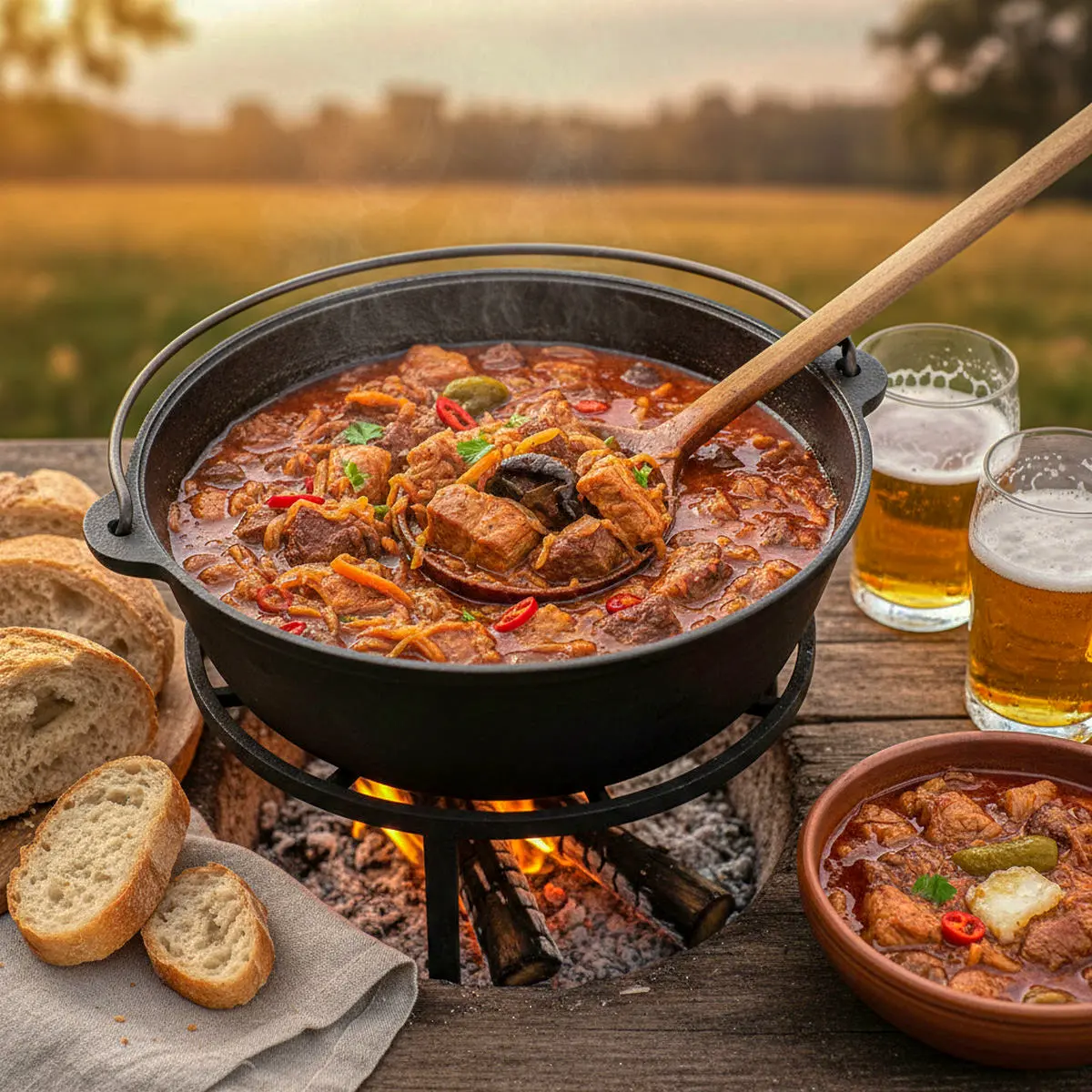
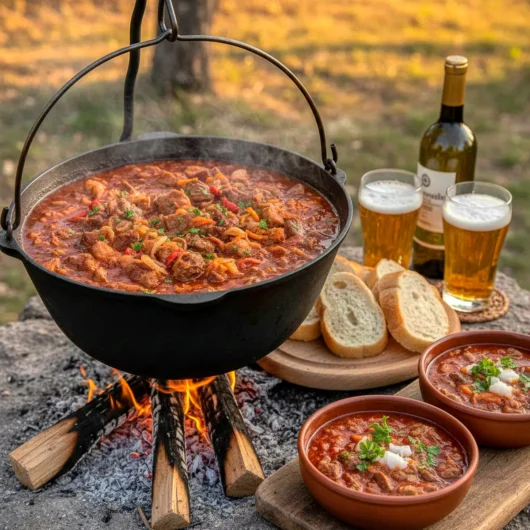
In eastern Croatia, among the lowland fields and river plains of Slavonia and Baranja, Čobanac sits at the center of many gatherings. This paprika-forward mixed-meat stew began as a practical one-pot meal cooked in a large copper kettle over an open fire for shepherds and field workers who needed something substantial, warming, and rich in protein to carry them through the day. Today it appears on restaurant menus, at festivals, and at family celebrations, yet it still carries the character of its pastoral roots.
Čobanac is often described as a shepherd’s stew made with several types of meat—commonly beef and pork, with lamb or game included when available—slowly simmered with plenty of onions and a generous measure of sweet and hot paprika. In traditional settings, the pot hangs from a tripod over a wood fire, and the stew quietly bubbles for hours until the liquid turns deep brick-red and glossy, the meat yields to the spoon, and the surface gives off an inviting aroma of roasted peppers and smoke.
The name itself comes from the word čoban (shepherd), a borrowing from Turkish that points to the dish’s rural history. Early versions functioned as a collective meal: workers would contribute whatever meat they had on hand—game, pork, beef—and share a single pot. Modern recipes still echo that approach. Many cooks insist on at least three kinds of meat and build flavor in stages, adding tougher cuts first, then more tender ones, and layering paprika at several points so it blooms in the fat rather than sitting raw in the broth.
Two elements define a good Slavonian Čobanac. The first is the paprika. Cooks in this region prize high-quality sweet and hot paprika from nearby Baranja, which gives the stew both its vivid color and its characteristic gentle heat. The second is time. Čobanac is not a quick weekday stew; it improves through slow simmering, where collagen from the meat and any added trotters or tails thickens the broth naturally. The result is neither a thin soup nor a stiff goulash, but something in between: a spoonable stew with a silky, full-bodied sauce.
In Slavonia, hosts often serve Čobanac during outdoor get-togethers or at late-afternoon meals, when large groups can gather around the kettle and eat from wide bowls with slices of crusty bread. Dumplings sometimes appear as a starchy companion, and a glass of local red wine or dry white sits nearby. The dish feels celebratory yet grounded—hearty enough for cold weather, but still balanced by the sweetness of long-cooked onions and peppers.
This home-kitchen version translates that cauldron tradition to a stovetop without losing the spirit of the original. You build a base from slowly softened onions, garlic, and carrots, seal in flavor by searing beef and pork, then simmer everything with paprika, wine, and stock until the meat gives way. Potatoes and peppers contribute gentle sweetness and body, so the stew feels complete with nothing more than bread on the side.
The recipe that follows respects the core of Slavonian Čobanac—mixed meats, paprika, time—while remaining workable for a domestic stove and a medium-sized pot. It suits a weekend cooking session, a winter gathering, or any occasion where a single pot of food needs to feed a group and tell a story at the same time.